
人教版新目标英语七年级下册unit2课件
- 格式:ppt
- 大小:3.63 MB
- 文档页数:34


Unit 2 Where is the post office?
Language goals:
In this unit students learn to talk about asking for and give directions on the
street.
New languages:
Excuse me, is there a bank near here?
Yes, there is. It’s on Center Street. Where is the pay phone?
It’s across from / next to / in front of / behind the library.
It’s between the post office and the library.
Just go straight and turn left.
Turn left on First Avenue. Take a walk through the park on Center Avenue.
There is a clean / dirty park near my house.
Difficult points:
1. Listening for the information of the names of the neighborhood
Read the tour guide and an e-mail from a friend you’re going to visit.
Write the dialogues about asking the way and giving directions.
2. Where questions.
Affirmative statements Prepositions of place
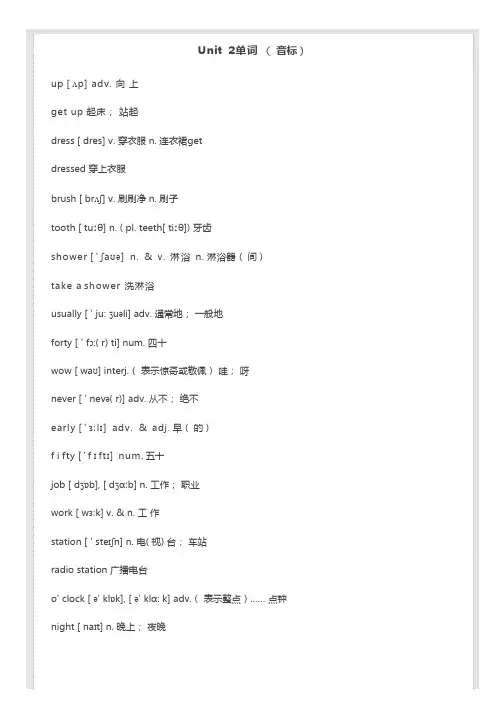
Unit 2单词 (
音标)
up [ ʌp] adv. 向
上get up 起床; 站起 dress [ dres] v. 穿衣服 n. 连衣裙get dressed 穿上衣服 brush [ brʌʃ] v. 刷刷净 n. 刷子 tooth [ tuːθ] n. ( pl. teeth[ tiːθ]) 牙齿 shower [ ' ʃaʊə] n. & v. 淋浴
n.
淋浴器(
间)
take a shower 洗淋浴
usually [ ' ju: ʒuəli] adv. 通常地;
一般地forty [ ' fɔ:( r) ti] num. 四十
wow [ waʊ] interj.( 表示惊奇或敬佩)
哇;
呀never [ ' nevə( r)] adv. 从不;
绝不
early [ ' ɜːlɪ]
adv.
&
adj.
早(
的)
f i fty [ ' f
ɪ
ftɪ]
num.
五十
job [ dʒɒb], [ dʒɑːb] n.
工作;
职业work [ wɜːk] v. & n.
工
作
station [ ' steɪʃn] n.
电(
视)
台;
车站radio station
广播电台
o' clock [
ə' klɒk], [
ə' klɑ: k] adv.(
表示整点)…… 点钟night [ naɪt] n.
晚上; 夜晚 funny [ ' fʌnɪ] adj. 奇怪的; 滑稽好笑的
exercise [ ' eksəsaɪz] v. & n. 锻炼; 练习on weekends ( 在) 周末
best [ best] adj. 最好的 adv. 最好地; 最group [ gruːp] n. 组; 群
half [ hɑːf], [ hæf] n. & pron. 一半; 半数
past [ pɑːst],[ pæst] prep. 晚于; 过( 时间) adj. 过去的quarter [ ' kwɔː( r) tə( r)] n. 一刻钟; 四分之一

1 第一课时 Section A(1a-2C)
课堂导学导练
1.dress的用法
(1)作名词,意为“连衣裙”。复数为dresses。
(2)dress作动词,意为“穿衣服”。其宾语多是人,常用短语有:dress sb.给某人穿衣服,
get dressed穿上衣服,强调“穿”的动作。如T一(2),T二(4)
2. usually adv.意为“通常地;一般地”。
常用的频度副词有:often(经常),sometimes(有时),always(总 是)。usually, often, always 一般位于句中,在行为动词之前,助动词、be动词之后。sometimes位置较灵活,可位于句首、句中及句末。如
T二(1),T三(2)
3. brush v.意为“刷"。brush 还可用作名词,意为“刷子”,其复数形式为brushes。如T一(4)
4. tooth n.意为“牙齿”,其复数形式为teeth。 类似的复数变化还有foot
-feet。如T一(4),T二(3)
2 5.What time do you usually get up,Rick?里克,你通常什么时候起床?
(1)what time意为“几点;什么时候”,用来询问具体时刻,常用于“What
time do/does+主语+动词原形+... ?”句型中。如T-(3),T三(1)
[拓展]when意为“什么时候”,所表示的时间范围较广,既可询问具体时刻,也可询问日期、月份、年份等。如T-(5),T四(1)
(2)time n.意为“时间”。询问时间的常用句型有What's the time now?
/What time is it now?
课内基础训练
一、单项选择。
( )1. We have breakfast 7 :00 the morning.
A. at ;at
B. in;on

1 人教新目标七年级英语下册Unit 2What time do you go to school?
课时分层训练
第1课时分层训练
[Section A1 1a2d]
Ⅰ.根据句意及汉语提示完成句子
1.My mother ________ (通常) does some shopping on Sundays.
2.Mr. White goes to work ________ (早) every morning.
3.The sports star ________ (从不) eats unhealthy food.
4.My cousin ________ (刷) his shoes every week.
5.His father ________ (工作) in our school.
6.Their father usually ________ (锻炼) on weekends.
7.The TV ________ (电视台) in our city is very beautiful.
8.________ (五十)old people are in the old people's home.
Ⅱ.用所给单词的适当形式填空
1.Does Tina ________(go) home every day?
2.Jane usually ________(eat) breakfast at home.
3.Helen brushes ________(tooth) twice a day(一天两次).
4.What a ________(fun) time to have supper!
5.Alan plays sports on ________(weekend).
Ⅲ.用方框中所给短语的适当形式填空
at night, take a shower, get up,