一般过去式讲解
- 格式:docx
- 大小:20.17 KB
- 文档页数:7
1 一般过去式 教学目标: ①理解一般过去式的使用规则 ④会用疑问词构成过去式的疑问句 ⑤掌握一般过去时的时间状语
教学重点: ①动词过去式的规则变化 ②动词过去式的不规则变化单词
教学难点: ①过去式的一般疑问句和特殊疑问句 ②动词过去式的不规则变化单词的记忆
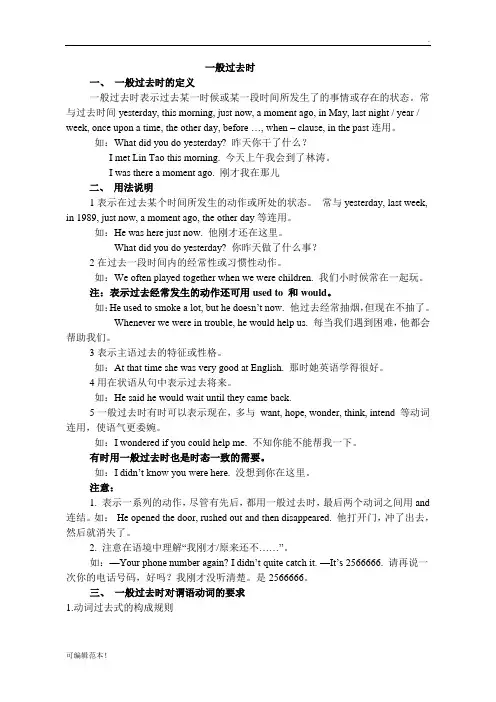
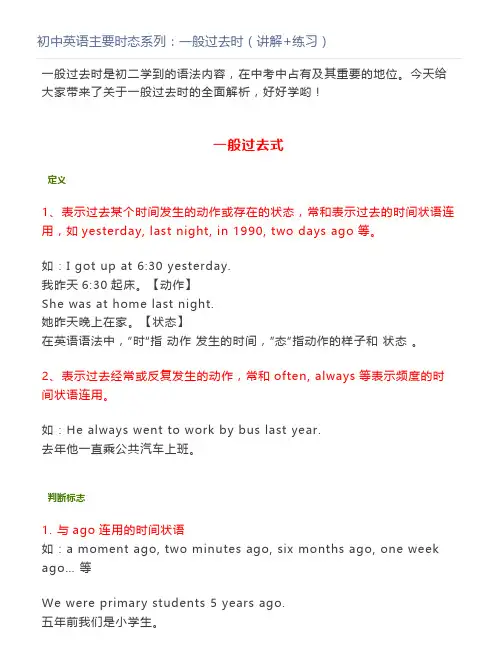
一、概念 表示在的过去某个时间里所发生的动作或存在的状态。通常在句子里找到表示过去时间的词或词组。如:yesterday,yesterday morning,yesterday afternoon,yesterday evening,the day before yesterday(前天),last night,last week,last month, last year,a moment ago(刚才),just now(刚才), two days ago,a week ago,in 1990等。 如:I went to bed at eleven last night. 昨晚我11:00睡觉。 二、动词过去式的构成规律 (一)规则动词的过去式 1、一般情况下,在动词原形后面加-ed;如:look→looked play→played; 2、以不发音e结尾的动词,在词尾直接加-d;如:live→lived use→used; 2
3、以“辅音字母+ y”结尾的动词,先将 y 改为i ,再加 –ed;如:study→studied, try→tried fly→flied 4、以重读闭音节(即辅音+元音+辅音)或r音节结尾,末尾只有一个辅音字母的动词,要先双写这个辅音字母后,再加 –ed。如:stop→stopped plan→planned; (二)不规则动词的过去式(后附不规则动词变化表) 1、改变动词中的元音;begin→began drink→drank come→came eat→ate grow→grew run→ran know→knew win→won speak→spoke take→took write→wrote get→got 2、变词尾的–d 为–t ;build→built lend→lent send→sent spend→spent bend→bent 3、与动词原形一样; cut→cut put→put cost→cost hurt→hurt shut→shut 4、变-ay 为-aid (少数动词); say→said pay→paid lay→laid 5、采用不同词根;sell→sold teach→taught buy→bought 6、其他。如:am/is→was are→were have/has→had do→did
三、句式变化 (一)一般过去时的一般疑问句 1、把was, were放在句首,其余位置不变。由Was…?引导的一般疑问句,肯定答为:Yes,… was. 否定回答为:No,…. wasn't. 由Were…?引导的一般疑问句,肯定回答为:Yes,… were. 否定回答 3
为:No,… weren't. 如:(1)I was born in Shanghai. →Were you born in Shanghai?→Yes, I was. (肯定回答) →No, I wasn't. (否定回答) (2)They were in Li Yan's home last night.→Were they in Li Yan's home last night?→Yes, they were. (肯定回答) →No, they weren't. (否定回答) 2、在行为动词的句子中,要用助动词词did来引导,其余的语序不变。要注意的是,要把行为动词的过去式改为原形。肯定回答为:Yes, …did. 否定回答:No, …didn't. 如:John played computer games last night.→Did John play computer games last night?→Yes, he did. (肯定回答) →No, he didn't. (否定回答) (二)一般过去时的否定句 1、在表示过去存在的状态的句子中,相接在was, were的后面加上not。如:(1)He was in the park the day before yesterday. →He was not in the park the day before yesterday.(2)We were busy last week. →We were not busy last week. 2、在表示过去的时间发生的动作的句子中,要在行为动词的前面加助动词didn't.然后把过去式的行为动词改为动词原形。即:didn't + 动词原形。如:(1)She played the violin last night. →She didn't play the violin last night.(2) They swam in the lake yesterday. →They didn't swim in the lake yesterday. (三) 一般过去式的特殊疑问句 4
1.What did … ?(主要是询问过去发生了什么事情,注意要把过去式改为动词原形。)We ate Chinese food last night. →What did we eat last night? 2.Where did ?( 主要是询问过去事情发生的地方。)They sang and dance in the music room yesterday morning.→Where did they sing and dance yesterday morning? 3.Who + 动词过去式 … ?( 主要是询问过去事情发生的人物。)Mike and Tom climbed mountains last weekend.→Who climbed mountains last weekend?
四、句子结构 1、在表示某个时间里存在的状态的句子,系动词用过式was,were构成。 如:(1)I was at home yesterday. 昨天我在家。 (3)We were in the gym just now. 刚才我们在体育馆。 2、在表示过去某个时间里发生的动作,用动词的过去式构成。如:I visited my uncle yesterday. 昨天我拜访了我的叔叔。 3.各种句式(1)一般过去时的肯定陈述句:主语 + 动词过去式 + 宾语或表语。He worked in Shanghai ten years ago. (2)一般过去时的否定句:a.主语 + didn't + 动词原形 + 宾语。 (did + not = didn't)He didn't do morning exercises yesterday.b.主语 + wasn't/weren't +表语。(was + not = wasn't were + not = 5
weren't)He wasn't an English teacher ten years ago. (3)一般过去时的一般疑问句:a.Did + 主语 + 动词原形 + 宾语 ?Did you study English in 1990 ?b.Was/Were + 主语 + 表语 ?Was he a pupil five years ago ? (4)一般过去时的特殊疑问句:a.特殊疑问词 + did + 主语 + 动词原形 + 宾语?Where did your parents live five years ago?What did you do last Sunday?b.特殊疑问词 + were/was + 表语?Who was at the zoo yesterday? 6
一般过去式动词不规则变化表 Am / is¬---was(是) are---were(是)become---became(成为,变成) bear---bore (忍受) begin---began(开始)break---broken(打坏,打破) buy---bought(买) bring---brought(带来) build---built(建筑,建设) can---could(能,会) come---came(来) catch---caught(揪住,抓住) cost---cost(花费) cut---cut(砍,切) do / does---did(做) drink---drank(喝) eat---ate(吃) drive---drove(驾驶,开车) feel---felt(感觉) fly---flew(飞行) find---found(发现,找到) forget---forgot(忘记) get---got(得到) give---gave(给予) go---went(走,去) have / has---had(有) grow---grew (成长,种植) hear---heard(听见) lend---lent(借给) know---knew(知道,了解) leave---left(离开,留下) let---let(让 ) learn---learned / learnt(学习) lie---lay(躺下) lose---lost(丢失) make---made(制造,制作) meet---met(遇见) may---might(可以) must---must(必须) pay---paid(付钱,赔偿) put---put(放) read---read(读)