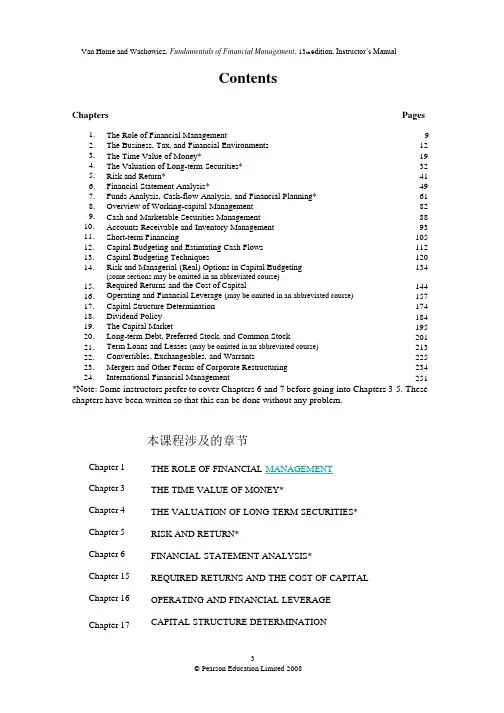
Financial Management leverage
- 格式:ppt
- 大小:265.50 KB
- 文档页数:54


毕业设计(论文)外文资料翻译系别:管理信息系专业:财务管理班级:姓名:学号:外文出处:Theory and Decision附件: 1. 原文; 2. 译文How Important is Financial Risk?作者:Sohnke M. Bartram, Gregory W. Brown, and Murat Atamer起止页码:1-7出版日期(期刊号):September 2009,V ol. 2, No. 4(Serial No. 11)出版单位:Theory and Decision, DOI 10.1007/s11238-005-4590-0Abstract:This paper examines the determinants of equity price risk for a large sample of non-financial corporations in the United States from 1964 to 2008. We estimate both structural and reduced form models to examine the endogenous nature of corporate financial characteristics such as total debt, debt maturity, cash holdings, and dividend policy. We find that the observed levels of equity price risk are explained primarily by operating and asset characteristics such as firm age, size, asset tangibility, as well as operating cash flow levels and volatility. In contrast, implied measures of financial risk are generally low and more stable than debt-to-equity ratios. Our measures of financial risk have declined over the last 30 years even as measures of equity volatility (e.g. idiosyncratic risk) have tended to increase. Consequently, documented trends in equity price risk are more than fully accounted for by trends in the riskiness of firms’ assets. Taken together, the results suggest that the typical U.S. firm substantially reduces financial risk by carefully managing financial policies. As a result, residual financial risk now appears negligible relative to underlying economic risk for a typical non-financial firm.Keywords:Capital structure;financial risk;risk management;corporate finance 1IntroductionThe financial crisis of 2008 has brought significant attention to the effects of financial leverage. There is no doubt that the high levels of debt financing by financial institutions and households significantly contributed to the crisis. Indeed, evidence indicates that excessive leverage orchestrated by major global banks (e.g., through the mortgage lending and collateralized debt obligations) and the so-called “s hadow banking system” may be the underlying cause of the recent economic and financial dislocation. Less obvious is the role of financial leverage among nonfinancial firms. To date, problems in the U.S. non-financial sector have been minor compared to the distress in the financial sector despite the seizing of capital markets during the crisis. For example, non-financial bankruptcies have been limited given that the economicdecline is the largest since the great depression of the 1930s. In fact, bankruptcy filings of non-financial firms have occurred mostly in U.S. industries (e.g., automotive manufacturing, newspapers, and real estate) that faced fundamental economic pressures prior to the financial crisis. This surprising fact begs the question, “How impo rtant is financial risk for non-financial firms?” At the heart of this issue is the uncertainty about the determinants of total firm risk as well as components of firm risk.Recent academic research in both asset pricing and corporate finance has rekindled an interest in analyzing equity price risk. A current strand of the asset pricing literature examines the finding of Campbell et al. (2001) that firm-specific (idiosyncratic) risk has tended to increase over the last 40 years. Other work suggests that idiosyncratic risk may be a priced risk factor (see Goyal and Santa-Clara, 2003, among others). Also related to these studies is work by Pástor and Veronesi (2003) showing how investor uncertainty about firm profitability is an important determinant of idiosyncratic risk and firm value. Other research has examined the role of equity volatility in bond pricing (e.g., Dichev, 1998, Campbell, Hilscher, and Szilagyi, 2008).However, much of the empirical work examining equity price risk takes the risk of assets as given or tries to explain the trend in idiosyncratic risk. In contrast, this paper takes a different tack in the investigation of equity price risk. First, we seek to understand the determinants of equity price risk at the firm level by considering total risk as the product of risks inherent in the firms operations (i.e., economic or business risks) and risks associated with financing the firms operations (i.e., financial risks). Second, we attempt to assess the relative importance of economic and financial risks and the implications for financial policy.Early research by Modigliani and Miller (1958) suggests that financial policy may be largely irrelevant for firm value because investors can replicate many financial decisions by the firm at a low cost (i.e., via homemade leverage) and well-functioning capital markets should be able to distinguish between financial and economic distress. Nonetheless, financial policies, such as adding debt to the capital structure, can magnify the risk of equity. In contrast, recent research on corporate risk management suggests that firms may also be able to reduce risks and increase value with financial policies such as hedging with financial derivatives. However, this research is often motivated by substantial deadweight costs associated with financialdistress or other market imperfections associated with financial leverage. Empirical research provides conflicting accounts of how costly financial distress can be for a typical publicly traded firm.We attempt to directly address the roles of economic and financial risk by examining determinants of total firm risk. In our analysis we utilize a large sample of non-financial firms in the United States. Our goal of identifying the most important determinants of equity price risk (volatility) relies on viewing financial policy as transforming asset volatility into equity volatility via financial leverage. Thus, throughout the paper, we consider financial leverage as the wedge between asset volatility and equity volatility. For example, in a static setting, debt provides financial leverage that magnifies operating cash flow volatility. Because financial policy is determined by owners (and managers), we are careful to examine the effects of firms’ asset and operating characteristics on financial policy. Specifically, we examine a variety of characteristics suggested by previous research and, as clearly as possible, distinguish between those associated with the operations of the company (i.e. factors determining economic risk) and those associated with financing the firm (i.e. factors determining financial risk). We then allow economic risk to be a determinant of financial policy in the structural framework of Leland and Toft (1996), or alternatively, in a reduced form model of financial leverage. An advantage of the structural model approach is that we are able to account for both the possibility of financial and operating implications of some factors (e.g., dividends), as well as the endogenous nature of the bankruptcy decision and financial policy in general.Our proxy for firm risk is the volatility of common stock returns derived from calculating the standard deviation of daily equity returns. Our proxies for economic risk are designed to capture the essential characteristics of th e firms’ operations and assets that determine the cash flow generating process for the firm. For example, firm size and age provide measures of line of- business maturity; tangible assets (plant, property, and equipment) serve as a proxy for the ‘hardness’of a firm’s assets; capital expenditures measure capital intensity as well as growth potential. Operating profitability and operating profit volatility serve as measures of the timeliness and riskiness of cash flows. To understand how financial factors affect firm risk, we examine total debt, debt maturity, dividend payouts, and holdings of cash and short-term investments.The primary result of our analysis is surprising: factors determining economicrisk for a typical company explain the vast majority of the variation in equity volatility. Correspondingly, measures of implied financial leverage are much lower than observed debt ratios. Specifically, in our sample covering 1964-2008 average actual net financial (market) leverage is about 1.50 compared to our estimates of between 1.03 and 1.11 (depending on model specification and estimation technique). This suggests that firms may undertake other financial policies to manage financial risk and thus lower effective leverage to nearly negligible levels. These policies might include dynamically adjusting financial variables such as debt levels, debt maturity, or cash holdings (see, for example, Acharya, Almeida, and Campello, 2007). In addition, many firms also utilize explicit financial risk management techniques such as the use of financial derivatives, contractual arrangements with investors (e.g. lines of credit, call provisions in debt contracts, or contingencies in supplier contracts), special purpose vehicles (SPVs), or other alternative risk transfer techniques.The effects of our economic risk factors on equity volatility are generally highly statistically significant, with predicted signs. In addition, the magnitudes of the effects are substantial. We find that volatility of equity decreases with the size and age of the firm. This is intuitive since large and mature firms typically have more stable lines of business, which should be reflected in the volatility of equity returns. Equity volatility tends to decrease with capital expenditures though the effect is weak. Consistent with the predictions of Pástor and Veronesi (2003), we find that firms with higher profitability and lower profit volatility have lower equity volatility. This suggests that companies with higher and more stable operating cash flows are less likely to go bankrupt, and therefore are potentially less risky. Among economic risk variables, the effects of firm size, profit volatility, and dividend policy on equity volatility stand out. Unlike some previous studies, our careful treatment of the endogeneity of financial policy confirms that leverage increases total firm risk. Otherwise, financial risk factors are not reliably related to total risk.Given the large literature on financial policy, it is no surprise that financial variables are,at least in part, determined by the economic risks firms take. However, some of the specific findings are unexpected. For example, in a simple model of capital structure, dividend payouts should increase financial leverage since they represent an outflow of cash from the firm (i.e., increase net debt). We find that dividends are associated with lower risk. This suggests that paying dividends is not as much a product of financial policy as a characteristic of a firm’s operations (e.g., amature company with limited growth opportunities). We also estimate how sensitivities to different risk factors have changed over time. Our results indicate that most relations are fairly stable. One exception is firm age which prior to 1983 tends to be positively related to risk and has since been consistently negatively related to risk. This is related to findings by Brown and Kapadia (2007) that recent trends in idiosyncratic risk are related to stock listings by younger and riskier firms.Perhaps the most interesting result from our analysis is that our measures of implied financial leverage have declined over the last 30 years at the same time that measures of equity price risk (such as idiosyncratic risk) appear to have been increasing. In fact, measures of implied financial leverage from our structural model settle near 1.0 (i.e., no leverage) by the end of our sample. There are several possible reasons for this. First, total debt ratios for non-financial firms have declined steadily over the last 30 years, so our measure of implied leverage should also decline. Second, firms have significantly increased cash holdings, so measures of net debt (debt minus cash and short-term investments) have also declined. Third, the composition of publicly traded firms has changed with more risky (especially technology-oriented) firms becoming publicly listed. These firms tend to have less debt in their capital structure. Fourth, as mentioned above, firms can undertake a variety of financial risk management activities. To the extent that these activities have increased over the last few decades, firms will have become less exposed to financial risk factors.We conduct some additional tests to provide a reality check of our results. First, we repeat our analysis with a reduced form model that imposes minimum structural rigidity on our estimation and find very similar results. This indicates that our results are unlikely to be driven by model misspecification. We also compare our results with trends in aggregate debt levels for all U.S. non-financial firms and find evidence consistent with our conclusions. Finally, we look at characteristics of publicly traded non-financial firms that file for bankruptcy around the last three recessions and find evidence suggesting that these firms are increasingly being affected by economic distress as opposed to financial distress.In short, our results suggest that, as a practical matter, residual financial risk is now relatively unimportant for the typical U.S. firm. This raises questions about the level of expected financial distress costs since the probability of financial distress is likely to be lower than commonly thought for most companies. For example, our results suggest that estimates of the level of systematic risk in bond pricing may bebiased if they do not take into account the trend in implied financial leverage (e.g., Dichev, 1998). Our results also bring into question the appropriateness of financial models used to estimate default probabilities, since financial policies that may be difficult to observe appear to significantly reduce risk. Lastly, our results imply that the fundamental risks born by shareholders are primarily related to underlying economic risks which should lead to a relatively efficient allocation of capital.Before proceeding we address a potential comment about our analysis. Some readers may be tempted to interpret our results as indicating that financial risk does not matter. This is not the proper interpretation. Instead, our results suggest that firms are able to manage financial risk so that the resulting exposure to shareholders is low compared to economic risks. Of course, financial risk is important to firms that choose to take on such risks either through high debt levels or a lack of risk management. In contrast, our study suggests that the typical non-financial firm chooses not to take these risks. In short, gross financial risk may be important, but firms can manage it. This contrasts with fundamental economic and business risks that are more difficult (or undesirable) to hedge because they represent the mechanism by which the firm earns economic profits.The paper is organized at follows. Motivation, related literature, and hypotheses are reviewed in Section 2. Section 3 describes the models we employ followed by a description of the data in Section 4. Empirical results for the Leland-Toft model are presented in Section 5. Section 6 considers estimates from the reduced form model, aggregate debt data for the no financial sector in the U.S., and an analysis of bankruptcy filings over the last 25 years. Section 6 concludes.2 Motivation, Related Literature, and HypothesesStudying firm risk and its determinants is important for all areas of finance. In the corporate finance literature, firm risk has direct implications for a variety of fundamental issues ranging from optimal capital structure to the agency costs of asset substitution. Likewise, the characteristics of firm risk are fundamental factors in all asset pricing models.The corporate finance literature often relies on market imperfections associated with financial risk. In the Modigliani Miller (1958) framework, financial risk (or more generally financial policy) is irrelevant because investors can replicate the financial decisions of the firm by themselves. Consequently, well-functioning capital markets should be able to distinguish between frictionless financial distress and economicbankruptcy. For example, Andrade and Kaplan (1998) carefully distinguish between costs of financial and economic distress by analyzing highly leveraged transactions, and find that financial distress costs are small for a subset of the firms that did not experience an “economic” shock. They conclude that financial distress costs should be small or insignificant for typical firms. Kaplan and Stein (1990) analyze highly levered transactions and find that equity beta increases are surprisingly modest after recapitalizations.The ongoing debate on financial policy, however, does not address the relevance of financial leverage as a driver of the overall riskiness of the firm. Our study joins the debate from this perspective. Correspondingly, decomposing firm risk into financial and economic risks is at the heart of our study.Research in corporate risk management examines the role of total financial risk explicitly by examining the motivations for firms to engage in hedging activities. In particular, theory suggests positive valuation effects of corporate hedging in the presence of capital market imperfections. These might include agency costs related to underinvestment or asset substitution (see Bessembinder, 1991, Jensen and Meckling, 1976, Myers, 1977, Froot, Scharfstein, and Stein,1993), bankruptcy costs and taxes (Smith and Stulz, 1985), and managerial risk aversion (Stulz,1990). However, the corporate risk management literature does not generally address the systematic pricing of corporate risk which has been the primary focus of the asset pricing literature.Lintner (1965) and Sharpe (1964) define a partial equilibrium pricing of risk in a mean variance framework. In this structure, total risk is decomposed into systematic risk and idiosyncratic risk, and only systematic risk should be priced in a frictionless market. However, Campbelletal (2001) find that firm-specific risk has increased substantially over the last four decades and various studies have found that idiosyncratic risk is a priced factor (Goyal and Santa Clara,2003, Ang, Hodrick, Xing, and Zhang, 2006, 2008, Spiegel and Wang, 2006). Research has determined various firm characteristics (i.e., industry growth rates, institutional ownership, average firm size, growth options, firm age, and profitability risk) are associated with firm-specific risk. Recent research has also examined the role of equity price risk in the context of expected financial distress costs (Campbell and Taksler, 2003, Vassalou and Xing, 2004, Almeida and Philippon, 2007, among others). Likewise, fundamental economic risks have been shown to be to be related to equity risk factors (see, for example, Vassalou, 2003, and the citations therein). Choiand Richardson (2009) examine thevolatility of the firm’s assets using issue-level data on debt and find that asset volatilities exhibit significant time-series variation and that financial leverage has a substantial effect on equity volatility.How Important is Financial Risk?财务风险的重要性作者:Sohnke M. Bartram, Gregory W. Brown, and Murat Atamer起始页码:1-7出版日期(期刊号):September 2009,Vol. 2, No. 4(Serial No. 11)出版单位:Theory and Decision, DOI 10.1007/s11238-005-4590-0外文翻译译文:摘要:本文探讨了美国大型非金融企业从1964年至2008年股票价格风险的决定小性因素。

常用会计英语词汇基本词汇acceptance 承兑account 账户,报表accountancy 会计职业accountant 会计师accounting entry会计分录accounting factor 会计要素accounting period 会计期间accounting policies 会计方针accounting voucher会计凭证accounting 会计acid test ratio 速动比率(酸性测试比率)acquisition 收购annual report and accounts 年度报告和报表assets cover 资产担保assets 资产associated company 联营公司audit report 审计报告audit 审计auditing standards 审计准则bad debts ratio 坏帐比率bad debts 坏帐balance sheet 资产负债表bank charges 银行手续费bank acceptance 银行承兑汇票bank draft 银行汇票bank overdraft 银行透支bank statement 银行对账单bankruptcy 破产basis of apportionment 分摊基础bill of exchange 汇票bill of lading 提单bill payable 应付票据bill receivable 应收票据bill 账单bonus 红利budget center 预算中心budget manual 预算手册budget period 预算期间budget 预算budgetary control 预算控制business entity 经营个体business unit 经营单位by-product 副产品capacity 生产能力capital expenditure 资本支出capital gain 资本收益capital investment appraisal 资本投资评估capital maintenance 资本保全capital surplus 资本盈余capital turnover 资本周转率capital 资本cash account 现金账户cash flow budget 现金流量预算cash flow statement 现金流量表cash flow 现金流量cash ledger 现金分类账cash 现金changeover time 变更时间chartered entity 特许经济个体cheque register 支票登记薄cheque 支票common cost 共同成本consolidated accounts 合并报表contingent liabilities 或有负债contract cost 合同成本contract costing 合同成本计算controllable cost 可控制成本cost account 成本账户cost accounting manual 成本手册cost accounting 成本会计cost adjustment 成本调整cost allocation 成本分配cost apportionment 成本分摊cost attribution 成本归属cost audit 成本审计cost benefit analysis 成本效益分析cost center 成本中心cost of capital 资本成本cost of sales 销售成本cost reduction 成本降低cost structure 成本结构cost unit 成本单位cost-volume-profit analysis(CVP) 本量利分析creditor 债权人current asset 流动资产current liabilities 流动负债current ratio 流动比率debit capacity 举债能力debt ratio 债务比率debtor' age analysis 应收账款账龄分析debtor 债务人;应收账款defects 次品detail ledger 明细分类账general ledger 总分类账deferred expenditure 递延支出departmental budget 部门预算depreciation 折旧development cost 开发成本differential cost 差别成本direct cost 直接成本discount rate 贴现率discounted cash flow 现金流量贴现distribution cost 摊销成本dividend per share 每股股利dividend 股利earning per share 每股盈利earning ratio 市盈率element of cost 成本要素entity 经济个体environmental impact assessment 环境影响评价equity share capital 权益股本equity 权益expenditure 支出expenses 费用external audit 外部审计fair value 公允价值FIFO 先近先出法final accounts 年终报表finance lease 融资租赁financial accounting 财务会计financial management 财务管理financial planning 财务计划financial statement 财务报表finished goods 产成品fixed asset turnover 固定资产周转率fixed asset 固定资产fixed cost 固定成本gearing 举债经营比率(杠杆)going concern concept 持续经营概念goodwill 商誉gross profit 毛利润group accounts 集团报表historical cost accounting 历史成本会计historical cost 历史成本income and expenditure account 收益和支出报表indirect cost 间接成本insolvency 无力偿付intangible asset 无形资产interest cover 利息保障倍数internal audit 内部审计inventory 存货investment 投资invoice register 发票登记薄issued share capital 已发行股本joint stock company 股份公司joint venture 合资经营journal 日记账ledger 分类账户letter of credit 信用证leverage 举债经营比率liabilities 负债LIFO 后近先出法liquid assets 变现资产liquidation 清算loan 贷款lower of cost or net realizable value concept 成本或可变净价孰低概念managed cost 管理成本management accounting concept 管理会计概念management accounting 管理会计management audit 管理审计margin cost 边际成本mark-down 降低标价market risk premium 市场风险补偿market share 市场份额marketing cost 营销成本merger accounting 兼并会计merger 兼并minority interest 少数股权mixed cost 混合成本net assets 净资产net book value 净账面价值net present value(NPV) 净现值net profit 净利润net realizable value 可变现净值non-adjusting events 非调整事项operating lease 经营租赁operating plans 经营计划operational gearing 经营杠杆opportunity cost 机会成本order 定单ordinary shares 普通股original voucher原始凭证out-of-date cheque 过期支票overhead absorption rate 制造费用分配率overhead cost 制造费用overhead 制造费用owners’ equity 所有者权益parent company 母公司participating preference shares 参与优先股partnership 合伙payback 回收期payments and receipts account 收入和支出报表payroll analysis 工资分析payroll 工资单period cost 期间成本perpetual inventory 永续盘存petty cash account 备用金账户physical inventory 实地盘存preference creditors 优先债权人preference shares 优先股prepayments 预付款项present value 现值prevention cost 预防成本price ratio 市盈率prior year adjustments 以前年度调整product cost 产品成本Product life cycle 产品寿命周期production cost 生产成本profit center 利润中心profit retained for the year 年度利润留存profitability index 盈利指数pro-forma invoice 预开发票project evaluation and review technique 项目评审法promissory note 本票raw material 原材料receivable ledger 应收款项账户registered share capital 注册资本replacement price 重置价格reserves 留存收益responsibility center 责任中心revenue expenditure 收益支出revenue 收入rolling budget 滚动预算sales ledger 销售分类账sales order 销售定单selling cost 销售成本sight draft 即期汇票source and application of funds statement 资金来源和运用表stock turnover 存货周转率stock 存货tangible asset 有形资产total assets 总资产total quality management 全面质量管理value added 增加值value analysis 价值分析。

DFL财务杠杆系数1. 什么是财务杠杆系数?财务杠杆系数(Financial Leverage Ratio)是衡量一个企业使用债务资金融资程度的指标。
它反映了企业财务结构中债务和所有者权益之间的相对比例。
财务杠杆系数越高,表示企业使用债务资金融资的程度越高,承担的财务风险也相对增加。
2. 财务杠杆系数的公式与计算方法财务杠杆系数可以通过多种不同的公式来计算,其中最常用的是资产负债率(Debt to Equity Ratio)和权益乘数(Equity Multiplier)两个指标。
2.1 资产负债率资产负债率反映了企业债务与所有者权益之间的相对比例。
它的计算公式如下:资产负债率 = 总负债 / 总资产其中,总负债表示企业的所有债务总额,总资产表示企业的总资产价值。
2.2 权益乘数权益乘数反映了企业使用债务资金融资的程度。
它的计算公式如下:权益乘数 = 总资产 / 所有者权益其中,总资产表示企业的总资产价值,所有者权益表示企业所有者的资金投入。
2.3 财务杠杆系数财务杠杆系数可以通过资产负债率和权益乘数来计算,公式如下:财务杠杆系数 = 资产负债率× 权益乘数3. 财务杠杆系数的意义和作用财务杠杆系数是分析企业财务结构和财务风险的重要指标,它能够帮助投资者和管理者评估企业的财务风险水平和偿债能力。
3.1 风险评估财务杠杆系数高的企业通常表示企业使用债务资金融资的程度较高,承担的财务风险也相对较大。
当企业经营不善或者遭遇经济衰退时,负债过高的企业可能更容易陷入财务困境,债务偿还能力下降。
3.2 偿债能力评估财务杠杆系数低的企业表示企业使用债务资金融资的程度较低,偿债能力相对较强。
这意味着企业更容易通过自有资金来偿还债务,减少了企业陷入财务困境的风险。
3.3 经营效率评估财务杠杆系数可以反映企业的资产利用效率和资本结构的合理性。
较低的财务杠杆系数可能说明企业在运营过程中较少依赖债务资金,能够更有效地使用自有资金进行投资和经营活动。