
6 Simple Org Comp-Alkanes Cycloalkanes
- 格式:ppt
- 大小:6.63 MB
- 文档页数:78


计算环烷烃沸点的新方法——基团键贡献
法
2∞2第22卷
第3期.194~199
有机化学 Chine~Joamalof(…0…
v0l22.2∞2
I3.J94~199
研究简报?
计算环烷烃沸点的新方法——基团键贡献法
王克强,王捷冯瑞英 (.洛阳师范学院化学系洛阳471022)
(许昌职业技术学院许昌461000)
洛阳市第一高级中学洛阳471002)
摘要根据分子中基团的特性和连接性.发展了一种直接根据分子结构信息计算环
烷烃沸点的新方法基团键
贡献法,该方法既考虑分子中基团的特性,又考虑基团之问的连接性(化学键),具有
基团贡献法和化学键贡献法的
特点对256种环烷烃沸点的计算结果表明,计算值与宴验值的一致性令人满意,平
均误差071啦.
关键词结构性能关系,基团键,基团键贡献法,沸点,烷烃 GroupBondContribution'__.?.___-——ANewMethodforCalculating
BomngPointsofCycloalkanes
WANG,Ke-QiangwA№,Jie.FENG,Rui—Yiag
(mofChoTaist~,Normalc.,h~/ang471022)
(~XuchangI.'ocatiormlTerhnical0f,461000)
('.增sHigh&hodNoJ,4~002)
AbslractOilcharacteristicsandconnectivi~,ofthegroupsinmolecules.groupbondscanbea
ppliedto
characterizemolecularstructure.Groupbondscontaininformationofgrouppropertyandco
nnectivityin
moleculcs.Groupbonds,obtaineddirectlyfr(1堋
molecularstructure,COIlbeusedtocNcuhWthepropertiesof

有机物英文命名(1)
附录七有机物命名规则
直链烷烃Straight chain alkanes
饱和Saturated
烃:只含C, H的化合物
Hydrogen 去词尾+ carbon——→hydrocarbon 烃(可数名词)
烷烃的常见英汉对照:
Alkanes 烷烃Alk——烃的组成标志-ane 烷的特征词尾Saturated aliphatic hydrocarbons 饱和脂肪烃
Paraffin 石蜡烃或链烷烃
(一)数词
全部数词在命名中只作前缀使用,它与英语日用数词完全不同应单独记忆。
1、从1~4的词头,作为主链母体词头时,英汉对照为
英:metha etha propa buta
汉:甲乙丙丁
作侧链基团数目词头则只准用:
英:mono di(bi) tri tetra
汉:一二三四
2、从5~10,不论主链碳数或侧链基团数的英文词头由
英:penta hexa hepta octa ennea(nona) deca 汉:戊己庚辛壬葵
3、英文数目从10开始用“-deca”表示“+”的基数,从11到19又加前缀:
hen- hendeca(undeca) 十一do- dodeca 十二tri- trideca 十三tetra- + -deca = tetradeca 十四………
octa- octadeca 十八nona- nonadeca 十九
4、eicosa是二十的词头,heneicosa 二十一,但从22~29则以“-cosa”表示“二 十”基数
do- docosa 二十二
319
octa + -cosa = octacosa 二十八nona- nonacosa 二十九
5、从30起,基数“+”用“aconta”为代号,前缀数词,构词如下:
tri- triaconta 三十
tetra- + -(a)conta = tetraconta 四十
……
octa- octaconta 八十
港澳台高考考试大纲 化学
Ⅰ.考試要求
1.正確理解和運用化學基本概念和基本原理。
2.了解常見元素單質及其重要化合物的性質、制法和用途。
3.了解有機化學基本知識。
4.掌握基本化學計算。
5.掌握實驗基本技能。
6.注意以上各部分知識的聯繫和綜合運用。
7.了解化學與生活、社會、環境及相關學科的聯繫。
Ⅱ.考試內容
一、化學基本概念和基本原理
1.原子和分子
(1)原子、分子、離子;
(2)物質的量(amount of substance)及其單位摩爾(mole)、摩爾質量(molar
mass)、氣體摩爾體積(molar volumes of gases);
(3)化學式(chemical formula)、化學方程式。
2.原子結構
(1)原子組成,原子核(nucleus)、質子(proton)、中子(neutron)、電子(electron);
(2)原子序數、同位素(isotope);
(3)以稀有氣體元素為例,掌握原子孩外電子層排布。
3.元素周期律(Periodic Law)
(1)原子核外電子排布的周期性和元素性質遞變的關係,原子半徑、化合價等的周期性變化;
(2)元素周期表,周期、主族和副族。
4.化學鍵
(1)離子鍵(ionic bonds of electrovalent bonds)、共價鍵(covalent bonds)、金屬鍵(metallic bonds)。
(2)極性鍵(polar bonds)與非極性鍵(non-polar bonds)、極性分子(polar
molecules)與非極性分子(non-polar molecules);
(3)分子間作用力(即van der waals forces)、氫鍵(hydrogen bonding);
(4)原子晶體(atomic crystals)、離子晶體(inoic crystals)、分子晶體(molecular crystals)、金屬晶體(metallic crystals)。
Alkanes
Formulae
Alkanes are the simplest family of hydrocarbons - compounds containing carbon and hydrogen only. They only contain
carbon-hydrogen bonds and carbon-carbon single bonds. The first six are:
methane CH4
ethane C2H6
propane C3H8
butane C4H10
pentane C5H12
hexane C6H14
You can work out the formula of any of them using: CnH2n+2
Isomerism
All the alkanes with 4 or more carbon atoms in them show structural isomerism. This means that there are two or
more different structural formulae that you can draw for each molecular formula.
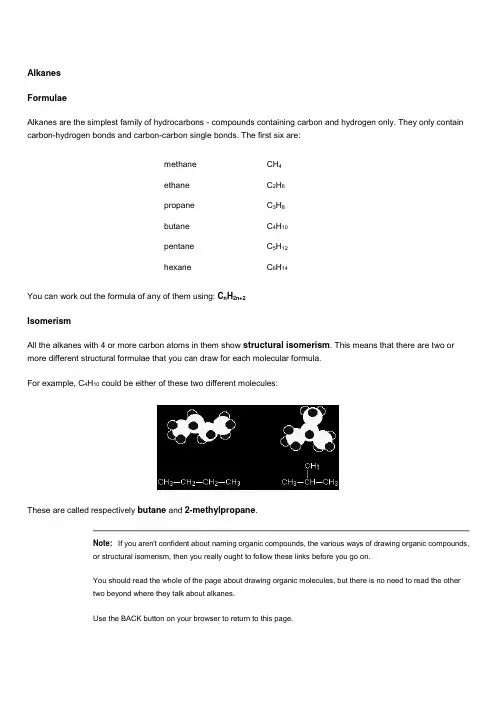
For example, C4H10 could be either of these two different molecules:
These are called respectively butane and 2-methylpropane.
Note: If you aren't confident about naming organic compounds, the various ways of drawing organic compounds,
or structural isomerism, then you really ought to follow these links before you go on.