
Articles aanthe
- 格式:ppt
- 大小:97.50 KB
- 文档页数:12

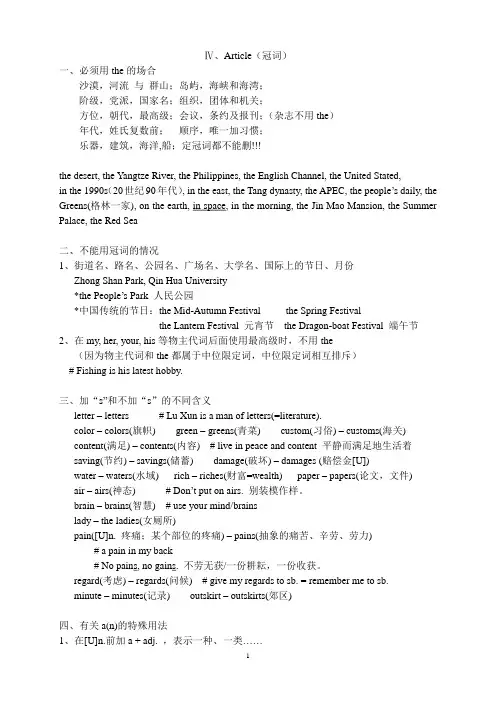
1 Ⅳ、Article(冠词)
一、必须用the的场合
沙漠,河流 与 群山;岛屿,海峡和海湾;
阶级,党派,国家名;组织,团体和机关;
方位,朝代,最高级;会议,条约及报刊;(杂志不用the)
年代,姓氏复数前; 顺序,唯一加习惯;
乐器,建筑,海洋,船;定冠词都不能删!!!
the desert, the Yangtze River, the Philippines, the English Channel, the United Stated,
in the 1990s(20世纪90年代), in the east, the Tang dynasty, the APEC, the people’s daily, the
Greens(格林一家), on the earth, in space, in the morning, the Jin Mao Mansion, the Summer
Palace, the Red Sea
二、不能用冠词的情况
1、街道名、路名、公园名、广场名、大学名、国际上的节日、月份
Zhong Shan Park, Qin Hua University
*the People’s Park 人民公园
*中国传统的节日:the Mid-Autumn Festival the Spring Festival
the Lantern Festival 元宵节 the Dragon-boat Festival 端午节
2、在my, her, your, his等物主代词后面使用最高级时,不用the
(因为物主代词和the都属于中位限定词,中位限定词相互排斥)
# Fishing is his latest hobby.
三、加“s”和不加“s”的不同含义
letter – letters # Lu Xun is a man of letters(=literature).
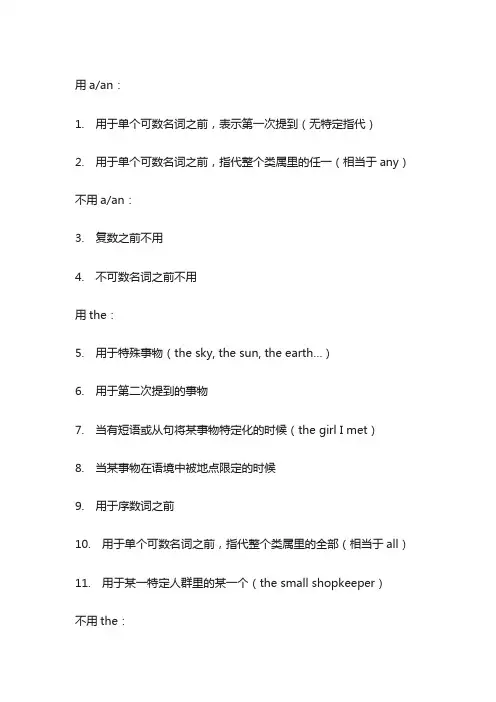
用a/an:
1. 用于单个可数名词之前,表示第一次提到(无特定指代)
2. 用于单个可数名词之前,指代整个类属里的任一(相当于any)
不用a/an:
3. 复数之前不用
4. 不可数名词之前不用
用the:
5. 用于特殊事物(the sky, the sun, the earth…)
6. 用于第二次提到的事物
7. 当有短语或从句将某事物特定化的时候(the girl I met)
8. 当某事物在语境中被地点限定的时候
9. 用于序数词之前
10. 用于单个可数名词之前,指代整个类属里的全部(相当于all)
11. 用于某一特定人群里的某一个(the small shopkeeper)
不用the: 12. 抽象事物之前(除非该抽象事物被赋予了特定含义)
13. 表示“自然”时,nature不用the(但表示“本质”时要用the)
14. 非特定地点的的地点名词之前(at home, at school, at prison)
==========复杂的来了==========
a/an vs. the
15.a/an用于第一次出现的事物,the用于继续出现的事物
16.a/an用于类属里某的任一事物(any),the用于类属里的全部事物(all)
17. 用the对某一事物做普遍性的陈述
=========更复杂的来了=========
零冠词(即不用冠词) vs. a/an
18. 在概念层面上的事物,即使是单数可数名词,也不用冠词。
零冠词 vs. the
19. 复数名词,且用于泛指,用零冠词
20. 不可数名词,且用于泛指,用零冠词 21. 抽象名词,无论可数或不可数,都用零冠词
22. 论文标题的第一个词,如果是名词,通常省略the
23. 图表标题的名词,通常省略the
========举例========
以下这些句子都是我曾经写过然后被导师修改的,这些类型的错误我犯了无数次。

定冠词a an the的用法
一、定冠词(a, an, the)的基本用法
定冠词a, an和the是英语中常见的冠词,它们在句子中起到限定名词用途。在正确使用定冠词时,我们需要注意以下几个方面。
1. 使用不确定性描述事物:定冠词a和an用来表示一个不确定的人或者事物。通常情况下,当我们提及一个事物时,尚未确定这个事物属于哪个具体的种类或者范围。例如:I saw a car in the parking lot.(我在停车场看到了一辆车。)
2. 单数可数名词前使用定冠词a:当我们提及单数可数名词时,并且此名词是第一次出现在文中时,应该使用定冠词a。例如:She adopted a puppy from the
shelter.(她从收容所领养了一只小狗。)
3. 元音音素前使用定冠词an:在特定情况下,如果一个单数可数名词以元音音素开头,则应该使用定冠词an。元音音素包括字母a, e, i, o, u以及以这些字母为首的发音开头的单复数可数名词。例如:He is an honest man.(他是一个诚实的人。)
4. 特指特定的人或物使用定冠词the:当我们提及一个事物时,确定这个事物属于特定的范围或类别时,应该使用定冠词the。通常情况下,这种范围或类别已在前文或者对话中提及过。例如:The car parked outside is mine.(外面停着的那辆车是我的。)
二、一些特殊情况下的用法
除了上述基本用法外,还有一些特殊情况需要注意。
1. 姓氏和复姓名前不使用冠词:英语中的姓氏和复姓名不需要加上任何冠词。例如:Smith is a common English surname.(史密斯是一个常见的英语姓氏。) 2. 避免重复使用定冠词the:通常情况下,在同一句子中连续出现两次相同的名词时,只需在第一次出现时使用定冠词the即可,后面可以省略。例如:I saw
the cat in the garden, and then the cat climbed up a tree.(我在花园里看到了那只猫,然后它爬上了树。)

柯林斯英语 冠词
Articles" with a word count of over 1000 words, written entirely in
English:
The English language is known for its nuanced and complex
grammar rules, and one of the most crucial aspects of this is the use
of articles. Articles, which include the words "a," "an," and "the," play
a vital role in providing specificity and clarity in English
communication. In the Collins English Grammar series, the topic of
articles is explored in depth, offering learners a comprehensive
understanding of when and how to use these essential linguistic
tools.
At the core of the Collins English Grammar's coverage of articles is
the distinction between the indefinite article "a/an" and the definite
article "the." The indefinite article is used to introduce a noun that is
not specific or unique, whereas the definite article is employed when