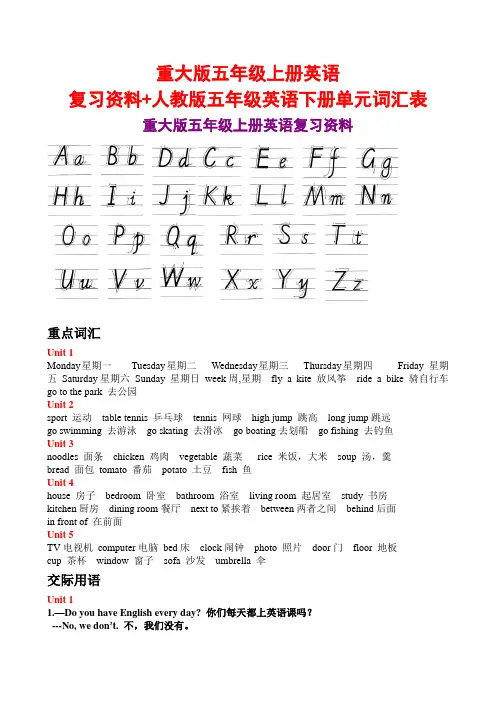
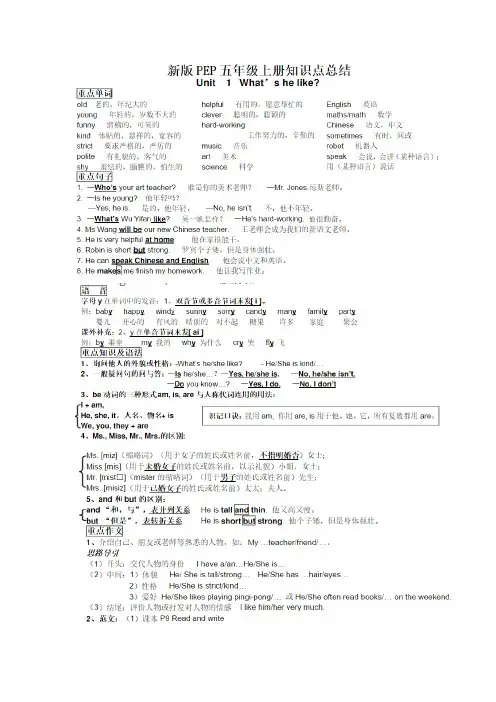
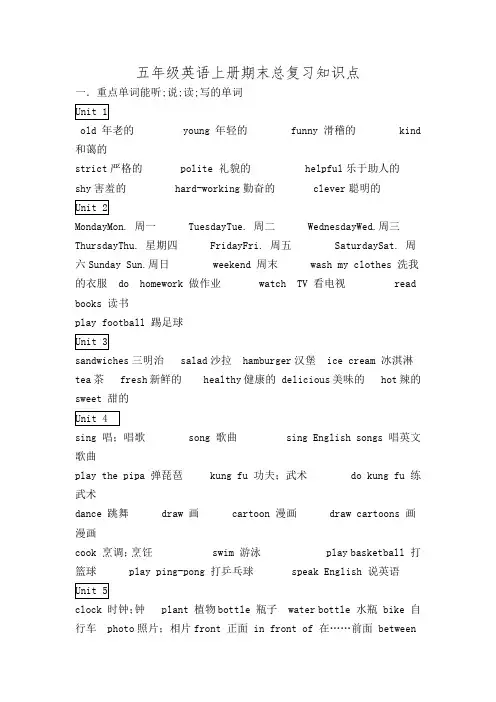
五年级英语复习资料
- 格式:docx
- 大小:21.00 KB
- 文档页数:13
英语五年级期末考试重点内容解析 Start unit Join in again 1Words touch 触摸enjoy 享受……的乐趣 everyone 每个人 fun 乐趣 head 头near 接近shake hands 握手 alphabet 字母 2Sentences 1. Touch your nose and shake your head. 触摸你的鼻子,摇摇你的头。 2. Welcome back now. 欢迎回来。 3. Learning can be lots of fun. 学习充满乐趣。 4. Enjoy your time in class again. 很高兴再次回到课堂。 5. Sing and dance and rock with me. 跟我来唱跳摇滚吧。 6. Shake hands with your partner. 和你的同伴摇摇手。 7. Turn around. 转圈。8. Dance with me. 跟我跳舞。 Unit 1 A phone call 1Words ask 问 before 在……以前 call 通话 get 收到,接到 ill 病 paint 颜料programme节目 something 某物,某事 website 网站 work 运转 wrong 有问题的 across 穿过;横过like 喜欢 read 读 collect 收集 2Phrases have to 不得不listen to music 听音乐 do shopping 购物 mobile phone 移动电话 over there 在那边,在那儿 phone box 电话亭 phone call 电话 write emails 写邮件 watch TV programmes 看电视节目 play games 玩游戏 visit websites 访问网站 see films 看电影 make phone calls 打电话 get messages 收信息take photos 拍照 send messages 发邮件 3Sentences 1. Wait a moment.稍等2. I’ve got a new CD-ROM. 我有一张新的光盘。 3. Can you come to my place? 你们可以来我家吗? 4. I have to ask my Mum first. 我不得不问问我的妈妈。 5. There’s one over there. 那边有一个。6. Phone your mum and your grandma. 给你的奶奶和妈妈打电话。7. Hello, is that Mike? 您好,你是迈克吗?8. Yes, this is Mike speaking. 是的,我是迈克。9. It’s your granny. 我是你的奶奶。 10. I have to do my homework. 我不得不做我的作业。11. See you tomorrow. 明天见 12. See you this evening. 今晚见。13. My computer doesn’t work. 我的电脑不能运转了。14. Mobile phones are very popular across the world. 移动电话在全世界很流行。 15. You can use a mobile phone to write emails, listen to music, watch TV programmes and play games. You can use it to visit your favourite websites and even do shopping. 你可以用它写邮件,听音乐,看电视和玩游戏。你可以用它来访问你最喜欢的网站甚至购物。 16. What can you do with a mobile phone? 用电话你可以做什么? 17. I can send and get messages. 我可以发送和接受信息。 18. Can you visit websites? 你能访问网站吗? 19. Of course I can, but I don’t visit websites often. 当然我可以,但是我不经常上网。 20. My cousin Yanmei works hard at English. 我的表妹严梅在英语方面很努力。 21. She likes English very much. 她非常喜欢英语。 22. She collects many English storybooks. 她收集许多英语故事书。 23. She often reads her storybooks. 她经常读故事书。 4Stroy 1. The red paint, please. 请给我红色的颜料。2. One week before Easter. 复活节的前一周3. One day before Easter. 复活节的前一天4. What can I do? 我可以做什么?5. Can you help me? 你可以帮助我吗? 6. Yes, of course. 是的,当然可以。7. Where are the eggs? 彩蛋在哪里?8. Here they are. 它们在这儿。9.How many eggs can you find? 你能找到多少彩蛋? Unit 2 Life in the Arctic 1Words Arctic北极的 early早期的earth地球 fishing钓鱼 grandma奶奶 grandpa爷爷hare野兔 hill小山ice冰 lake湖North Pole北极 polar bear北极熊 pull拉 shopping mall购物中心 snow雪 South Pole南极 will 将要 seal海豹 2Phrases jump in the water跳进水里 swim across the lake游过湖面 walk through the snow走过雪地 run up the hill跑上小山 come to the top到达山顶 look around环顾四周 go fishing/swimming 去钓鱼/去游泳go to the playground去操场 go to the Great Wall去长城 go to the park去公园 go to the zoo去动物园 3Sentences 1. What do you know about the Arctic? 关于北极,你了解多少?2. The Arctic is very cold.北极非常冷。3. There is ice everywhere in the Arctic. 在北极到处都是冰。4. The sky is very blue. 天空蔚蓝。5. The Arctic is very beautiful. 北极非常美丽。6. What’s over there? 那儿是什么? 7. What’s he doing over there? 他在那儿做什么?8. He wants to catch a hare. 他想要捉野兔。9. Tomorrow is Saturday. 明天是星期六。 10. What will the children do? 孩子们将要做什么?11. I’ll go swimming. 我将要去游泳 4Stroy 1. Nicola comes to the Arctic. 尼克拉来到了北极。 2. She is going to have her holiday. 她将要在这儿度过她的假期。 3. This is our house. 这是我们的房子。4. Do you like it here? 你喜欢这儿吗?5. What can I do? 我可以做什么? 6. There are no shopping malls, no playground and there’s no TV. 这儿没有购物中心,没有操场也没有电视。 7. Can we go fishing again tomorrow? 明天我们可以再来钓鱼吗? 8. This is great fun! 太有趣了!9. Can I come again next year? 明年我能再来吗?10. Do you know what’s on his TV? 你知道在他的电视上有什么?11. I’ll show you my TV. 我将要展示给你我的电视。 12. Wasn’t it boring? 难道不无聊吗? 5Grammar 1.There be 句型及否定用法 There is +单数 There isn't a=There is no There are +复数 There aren't any=There are no no =not a(单数)/not any(复数或不可数) 2.will 和be going to 的用法 will+动词原形 (将来时间则较远一些,而非最近期间的事) He will write a book one day. be going to +动词原形(近期眼下,即将要发生的事) He is going to write a letter this evening. 3. have got------has got(单数第三人称)haven’t--------hasn’t (表否定) Unit 3 Television 1Words