
MANAGING THE CHALLENGE OF FOREIGGN TECHNOLOGIES-Bruce McConnell
- 格式:pptx
- 大小:1.05 MB
- 文档页数:12


ManagementLecturer: Prof. Dr. Paulo R. Motta Course Language: English1. THE CHALLENGES OF INTERNATIONAL MANAGEMENT: introducing cultural ideas for improving management actions.Definitions of CultureHow is culture learned?Frameworks for Studying CultureNational cultures and work organizationsRelationships of culture to management behaviorImplications for ManagersBIBLIOGRAPHYTo get acquainted with the theme (read three chapters - choose):THOMAS –chapter 1 ―The Challenging Role of the Global Manager‖THOMAS –chapter 2 ―Describing Culture: What It Is and Where It Comes From‖ THOMAS –chapter 3 ―Comparing Cultures: Systematically Describing Cultural Differences‖THOMAS –chapter 4, ―How Culture Works: Fundamentals of Cross-Cultural Interaction‖MORAN, HARRIS, and MORAN - chapter 1 ―Global Leaders and Cultures‖ MORAN, HARRIS, and MORAN - chapter 2 ―Global Leaders and Communications‖ MORAN, HARRIS, and MORAN - chapter 3 ―Global Leaders in NegotiationsTo pursue furtherBYE, Hege Høivik, SANDA,,Gro Mjeldheim SANDAL, VAN DE VIJVER, Fons J.R., SAM, David Lackland, ÇAKAR, Nigar Demircan and FRANKE, Gabriele Helga (2011), ―Personal Values and Intended Self-Presentation during Job Interviews: A Cross-Cultural Comparison, ―Applied Psychology: An International Review‖,60 (1): 160–182CHEVRIER, Sylvie (2009), ―Is National Culture Stil l Relevant to Management in a Global Context?: The Case of Switzerland‖, International Journal of Cross Cultural Management, 9: 169-184.D'IRIBARNE, Philippe (2009), ―National Cultures and Organisations in Search of a Theory: An Interpretative Approach‖, International Journal of Cross Cultural Management, 9: 309-321.TIPTON, Frank B. (2009), ―Modeling National Identities and Cultural Change: The Western European, Japanese, and United States Experiences Compared‖, International Journal of Cross Cultural Management, 9: 145-168.2. COMMUNICATION AND NEGOTIATION ACROSS CULTURESCross cultural communication differencesSocial contextualizationVerbal and non verbal communicationHow culture influences the negotiation processThe Managers as NegotiatorBIBLIOGRAPHYTo get acquainted with the theme:THOMAS –chapter 6, ―The Manager as Negotiator: Communicating and Negotiating Across Cultures‖MORAN, HARRIS, and MORAN - chapter 2, ―Global Leaders and Communications‖ To pursue furtherCHEN, Chao C./ CHEN, Xiao-Ping (2009), ―Negative externalities of close guanxi within organizations‖, Asian Pacific Journal of Management, 26:37-53. FRIEDMAN, Victor J./ANTAL, Ariane Berthoin (2005), ―Negotiating Reality: A Theory of Action Approach to Intercultural Comp etence‖, Management Learning, 36(1): 69–86.LEONARD, Karen Moustafa/VAN SCOTTER, James R./PAKDIL, Fatma (2009), ―Culture and Communication: Cultural Variations and Media Effectiveness‖, Administration & Society, 41; 850.OHBUCHI, Ken-ichi ATSUMI, Emi.(20100 ―Avoidance Brings Japanese Employees What They Care About in Conflict Management: Its Functionality and ‗‗Good Member Image,‖ Negotiation and Conflict Management Research, 3(2): 117–1293. MANAGING DIVERSITY: WORK GROUPS IN DIFFERENT CULTURES AND MULTICULTURAL TEAMSCooperation and competition: cultural conceptsDirecting, leading and consensus buildingGroup and Team in a Cultural PerspectiveDiversity as a management conceptDiversity in different culturesModels of the multicultural organizationHow to manage diversityBIBLIOGRAPHYTo get acquainted with the theme:THOMAS, ―The Challenge of Multicultural Work Groups and Teams‖ – chapter8 HARRIS, MORAN and MORAN, ―Managing Diversity in the Global Work Culture‖ chapter 7FRANCESCO AND GOLD, ―Groups and Teams‖ chapter 7FRANCESCO AND GOLD ―Managing Diversity‖ chapter 13To pursue furtherBOWEN, Sarah (2008), ―Beyond Self-Assessment —Assessing Organizational Cultural Responsive-ness‖, Journal of Cultural Diversity, (15), 1.KALLINY, Morris/CRU THIRDS, Kevin W./MINOR, Michael S. (2006), ―Differences between American, Egyptian and Lebanese Humor Styles: Implications for International Management‖, International Journal of Cross Cultural Management, 6; 121-134.MURDOCH, Anna (2006), ―Diversity And Complementarity Of Cultures As Principles Of Universal Civilization‖, Dialogue and Universalism, No. 5-6: 117- 128.VALLASTE, Christine (2005), ―Cultural Diversity and Its Impact on Social Interactive Processes Implications from an Empirical Study‖, International Journal of Cross Cultural Management, 5; 139-163.ZIMMERMANN, Angelika, (2011) ―Interpersonal relationships in transnational, virtual teams: Towards a configurational perspective‖. International Journal of Management Reviews, 13: 59–784. LEADERSHIP ACROSS CULTURESThe cultural context and leadership practiceBeliefs and attitudes about leadersCultural variations in leadership concepts and practicesManager‘s leadership roles by culturesBIBLIOGRAPHYTo get acquainted with the themeTHOMAS - chapter 7 ―The manager as a leader: The Leadership Role Across Cultures‖MORAN, HARRIS, and MORAN - chapter 4 ―Global Leaders and the Changing Knowledge Culture‖JAVIDON, Mansur/DORFMAN, Peter W./HOWELL, Jon Paul/HANGES, Paul J (2010), ―Leadership and C ultural Context: A Theoretical and Empirical Examination Based on Project GLOBE‖, in NOHRIA, Nitin/KHURANA, Ralesh, Handbook of Leadership Theory and Practice, Boston: Harvard Business Press.To pursue furtherBOLDEN, Richard/KIRK, Philip (2009), ―Afri can Leadership: Surfacing New Understandings through Leadership Development‖, International Journal of Cross Cultural Management, 9: 69-86.DORFMAN, Peter/HOUSE, Robert (2004), ―Cultural Influences on Organizational Leadership‖ in HOUSE, Robert J./HANGES, Paul J./JAVIDAN, Mansour/DORFMAN, Peter W./GUPTA, Vipin (edi-tors), Culture, Leadership and Organizations: The GLOBE Study of 62 Societies, Thousand Oaks: Sage.PRIME, Jeanine/JONSEN, Karsten/CARTER, Nancy/MAZNEVSKI, Martha L. (2008), ―Managers' Perceptions of Women and Men Leaders: A Cross Cultural Comparison‖, International Journal of Cross Cultural Management, 8: 171-210.VAN EMMERIK, IJ. Hetty/EUWEMA, Martin C./WENDT, Hein (2008), ―Leadership Behaviors around the World: The Relative Importance of Gender versus Cultural Background‖, International Journal of Cross Cultural Management, 8: 297-315.5. ETHICS IN INTERNATIONAL MANAGEMENTEthics in international management decisionsHow attitudes toward ethics vary with the cultureUniversal versus culturally contingentRelativism and beliefs about values and corruptionacquainted with the theme:BIBLIOGRAPHYTo get acquainted with the theme:LANE, DISTEFANO, MAZNEVSKY and DIETZ - chapter 8 ―Competing with Integrity in Global Busi-ness‖PHATAK. BHAGAT and KASHLAK - chapter 14, ―Ethics and Social Responsibility for International Firms‖To pursue furtherBULLER, Paul F./KOHLS, John J./ANDERSON, Kenneth S. (2003), ―When Ethics Collide: Managing Conflicts Across Cultures‖, in THOMAS, David, Readings a nd Cases in International Management, Thousand Oaks: Sage.CULLEN, John B./PARBOTEEAH, K. Praven/HOEGL, Martin (2004), ―Cross- National Differences in Managers‘ Willingness to Justify Ethically Suspect Behaviors: A Test of Institutional Anomie Theory‖, Academy of Management Journal, 47 (3): 411-421.DUSSEL, Enrique/IBARRA-COLADO, Eduardo (2006), Globalization, Organization and the Ethics of Liberation, Organization, 13(4) 489–508.PALAZZO, Bettina (2002), ―A U.S. –American and German Business Ethics: An Intercultural Comparison‖, Journal of Business Ethics, 41: 195-216. PARBOTEEAH, K. Praveen (2005), ―Does National Culture Affect Willingness to Justify Ethically Suspect Behaviors? A Focus on the GLOBE National Culture Scheme‖, International Journal of Cross Cultural Management, 5(2): 123–138. TURCOTTE, Marie-France/MACLEAN, Joan/AGUILERA, Gustavo Munoz/RAVLIN, Eliza-beth/TIESSEN, James H./BESS, Dave/MACNAB, Brent/BRISLIN, Richard, Worthley, Reg/GALPERIN, Bella L./JENNER, Steve/LITUCHY, Terri R. (2007), ―Culture and Ethics Management: Whistle-blowing and Internal Reporting within a NAFTA Country Context‖, International Journal of Cross Cultural Management, 7: 5-28.WATSON, Sharin/WEAVER, Gary (2003), ―How internationalization affects corporate ethics: fo rmal structures and informal management behavior‖, Journal of International Management, 9: 75-93.6. STRATEGY, STRUCTURE AND DECISION MAKING ON A CROSS CULTURAL PERSPECTIVEHow attitudes toward the future affect planningThe strategic value of cultural differencesExamples of strategic dimensions across culturesCross cultural dimensions of decision makingCultural perspectives on problems and opportunitiesCultural and non cultural constraints on rationalityBIBLIOGRAPHYTo get acquainted with the themeLANE, DISTEFANO, MAZNEVSKY and DIETZ - chapter 5 ―Executing Global Strategy‖THOMAS –chapter 5, ―The Manager as Decision Maker: Cross Cultural Dimensions of Decision Making‖THOMAS –chapter 9, ―The Challenge of International Organizations‖To pursue furtherCARR, Chris (2005), ―Are German, Japanese and Anglo-Saxon Strategic Decision Styles Still Diver-gent in the Context of Globalization?‖, Journal of Management Studies, 42(6): 1155-1188.CHIANG, Flora F. T. and BIRTCH, Thomas A. (2010) ―Appraising Performance across Borders: An Empirical Examination of the Purposes and Practices of Performance Appraisal in a Multi-Country Context.‖ Journal of Management Studies 47 (7): 1365- 1393LEONG, Joyce L.T./BOND, Michael Harris/PING FU, Ping (2006), ―Perceived Effectiveness of Influ-ence Strategies in the United States and Three Chinese Societies‖, International Journal of Cross Cultural Management, Vol. 6(1): 101–120. NOORDERHAVEN, Niels G./BENDERS, Jos/KEIZER, Arjan B. (2007), ―Comprehensivene ss versus Pragmatism: Consensus at the Japanese–Dutch Interface‖, Journal of Management Studies, 44(8): 1349-1370.TYLER, Beverly B./GNYAWALI, Devi R. (2009), ―Managerial Collective Cognitions: An Examination of Similarities and Differences of Cultural Or ientations‖, Journal of Management Studies, 46(1): 93-126.VANCE, Charles M. (2006), ―Strategic Upstream and Downstream Considerations for Effective Global Performance Management‖, International Journal of Cross Cultural Management, Vol. 6(1): 37–56.7. INTERCULTURAL RESEARCH and TRANSFERENCE OF MANAGEMENT KNOWLEDGEEvaluating cross-cultural management studiesTransference of management knowledge and practicesCultural obstacles for applying management knowledge cross culturally Multinational management orientationBIBLIOGRAPHYTo get acquainted with the theme:THOMAS - chapter 11, ―The Challenge of Managing Across Cultures in the Future‖ HARRIS, MORAN and MORAN - chapter 5, ―Global Leaders Learn from other Management Systems‖To pursue furtherFISCHER, Ronald (2009), ―Where Is Culture in Cross Cultural Research?: An Outline of a Multilevel Research Process for Measuring Culture as a Shared Meaning System“, International Journal of Cross Cultural Management, 9: 25-49. GERHART, Barry (2008), ―Cross Cultural Management Research: Assumptions, Evidence, and Suggested Directions―, International Journal of Cross Cultural Management, 8: 259-274.NELSON Reed E./GOPALAN, Suresh (2003), ―Do Organizational Cultures Replicate National Cultures? Isomorphism, Rejection and Reciprocal Opposition in the Corporate Values of Three Countries‖, Organization Studies, 24(7): 1115–1151. PRIMECZ, Henriett/ROMANI, Laurence/SACKMANN, Sonja A. (2009), ―Cross-Cultural Management Research: Contributions from Various Paradigms“, International Journal of Cross Cultural Management, 9; 267-274.TAKEUCHI, Riki/TESLUK, Paul E./YUN, Seokhwa/LEPAK, David (2005), ―An Integrative View of International Experience‖, Academy of Management Journal, 48(1): 85–100.TARIQUE, Ibraiz and CALIGIURI, Paula, (2009) ―The role of cross-cultural absorptive capacity in the effectiveness of in-country cross-cultural training‖ International, Journal of Training and Development, 13(3): 148-164VAARA, Eero, SARALA, Riikka, STAHL, Guenter and BJÖRKMAN, Ingmar, (2010), ―The Impact of Organizational and National Cultural Differences on Social Conflict and Knowledge Transfer in International Acquisitions‖ Journal of Management Studies,:1.27YEGANEH, Hamid/ZHAN, Su (2006), ―Conceptual Foundations of C ultural Management Research‖, International Journal of Cross Cultural Management, 6(3): 361–376.REFERENCES AND ADDITIONAL READINGS:ADLER, Nancy. 1997. International Dimensions of Organizational Behavior. Cincinnati: South Western College.AXTELL, Roger, 1998, Gestures : The Do's and Taboos of Body Language Around the World. New York: John Wiley.AXTELL, Roger, et alli. 1997. Do's and Taboos Around the World for Women in Business. New York: John Wiley.BERGER, Peter L. e HUNTINGTON, Samuel P. 2002. editors, Many Globalizations: Cultural Diversity in the Contemporary World. Oxford: Oxford University Press, 2002. BOSROCK, Mary Murray. European Business: Customs & Manners. New York: Meadwbrook Press, 2006.CHANEY, Lilian H. and MARTIN, Jeanette S. Intercultural Business Communication. Upper Saddle River, Pearson, 2007.CHONG, Nilda and BAEZ, Francia, Latino Culture. Yarmouth, ME, Intercultural Press, 2005.COX, Taylor. 2001. Creating the Multicultural Organization. San Francisco, Jossey Bass.CULLEN, John B and PARBOETEEAH, K. Praveen. 2005. Multinational Management, A Strategic Approach. Mason, South Western.CYR, Donald, 2002. The Art of Global Thinking. West Lafayette: Purdue University Press.ELASHMAWI, Farid e HARRIS, Philip. 1998, Multicultural Management 2000 : Essential Cultural Insights for Global Business Success.Houston: Gulf Publishing Co.FERRARO, Gary 2001. The Cultural Dimension of International Business. Englewood Cliffs, NJ: Prentice Hall.FOSTER, Dean Allen. 2000. The Global Etiquette Guide to Asia. New York: John Wiley.FOSTER, Dean Allen. 2000. The Global Etiquette Guide to Europe : Everything You Need to Know for Business and Travel Success. New York: John Wiley. FRANCESCO, Anne Marie e GOLD, Barry. 1997. International Organizational Behavior. Upper Saddle River, NJ: Prentice Hall.GRANROSE, Cherlyn S. e OSKAMP, Stuart. 1997. (editors) Cross-Cultural Work Groups. Thousand Oaks: Sage.HARRIS, Philip, MORAN, Robert, MORAN, Sarah and SOCCORSY, Judith. 2004 (editorial coordinators) Managing Cultural Differences: global leadership strategies for the 21st century. Elsevier.HARRISON, Lawrence E. e HUNTINGTON, Samuel P. 2000 editors, Culture Matters: How values shape human progress. New York: Basic Books.HOECLIN, Lisa. 1995. Managing Cultural Differences: strategies for competitive advantage. Workingham,UK: Addison-Wesley. 1995HOFSTEDE, Geert, and HOFSTEDE, Gert Jan. 2005 Cultures and Organizations: software of the mind. New York: McGraw-Hill.HOFSTEDE, Geert, Culture’s Consequences: Internat ional Differences in Work-Related Values. Beverly Hills: Sage, 1980.HOPKINS, Bryan 2009. Cultural Differences and Improving Performance. Farham. Gower.HOUSE, Robert J. (Editor), and Mansour Javidan, Paul J. Hanges, Vipin Gupta, Peter W. Dorfman. 2004 Culture, Leadership, and Organizations: The GLOBE Study of 62 Societies, Thousand Oaks.LANE, Henry W, DISTEFANO, Joseph J., MAZNEVSKY, Martha L. 2003. Management Behavior: Text, Readings and Cases. London: Blackwell.LAROCHE, Lionel. 2003. Managing Cultural Diversity in Technical Professions. Woburn Ma: Elsevier Science, 2003.McCALL, Morgan e HOLLENBECK, George. 2002. Developing Global Executives, Boston: HBS Press.MOLE, John. 1995.Mind Your Manners: Managing Business Cultures in Europe. Londres, Nicholas Brealey.MORAN, Robert, HARRIS, Philip, and, MORAN, Sarah. 2011 Managing cultural differences: Global Leadership Strategies for Cross-Cultural Business Succes s.ElsevierMORRISON, Terri, et alli, 1994. Kiss, Bow, or Shake Hands: How to Do Business in 60 Countries Holbrook: Adams Media.PETERSON, Brooks, 2004, Cultural Intelligence. Yarmouth:Intercultural Press.PUNNETT, Betty Jane. 2004. International Perspectives on Organizational Behavior and Human Resource Management. Armonk, NY: Me Sharpe.SABATH, Ann Marie. 2000. International Business Etiquette, Latin America: What You Need to Know to Conduct Business Abroad with Charm and Savvy. Franklin Lanes, NJ: Career PressSCARBOROUGH, Jack. 2001. The Origins of Cultural Differences and Their Impact on Management. Westport: Quorum Books.SHWEDER, Richard A. 1991. Thinking Through Cultures: Expeditions in Cultural Psychology. Cambridge: Harvard University PressSIMONS, George F. 2002. Euro Diversity. Woburn Ma: Elsevier Science.SORTY, Craig. 2004. American at Work: A Guide to the Can-Do People. Yarmouth, Maine: Intercultural Press.THOMAS, David, 2002. Essentials of International Management: A Cross Cultural Perspective. Thousand Oaks: Sage.TROPENAARS, Fons and HAMPDEN-TURNER. 1998. Charles. Riding the Waves of Culture. London: Nicholas Brealey.WALLACE, Joel e METCALF, Gale. 1995. Working with Americans: a practical guide for Asians on how to succeed with US managers. Singapore: McGraw-Hill.PROPOSED SCHEDULE (Preliminary)。
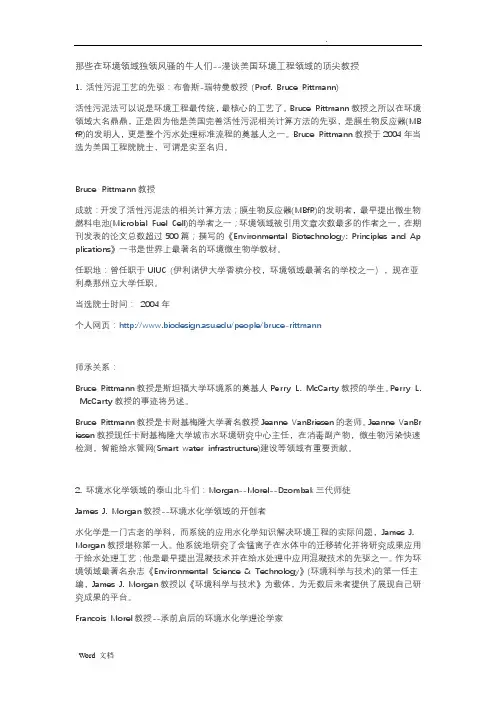
那些在环境领域独领风骚的牛人们--漫谈美国环境工程领域的顶尖教授1. 活性污泥工艺的先驱:布鲁斯-瑞特曼教授(Prof. Bruce Rittmann)活性污泥法可以说是环境工程最传统,最核心的工艺了。
Bruce Rittmann教授之所以在环境领域大名鼎鼎,正是因为他是美国完善活性污泥相关计算方法的先驱,是膜生物反应器(MB fR)的发明人,更是整个污水处理标准流程的奠基人之一。
Bruce Rittmann教授于2004年当选为美国工程院院士,可谓是实至名归。
Bruce Rittmann教授成就:开发了活性污泥法的相关计算方法;膜生物反应器(MBfR)的发明者,最早提出微生物燃料电池(Microbial Fuel Cell)的学者之一;环境领域被引用文章次数最多的作者之一,在期刊发表的论文总数超过500篇;撰写的《Environmental Biotechnology: Principles and Ap plications》一书是世界上最著名的环境微生物学教材。
任职地:曾任职于UIUC (伊利诺伊大学香槟分校,环境领域最著名的学校之一),现在亚利桑那州立大学任职。
当选院士时间:2004年个人网页:/people/bruce-rittmann师承关系:Bruce Rittmann教授是斯坦福大学环境系的奠基人Perry L. McCarty教授的学生。
Perry L. McCarty教授的事迹将另述。
Bruce Rittmann教授是卡耐基梅隆大学著名教授Jeanne VanBriesen的老师。
Jeanne VanBr iesen教授现任卡耐基梅隆大学城市水环境研究中心主任,在消毒副产物,微生物污染快速检测,智能给水管网(Smart water infrastructure)建设等领域有重要贡献。
2. 环境水化学领域的泰山北斗们:Morgan--Morel--Dzombak三代师徒James J. Morgan教授--环境水化学领域的开创者水化学是一门古老的学科,而系统的应用水化学知识解决环境工程的实际问题,James J. Morgan教授堪称第一人。