
(牛津译林)高一英语必修三课件:Unit2Language(共66张PPT)
- 格式:ppt
- 大小:2.00 MB
- 文档页数:66

高一必修3 Unit 2 Using language(新课标版 高一必修三)
简介: ppt制作 现在许多蔬菜种在温室里, 在那儿他们可以免受风雨袭击。
Today many vegetables planted in greenhouses, where they
are protected from the rain and the wind .
8.在过去的十年中, 科学技术取得了重大发现。
In the past/last few years, important discoveries have made
in science and technology.
. 上传者:***************************相关课件:
简介: ppt制作 对课后的单词rare,value,search
of,select,amaze,fancy,belong to,in return,at
war ,remove,than,doubt,worth,apart,trial,sink,think highly of进行拓展以及重要短语讲解。讲解的相对比较细致。. 上传者:bear201314 「下载次数:1030」
人教课标高一必修3 Unit 1 Festivals around the world
(Reading)
简介: ppt制作 ppt制作 必修3Unit1中的第1篇阅读,先引导学生读题目,再从整体上读文章,理清框架。接着读文章细节,再挖掘深度。. 上传者:baby梁宝宝2009 「下载次数:404」
简介: ppt制作 内容包括reading和introduction, 适用作课,可改动一下 图片精美. 上传者:ritamaomao 「下载次数:581」
高一必修一模块二 Unit 1 Reading
简介: ppt制作 本课件经过备课组精心准备磨课,并修改,非常适合公开课使用,平时自己上课使用也很实用. 上传者:ftyzly 「下载次数:453」
百度文库 - 让每个人平等地提升自我
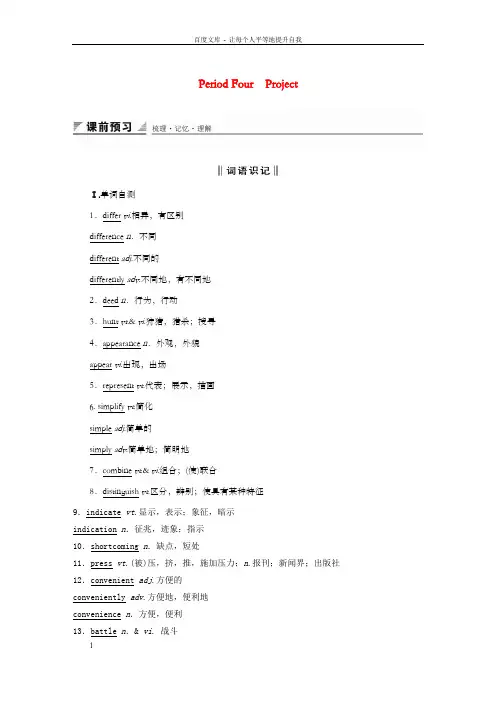
1 Period Four Project
Ⅰ.单词自测
1.differ vi.相异,有区别
difference n.不同
different adj.不同的
differently
adv.不同地,有不同地
2.deed n.行为,行动
3.hunt vt.&
vi.狩猎,猎杀;搜寻
4.appearance n.外观,外貌
appear vi.出现,出场
5.represent vt.代表;展示,描画
6. simplify vt.简化
simple adj.简单的
simply adv.简单地;简明地
7.combine vt.& vi.组合;(使)联合
8.distinguish vt.区分,辨别;使具有某种特征
9.indicate vt.显示,表示;象征,暗示
indication n.征兆,迹象;指示
10.shortcoming n.缺点,短处
11.press vt.(被)压,挤,推,施加压力;n.报刊;新闻界;出版社
12.convenient adj.方便的
conveniently adv.方便地,便利地
convenience n.方便,便利
13.battle n.& vi. 战斗 百度文库
-
让每个人平等地提升自我
2 14.pattern
n.图案,花纹;模式,方式
15.drag vt.(使劲地)拖,拉
16.practical adj.切实可行的,实用的
practice n.& vt.实践;应用;练习
17.thus adv.以此方式;如此;因此,从而
18.version n.版本
Ⅱ.短语自测
1.differ from 与……不同,不同于
2.instead of 代替,而不是
3.stand for 代表,象征
4.as a whole 作为整体,整体上
5.turn into 变成
6.in the 1950s 二十世纪五十年代
由疑问词引导的名词性从句
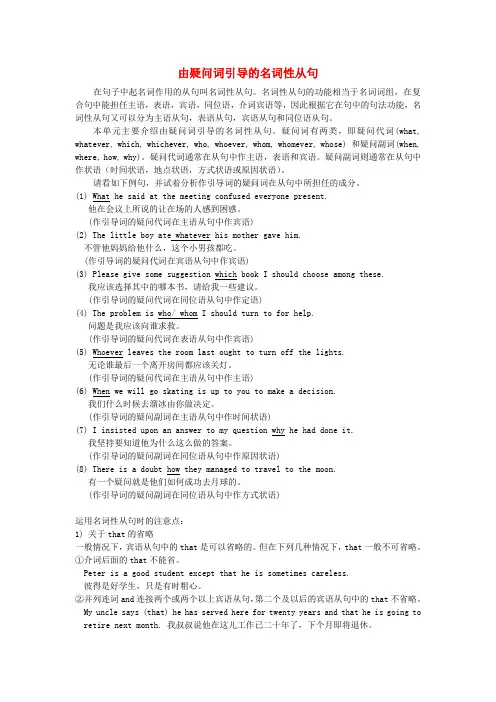
在句子中起名词作用的从句叫名词性从句。名词性从句的功能相当于名词词组,在复合句中能担任主语,表语,宾语,同位语,介词宾语等,因此根据它在句中的句法功能,名词性从句又可以分为主语从句,表语从句,宾语从句和同位语从句。
本单元主要介绍由疑问词引导的名词性从句。疑问词有两类,即疑问代词(what,
whatever, which, whichever, who, whoever, whom, whomever, whose) 和疑问副词(when,
where, how, why)。疑问代词通常在从句中作主语,表语和宾语。疑问副词则通常在从句中作状语(时间状语,地点状语,方式状语或原因状语)。
请看如下例句,并试着分析作引导词的疑问词在从句中所担任的成分。
(1) What he said at the meeting confused everyone present.
他在会议上所说的让在场的人感到困惑。
(作引导词的疑问代词在主语从句中作宾语)
(2) The little boy ate whatever his mother gave him.
不管他妈妈给他什么,这个小男孩都吃。
(作引导词的疑问代词在宾语从句中作宾语)
(3) Please give some suggestion which book I should choose among these.
我应该选择其中的哪本书,请给我一些建议。
(作引导词的疑问代词在同位语从句中作定语)
(4) The problem is who/ whom I should turn to for help.
问题是我应该向谁求救。
(作引导词的疑问代词在表语从句中作宾语)
(5) Whoever leaves the room last ought to turn off the lights.
无论谁最后一个离开房间都应该关灯。

精品 Word 可修改 欢迎下载 Unit 2 Language
当今社会, 一个人会讲两、三种语言已不再是什么稀奇的事。但你有没有思考过这样一个问题:世界上到底有多少种语言? 读完下面的短文, 会让你大吃一惊。
When people are asked how many languages they think there are in the world, the
answers vary quite a bit.One random(随意的)sampling of New Yorkers, for instance,
resulted in answers like “probably several hundred”.However we choose to count
them, though, this is not close.When we look at reference works, we find estimates(估计) that have escalated (上升) over time.The 1911(11th)edition of the Encyclopedia
Britannica(大英百科全书), for example, implies a figure somewhere around 1,000,
a number that climbs steadily over the course of the twentieth century.
That is not due to any increase in the number of languages, but rather to our
increased understanding of how many languages are actually spoken in areas that had