
纺织品中甲醛含量的测定流程图
- 格式:xlsx
- 大小:42.14 KB
- 文档页数:4


一、实验目的
1. 掌握甲醛含量的测定方法。
2. 熟悉实验仪器的使用和操作流程。
3. 了解甲醛对环境和人体健康的危害。
二、实验原理
甲醛是一种无色、有强烈刺激性气味的气体,易溶于水、醇和醚。甲醛的测定方法有多种,本实验采用乙酰丙酮分光光度法进行测定。
实验原理:采用蒸馏方法将样品中的甲醛蒸出,在pH6的乙酸-乙酸铵缓冲溶液中,馏分出的甲醛与乙酰丙酮在加热的条件下生成稳定的黄色化合物,冷却后在波长412nm处进行吸光度测试。根据标准工作曲线,计算试样中甲醛的含量。
三、实验材料与仪器
1. 实验材料:甲醛标准溶液、水、乙酸铵、冰乙酸、乙酰丙酮、蒸馏装置、电加热套、水浴锅、紫外可见分光光度计、移液管、容量瓶、锥形瓶等。
2. 实验试剂:乙酸铵、冰乙酸、乙酰丙酮、甲醛标准储备液等。
四、实验步骤
1. 标准溶液的配制:根据甲醛标准储备液浓度和所需浓度,用移液管准确量取一定体积的甲醛标准储备液,加入适量水,定容至100ml容量瓶中,配制成所需浓度的甲醛标准溶液。
2. 样品溶液的配制:根据样品的性质和甲醛含量,用移液管准确量取一定体积的样品,加入适量水,定容至100ml容量瓶中,配制成所需浓度的样品溶液。
3. 蒸馏:将样品溶液加入蒸馏装置中,加热蒸馏,收集馏出液。
4. 吸光度测试:将馏出液加入pH6的乙酸-乙酸铵缓冲溶液中,加入乙酰丙酮,加热反应,冷却至室温。用紫外可见分光光度计在412nm波长处测定吸光度。
5. 标准曲线绘制:将不同浓度的甲醛标准溶液按照上述步骤进行测定,绘制标准曲线。
6. 样品中甲醛含量的计算:根据样品溶液的吸光度,从标准曲线中查得对应浓度,计算样品中甲醛的含量。 五、实验结果与分析
1. 标准曲线的绘制:以甲醛浓度为横坐标,吸光度为纵坐标,绘制标准曲线。
2. 样品中甲醛含量的计算:根据样品溶液的吸光度,从标准曲线中查得对应浓度,计算样品中甲醛的含量。
六、实验结论
甲醛的分析工序
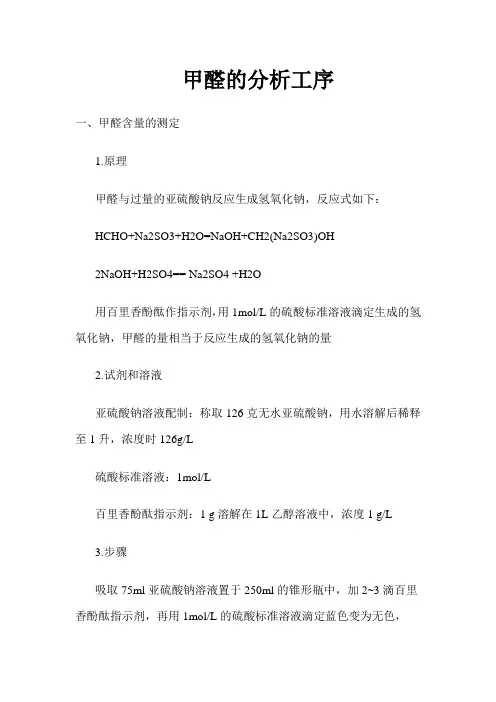
一、甲醛含量的测定
1.原理
甲醛与过量的亚硫酸钠反应生成氢氧化钠,反应式如下:
HCHO+Na2SO3+H2O=NaOH+CH2(Na2SO3)OH
2NaOH+H2SO4== Na2SO4 +H2O
用百里香酚酞作指示剂,用1mol/L的硫酸标准溶液滴定生成的氢氧化钠,甲醛的量相当于反应生成的氢氧化钠的量
2.试剂和溶液
亚硫酸钠溶液配制:称取126克无水亚硫酸钠,用水溶解后稀释至1升,浓度时126g/L
硫酸标准溶液:1mol/L
百里香酚酞指示剂:1 g溶解在1L乙醇溶液中,浓度1 g/L
3.步骤
吸取75ml亚硫酸钠溶液置于250ml的锥形瓶中,加2~3滴百里香酚酞指示剂,再用1mol/L的硫酸标准溶液滴定蓝色变为无色,
称取1克左右的(称准至0.0002g)甲醛试样,剧烈搅拌使其溶解,然后用1mol/L的硫酸标准溶液滴定,蓝色变为无色,记录消耗硫酸的体积。
计算公式:
HCHO%=C×V×0.03003÷M×100%式中:
V --滴定消耗硫酸标准溶液的体积
C----滴定消耗硫酸标准溶液的浓度
M----甲醛试样的质量g
二.甲醛的酸度测定方法
称取10g甲醛,将样品移至250ml的烧瓶中,加50ml水,装上回流冷凝管,加热混合物至沸腾,连续煮沸10分钟,用25ml水洗回流冷凝管,移开烧瓶并冷却至室温加入4滴溴百里香酚蓝,用0.1mol/L的标准氢氧化钠滴定至浅蓝色
计算公式:
酸度% == C×V×0.046÷M×100%式中:
V --滴定消耗氢氧化钠标准溶液的体积(毫升)
C----氢氧化钠标准溶液的浓度,0.1mol/L
M-----甲醛试样的质量g
五.甲醛的灰分测定
坩埚在马弗炉中约半小时灼烧至恒重,待冷却后,称约2g(精确准至0.0001g)甲醛放于马弗炉中,600℃下灼烧1~2小时至恒重,计算残渣质量百分含量。
灰分=(m烧─ m空坩埚)÷(m总─m空坩埚)×100%
2006年第4期 纺织科技避展 ・ 6l ・
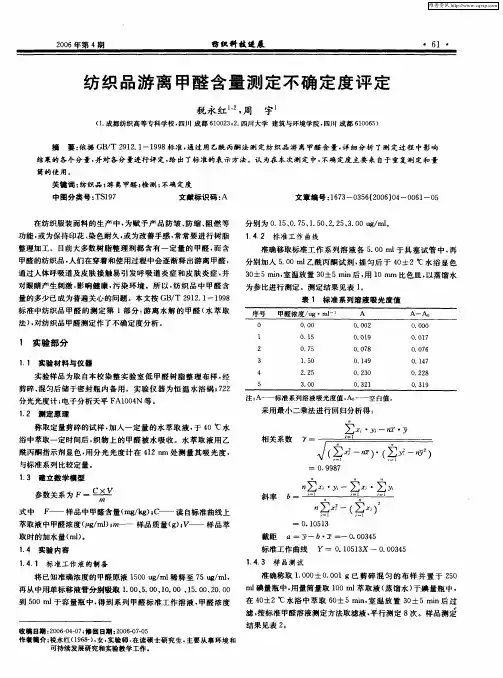
纺织品游离甲醛含量测定不确定度评定
税永红h ,周 宇
(1.成都纺织高等专科学校。四川成都610023;2.四川大学建筑与环境学院.四川成都610065)
摘要:依据GB/T 2912.1—1998标准,通过用乙酰丙酮法测定纺织品游离甲醛含量。详细分析了测定过程中影响
结果的各个分量,并对各分量进行评定,给出了标准的表示方法。认为在本次测定中,不确定度主要来自于重复测定和量
筒的使用。
关键词:纺织品;游离甲醛;检测;不确定度
中图分类号:TS197 文献标识码:A 文章编号:1673--0356{2006)04--0061--05
在纺织服装面料的生产中,为赋予产品防皱、防缩、阻燃等
功能・或为保持印花、染色耐久,或为改善手感,常常要进行树脂
整理加工。目前大多数树脂整理剂都含有一定量的甲醛。而含
甲醛的纺织品,人们在穿着和使用过程中会逐渐释出游离甲醛,
通过人体呼吸道及皮肤接触易引发呼吸道炎症和皮肤炎症,并
对眼睛产生刺激。影响健康,污染环境。所以,纺织品中甲醛含
量的多少已成为普遍关心的问题。本文按GB/T 2912.1—1998
标准中纺织品甲醛的测定第1部分:游离水解的甲醛(水萃取
法),对纺织品甲醛测定作了不确定度分析。
1实验部分
1.1实验材料与仪器
实验样品为取自本校染整实验室低甲醛树脂整理布样,经
剪碎、混匀后储于密封瓶内备用。实验仪器为恒温水浴锅;722
分光光度计;电子分析天平FA1004N等。
1.2测定原理
称取定量剪碎的试样,加入一定量的水萃取液,于4O℃水
浴中萃取一定时间后,织物上的甲醛被水吸收。水萃取液用乙
酰丙酮指示剂显色,用分光光度计在412 nln处测量其吸光度,
与标准系列比较定量。
1.3建立数学模型
参数关系为F:cx.:。y
式中 F——样品中甲醛含量(m4 ̄/kg);C 一读自标准曲线上
萃取液中甲醛浓度( ̄g/m1);m——样品质量(g); 一样品萃
Copyright © 2006 American Association of Textile Chemists and Colorists174TM 112-2003
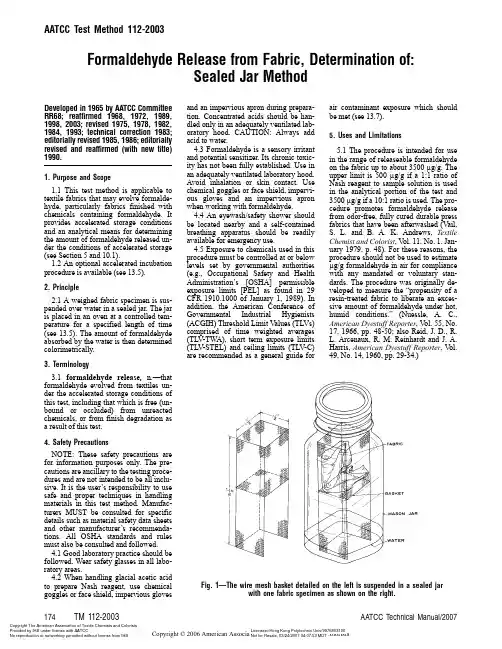
AATCC Technical Manual/2007Developed in 1965 by AATCC CommitteeRR68; reaffirmed 1968, 1972, 1989,1998, 2003; revised 1975, 1978, 1982,1984, 1993; technical correction 1983;editorially revised 1985, 1986; editoriallyrevised and reaffirmed (with new title)1990.1. Purpose and Scope1.1 This test method is applicable totextile fabrics that may evolve formalde-hyde, particularly fabrics finished withchemicals containing formaldehyde. Itprovides accelerated storage conditionsand an analytical means for determiningthe amount of formaldehyde released un-der the conditions of accelerated storage(see Section 5 and 10.1).1.2 An optional accelerated incubationprocedure is available (see 13.5).2. Principle2.1 A weighed fabric specimen is sus-pended over water in a sealed jar. The jaris placed in an oven at a controlled tem-perature for a specified length of time(see 13.5). The amount of formaldehydeabsorbed by the water is then determinedcolorimetrically.3. Terminology3.1 formaldehyde release, n.—thatformaldehyde evolved from textiles un-der the accelerated storage conditions ofthis test, including that which is free (un-bound or occluded) from unreactedchemicals, or from finish degradation asa result of this test.4. Safety PrecautionsNOTE: These safety precautions arefor information purposes only. The pre-cautions are ancillary to the testing proce-dures and are not intended to be all inclu-sive. It is the user’s responsibility to usesafe and proper techniques in handlingmaterials in this test method. Manufac-turers MUST be consulted for specificdetails such as material safety data sheetsand other manufacturer’s recommenda-tions. All OSHA standards and rulesmust also be consulted and followed.4.1 Good laboratory practice should befollowed. Wear safety glasses in all labo-ratory areas.4.2 When handling glacial acetic acidto prepare Nash reagent, use chemicalgoggles or face shield, impervious glovesand an impervious apron during prepara-tion. Concentrated acids should be han-dled only in an adequately ventilated lab-oratory hood. CAUTION: Always addacid to water.4.3 Formaldehyde is a sensory irritantand potential sensitizer. Its chronic toxic-ity has not been fully established. Use inan adequately ventilated laboratory hood.Avoid inhalation or skin contact. Usechemical goggles or face shield, impervi-ous gloves and an impervious apronwhen working with formaldehyde.4.4 An eyewash/safety shower shouldbe located nearby and a self-containedbreathing apparatus should be readilyavailable for emergency use.4.5 Exposure to chemicals used in thisprocedure must be controlled at or belowlevels set by governmental authorities(e.g., Occupational Safety and HealthAdministration’s [OSHA] permissibleexposure limits [PEL] as found in 29CFR 1910.1000 of January 1, 1989). Inaddition, the American Conference ofGovernmental Industrial Hygienists(ACGIH) Threshold Limit Values (TLVs)comprised of time weighted averages(TLV-TWA), short term exposure limits(TLV-STEL) and ceiling limits (TLV-C)are recommended as a general guide forair contaminant exposure which shouldbe met (see 13.7).5. Uses and Limitations5.1 The procedure is intended for usein the range of releaseable formaldehydeon the fabric up to about 3500 µg/g. Theupper limit is 500 µg/g if a 1:1 ratio ofNash reagent to sample solution is usedin the analytical portion of the test and3500 µg/g if a 10:1 ratio is used. The pro-cedure promotes formaldehyde releasefrom odor-free, fully cured durable pressfabrics that have been afterwashed (Vail,S. L. and B. A. K. Andrews, TextileChemist and Colorist, Vol. 11, No. 1, Jan-uary 1979, p. 48). For these reasons, theprocedure should not be used to estimateµg/g formaldehyde in air for compliancewith any mandated or voluntary stan-dards. The procedure was originally de-veloped to measure the “propensity of aresin-treated fabric to liberate an exces-sive amount of formaldehyde under hot,humid conditions.” (Nuessle, A. C.,American Dyestuff Reporter, Vol. 55, No.17, 1966, pp. 48-50; also Reid, J. D., R.L. Arcenaux, R. M. Reinhardt and J. A.Harris, American Dyestuff Reporter, Vol.49, No. 14, 1960, pp. 29-34.)AATCC Test Method 112-2003Formaldehyde Release from Fabric, Determination of:Sealed Jar Method