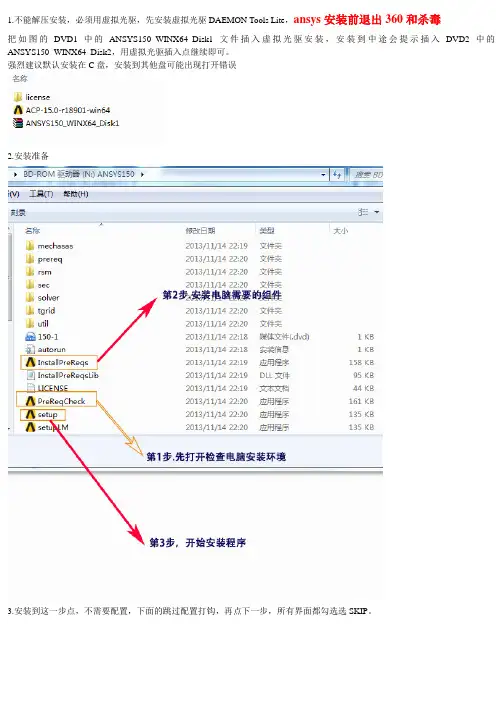
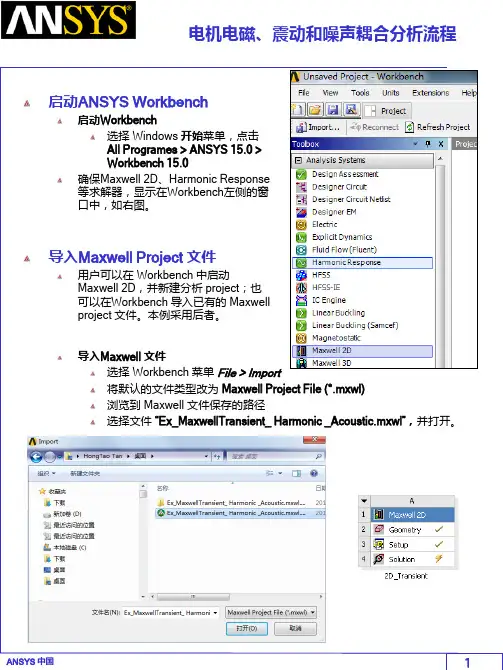
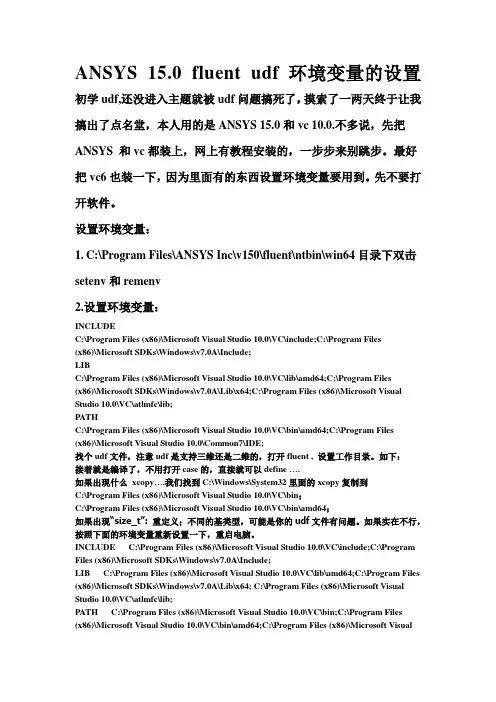
ANSYS 15.0 新功能介绍
- 格式:pdf
- 大小:1.79 MB
- 文档页数:55
ANSYS Release 15.0 Structural Mechanics HighlightsRichard Mitchell ANSYS UKAgendaAnalysis of Large and Complex ModelsMotivationMany users deal withalways larger models.Increased performanceand usability is requiredat each step of ananalysis in order toreduce the time fromgeometry to results.Submodeling for local refinementSubmodelingsaves time whenonly a portion ofthe modelmatters.Submodeling between shells and solids2D to 3D submodeling allows tocompute local detailed results that are not captured using a surface model.R15.0HPC and GPU•Linux workstation : Two Intel Xeon X5677processors (3.47 GHz, 8 cores total), 48 GB RAM, 2 NVIDIA Tesla C2075, Red Hat EL 6.12.1M DOF, Nonlinear Static AnalysisThe sparse solver now utilizemultiple GPUs to reduce solution timeHPC and Explicit DynamicsThe ParallelTrajectory Contact technology allows for fastercomputation of Explicit solutions.0.51.52.53.54.55.56.57.58.5024681012S p e e d -U p Number of coresR15.0HPC and Linear DynamicsA new proprietary Subspace Eigensolver accelerates the computation of normal modes on large models.R15.02.09 MDofs first 20 modesKeyboard shortcutsKeyboard Shortcuts are now supported in Mechanical forcommon actions such as: Select All Objects (Ctrl+ A),Body Filter Selection (Ctrl+B), Zoom to Fit (F7).R15.0Scoping entities to FE nodesAs with previous releases, R15 provides closer links to the finite element model as opposed to geometry only.Remote Forces, Remote Displacements, Joints,Springs, Beam Connections, Point Masses as well as paths can now be scoped directly to nodes.R15.0AssembliesMotivation for Mesh AssembliesGeometry is not the only starting point of a Workbench based structural simulation. Multiple finite element models can be assembled and leverage all Mechanicalfunctionalities, including contact detection.R15.0Mesh Assembly from CDB filesYou can now import mesh data (solids and shells) from CDB file into Workbench using the External Model system and also scale, rotate or translate parts.Contact detection will happen as if you are working with geometry data.R15.0Model AssemblyMultiple WB systems can also becombined. Geometry, Mesh andNamed Selections are retrieved.R15.0R15.0 MeshingMotivationWith R15.0, wehave pursued threemain goals forpreprocessing:increase theperformance,reduce memoryrequirements andimprove robustnessof algorithms.Performance increase SPAR To increase the user’s productivity, our meshing algorithms havebeen improved to reduce the meshing time as well as the memory requirements.R15.0Mesh Failure Handling Out of date mesh:When user changes mesh controls or updates geometry and mesh is out of date, the mesh is colored differently foreasier inspectionFailed mesh:When meshing fails, some meshis returned, but coloreddifferently for easier inspectionWhen meshing fails in surface meshing, valid surface mesh is returned. Edge coloring can indicate where problem is.Additional feedback is provided to the user in order to understand where failure occurred and which area is causing the failure.R15.0Hex meshing robustnessThe robustness of our automated hex meshing solutions has been improved for swept mesh along varying profiles as well as for complex geometries.R15.0Modeling 3D Composites ShapesThermal analysis of solid composites in MechanicalThermal analysis of composites is necessary to understand how thermal effects will affect the potential failure of composites products subjected to temperature changes such as fuselage parts.R15.0Advances in composites modelingProgressive damageProgressive damage techniques are required to understand the ultimate failure of a composites products.Such failure may happen because of successive plies failures or from delamination between plies.R15.0Customization for Structural MechanicsMotivationCompanies need toinclude best practicesin their simulationenvironment so as toprovide the ability touse and re-use expertknowledge, beyondstandard capabilities.ACT for Design Modeler –R15•Ability to create additional customized features in DM•New objects for specific geometry creation (pipes…)•«As native » integration•Build an API on top of Parasolid featuresACT-based propertiesCreation of one ACT-based object to encapsulate user-defined geometryR15.0ACT for DesignXplorer –R15Proprietary optimizer accessible in DX, as anadditional optimization methodSpecific settings of the proprietary optimizers presented as for any other standard DX methodR15.0Fracture MechanicsMotivationEngineers need to investigate theconsequences of cracks appearing in a productfrom themanufacturing process or from fatigue to avoid early failure of theproduct –possibly in an easy way.Material Cohesion FailureMaterial cohesionfailure can be definedin Mechanical usingcontact debonding orinterface elements tomodel for exampleadhesive failurebetween glued parts.R15.0Toward crack growth VCCT based Crackgrowth simulation isnow supported inMechanical to performdelamination basedcrack analysis.R&D is active on c rackgrowth simulation basedon XFEM and generalpurpose node releaseapproach.R15.0Importing External Data in Structural AnalysesMotivationExchange files arefrequently used totransfer quantities fromone simulation toanother.Efficient mapping ofpoint cloud data isrequired to account formisalignment, nonmatching units or scalingissues.Additional support for initial states Initial stresses (andstrains) can now beimported tointroduce residualstresses frommanufacturing orfrom a previoussimulation.R15.0Post-processingSummary table for resultsA table view of all theresults in the simulationtree is now available todisplay a text summary.This can be used to checkmultiple reaction forces atonce in a table rather thanbrowsing through eachsingle object.R15.0Post-processing Enhancements Contour plots can beaveraged across bodies in amulti-body part to displaycontinuous results when bodymaterials are the same.The visualization of resultsscoped to a body or face nowautomatically hide otherbodies are hidden (default)instead of translucent (noneed to hide parts in tree)Unaveraged Averaged R14.5R15.0R15.0Advances in Contact ModelingContact Technology Bolt Thread modeling without meshing the thread provides faster solutions while retaining a good level of accuracy.Thread characteristics are defined on thecontact region.True Thread Simulation Bolt Section Method10 times faster!R15.0my_secid = cidSECTYPE,my_secid,CONTACT,BOLT! SECDATA,Dm,P,ALPHA,N,X1,Y1,Z1,X2,Y2,Z2! where ! Dm = Mean pitch diameter, dm ! P = Pitch distance, p ! ALPHA = Half-thread angle, αVibroacousticsTechnology Enhancements Boundary Layerenhancements allows foraccurate modeling forsound flowing throughnarrow structures.Transfer Admittancematrix allows for simpleacoustic representationof complex structures eg.Perforated plates.R15.0Acoustics in MechanicalAn ACT Extension isavailable from theCustomer Portal thatexposes 3D acousticfeatures in Mechanicalwithout the need forAPDL, providing ease ofuse for acousticsanalyses.Frequency dependent propertiesFrequency dependentsupport for basicproperties (such asDensity, viscosity…),loads (impedance,velocity…) as well asperforated materialmodels are nowavailable.R15.0Uncoupled analyses Velocities from astructural harmonicanalysis may beimported on an acousticmesh to performacoustics analysis whenno strong coupling isrequired, allowing forfaster computation ofthe acoustics results.R15.0Material modelsCyclic behavior of metallic parts Accurately modeling thecyclic behavior of metallicparts for life predictionrequires to combinehardening/softening as wellas cyclic creep effects. R15implements a solution thatmixes implicit Creep withChaboche KinematicHardening.Curve fitting for thekinematic hardening is alsoavailable.R15.0Increased performance for thin SMA structuresShape Memory Alloy materials can beused for beamstructures, for fastermodeling andcomputation of thinmodels such asstents.Beam188Solid185Total Solution TimeBEAM188 : SOLID185=1:4R15.0Solver AdvancesNonlinear Adaptivity Some products in their operating conditions undergo severedeformation. Automatic mesh splitting andmorphing allow for local topology correction so that large deformations can effectively becomputed.R15.0。