
热能与动力工程专业英语第一_二_三 四_五_八章译文
- 格式:doc
- 大小:6.17 MB
- 文档页数:58

Chapter 1 Introduction to ThermalScience第一章热科学基础Acoustic flow meter 声波流量计Corrugated fin 波状散热片Adiabatic[]绝热的Cross product 矢量积Aerodynamics 空气动力学Denominator 分母Affiliation 联系Developed flow 充分发展流Airfoil 机翼,螺旋桨Diffusion 扩散Alternative 替代燃料Doppler effect 多普勒效应Anemometer 风速计Double-pipe heat exchanger 套管式换热器Angular speed 角速度Dry saturated vapor 干饱和蒸汽Area density 表面密度Electrode 电极Baffle 挡板Electrolyte 电解,电解液Bifurcation 分形Electrostatic 静电的Blackbody 黑体Emissivity 发射率Blade 浆叶,叶片Equilibrium 平衡Boiler 锅炉Fluid mechanics 流体力学Boundary layer 边界层Forced convection 强制对流Carnot Cycle 卡诺循环Free convection 自然对流Cartesian coordinates 笛卡尔坐标系Friction loss 摩擦损失Celsius Degree 摄氏度Glass ceramic 微晶玻璃,玻璃陶瓷Compact heat exchanger 紧凑式换热器Heat engine 热机Composition 成分,合成物Heat pump 热泵Compressed liquid 压缩液体Hydrofoil 水翼Compressibility 可压缩性,压缩率Hypersonic speed 高超音速Condensation 凝结Infinitesimal 无穷小的Condenser 冷凝器Inflating/deflating 充气/压缩Conduction 导热Internal combustion engine 内燃机Control volume 控制体Isentropic 等熵的Convection 对流Isobaric 等压的Isolated system 孤立体系的Coriolis-accelaration flowmeter 科氏加速流量计Isometric 等容的Rough-wall tube 粗糙管Isothermal 等温的Saturation 饱和Kinematic viscosity 运动黏度Shear stress 剪切力、切应力Laminar 层流Shell-and-tube heat exchanger管壳式换热器Manuscript 手稿,原稿Specific volume 比容Moisture 湿度,水分Steady 稳态的,定常的Molecule (化学)分子Stifling engine 斯特林机Molten polymer 熔融聚合物Strain rate 变形速度,应变率Muti-disciplinary 多学科的Streamline 流线Newtonian Fluid 牛顿流体Strut 支撑,支柱Subcooled liquid过冷液体Nominal temperature gradient 法向温度梯度Numerator (数学)分子Superheated vapor 过热蒸汽Parallel flow 平行流动,并流Surrounding 环境,外界Pathline迹线Thermal conductivity 热传导率Phase change 相变Thermal efficiency 热效率Plane flow 平面流,二元流Thermodynamics 热力学Plate and flame heat exchangerTorsional 扭力的,扭转的板式换热器Polymer solution 胶浆Trailing edge 机翼后缘、尾缘Proof 校样Transmitter 传送装置、发送器Propeller 螺旋桨,推进器Turbine meter 涡轮流量计Pump泵Turbulent 湍流的Qulity 干度Ultrosonic 超声波的Qusi-equilibrium 准平衡、准静态Uniform flow 均匀刘Radiation 辐射Vacuum 真空Rankin Cycle 朗肯循环View factor 角系数Viscous 黏性的Regenerative heat exchanger蓄热/再生式换热器Reservoir 水库,蓄水池Cortex shedding 漩涡脱落Reversible 可逆的Water faucet 水龙头,水嘴Rotameter 转子流量计Bi Biot number 比澳数NPSH 汽蚀余量CFD 计算流体力学NTU 传热单元数CHF 临界热流量Nu 努谢尔特数COP 制冷系数PE 势能Eu 欧拉数Pr 普朗特数Fo 富立叶数Ra 瑞利数Fr 弗劳德数Re 雷诺数Gr 格拉晓夫数Sc 施密特数KE 动能St 斯坦顿数,斯特劳哈数LMTD对数平均温差We 韦伯数1.1Fundamental of Engineering Thermodynamics1.1工程热力学基础Thermodynamics is a science in which the storage, transformation and transfer of energy are studied. Energy is stored as internal energy (associated with temperature), kinetic energy (du to motion), potential energy (due to elevation) and chemical energy (due to chemical composition); it is transformed from one of these forms to another; and it is transferred across a boundary as either heat or work.热力学是一门研究能量储存、转换及传递的科学。

2.5Natural Convection 自然对流Heat transfer involving motion in a fluid caused by the difference in density and the action ofgravity is called natural or free convection. Heat transfer coefficients for natural convection are generally much lower than for forced convection, and it is therefore important not to ignore radiationin calculating the total heat loss or gain. Radiant transfer may be of the same order of magnitude as natural convection, even at room temperatures, since wall temperatures in a room can affect human comfort. 由于密度差和重力作用引起流体运动而产生的热传递称为自然对流或自由对流。
自然对流的传热系数一般远低于强迫对流,因此在计算总的吸热量或放热量时,主要的一点就是不要忽略辐射热。
辐射热传递与自然对流可以有相同的数量级,甚至在室温下也如此,因为室内墙体温度影响人体的舒适感。
Natural convection is important in a variety of heating and refrigeration equipment: (1) gravitycoils used in high humidity cold storage rooms and in roof-mounted refrigerant condensers, (2) the evaporator and condenser of household refrigerators, (3) baseboard radiators and convectors for space heating and (4) cooling panels for air conditioning. Natural convection is also involved in heat loss or gain to equipment casings and interconnecting ducts and pipes. 在各种供热和制冷设备中自然对流是非常重要的:(1)在高湿度冷藏室内及室内安装的制冷剂冷凝器内使用的重力盘管;(2)家用冰箱的蒸发器和冷凝器;(3)空间采暖用的踢脚板散热器和对流器;(4)空调用辐射对流护壁板。

热能与动力工程专业英语翻译5.1
5.1 Boiler and Its Development
5.1
leaving the furnace ,the gases pass through a superheater in which steam receives heat from the gases and has its temperature risen above the saturation
℃.
538℃左右。
20世纪50年代普遍使用煤粉炉,设备尺寸已经有大量增加。
,结果会失去标准的可靠性。
1)由于设计和制造的发展,汽包内部部件将改变,以提高蒸汽/水的分离,并允许汽包组件之间交换的。
2)改变过热器和再热器的管道厚度和材料,增加设计寿命和提高抗腐蚀性。
)炉膛内部的变化,将提供更好的传热特性和简单结构规程。
have been subjected to 100% ultrasonic examination to comply with more stringent specification requirements and case histories have been
4)锅炉管已受到100%超声波检查,以符合更严格的规范要求和实例,已准备所有相关的压力部件。
5)许多发电厂的运作经验表明,,送风机和引风机的发动机速度为2时是最有利的,因为潜在的彻底改变,往往总在高速模式下运行。
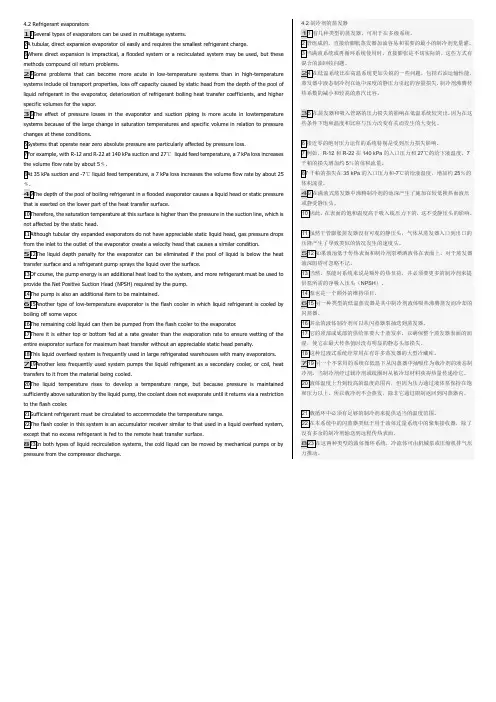
4.2 Refriger ant evaporators11Several ty pes of evapor ators c an be used in multistage systems.2A tubular, dir ect expansion evapor ator oil easily and requires the smallest refrigerant charge.3Where dir ect expansion is impr actical, a flooded system or a recirculated system may be used, but these methods c ompound oil r eturn pr oblems.24Some problems that can bec ome mor e acute in low-temper ature systems than in high-temperatur e sy stems include oil transport pr operties, loss off c apacity caused by static head from the depth of the pool of liquid r efrigerant in the evaporator, deterioration of refriger ant boiling heat tr ansfer c oeff icients, and higher specif ic volumes for the vapor.35The effect of pressure losses in the evapor ator and suc tion piping is mor e acute in lowtemperatur e sy stems because of the lar ge change in satur ation temperatures and specif ic volume in relation to pr essur e changes at these c onditions.6Sy stems that oper ate near zero absolute pressure are particularly affected by pressur e loss.7F or example, with R-12 and R-22 at 140 kPa suction and 27℃liquid feed temper ature, a 7 kPa loss incr eases the volume flow r ate by about 5﹪.8A t 35 kPa suction and -7℃ liquid feed temperature, a 7 kPa loss increases the volume flow rate by about 25﹪.49The depth of the pool of boiling r efrigerant in a flooded evaporator causes a liquid head or static pressur e that is exerted on the lower part of the heat transfer surfac e.10Therefore, the saturation temperatur e at this sur face is hi gher than the pr essure in the suction line, which is not affected by the static head.11A lthough tubular dr y expanded evaporators do not have appreciable static liquid head, gas pressur e dr ops from the inlet to the outlet of the evaporator create a velocity head that c auses a similar condition.512The liquid depth penalty for the evaporator can be eliminated if the pool of liquid is below the heat transfer surface and a r efrigerant pump spr ays the liquid over the surface.13Of course, the pump energy is an additional heat load to the system, and more refrigerant must be used to prov ide the Net Positive Suction Head (NPSH) requir ed by the pump.14The pump is also an additional item to be maintained.615Another type of low-temperatur e evaporator is the flash cooler in w hic h liquid refrigerant is cooled by boiling off some vapor.16The r emaining cold liquid c an then be pumped from the flash c ooler to the evaporator.17There it is either top or bottom fed at a r ate greater than the evapor ation rate to ensure wetting of the entire evaporator surface for maximum heat tr ansfer without an appreciable static head penalty.18This liquid over feed system is fr equently used in large refrigerated war ehouses with many evapor ators. 719Another less frequently used system pumps the liquid r efrigerant as a secondar y cooler, or coil, heat transfers to it from the material being cooled.20The liquid temperature rises to develop a temper ature r ange, but bec ause pr essur e is maintained suff iciently above satur ation by the liquid pump, the coolant does not evapor ate until it returns via a restriction to the flash cooler.21Suff icient refriger ant must be circ ulated to acc ommodate the temperatur e range.22The flash c ooler in this sy stem is an acc umulator r eceiver similar to that used in a liquid overfeed system, except that no excess r efrigerant is fed to the remote heat transfer surfac e.823In both types of liquid r ecirculation systems, the cold liquid can be moved by mec hanic al pumps or by pressure from the compr essor dischar ge. 4.2制冷剂的蒸发器11有几种类型的蒸发器,可用于在多级系统。