
小学三年级英语方位介词的用法微
- 格式:pptx
- 大小:1.28 MB
- 文档页数:7

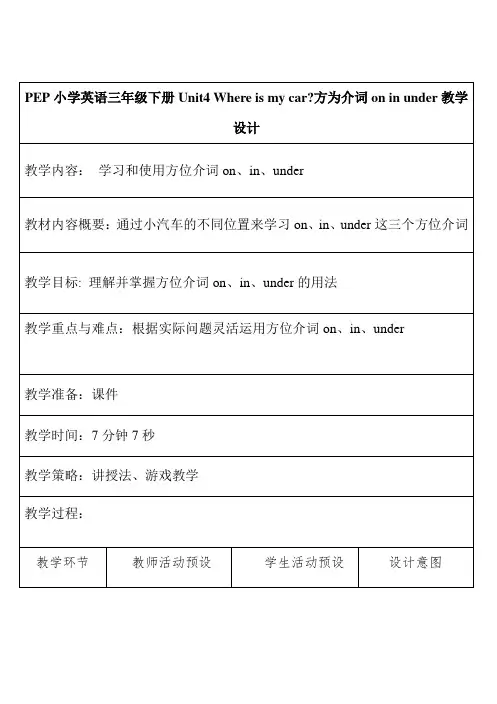

介词⽅位介词时间介词⽅式介词常⻅的介词短语 1. on,over 和above 的⽤法都有“在....上⾯”的意思1)on 表示两个物体的表⾯互相接触 2)over 表示“在....的正上⽅”,两个物体表⾯没有接触 3)above 表示⼀个物体在另⼀个的上⽅,但不⼀定是在正上⽅,两个物体之间没有接触 2. under 和below 的⽤法都有“在....下⾯”的意思1)under 表示“在....的正下⽅” 2)below 表示“在....的下⾯”,但不强调是否在正下⽅3. in 的⽤法表示“在...⾥⾯”,也可以⽤来表示在⼀个很⼤的空间内T here are some books in the box.4. at ,about 和around 的⽤法1)at 表示“在...旁边”,在某物旁边 2)about 和around 两个词都表示“在...周围”,“围绕....” 5. behind 的⽤法表示“在...的后⾯”Y ang Ling sits behind me.7. between 和among1)between 表示“在两者之间”2)among 表示“在三者或三者以上之间”8. beside 和near 的⽤法1)beside 表示“在...旁边” 2)near 表示“在...附近(范围⽐较⼴”) 6. in front of 的⽤法表示“在....的前⾯”,与behind 意思刚好相反 There is a tree in front of the house.=There is a house behind the tress.1. in ,on 和at 的⽤法 1)in 通常⽤在⽐较⼤的时间之前,如年、⽉、季节等,也可⽤在泛指上午、下午、晚上之前;T hey like making snowmen in winter. 2)on ⽤在具体的某⼀天或某天的上午、下午、晚上之前;M y birthday is on the second of October.T hey went there on the morning of March 26.3)at ⽤于某⼀时刻或某⼀时间点之前。

小学英语常用介词用法在学习英语的过程中,掌握介词的正确用法是非常重要的。
介词是连接词与词之间关系的一种词类,它能够表示时间、地点、方式、原因等等。
在小学英语中,常用的介词有很多,下面将为大家介绍一些常用的介词及其用法。
1. in介词"in"用于表示在某个范围内或在某个具体的位置上。
例如:- I live in a house.- There is a book in the bag.2. on介词"on"用于表示在某个表面上。
例如:- The cup is on the table.- The picture is on the wall.3. at介词"at"用于表示在某个点、位置或地方。
例如:- He is waiting at the bus stop.- We will meet at the park.4. by介词"by"用于表示通过某种方式或手段。
例如:- I go to school by bus.- They communicate by email.5. for介词"for"用于表示目的、原因或表示给予的对象。
例如:- This gift is for you.- I study hard for good grades.6. with介词"with"用于表示陪伴或伴随的状态。
例如:- She went to the park with her friends.- He plays basketball with his brother.7. to介词"to"用于表示目的、方向、接触等。
例如:- I go to school every day.- She gives a present to her teacher.8. from介词"from"用于表示出发地、来源或起点。

小学英语方位介词1、in:在......里面(内部)例:She is in the classroom. 她在教室里。
2、on:在。
上面(表面上)例:There is a picture on the wall. 墙上有一幅画。
3、under:在。
下面。
与它相反的是over(在......上方)。
例:There is a little dog under the tree. 树下有一只小狗。
4、behind:在。
后面例:Is there a student behind the door?门后有一个学生吗?5、between:在。
中间。
(表达在两者中间,后面的名词要用复数形式)例:There is a small house between the hills. 在两座山中间有一个小房子。
6、beside:在。
旁边,相当于next to和by。
near意为“在。
附近”。
例:Don't sit beside me. = Don't sit by me. = Don't sit next to me. 不要坐在我旁边。
7、in front of:在。
前面(不包含)例:There is a tall boy in front of me.在我前面有一个个子高高的男孩。
8、in the front of:在。
前面(包含关系)例1:The blackboard is in the front of the classroom.黑板在教室的前面。
(黑板在教室内部,是包含关系)例2:There is a beautiful garden in front of the kitchen.有一个漂亮的花园在厨房的前面。
(花园和厨房是互不包含的,不加the)9、on the left:在左边;on the right:在右边;in the middle of:在。
中间例1:There is a book on your left.在你左边有一本书。