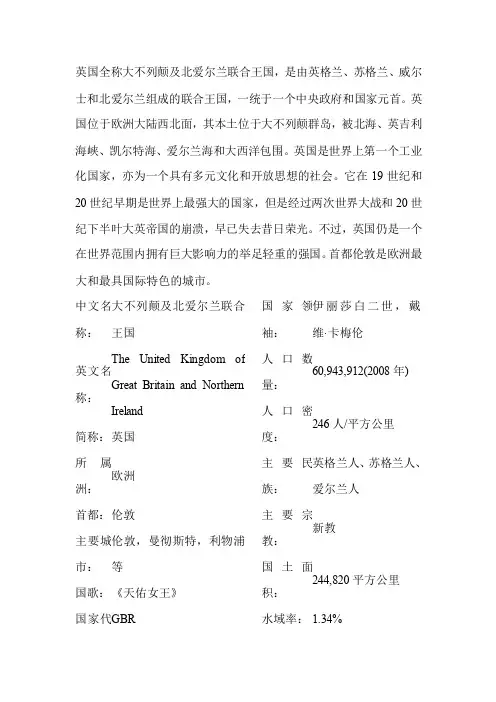
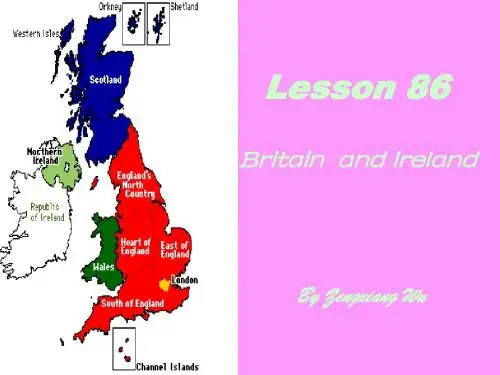
Britain and Ireland
- 格式:ppt
- 大小:1.45 MB
- 文档页数:25
Unit 22. Britain and IrelandI.单项选择1. The party was about _____ when the light ______.A. beginning; went badB. beginning ; went overC. to begin; went outD. to begin; went away2. "Are you ____"? NO, I am notA. EnglishB. an EnglishC.. a EnglishD. the English3. Although many families became separated, people still ____ each other.A. keep in tough with ?B. kept in touch withC. get in touch withD. got in touch with4. The two girls are forced to play the piano ,. In fact neither of them _____ playing itA. liked B, like C. likes D. liking5. Do you think Dr Baker is going to attend the conference held in London? _____A. I don't think itB. I don't thinkC. I think not soD. I think not6. Japan lies _____ the east of China ___ the east of Asia. It faces the Pacific ___ the east.A. in, on toB. to, in, onC. on, to, onD. to, on, to7. ______ of the students ____ able to work out this problemA. Neither , areB. Both, isC. Neither , isD. All , is8.It was so cold that we had the fire ____ in the room all night longA. burnB. to burnC. burntD. burning9. There are 700 students in our school, 45% _____ are girls.A. of whichB. of whomC. of themD. in them700 students in our school and 45%of them are girls.10. This is the man ____I talked just nowA. who I talkedB. to whom I talkedC. whom I toldD. who spoke me11. Mr Green is famous ____ a good singer , he is famous ____English folk songs.A. for, toB. to, forC. for, asD. as , for12. "Margaret did well in her family's party last night. "Yes, all her family ____ music and poemsA. likesB. will enjoyC. were fond ofD. are fond of13. The area was badly ____ by the great stormA. hitB. hurtC. woundedD. beaten14. David comes from ____ , so he must be ____.A. Scottish , ScotlandB. Scotland, ScotsC. Scotland. ScottishD. Scots, Scotland15. They went to Alaska to look for ___ lifeA. betterB. goodC. a better C. a good life16. The matter ____ worse . What should he do?A. has goneB. has madeC. droveD. did17. ____ of the town is a large hospitalA. The northB. In north ?C to north D. North18. There was a ____ look on her face so he got _____.A. puzzled, puzzledB. puzzling , puzzlingC. puzzled, puzzledD. puzzling, puzzled19. There _____ an old temple on the hill, Cab you see it?A. liesB. lyingC. standsD. lives20. The stone ____ him on the headA. struckB. hitC. hurtD. beatII.完形填空:Lane was a successful spy. One day he was __21___ to wait on the bench nearest the bridge. The wind blew straight _22___ the river. It was very sharp . He _23____ pull his coat closer about him so that he could __24___ the cold.While waiting, he __25___ his instructions in his mind. The man he was waiting for would ___26__ at four o'clock . He would talk to Lane for a while, and then he would get up, _27____ his newspaper behind. Their plans would ___28__ inside.A distant clock began to __29___ the hour. As if from nowhere , a man appeared and _30____ beside Lane , placing his __31___ on the seat between them. He was thin and middle -aged , and __32___ in need of a good meal.A few minutes later he got up and __33___ on his way. Lane picked up the paper which lay on __34___ , as if he wanted to look at _35___ . When he opened the paper, he was _36___ to see the plans, _37____ on the center page. At that moment, a gust of (一阵) strong wind lifted the newspaper into __38___, like a kite , and __39___ it into the river. As a result, he knew _40____ about the plan.21. A. invited B. sent C. permitted D. warned22. A. through B. over C. on D. across23. A. had to B.. should C. would D. might24. A. keep away B. keep back C. keep out D. keep from25. A. received B. put C. remembered D. went over26. A. appear B. reach C. go D. start27. A. putting B. leaving C. forgetting D. remaining28. A. put B. be laid C. hide D. be tied29. A. hit B. beat C. strike D. knock30. A. sat down B. arrived C. lay D. arrived31. A. caps B. newspaper C. bag D. clothes32. A. seemed B. wanted C. had D. took33. A. came B. moved C. went D. the bench34. A his knees B. the ground C. his bag D. the bench35. A. the news B. the plans C. pictures D. stories36. A. surprised B. excited C. sad D. disappointed37. A. written B. printed C. put D stuck38. A. a tree B. a river C. the air D. the bridge39. A. blew B. sent C. raised D. took40. A. something B. anything C. everything D. nothingIII.阅读理解:AMost words in everyday use have several meanings. Usually , there is some connection between the meanings so that you can see how one grew out of another. Occasionally, there is a meaning which is not connected with the others, even completely different from the others.Knowing these facts about words, you do not expect a word to have the same meaning in very sentence . But in some expressions and phrase. none of the usual meanings seems to fit. Thephrase has a special meaning of it's own. Phrases of this sort are called idioms. Y ou cannot get the meaning of a phrase by adding together the meanings of each of the words within it.41. Which of the statements is true according to the passage?A. Most words grow out of other words.B. Few words are completely different in meaningC. there are several words which have different meaningsD. the different meanings of a word have some connection42.We don't expect a word to have the same meaning in very sentence because _______.A. sometimes a word might have a meaning completely different from the otherB. it is necessary for the same word to have different meanings in different sentencesC. the same word may have different meanings in different sentencesD. every sentence has a special meaning of it's own.43. In an idiom, ______.A. a word has the same meaning as it does in a sentenceB. the meaning of a word seem unfitC. the usual meanings of a word seem unfitD. the meaning of a word is closely connected with the others44. Add together the meanings of all the words within an idiom, and you will _______.A. be in a puzzle about its meaningB. be able to make a new phrase of your ownC. be able to grasp its meaningD. get a bridge to the understanding of the idiom45. In the writer's judgment , which of the following is an idiom?A. Put on in "put on your coatB. Put back in "put the book back on the shelf."C. Put across in "What point is he trying to put across?"D. Put together in "He thought he knew more than all the teachers put together."BRats have lived on the earth longer than man. And wherever man has gone, except for the very coldest parts of the world, rats have also gone and have very quickly grown in numbers.History books tell us that armies of rats moved into Europe from Asia hundreds of years ago. On their way, these armies of rats swam rivers raced across open fields, destroyed crops, and moved through buildings, scaring and frightening people.It didn't take rats long to discover that there was a better way of traveling than on foot. they found ships just to their liking. These unlisted passengers had no trouble adjusting to sea life on any kind of ship.In no time, they were exploring below decks and making holes in sacks and boxes filled with good things to eat. then as now they were no friends of sailors. Along the wharves of the seaports all over the world you can hear tales about rats. Some of these stories , such as those about rats being the first to leaving the sinking ship, are probably true. This is because more rats live below decks in the very bottom of a shop ,so they are the first to get wet if the ship develops a leak. No wonder they run!Though people have lived with rats all through history, they have said very little good about rats. Rats eat crops , damage property and even cause deaths by carrying disease from one place to another.Y et, it is no easy job destroying rats. Rats defend their homes with great courage. Even a cat will think twice about fighting a large rat. And they are smart enough to live under all sorts of conditions. Now there are more rats living on the earth than there are people. it is thought thatthere are more than five billion rats alive today.46. The writer tells the reader in the first paragraph that _____.A. rats like to live with manB. rats have followed man into all parts of the worldC. rats and man appeared on the earth at the same timeD. rats move in with man at every chance47. The sentence "These unlisted passengers had no trouble adjusting to sea life on any kind of ship. "means _______.A. rats soon learned how to live on shipsB. rats enjoyed life on the ship and they never suffered from seasicknessC. rats adapted themselves to sea life better than passengers on the shipD. rats lived better on sea than on land48. If a ship is singing, rats are the first to leave because ______.A. when in danger, rats act more quickly than manB. living in the bottom of the ship, rats are the first to feel water coming into the shipC. rats are very sensitive to what is happening around themD. rats can predict (预测) dangers49. After reading the fifth paragraph , we can conclude all the following except _____.A. man has every reason to dislike ratsB. man can do nothing about rats and has to put up with themC. there seems nothing good about ratsD. it is doubtful that man and rats will ever be friends50. Rats are hard to destroy mainly because _____.A. they are more careful than catsB. their homes are well builtC. they are intelligent and can adapt to almost any circumstance ( 环境)D. they move from place to place very quicklyCWe usually think of a talk in terms of spoken language. But in fact we often talk with others nonverbably (非词语的) , although we may do it unconsciously. For example, sometimes we gesture (表示意见) with our eyebrows or hands or even with the motion of our body. These actions often seem casual (随便的) . But researchers have discovered in recent years that these actions follow a certain system. They are as consistent (一致的)and comprehensive as verbal language. This is what we call body language.Different people use different body languages. Ours is quite different from other peoples' When a Chinese feels disappointed or doubtful, he will probably shake his head while an American will be likely to shrug his shoulders. During a talk, a polite listener in England will look at the speaker attentively and blink his eyes occasionally to show his interest, but to blink eyes means nothing to Americans, who expect their listener to nod or murmur something. In some African countries , when people become interested in what you are talking about, they will move their fists to and for slightly. But to us Chinese , we will tend to think that he's ready for fighting.Now we are learning a certain foreign language, but we should also learn some body languages so as to avoid unnecessary misunderstanding.51. From this passage we know the writer is likely to be ____.A. an AmericanB. a ChineseC. an EnglishmanD. an Egyptian52. Which of the following is not true?A. Both spoken language and body language can be used for a talkB. Different body languages are used by different peopleC. to blink eyes means nothing to Americans.D. Body language is probably a certain language that is made of body53. Why does a listener in England , during a talk , blink his eyes from time to time?A. because he wants to show that he himself is interested in the talkB. Because there is something wrong with his eyesC. Because the listener is sleepyD. Because the listener is making faces to make the other listeners laugh.54. In order to show his interest, a listener in the U.S.A will _____.A. shrug his shouldersB. blink his eyesC. nod or murmur somethingD. move his fists to and for slightly55. The main point of this passage is ____.A. how body language comes into beingB. what is body languageC. body languageD. spoken languageIV.单词拼写:56.Do you know how many people die of h ______ in the old days? hunger57. There are many c ______ around the city of London. churches58. The p _______ of China is larger than that of India. population59. The mainland and Taiwan are s _____ by the sea. separated60. It is very hot in Hubei in summer , e_____ in Wuhan. especially61. What’s the c ______ of China? capital62. G ______ it is warmer in the south than in the north in winter. Generally63. I was p ______ what I saw what she had done. puzzled64. M _______ are covered with beautiful flowers in spring. Mountains65. The people living in the north of China live a s ____ life. simpleV. 短文改错Cats are animal of habit. They like to go to 66. __________sleep about same time every day and for a certain 67. _________length of time. They seem to have a nature clock 68. _________inside them that tell them when to sleep, 69. __________Besides its regular sleep, cats take naps (午睡) . 70. __________Some scientists think that people should also taking cat 71. __________naps. The habit would do good for people's health. 72. __________Cat naps help to build up energy on the body. Since 73. __________cats have moods (情绪) like those of people, scientists 74. _________believe that people can be improve their moods by 75. __________cat-napping. People might become happier and more active.VI.书面表达遗失启示:高三2班李维,不慎于本月10日下午在学校阅览室丢失书包一个;内有三本英语书和一本旧字典。