
Do-you-like-bananas新目标
- 格式:ppt
- 大小:525.50 KB
- 文档页数:18
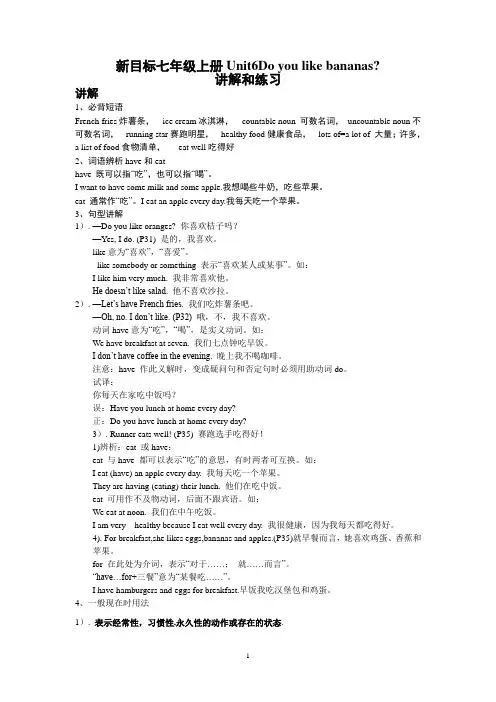
新目标七年级上册Unit6Do you like bananas?讲解和练习讲解1、必背短语French fries炸薯条,ice cream冰淇淋,countable noun 可数名词,uncountable noun不可数名词,running star赛跑明星,healthy food健康食品,lots of=a lot of 大量;许多,a list of food食物清单,eat well吃得好2、词语辨析have和eathave 既可以指“吃”,也可以指“喝”。
I want to have some milk and some apple.我想喝些牛奶,吃些苹果。
eat 通常作“吃”。
I eat an apple every day.我每天吃一个苹果。
3、句型讲解1). —Do you like oranges? 你喜欢桔子吗?—Yes, I do. (P31) 是的,我喜欢。
like意为“喜欢”,“喜爱”。
like somebody or something 表示“喜欢某人或某事”。
如:I like him very much. 我非常喜欢他。
He doesn’t like salad. 他不喜欢沙拉。
2). —Let’s have French fries. 我们吃炸薯条吧。
—Oh, no. I don’t like. (P32) 哦,不,我不喜欢。
动词have意为“吃”,“喝”,是实义动词。
如:We have breakfast at seven. 我们七点钟吃早饭。
I don’t have coffee in the evening. 晚上我不喝咖啡。
注意:have 作此义解时,变成疑问句和否定句时必须用助动词do。
试译:你每天在家吃中饭吗?误:Have you lunch at home every day?正:Do you have lunch at home every day?3). Runner eats well! (P35) 赛跑选手吃得好!1)辨析:eat 或have:eat 与have 都可以表示“吃”的意思,有时两者可互换。
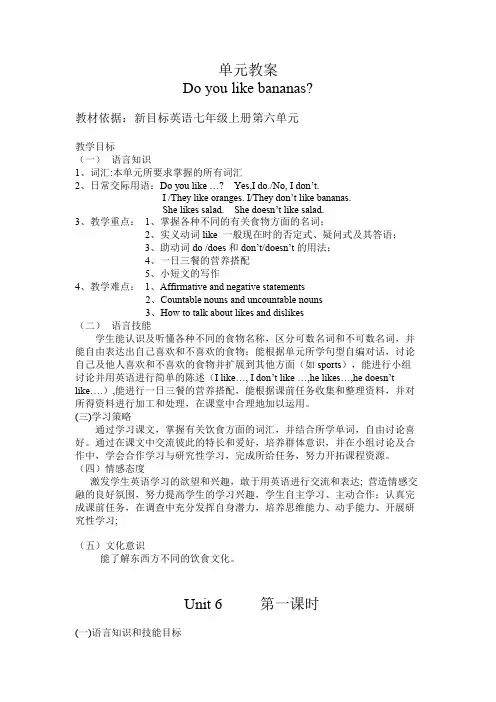
单元教案Do you like bananas?教材依据:新目标英语七年级上册第六单元教学目标(一)语言知识1、词汇:本单元所要求掌握的所有词汇2、日常交际用语:Do you like …? Yes,I do./No, I don’t.I /They like oranges. I/They don’t like bananas.She likes salad. She doesn’t like salad.3、教学重点:1、掌握各种不同的有关食物方面的名词;2、实义动词like 一般现在时的否定式、疑问式及其答语;3、助动词do /does和don’t/doesn’t的用法;4、一日三餐的营养搭配5、小短文的写作4、教学难点:1、Affirmative and negative statements2、Countable nouns and uncountable nouns3、How to talk about likes and dislikes(二)语言技能学生能认识及听懂各种不同的食物名称,区分可数名词和不可数名词,并能自由表达出自己喜欢和不喜欢的食物;能根据单元所学句型自编对话,讨论自己及他人喜欢和不喜欢的食物并扩展到其他方面(如sports),能进行小组讨论并用英语进行简单的陈述(I like…, I don’t like …,he likes…,he doesn’t like….),能进行一日三餐的营养搭配,能根据课前任务收集和整理资料,并对所得资料进行加工和处理,在课堂中合理地加以运用。
(三)学习策略通过学习课文,掌握有关饮食方面的词汇,并结合所学单词,自由讨论喜好。
通过在课文中交流彼此的特长和爱好,培养群体意识,并在小组讨论及合作中,学会合作学习与研究性学习,完成所给任务,努力开拓课程资源。
(四)情感态度激发学生英语学习的欲望和兴趣,敢于用英语进行交流和表达; 营造情感交融的良好氛围,努力提高学生的学习兴趣,学生自主学习、主动合作;认真完成课前任务,在调查中充分发挥自身潜力,培养思维能力、动手能力、开展研究性学习;(五)文化意识能了解东西方不同的饮食文化。
U n i t-6-D o-y o u-l i k e-b a n a n a s-S ec t i o n B-(2a-2c)-教学设计(总7页)-本页仅作为预览文档封面,使用时请删除本页-Unit 6 Do you like bananas?Section B (2a-2c)Part 1 Teaching materialsThis teaching material is the second period of Section B in Unit6 Do you like bananas, including 2a,2b and 2c.This period is a reading part, mainly focusing on developing students’ reading skills, their ability of judging healthy or unhealthy food so as to adjust their own eating habits andcultivating their text awareness .In this period, it presents several expressions about eating habits, which is a good foundation of next writing class; 2a is a short pre-reading activity about judging healthy and unhealthy food, which is aimed at developing students' awareness of keeping a healthy eating habit and prepare for the next part about eating habits; the goal of 2b (a reading material selected from a magazine which is an interview about a sports star’s e ating habit) is to cultivate students' text awareness and their ability of expressing themselves and communicating with each other; the goal of 2c is to help students to adjust their own eating habits by learning the material and know more about healthy and unhealthy food after class.Teaching objectives1. Knowledge objectives:Key words & phrases:After this lesson, students should be able to say, read and write these words: star, well, habit, healthy, really, question, want, be, and fat Expressions: -----What do you like for breakfast/lunch/dinner?-----I like..../I don’t like..../He likes.../He doesn’t like...2.Ability objectives :students’speaking abilitystudents’listening ability3. Enable students to master the target language3. Emotional objectives:(1). Encourage students’ to keep a balanced diet(2). Let students learn to cooperate and enjoy learning English4. Strategies objectives:Use the listening and speaking skills to help students to cultivate their information-collecting skills and their text awareness.5. Cultural awareness:Understand the different expressions of foods, likes and dislikes between China and foreign countries and the different eating habits between China and foreign country.Teaching important points(1). Learn these words and be able to say, read and write these words:star, well, habit, healthy, really, question, want, be, and fat(2). Be able to talk about and write about one’s eating habits by using-----What do you like for breakfast/ lunch / dinner?-----I like..../I don’t like.../He likes.../He doesn’t like... /She likes.../She doesn’t like...Do you like hamburgers for dinnerThey’re not healthy./ I don’t want to be fat./ Cindy likes healthy food.Teaching difficult points: To help students to master the target language.Be able to understand the difficult sentences like:Which food do you think is healthy?David asks the volleyball star, Cindy Smith, about her eating habits.Part 2 Analysis of StudentsStudents in 7th grade are so active and energetic that they are willing to participate in classroom activities. Before this lesson, the students have learned the expressions of foods and likes and dislikes. And the topic of this part (2a-2c) is about eating habits which students are very interested in. However, students are not so good at judging healthy and unhealthy eating habits. Thus, the teacher should help students to master the key words and phrases, cultivate their awareness of keeping a healthy eating habit through activities, encourage them to search for more information about healthy and unhealthy food to adjust their own habit and prepare for the next class.Part 3 Teaching methods(1). Situational teaching method(2). Task-based teaching method(3). Communicative and cooperative teaching methodsPart 4 Teaching aidsMultimedia, chart, blackboard, projector and chalksPart 5 Teaching proceduresI will design the following steps to organize the teaching.Step1.Warming up and leading in(1). Show some pictures about food, vegetables and fruit. review the words about food.(2). Use the following sentences to talk about your favorite food.What do you like for your breakfast / lunch / dinnerDo you eat healthy foodFor breakfast / lunch / dinner, I like….I like … for breakfast / lunch / dinner.Step2.Brainstorm. Talk about healthy food and unhealthy food. Ask students to think as many words as possible. What kind of food do you think are healthy or unhealthy?healthy food :fruit,vegetables, salad , eggs ,milk…unhealthy food :hamburgers ,ice-cream,French fries , coffee,cola ,sweets, snack ,chocolate ,milk tea , fried chickenWork on 1a.food do you think is healthyCheck (√) Yes, Maybe or No.3.Step 3 While-reading activities (读中活动)T: Today I’ll introduce a new friend to you. Look, this is Cindy Smith. She is a volleyball star. Do you want to know more about her If so, follow me.Task 1 PredictLook at the picture and the title to predict :1. What’s the article about What does the title mean2. Read the passage fast and silently to find the general idea.The main idea of the magazine article is about _________.A. sports starB. Cindy’s eating habits C: sports star likes fruitTask 2. Read the article carefully again and answer the questions:(1). Who is Cindy Smith(2). What does Cindy like for breakfast?(3). What does Cindy like for lunch?(4). What does Cindy like for dinnerto the magazine article and circle the food words.Task4: Complete the mind map: Cindy’s Eating Habits.Task5: Read the article and write five sentences about Cindy’s eating habits. . Cindy likes fruit for breakfast.Cindy likes healthy food.1. Cindy _______________________________2. She _________________________________3. She _________________________________4. Cindy doesn’t ________________________5. She doesn’t __________________________Task6: Ask students to answer the following questions.(1). What do you think of Cindy Smith’s eating habits?(2). Does she have healthy eating habits?We should eat healthy food and have a healthy eating habitStep 4. Post-readingAsk students to complete the passage and try to retell the Cindy’s Eating Habits.Cindy’s Eating HabitsCindy is a volleyball star. She has good ____________. She loves breakfast, she likes __________________, but she doesn’t like bananas. For lunch, she likes____________ . For dinner , she doesn’t like _____________because she thinks they are not has chicken for dinner. She likes ____________, but she doesn’t eat it after dinner, because she doesn’t want to be fat.Step5. Summary:(1). Summary what we learn: words and sentences.(2). Present moral objectives.An apple a day keeps the doctor away.Diet cures more than doctors. 饮食有节胜过求医。
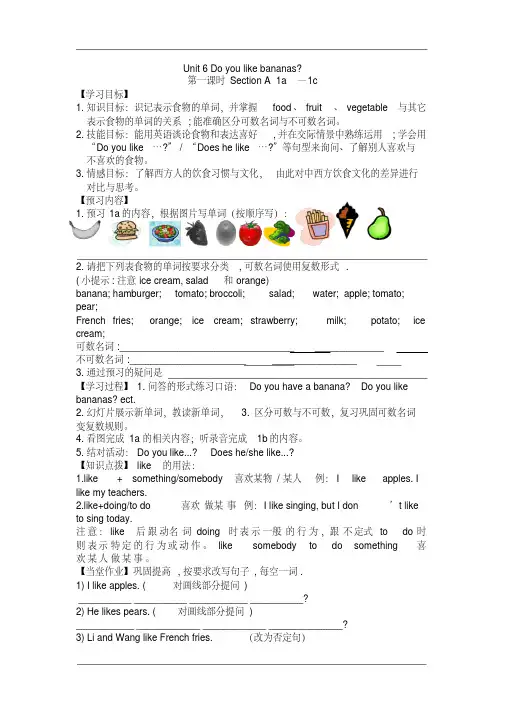
Unit 6 Do you like bananas?第一课时Section A 1a—1c【学习目标】1.知识目标:识记表示食物的单词,并掌握food、 fruit、 vegetable与其它表示食物的单词的关系;能准确区分可数名词与不可数名词。
2.技能目标:能用英语谈论食物和表达喜好,并在交际情景中熟练运用;学会用“Do you like…?” /“Does he like…?”等句型来询问、了解别人喜欢与不喜欢的食物。
3.情感目标:了解西方人的饮食习惯与文化,由此对中西方饮食文化的差异进行对比与思考。
【预习内容】1.预习1a的内容,根据图片写单词(按顺序写):2.请把下列表食物的单词按要求分类,可数名词使用复数形式.(小提示:注意ice cream, salad和orange)banana; hamburger; tomato; broccoli; salad; water; apple; tomato; pear;French fries; orange; ice cream; strawberry; milk; potato; ice cream;可数名词:_________________________________ _____________不可数名词:______________________ ________________3.通过预习的疑问是【学习过程】1.问答的形式练习口语:Do you have a banana? Do you like bananas? ect.2.幻灯片展示新单词,教读新单词,3.区分可数与不可数,复习巩固可数名词变复数规则。
4.看图完成1a的相关内容;听录音完成1b的内容。
5.结对活动:Do you like...? Does he/she like...?【知识点拨】like 的用法:1.like + something/somebody 喜欢某物/某人例:I like apples. I like my teachers.2.like+doing/to do喜欢做某事例:I like singing, but I don’t like to sing today.注意:like后跟动名词doing时表示一般的行为,跟不定式to do时则表示特定的行为或动作。