最新版仁爱英语八年级上册unit 1 topic 1 重点知识点总结及练习(无答案 )培训资料
- 格式:doc
- 大小:84.00 KB
- 文档页数:8
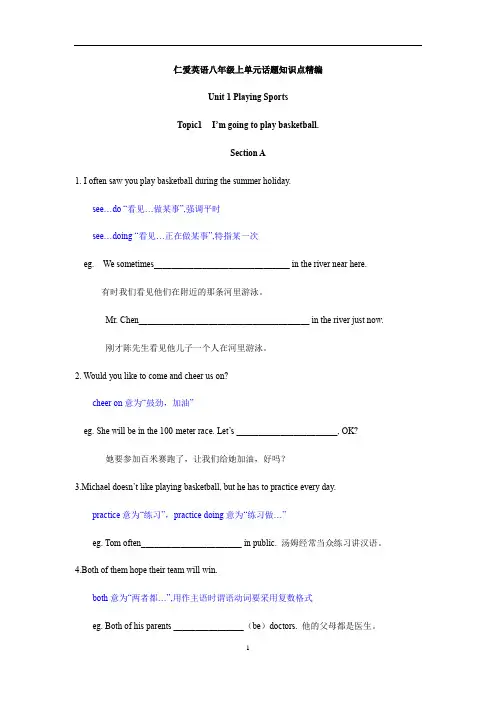
精品文档 精品文档 Unit 1 Playing Sports Topic 1 I’m going to play basketball. 一.重要句型: Section A 1. I often saw you play basketball during the summer holiday. 在暑假期间,我经常看见你打篮球。 1)A. see sb. do sth. 意为“看见某人做了某事”。 强调动作的全过程或经常反复发生,现在动作已完成; e.g. I often see Tom play basketball on the playground. 我经常看见汤姆在操场上打球。 B. see sb. doing sth. 意为“看见某人正在做某事”。 强调动作正在进行。 e.g. I see Tom playing basketball on the playground yesterday. 我看见汤姆在操场上打球。 2. We are going to have a basketball game against Class Three on Sunday. 周日我们班和三班要举行一场篮球比赛。 1)be going to + 动词原形是将来时的一种表达法,表示主语将要进行某一行动的打算、意图,且这种打算会付诸实践。 e.g. — What are you going to do tomorrow? 明天你打算做什么? — I’m going to play soccer. 我打算踢足球。 2)against 意为“对着,反对。” e.g. He walked against the wind. 他逆风行走。 We are against wars. 我们反对战争。 3. I hope our team will win. 我希望我们队会赢。 1) A. hope + that从句,that 可省去。 e.g. I hope that I can see you soon. 我希望我可以很快见到你。 B. hope to do sth. e.g. I hope to see you soon. 我希望很快见到你。 区别:a) wish(愿)与hope的用法一样,后既可以接从句也可以接不定式,但不能说 hope sb. to do sth. (hope 后不接双宾语), 但 wish可以,即: wish sb. to do sth.。 e.g. I wish him to have a good time. 我希望他玩得愉快。 b) hope 后接的从句常用将来时态表可以实现的愿望,而wish 后接的宾语从句常用过去时态表难以实现的愿望。 e.g. I hope you will win. 我希望你会赢。 I wish I could fly to the moon. 我希望我可以飞到月球去。 2) win意为“赢,赢得(比赛、奖品等)”,着重指比赛、竞赛或者战斗中经过努力而获得奖牌、名次或胜利。现在分词 winning;过去式:won ;获胜者:winner;反义词: lose。 e.g. In the end We won the game. 最后我们赢得了比赛。 4. — Me, too.Would you like to come and cheer us on? 我也是。你愿意来为我们加油吗? — Sure, I’d love to. 当然,我很乐意。 1)Me, too. 意指自己的做法或想法与别人的一致。 e.g. — I like drinking milk in the morning. 我喜欢早上喝牛奶。 — Me, too. 我也是。 精品文档 精品文档 2)a. Would you like +to do? 表建议或邀请。常用I’d love to来回答,不同意也常用 I’d love to, but… 来拒绝别人。 e.g. —Would you like to play basketball with me? 你愿意和我打篮球吗? —I’d love to, but I have a lot of homework to do. 我很愿意啊,但是我有很多作业要做。 b. 在肯定句中 would like to do sth. = want to do sth. e.g. I’d like to have a rest. = I want to have a rest. 我想休息下。 3) cheer v. 意为“加油,欢呼,喝彩”,cheer sb. on 意为“为某人喝彩”。 5. Which sport do you prefer,swimming or rowing? 你更喜欢哪一项运动,游泳还是划船? 相当于Which sport do you like better,cycling or rowing ? 6. I prefer rowing. 我更喜欢划船。 1) 相当于I like rowing better. 2) prefer v. “较喜欢,更喜欢”,后可接动名词、代词、动词不定式。 e.g. I prefer swimming. 更喜欢经常游泳。 I prefer to swim. 更喜欢这一次去游泳。 3) prefer (doing) A to (doing) B 相当于:like… better than 意为“比起……更喜欢……” e.g. I prefer swimming to skating. 比起滑冰,我更喜欢游泳。 =I like swimming better than skating. 7. Yes , quite a lot. 是的,经常。 quite 用于肯定句中,意为“完全,十分,相当”;quite a few 相当多的,quite a lot 许多,大量. 而quite a bit = quite a lot。quite与not 连用时,意为“差不多,不太” 表示程度上的接近。 e.g. You’re quite right. 你完全正确。 We don’t quite like him. 我们并不十分喜欢他。 8. Are you going to join the school rowing club? A. join意为“加入,参加”,其后接人或组织,意为“加入某人或某组织”; e.g. join the Party 入党; join us 加入我们之中; B. take part in=join in = be in 意为“参加某项(活动,比赛)”; e.g. I will join in the school sports meet. 我将参加学校运动会。 Section B 1. He played for the Houston Rockets in the NBA. 他曾效力于NBA的休斯敦火箭队。 play for 为某个队效力;play against 与某个队比赛;play with 玩某物/与某人玩; 2. That’s my dream. 那是我的梦想。 A. dream n. 意为“梦,梦想”。 e.g. I believe my dream will come true. 我相信我的梦想会实现的。 B. dream v. 意为“做梦”, dream of = dream about 意为“梦见”。 e.g. Last night I dreamt of flying in the sky. 昨天夜里我梦见自己在天空中飞翔。 3. What are you going to be when you grow up ? 你长大后想干什么? 相当于What do you want to be when you grow up? Section C 1. She goes cycling twice a week and often goes mountain climbing on Sundays. 她一周骑自行车两次,还经常周天去爬山。 1) twice a week意为“一周两次”,a week 相当于every week 。类似短语:once a week精品文档 精品文档 一周一次twice a year一年两次, 三次或三次以上用“数字+times”。 e.g. three times a year, four times a day I play basketball three times a week. 我一周打三次球。 2) go mountain climbing 意为“去爬山”。 go + v-ing形式的短语表“去做某事”。 e.g. go hiking 去徒步旅行,go shopping去购物, go skating 去滑冰,go skiing 去滑雪;
go fishing 去钓鱼 2. She spends half an hour exercising in the gym every day. 她每天在体育馆花半个小时来锻炼。 1) spend+时间+on sth. 意为“花费时间在某事上” ;spend+时间+(in)doing sth. 意为“花费时间做某事”; e.g. He spent his whole life looking after the poor. 他把他的一生用来照顾贫穷的人。 2)It takes sb. some time to do sth. 也表示某人花费时间做某事; e.g. It took me two hours to finish the composition. 我用两个小时写完那篇作文。 3)A. 当exercise指“体操、练习”时,是可数名词。 e.g. do morning exercises 做早操; do English exercises 做英语练习题;
B. 当exercise指“锻炼,运动”时,是不可数名词。 e.g. do exercise 做运动;
Exercise makes us strong. 锻炼使我们强壮。 C. exercise 还可作动词,指“锻炼,运动”。 e.g. She exercises every morning. 她每天早上锻炼。
3. She is also good at jumping. 她还擅长跳跃。 be good at…= do well in…擅长… e.g. I am good at English.= I do well in English. 我擅长英语。