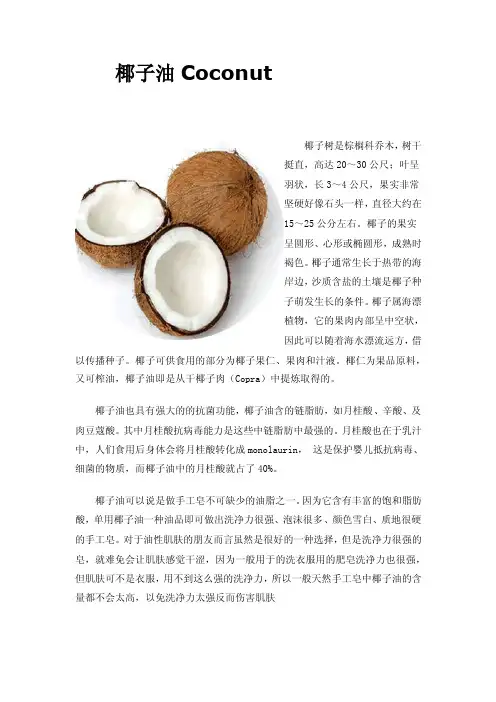
椰子油Coconut椰子树是棕榈科乔木,树干挺直,高达20~30公尺;叶呈羽状,长3~4公尺,果实非常坚硬好像石头一样,直径大约在15~25公分左右。
椰子的果实呈圆形、心形或椭圆形,成熟时褐色。
椰子通常生长于热带的海岸边,沙质含盐的土壤是椰子种子萌发生长的条件。
椰子属海漂植物,它的果肉内部呈中空状,因此可以随着海水漂流远方,借以传播种子。
椰子可供食用的部分为椰子果仁、果肉和汁液。
椰仁为果品原料,又可榨油,椰子油即是从干椰子肉(Copra)中提炼取得的。
椰子油也具有强大的的抗菌功能,椰子油含的链脂肪,如月桂酸、辛酸、及肉豆蔻酸。
其中月桂酸抗病毒能力是这些中链脂肪中最强的。
月桂酸也在于乳汁中,人们食用后身体会将月桂酸转化成monolaurin,这是保护婴儿抵抗病毒、细菌的物质,而椰子油中的月桂酸就占了40%。
椰子油可以说是做手工皂不可缺少的油脂之一。
因为它含有丰富的饱和脂肪酸,单用椰子油一种油品即可做出洗净力很强、泡沫很多、颜色雪白、质地很硬的手工皂。
对于油性肌肤的朋友而言虽然是很好的一种选择,但是洗净力很强的皂,就难免会让肌肤感觉干涩,因为一般用于的洗衣服用的肥皂洗净力也很强,但肌肤可不是衣服,用不到这么强的洗净力,所以一般天然手工皂中椰子油的含量都不会太高,以免洗净力太强反而伤害肌肤The Coconut Palm (Cocos nucifera) is a member of the Family Arecaceae (palm family). It is the only species in the genus Cocos, and is a large palm, growing to 30 m tall, with pinnate leaves 4-6 m long, pinnae 60-90 cm long; old leaves break away cleanly leaving the trunk smooth.The coconut palm is grown throughout the tropical world, for decoration as well as for its many culinary and non-culinary uses; virtually every part of the coconut palm has some human uses.Botanically, a coconut is a simple dry nut known as a fibrous drupe.Adhering to the inside wall of the endocarp is the testa, with a thick albuminous endosperm (the coconut "meat"), the white and fleshy edible part of the seed.Although coconut meat contains less fat than other dry nuts such as almonds, it is noted for its high amount of saturated fat. Approximately 90% of the fat found in coconut meat is saturated, a proportion exceeding that of foods such as lard, butter, and tallow. However, there has been some debate as to whether or not the saturated fat in coconuts is healthier than the saturated fat found in other foods (see coconut oil for more information). Coconut meat also contains less sugar and more protein than popular fruits such as bananas, apples and oranges, and it is relatively high in minerals such as iron, phosphorus and zinc.The endosperm surrounds a hollow interior space, filled with air and often a liquid referred to as coconut water, not to be confused with coconut milk. The milk is used to produce virgin coconut oil by controlled heating and removing the oil fraction. Virgin coconut oil is found superior to the oil extracted from copra for cosmetic purposes.Traditional Use: Coconut oil, also known as coconut butter, is a tropical oil with many applications. It is extracted from copra (the dried meat, or kernel, of the coconut). Coconut oil is solid at room temperature. It is used to create a barrier on the skin. It is also the preferred oil for high quality cold process soapers. Coconut oil is used in volume quantities for cooking oil, making margarine. It also used in the manufacture of soap, essences, massage oils and cosmetics. Coconut oil has been tested for use as an engine lubricant; the company producing the oil claims the oil reduces fuel consumption, smoke emissions and allows the engine to run at a cooler temperature.Coconut Virgin Oil Botanical Name: Cocos nuciferaExtraction Method: Cold Pressed (VIRGIN)Virgin coconut oil: Virgin coconut oil is derived from fresh coconuts (rather than dried, as in copra). Most oils marketed as "virgin" are produced one of three ways:1. Quick-drying of fresh coconut meat, which is then used to press out the oil.2. Wet-milling (coconut milk). With this method, the oil is extracted from fresh coconut meat without drying first. "Coconut milk" is expressed first by pressing. The oil is then further separated from the water. Methods which can be used to separate the oil from the water include boiling, fermentation, refrigeration, enzymes and mechanical centrifuge.3. Wet-milling (direct micro expelling). In this process, the oil is extracted from fresh coconut meat after the adjustment of the water content, then the pressing of the coconut flesh results in the direct extraction of free-flowing oil.Physical properties: Coconut oil is a fat consisting of about 90% saturated fat. The oil contains predominantly medium chain triglycerides, with roughly 92% saturated fatty acids, 6% monounsaturated fatty acids, and 2% polyunsaturated fatty acids. Of the saturated fatty acids, coconut oil is primarily 44.6% lauric acid, 16.8% myristic acid , 8.2% palmitic acid and 8% caprylic acid. Although it contains seven different saturated fatty acids in total, its only monounsaturated fatty acid is oleic acid while its only polyunsaturated fatty acid is linoleic acid. In the human body lauric acid is converted into monolaurin. Unrefined coconut oil melts at24-25×C (76×F) and smokes at 177×C (350?] while refined coconut oil has a higher smoke point of 232×C (450×F). Among the most stable of all oils, coconut oil is slow to oxidize and thus resistant to rancidity, lasting up to two years due to its high saturated fat content.[citation needed] In order to extend shelf life, it is best stored in solid form (i.e. below 24.5×C [76×F]).Color: White to Off WhiteAromatic Description: Coconut has a very slight coconut scent, but is generally considered odourlessHealth effects:Heart diseaseo Blood tests performed on rats showed decreased risk factors for heart disease (reduced total cholesterol,triglycerides and low-density lipoprotein and increased high-density lipoprotein) in rats fed virgin coconut oil, when compared to rats fed copra oil. In addition, the polyphenol fraction of unprocessed coconut oil prevented in vitro oxidation of low-density lipoproteins.A study of Polynesian populations that consumed mainly coconut meat found that increased consumption of coconut was associated with significantly higher levels of serum cholesterol but this was not associated with higher rates of death due to heart attacks and other forms of cardiovascular disease.Reducing the consumption of coconut oil and replacing a portion of it with polyunsaturated fats resulted in changes to blood cholesterol levels that are associated with a reduced risk of cardiovascular diseases.Antimicrobial effectso Coconut oil has been found effective against certain strains of the Candida yeast, though it is ineffective against others.Coconut oil taken orally was found to be a useful adjunct therapy in children withcommunity-acquired pneumonia. Taken in conjunction with IV ampicillin, coconut oil supplementation resulted in earlier normalization of respiratory rate and earlier normalization of lung sounds vs. IV ampicillin alone. Monolaurin from coconut oil has demonstrated virucidal activity against 14 human RNA and DNA enveloped viruses in vitro. Another laboratory study investigated the effect of monolaurin on primary and secondary skin infections compared with six common antibiotics. In culture isolates from the skin infections, monolaurinshowed statistically significant broad-spectrumsensitivity to both Gram-positive and Gram-negativebacterial isolates, such as Staphylococcus aureus,Streptococcus spp. and Enterobacter spp.Cosmetics and skin treatments: Coconut oil is excellent as a skin moisturizer and softener. A study shows that extra virgin coconut oil is effective and safe when used as a moisturizer, with absence of adverse reactions. In India and Sri Lanka, coconut oil is commonly used for styling hair, and cooling or soothing the head. People of Tamil Nadu and other coastal areas such as Kerala, Karnataka, Maharashtra and Goa bathe in warm water after applying coconut oil all over the body and leaving it as is for an hour to keep body, skin, and hair healthy.Consistency: Solid at room temperatures. Gentle heating is required.Absorption: Coconut creates an oily, protective barrier on the skin.Shelf life: Coconut oil is slow to go rancid; users can expect a minimum shelf life of 6 Months, but much longer with proper storage conditions (cool, out of direct sunlight). Refrigeration after opening is recommended.Cautions: Direct application to the face with Coconut should be avoided because of possible allergic reactions.Note: Coconut oil is solid at room temperature, however gentle heating will allow it to liquefy.GENERAL SAFETY INFORMATION: Caution should be taken when using Essential Oils. Do not use any oils without consultation from a qualified aroma therapy practitioner. All Essential Oils should be kept out of the reach of children.DISCLAIMER: This information is provided purely for informational purposes only, and does not in any way purport to be medical or prescriptive suggestions. Any reference to medicinal or health benefits is not meant to treat or diagnose any problem and is not meant to replace professional medical advice and should not take the place of any prescribed medication that has been prescribed by a physician.The material in this website is not meant to take the place of diagnosis and treatment by a qualified medical practitioner. Since the actual use of essential oils by others is beyond our control, no expressed or implied guarantee as to the effects of their use can be given nor liability taken. Essential oils are to be used at your own discretion. Any application of the recommendations is at user's sole risk. The Altiec disclaims any liability arising directly or indirectly from the use of this information and assumes no responsibility for any actions taken。