
跨文化交际英语版unit2-Understanding-Communication
- 格式:ppt
- 大小:820.00 KB
- 文档页数:24
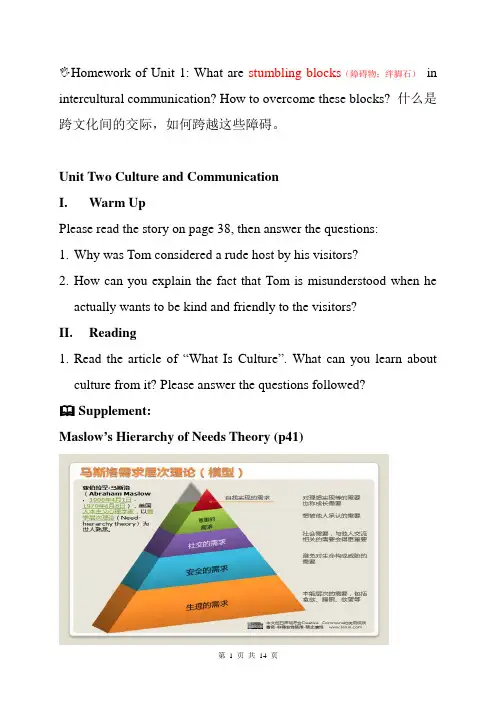
✋Homework of Unit 1: What are stumbling blocks(障碍物;绊脚石)in intercultural communication? How to overcome these blocks? 什么是跨文化间的交际,如何跨越这些障碍。
Unit Two Culture and CommunicationI.Warm UpPlease read the story on page 38, then answer the questions:1.Why was Tom considered a rude host by his visitors?2.How can you explain the fact that Tom is misunderstood when heactually wants to be kind and friendly to the visitors?II.Reading1.Read the article of ―What Is Culture‖. What can you learn aboutculture from it? Please answer the questions followed?Supplement:Maslow’s Hierarchy of Needs Theory (p41)What is culture?1.Origins of culture in English and Chinese(1)―Culture‖ is a loan word from Latin meaning ―cultivating or tillingthe land‖. It was originally associated with physical activities and production of food. Later, its meaning was extended to include mental, moral, aesthetic, educational and intellectual activities. In contemporary English its original meaning is still retained. (2)―文化‖is a native word in Chinese. ―文‖and ―化‖were usedtogether in the Warring States. ―人文‖ in ―观乎人文,以化成天下‖refers to the interwoven relationships between the monarch and his subjects, fathers and sons, husbands and wives, brothers and friends, and ―化‖ means ―changing and/or cultivating‖. When used together, ―文‖and ―化‖mean ―以文教化‖. They were combined into one word in Han Dynasty, with its meaning contrasted with ―nature‖ on one hand and ―primitiveness‖ and ―savage‖ on the other hand. So ―文化‖ was originally associated with mental activities.2.DefinitionThe term ―culture‖does not correspond perfectly with ―文化‖. For examples:他没有文化(He is illiterate.)―What really binds men together is their culture--- the ideas and the standards they have in common.‖— R. Benedict According to The Concise Oxford Dictionary,culture is ―the arts and other manifestations of human intellectual achievement regarded collectively‖.Defining Culture from the Anthropological Perspective:♦―Culture consists of patterns, e xplicit and implicit, of and for behavior acquired and transmitted by symbols, constituting the distinctive achievement of human groups, including their embodiments in artifacts; the essential core of culture consists of traditional ideas and especially th eir attached values‖.-----Kroeber and Kluckhohn Defining Culture from the Psychological Perspective♦culture is "the collective programming of the mind which distinguishes the members of one category of people from another".----Geert HofstedeDefining Culture from the Sociological Perspective♦―Culture is defined as a pattern of learned, group-related perception —including both verbal and nonverbal language attitudes, values, belief system, disb elief systems, and behavior‖. Defining Culture from the Intercultural Perspective♦―Culture is a system of shared beliefs, values, customs,behaviours and artifacts that are transmitted from generation to generation through learning.‖----[Bates and Plog]There are altogether no less than 250 definitions of culture by scholars from several different fields. Despite so, almost all scholars agree that culture has two senses: the broad sense and the narrow sense.A. Culture in its broad senseCulture is the attribute of man, or, whatever distinguishes man from the rest part of the world is culture. Based on this, Prof. Lin Dajin provides a Chinese counterpart definition: 文化是人类区别于动物的综合特征. It may include the following components:①Materials man has got to satisfy his needs, including science and technology, such as space shuttles, airplanes, and cars;②Social institutions and organizations man has established, including socioeconomic institutions, politico-legal institutions, and religious organizations;③Knowledge about nature and man himself and artistic development, including various subjects such as mathematics and education, and artistic forms such as literature, painting, music and dance;④Language and other communication systems such as gestures and facial expressions;⑤Customs, habits and behavioral patterns;⑥Value systems, world views, national traits, aesthetic standards and thinking patterns.Culture in this sense is also called ―large C culture‖ or academic culture or culture with a big C(大写字母的文化). It‘s culture in general, culture of all nationalities and ethnic groups. But we know there are specific cultures such as Chinese, American and British. According to this sense, specific culture can be defined (by Prof. Lin Dajin) as the comprehensive features that distinguish one group (be it a nation, a race or any section of people) of people from another (一个民族区别于另一个民族的综合特征).﹡Dominant culture and subculture/co-culture♦Culture is subdivided into dominant culture(主流文化), mainstream culture, and subculture(s)(亚文化), which coexist within each culture.♦A subculture resembles像;类似于a culture in that it usually encompasses a relatively large number of people and represents the accumulation of generations of human striving. However, subcultures have some important differences: they exist within dominant cultures and are often based on economic or social class, ethnicity, race, or geographic region.Today the tendency is to say ‗co-culture‘ and sub-groups to avoid prejudice.B. Culture in its narrow senseIt's called ―small c culture‖ or anthropological culture or culture with a small c (小写字母的文化). It can be defined as life way of a population, Culture in this sense emphasizes what characterizes the way of life of a people, including components ②, ③, ④, ⑤ and ⑥, with components ②, ④, ⑤ and ⑥ as the central part.Some scholars are interested in ―large C culture‖ while others in ―small c culture‖, depending on the purpose of investigation. We shall focus on culture in its narrow sense.﹡Cultural Identity文化认同Cultural identity refers to one‘s sense of belonging to a particular culture or ethnic种族的group. People consciously identify themselves with a group that has a shared system of symbols and meanings as well as norms for conduct.3.Properties of culture(1)It is human specific.(2)It is a social phenomenon (contrast between society and nature). Itis the embodiment of human knowledge, skill and cooperative labor.(3)It is a national phenomenon for each nature has its own culture.(4)It is a historical phenomenon. Each culture has some history andeach generation contributes to it. But culture won‘t necessarilyA. Overt CultureB. Covert Culture(公开文化层)Exposed Material Culture,Visible and Easily Described(隐蔽文化层)Hidden in the material culture,Soft or Spiritual cultureremain the same.(5) It is general and abstract.2. Culture can be viewed as an iceberg. Nine-tenths of an iceberg is out of sight. The part of the cultural iceberg that is above the water is easy to be noticed. The other part that is hidden below the water and is outside of conscious awareness. It is sometimes called ―deep culture ‖. But what are the things in a culture that can be said to be above or below the water – within or out of our awareness? The Structure of Culture3.Read the article on page 45-48:From this article, we can learn there are three characteristics of culture – coherent, learned, the view of a group of people; and there are three things culture does – culture ranks what is important (or cultures teach values or priorities), culture furnishes attitudes, and culture dictates how to behave.4.Decide whether the following are examples of communications ornot? Why?1)You complain to your instructor about your course credits through telephone.2) Two blind people exchange ideas in Braille.3) A German businessman negotiates, through an interpreter, with his Chinese counterpart.4) A farmer gives instructions to his ploughing cow.5) A programmer issues commands to a computer.6) Tom talks to himself while flourishing his toy gun.7) You send an e-mail message to an American friend.8) Jane lies in bed reading a novel.The Basics of Communication:Communication occurs if: 1. two or more people; 2. contact; 3. ashared language; 4. an exchange of information.5.Read the article of ―Elements of Communication‖. What are theelements of communication?Context: four aspects (the physical setting, historical aspect, psychological aspect, culture aspect)Participants: three variables (relationship, gender, culture)Messages: meanings, symbols, encoding and decoding.Channels: the method used to deliver a message (sound, sight, smell, taste, touch, or any combination of these)Noise (干扰): a term used for factors that interfere with the exchange of messages, including external noise, internal noise and semantic noise. Noise is inevitable.Feedback: t he response of a receiver to a sender‘s message Please answer the questions followed.Supplement:What Is Communication?There are altogether 126 definitions of communication. Among them the most accepted one defined by L. A. Samovar, et al.Definition:―Communication may be defined as that which happens whenever someone responds to the behavior or the residue of the behavior of another person.‖---- L. A. Samovar, et alA few key points about this definition:①The behavior includes verbal behavior and non-verbal behavior. For example, you meet an acquaintance in the street. You smile and nod to each other without uttering a word. Then your behavior is non-verbal, and your communication is also non-verbal. So according to this, communication can be divided into verbal communication and non-verbal communication.②As to the meaning of ―behavior residue", here is an example. You leave a note before you go out, and your roommate sees it when coming back and will make certain response. Then this note is your behavior residue. In this case, whether your roommate does something about or just ignores the note, as long as he receives the note, communication happens, but it is non-simultaneous. Therefore, communication can also be divided into simultaneous communication and non-simultaneous communication.③ A behavior, whether intentional or unintentional, conscious or unconscious, once is received, communication occurs. For example, when you are giving a speech, you may blush (unintentional) or repeat the same movement (unconscious), which gives your audience a message that you are nervous.④Feedback is not a prerequisite of communication. So there may beone-way communication. Hu Wenzhong of Beijing Foreign Studies University once said translation is in fact a kind of (intercultural) communication, because when one is translating, one is in fact communication interculturally with the writer of the original work. In deed, written translation is in most cases one-way communication. 2. Factors Affecting CommunicationEight specific ingredients of communication:①the source (行为源): a person who has a need to communicate②encoding (编码): an internal activity in which a source creates a message through the selection of verbal and non-verbal symbols (行为源组织信息的内心活动).③message (信息): the result of encoding, once spoken out and received, becomes a message.④channel (渠道): the physical means by which the message is transmitted.⑤the responder (反应者): the person who intercepts the message and as a consequence becomes linked to the source.⑥decoding (译码): the internal activity of the receiver‘s information processing.⑦response (反应): what a receiver decides to do about the message.⑧feedback (反馈): feedback and response are clearly related. Response becomes feedback when received by the source.Of the eight ingredients, the source and the responder, encoding and decoding, are the most important because they are related to persons.Some personal factors may affect communication effectiveness:①sex ②age③temperament (e.g. introverted and extroverted)④occupation (e.g. businessman, officers, etc.) ⑤social status ⑥knowledge structure ⑦life experienceUncertain factors, varying at different time:①intention: though disgusted, you nod or smile for politeness.②mood: someone tells you that it is useless to live in this world. You might have different responses.③status at that time: you, as a guest, can‘t ask the host to help himself to some dish.Objective factors:①time: you never say ―Good morning‖ in the evening.②place:③occasion: you never say ―节哀顺便‖ in a wedding ceremony.3. Communication Types①based on symbols used: verbal and non-verbal②based on media: direct and indirect③based on feedback: two-way and one-way④based on numbers of the sources and responders: one/group-to-one and one/group-to-group⑤based on set responder: directed and non-directed⑥based on the source‘s intention: intentional and unintentional⑦based on the responder‘s activeness: active and passive⑧based on time: simultaneous and non-simultaneous4. Characteristics of Communication (Essentials of Human Communication) p68-73①Communication is dynamic. It is an on-going, never-changingactivity. We are sure to be influenced by other‘s message, whether gradually or radically.②Communication is symbolic: Symbols are central to thecommunication process because they represent the shared meanings that are communicated. A symbol is a word, action, or object that stands for or represents a unit of meaning. People's behaviors are frequently interpreted symbolically, as an external representation of feelings, emotions, and internal states.③Communication is systematic: Communication does not occur inisolation or in a vacuum, but rather is part of a larger system. We send and receive messages not in isolation, but in a specific setting.Setting and environment help determine the words and actions we generate. Dress, language, topic selection, and the like are alladapted to context.④It involves making inferences.⑤It has a consequence.⑥It is interactive (interpersonal communication).⑦It is irreversible.⑧It is contextual.⑨Communication is self-reflective: Human beings have a uniqueability to think about themselves, to watch how they define the world, and to reflect on their past, present, and future.6.Match each of what the first speaker says on the left with what thesecond speaker says on the right to form a dialogue that will make sense, and then decide what is possibly meant by the second speaker in the dialogue. (p57)7.Read the passage of ―Communicating or CommunicatingEffectively‖and try to explain why we sometimes find it very difficult to communicate effectively with others, and then suggest what we can do about it.III.Case Study: Students are required to read the cases given carefully and try to analyse them from the viewpoint of IC.。

新编跨⽂化交际英语教程_参考答案Unit2Unit 2Culture and CommunicationReading IWhat Is CultureComprehension questions1. Which of the definitions given above do you prefer? Why?Some may prefer a short definition, such as the one given by E. Sapir or R. Benedict, for it is highly generalized and easy to remember. Some may prefer a longer one, such as Edward T. Hall’s definition of culture, because it provides us with a more comprehensive understanding of culture and points out the all-pervasive impact of culture on human life in different dimensions.2. What have you learned from those definitions about culture?Many things can be learned from those definitions, for each definition, though not without its limitations, tells us something very important about culture or certain aspect(s) of culture.3. Do you agree that our lower needs always have to be satisfied before we can try tosatisfy the higher needs?Even though this is generally the case, there will still be some exceptions. Sometimes people might prefer to satisfy higher needs, for instance, esteem needs, before their lower needs, such as certain physiological needs or safety needs are satisfied.4. What examples can you give about how people of different cultures achieve thesame ends by taking different roads?For example, everyone has to eat in order to live and this is universally true. However, to satisfy this basic need, people of various cultures may do it in very different ways: what to eat and how to eat it vary from culture to culture.5. What behaviors of ours are born with and what are learned in the culturalenvironment?Instinctive behaviors are behaviors that we are born with and ways of doing things in daily life, such as ways of eating, drinking, dressing, finding shelter, making friends, marrying, and dealing with death are learned in the cultural environment.6. What other cultural differences do you know in the way people do things in theireveryday life?We can also find cultural differences in ways of bringing up children, treating the elderly, greeting each other, saving and spending money, and many other things people do in everyday life.7. In what ways are the Chinese eating habits different from those of theEnglish-speaking countries?We Chinese may enjoy something that is not usually considered as edible by the English-speaking people. Generally we prefer to have things hot and lay much emphasis on tastes. We tend to share things with each other when we are eating with others.Reading IIElements of CommunicationComprehension questions1. What are the aspects of context mentioned above?One aspect of context is the physical setting, including location, time, light, temperature, distance between communicators, and any seating arrangements. A second aspect of context is historical. A third aspect of context is psychological. A fourth aspect of context is culture.2. In what ways would your posture, manner of speaking or attire change if you movefrom one physical setting to another, for example, from your home to a park, to a classroom, to a restaurant, to a funeral house, etc?One’s posture, manner of speaking or attire change from being casual to formal gradually from home to a park, to a classroom, to a restaurant, to a funeral house, etc, according to different formalness and seriousness of these situations. 3. How do people acquire communication norms in their life?People acquire communication norms from their experiences in life.4. What examples can you give to describe some Chinese norms in our everydaycommunication?For example, it seems to be a norm in China to address one’s boss by his or her title and never to express one’s disapproval directly to him or her.5. How can we play both the roles of sender and receiver in communication?As senders, we form messages and attempt to communicate them to others through verbal and nonverbal symbols. As receivers, we process the messages sent to us and react to them both verbally and nonverbally.6. Does the sender play a more important role than the receiver in communication? No, they are equally important for both of them are essential in the process of communication.7. In what ways do the differences between participants make communication more or less difficult?Three especially important variables affecting participants which are relationship, gender, and culture make communication more or less difficult.8. What is a symbol and what is a meaning?The pure ideas and feelings that exist in a person’s mind represent meanings. The words, sounds, and actions that communicate meaning are known as symbols because they stand for the meanings intended by the person using them.9. How can meanings be transferred from one person to another? What problems may arise in this process?A message from one person is encoded into symbols and then decoded into ideas and feelings to another person. In this process of transforming include nonverbal cues, which significantly affect the meaning created between the participants in a communication transaction.10. When are unintended or conflicted meanings likely to be created?Unintended meanings are created when the decoding person receives a meaning unrelated to what the encoder thought he or she was communicating. Conflicting meanings are created when the verbal symbols are contradicted by the nonverbal cues.11. Which channels do you usually prefer in communication? Why?Of the five channels, some may prefer sight. As the old saying goes, words are but wind, but seeing is believing.12. What examples can you find to show that one channel is more effective than othersfor transmitting certain messages?For example, when asking a lady for a date, a young man may wear an immaculate suit and spray some perfume to show that he highly values this date with her. In this case, sight and smell are definitely more effective than words for conveying that particular message.13. What are the things that can create noises in the process of communication?Sights, sounds, and other stimuli in the environment that draw people‘s attenti on away from intended meaning are known as external noise. Thoughts and feelings that interfere with the communication process are known as internal noise. Unintended meanings aroused by certain verbal symbols can inhibit the accuracy of decoding. This is known as semantic noise.14. What should we do to reduce the interference of noise in communication?When communicating with others, we should pay undivided attention to communication itself, avoiding being distracted by any external or internal noise. Besides, we should make sure that what we say is correctly understood by others and vice versa to prevent semantic noise from generating.15. Why is feedback a very important element of communication?Feedback is very important because it serves useful functions for both senders and receivers: it provides senders with the opportunity to measure how they are coming across, and it provides receivers with the opportunity to exert some influence over the communication process.16. What will you usually do when you receive negative feedback in communication?Open.Case StudyCase 5In China, it is often not polite to accept a first offer and Heping was being modest, polite and well-behaved and had every intention of accepting the beer at the second or third offer. But he had not figured on North American rules whichfirmly say that you do not push alcoholic beverages on anyone.A person may not drink for religious reasons, he may be a reformed alcoholic, or he may be allergic. Whatever the reason behind the rule, you do not insist in offering alcohol. So unconscious and so strong are their cultural rules that the Americans equally politely never made a second offer of beer to Heping who probably thought North Americans most uncouth. However, what we have to remember is that cultures are seldom a strict either-or in every instance for all people and there are always individual differences. Probably this young Chinese nurse was very different from Heping or, unlike Heping, she may have known something about the American cultural rules and was just trying to behave like an American when she was in an American family.Case 6When a speaker says something to a hearer, there are at least three kinds of meanings involved: utterance meaning, speaker’s meaning and hearer’s meaning. In the dialogue, when Litz said ‘How long is she going to stay?’ she meant to say that if she knew how long her mother-in-law was going to stay in Finland, she would be able to make proper arrangements for her, such as taking her out to do some sightseeing. However, her mother-in-law overheard the conversation, and took Litz’s question to mean “Litz does not want me to stay for long”. From the Chinese point of view, it seems to be inappropriate for Litz to ask such a question just two days after her mother-in-law’s arrival. If she feels she hasto ask the question, it would be better to ask some time later and she should not let her mother-in-law hear it.Case 7Keiko insists on giving valuable gifts to her college friends, because in countries like Japan, exchanging gifts is a strongly rooted social tradition. Should you receive a gift, and don’t have one to offer in return, you will probably create a crisis. If not as serious as a crisis, one who doesn’t offer a gift in return may be considered rude or impolite. Therefore, in Japan, gifts are a symbolic way to show appreciation, respect, gratitude and further relationship.Keiko obviously has taken those used items from Mary, Ed and Marion as gifts, for she probably doesn’t know th at Americans frequently donate their used household items to church or to the community. Mary, Ed and Marion would never consider those used household items given to Keiko as gifts. No wonder they felt very uncomfortable when they received valuable gifts in return.Case 8As the Chinese girl Amy fell in love with an American boy at that time, it seems that she preferred to celebrate Christmas in the American way, for she wanted very much to appear the same as other American girl. She did not like to see her boyfriend feel disappointed at the “shabby” Chinese Christmas. That’s why she cried when she found out her parents had invited the minister’s family over for theChristmas Eve dinner. She thought the menu for the Christmas meal created by her mother a strange one because there were no roast turkey and sweet potatoes but only Chinese food. How could she notice then the foods chosen by her mother were all her favorites?From this case, we can find a lot of differences between the Chinese and Western cultures in what is appropriate food for a banquet, what are good table manners, and how one should behave to be hospitable. However, one should never feel shameful just because one’s culture is different from others’. As Amy’s mother told her, you must be pr oud to be different, and your only shame is to have shame.。

新编跨文化交际英语教程_参考答案Unit2Unit 2Culture and CommunicationReading IWhat Is CultureComprehension questions1. Which of the definitions given above do you prefer? Why?Some may prefer a short definition, such as the one given by E. Sapir or R. Benedict, for it is highly generalized and easy to remember. Some may prefer a longer one, such as Edward T. Hall’s definition of culture, because it provides us with a more comprehensive understanding of culture and points out the all-pervasive impact of culture on human life in different dimensions.2. What have you learned from those definitions about culture?Many things can be learned from those definitions, for each definition, though not without its limitations, tells us something very important about culture or certain aspect(s) of culture.3. Do you agree that our lower needs always have to be satisfied before we can try tosatisfy the higher needs?Even though this is generally the case, there will still be some exceptions. Sometimes people might prefer to satisfy higher needs, for instance, esteem needs, before their lower needs, such as certain physiological needs or safety needs are satisfied.4. What examples can you give about how people of different cultures achieve thesame ends by taking different roads?For example, everyone has to eat in order to live and this isuniversally true. However, to satisfy this basic need, people of various cultures may do it in very different ways: what to eat and how to eat it vary from culture to culture.5. What behaviors of ours are born with and what are learned in the culturalenvironment?Instinctive behaviors are behaviors that we are born with and ways of doing things in daily life, such as ways of eating, drinking, dressing, finding shelter, making friends, marrying, and dealing with death are learned in the cultural environment.6. What other cultural differences do you know in the way people do things in theireveryday life?We can also find cultural differences in ways of bringing up children, treating the elderly, greeting each other, saving and spending money, and many other things people do in everyday life.7. In what ways are the Chinese eating habits different from those of theEnglish-speaking countries?We Chinese may enjoy something that is not usually considered as edible by the English-speaking people. Generally we prefer to have things hot and lay much emphasis on tastes. We tend to share things with each other when we are eating with others.Reading IIElements of CommunicationComprehension questions1. What are the aspects of context mentioned above?One aspect of context is the physical setting, includinglocation, time, light, temperature, distance between communicators, and any seating arrangements. A second aspect of context is historical. A third aspect of context is psychological.A fourth aspect of context is culture.2. In what ways would your posture, manner of speaking or attire change if you movefrom one physical setting to another, for example, from your home to a park, to a classroom, to a restaurant, to a funeral house, etc?One’s posture, manner of speaking or attire change from being casual to formal gradually from home to a park, to a classroom, to a restaurant, to a funeral house, etc, according to different formalness and seriousness of these situations.3. How do people acquire communication norms in their life?People acquire communication norms from their experiences in life.4. What examples can you give to describe some Chinese norms in our everydaycommunication?For example, it seems to be a norm in China to address one’s boss by his or her title and never to express one’s disapproval directly to him or her.5. How can we play both the roles of sender and receiver in communication?As senders, we form messages and attempt to communicate them to others through verbal and nonverbal symbols. As receivers, we process the messages sent to us and react to them both verbally and nonverbally.6. Does the sender play a more important role than the receiver in communication? No, they are equally important forboth of them are essential in the process of communication.7. In what ways do the differences between participants make communication more or less difficult?Three especially important variables affecting participants which are relationship, gender, and culture make communication more or less difficult.8. What is a symbol and what is a meaning?The pure ideas and feelings that exist in a person’s mind represent meanings. The words, sounds, and actions that communicate meaning are known as symbols because they stand for the meanings intended by the person using them.9. How can meanings be transferred from one person to another? What problems may arise in this process?A message from one person is encoded into symbols and then decoded into ideas and feelings to another person. In this process of transforming include nonverbal cues, which significantly affect the meaning created between the participants in a communication transaction.10. When are unintended or conflicted meanings likely to be created?Unintended meanings are created when the decoding person receives a meaning unrelated to what the encoder thought he or she was communicating. Conflicting meanings are created when the verbal symbols are contradicted by the nonverbal cues.11. Which channels do you usually prefer in communication? Why?Of the five channels, some may prefer sight. As the old saying goes, words are but wind, but seeing is believing.12. What examples can you find to show that one channel ismore effective than othersfor transmitting certain messages?For example, when asking a lady for a date, a young man may wear an immaculate suit and spray some perfume to show that he highly values this date with her. In this case, sight and smell are definitely more effective than words for conveying that particular message.13. What are the things that can create noises in the process of communication?Sights, sounds, and other stimuli in the environment that draw people‘s attenti on away from intended meaning are known as external noise. Thoughts and feelings that interfere with the communication process are known as internal noise. Unintended meanings aroused by certain verbal symbols can inhibit the accuracy of decoding. This is known as semantic noise.14. What should we do to reduce the interference of noise in communication?When communicating with others, we should pay undivided attention to communication itself, avoiding being distracted by any external or internal noise. Besides, we should make sure that what we say is correctly understood by others and vice versa to prevent semantic noise from generating.15. Why is feedback a very important element of communication?Feedback is very important because it serves useful functions for both senders and receivers: it provides senders with the opportunity to measure how they are coming across, and it provides receivers with the opportunity to exert some influence over the communication process.16. What will you usually do when you receive negativefeedback in communication?Open.Case StudyCase 5In China, it is often not polite to accept a first offer and Heping was being modest, polite and well-behaved and had every intention of accepting the beer at the second or third offer. But he had not figured on North American rules which firmly say that you do not push alcoholic beverages on anyone.A person may not drink for religious reasons, he may be a reformed alcoholic, or he may be allergic. Whatever the reason behind the rule, you do not insist in offering alcohol. So unconscious and so strong are their cultural rules that the Americans equally politely never made a second offer of beer to Heping who probably thought North Americans most uncouth.However, what we have to remember is that cultures are seldom a strict either-or in every instance for all people and there are always individual differences. Probably this young Chinese nurse was very different from Heping or, unlike Heping, she may have known something about the American cultural rules and was just trying to behave like an American when she was in an American family.Case 6When a speaker says something to a hearer, there are at least three kinds of meanings involved: utterance meaning, sp eaker’s meaning and hearer’s meaning. In the dialogue, when Litz said ‘How long is she going to stay?’ she meant to say that if she knew how long her mother-in-law was going to stay in Finland, she would be able to make proper arrangements for her, such astaking her out to do some sightseeing. However, her mother-in-law overheard the conversation, and took Litz’s question to mean “Litz does not want me to stay for long”. From the Chinese point of view, it seems to be inappropriate for Litz to ask such a question just two days after her mother-in-law’s arrival. If she feels she hasto ask the question, it would be better to ask some time later and she should not let her mother-in-law hear it.Case 7Keiko insists on giving valuable gifts to her college friends, because in countries like Japan, exchanging gifts is a strongly rooted social tradition. Should you receive a gift, and don’t have one to offer in return, you will probably create a crisis. If not as serious as a crisis, one who doesn’t offer a gift in return may be considered rude or impolite. Therefore, in Japan, gifts are a symbolic way to show appreciation, respect, gratitude and further relationship.Keiko obviously has taken those used items from Mary, Ed and Marion as gifts, for she probably doesn’t know th at Americans frequently donate their used household items to church or to the community. Mary, Ed and Marion would never consider those used household items given to Keiko as gifts. No wonder they felt very uncomfortable when they received valuable gifts in return.Case 8As the Chinese girl Amy fell in love with an American boy at that time, it seems that she preferred to celebrate Christmas in the American way, for she wanted very much to appear the same as other American girl. She did not like to see her boyfriend feel disappointed at the “shabby” Chinese Christmas. That’s whyshe cried when she found out her parents had invited the minister’s family over for theChristmas Eve dinner. She thought the menu for the Christmas meal created by her mother a strange one because there were no roast turkey and sweet potatoes but only Chinese food. How could she notice then the foods chosen by her mother were all her favorites?From this case, we can find a lot of differences between the Chinese and Western cultures in what is appropriate food for a banquet, what are good table manners, and how one should behave to be hospitable. However, one should never feel shameful just because one’s culture is different from others’. As Amy’s mother told her, you must be pr oud to be different, and your only shame is to have shame.。
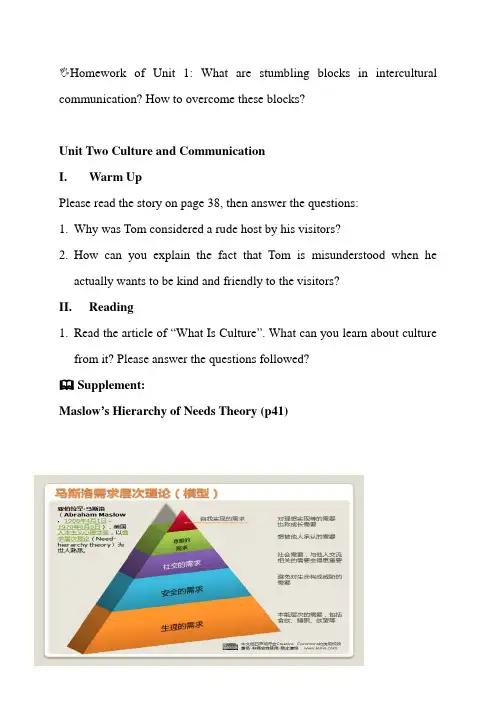
✋Homework of Unit 1: What are stumbling blocks in intercultural communication? How to overcome these blocks?Unit Two Culture and CommunicationI.Warm UpPlease read the story on page 38, then answer the questions:1.Why was Tom considered a rude host by his visitors?2.How can you explain the fact that Tom is misunderstood when heactually wants to be kind and friendly to the visitors?II.Reading1.Read the article of ―What Is Culture‖. What can you learn about culturefrom it? Please answer the questions followed?Supplement:Maslow’s Hierarchy of Needs Theory (p41)What is culture?Origins of culture in English and Chinese(1)―Culture‖ is a loan word from Latin meaning ―cultivating or tilling种田the land‖. It was originally associated with physical activities and production of food. Later, its meaning was extended to include mental, moral, aesthetic美学, educational and intellectual activities. In contemporary English its original meaning is still retained保留. (2)―文化‖ is a native word本族词in Chinese. ―文‖ and ―化‖ were usedtogether in the Warring States战国. ―人文‖ in ―观乎人文,以化成天下‖refers to the interwoven互相编织relationships between the monarch君主and his subjects, fathers and sons, husbands and wives, brothers and friends, and ―化‖means ―changing and/or cultivating‖.When used together, ―文‖and ―化‖mean ―以文教化‖. They were combined into one word in Han Dynasty, with its meaning contrasted with ―nature‖ on one hand and ―primitiveness‖原始and ―savage‖未开化,野蛮on the other hand. So ―文化‖ was originally associated with mental activities.1.DefinitionThe term ―culture‖does not correspond 一致perfectly with ―文化‖. For examples:他没有文化(He is illiterate.)―What really binds 捆绑men together is their culture--- the ideas and the standards they have in common.‖— R. BenedictAccording to The Concise Oxford Dictionary,culture is ―the arts and other manifestations 表现of human intellectual achievement regarded collectively‖.Defining Culture from the Anthropological Perspective人类学观点:♦―Culture consists of patt erns, explicit明确and implicit含蓄, of and for behavior acquired and transmitted by symbols, constituting 组成the distinctive有特色的achievement of human groups, including their embodiments 体现in artifacts史前古器物; the essential core of culture consists of traditional ideas and especially their attached values‖.-----Kroeber and Kluckhohn Defining Culture from the Psychological Perspective♦culture is "the collective programming of the mind which distinguishes the members of one category 种类of people from another".----Geert HofstedeDefining Culture from the Sociological Perspective♦―Culture is defined as a pattern of learned, group-related perception —including both verbal口头and nonverbal language attitudes, values, belief system信念系统, disbelief systems, and behavior‖. Defining Culture from the Intercultural Perspective♦―Culture is a system of shared beliefs, values, customs, behavioursand artifacts that are transmitted from generation to generation through l earning.‖----[Bates and Plog]There are altogether no less than 250 definitions of culture by scholars from several different fields. Despite so, almost all scholars agree that culture has two senses: the broad sense 广义and the narrow sense.A. Culture in its broad senseCulture is the attribute特质of man, or, whatever distinguishes man from the rest part of the world is culture. Based on this, Prof. Lin Dajin provides a Chinese counterpart副本definition: 文化是人类区别于动物的综合特征. It may include the following components:①Materials man has got to satisfy his needs, including science and technology, such as space shuttles航天飞机, airplanes, and cars;②Social institutions社会制度and organizations man has established, including socioeconomic社会经济学的institutions体系, politico-legal institutions, and religious organizations宗教组织;③Knowledge about nature and man himself and artistic development艺术发展, including various subjects such as mathematics数学and education, and artistic forms such as literature, painting, music and dance;④Language and other communication systems such as gestures and facial expressions;⑤Customs, habits and behavioral patterns;⑥Value systems, world views, national traits名族性, aesthetic standards 审美标准and thinking patterns.Culture in this sense is also called ―large C culture‖or academic culture or culture with a big C(大写字母的文化). It‘s culture in general, culture of all nationalities and ethnic groups族群. But we know there are specific cultures such as Chinese, American and British. According to this sense, specific culture can be defined (by Prof. Lin Dajin) as the comprehensive features that distinguish one group (be it a nation, a race or any section of people) of people from another (一个民族区别于另一个民族的综合特征).﹡Dominant culture and subculture亚文化群/co-culture共同培养♦Culture is subdivided 被再分成into dominant culture, mainstream culture, and subculture(s), which coexist 共存within each culture.♦ A subculture resembles似a culture in that it usually encompasses 包含围绕a relatively large number of people and represents the accumulation积累of generations of human striving努力奋斗.However, subcultures have some important differences: they exist within dominant cultures and are often based on economic or social class, ethnicity种族划分, race, or geographic region.Today the tendency is to say ‗co-culture‘ and sub-groups to avoid prejudice.B. Culture in its narrow senseIt's called ―small c culture‖ or anthropological culture or culture with a small c (小写字母的文化). It can be defined as life way of a population, Culture in this sense emphasizes what characterizes the way of life of a people, including components ②, ③, ④, ⑤ and ⑥, with components ②, ④, ⑤ and ⑥ as the central part.Some scholars are interested in ―large C culture‖ while others in ―small c culture‖, depending on the purpose of investigation. We shall focus on culture in its narrow sense.﹡Cultural Identity文化身份文化认同Cultural identity refers to one‘s sense of belonging to a particular culture or ethnic group. People consciously 有意识地,自觉地identify themselves with a group that has a shared system of symbols and meanings as well as norms for conduct.2.Properties 内容of culture(1)I t is human specific.(2)I t is a social phenomenon (contrast between society and nature). It is theembodiment体现of human knowledge, skill and cooperative labor.(3)I t is a national phenomenon for each nature has its own culture.(4)I t is a historical phenomenon. Each culture has some history and eachgeneration contributes to it. But culture won‘t necessarily remain the same.(5)I t is general and abstract.A. Overt CultureB. Covert Culture(公开文化层)Exposed Material Culture,Visible and Easily Described(隐蔽文化层)Hidden in the material culture,Soft or Spiritual culture2. Culture can be viewed as an iceberg. Nine-tenths of an iceberg is out ofsight. The part of the cultural iceberg that is above the water is easy to be noticed. The other part that is hidden below the water and is outside of conscious awareness. It is sometimes called ―deep culture ‖. But what are the things in a culture that can be said to be above or below the water – within or out of our awareness?The Structure of Culture3.Read the article on page 45-48:From this article, we can learn there are three characteristics of culture –coherent, learned, the view of a group of people; and there are three things culture does – culture ranks what is important (or cultures teach values or priorities), culture furnishes attitudes, and culture dictates how to behave.4.Decide whether the following are examples of communications or not?Why?1)You complain to your instructor about your course credits through telephone.2) Two blind people exchange ideas in Braille盲文.3) A German businessman negotiates, through an interpreter口译, with his Chinese counterpart.4) A farmer gives instructions to his ploughing 耕种cow.5) A programmer issues commands to a computer.6) Tom talks to himself while flourishing his toy gun.7) You send an e-mail message to an American friend.8) Jane lies in bed reading a novel.The Basics of Communication:Communication occurs if: 1. two or more people; 2. contact; 3. a shared language; 4. an exchange of information.5.Read the article of ―Elements of Communication‖. What are theelements of communication?Context: four aspects (the physical setting, historical aspect, psychological aspect, culture aspect)Participants: three variables (relationship, gender, culture)Messages: meanings, symbols, encoding and decoding.Channels: the method used to deliver a message (sound, sight, smell, taste, touch, or any combination of these)Noise (干扰): a term used for factors that interfere with the exchange of messages, including external noise, internal noise and semantic noise. Noise is inevitable.Feedback: t he response of a receiver to a sender‘s messagePlease answer the questions followed.Supplement:What Is Communication?There are altogether 126 definitions of communication. Among them the most accepted one defined by L. A. Samovar, et al.Definition:―Communication may be defined as that which happens whenever someone responds to the behavior or the residue剩余of the behavior of another person.‖---- L. A. Samovar, et alA few key points about this definition:① The behavior includes verbal behavior语言行为and non-verbalbehavior. For example, you meet an acquaintance in the street. You smile and nod to each other without uttering发出a word. Then your behavior is non-verbal, and your communication is also non-verbal.So according to this, communication can be divided into verbal communication and non-verbal communication.②As to the meaning of ―behavior residue", here is an example. You leavea note before you go out, and your roommate sees it when coming back and will make certain response. Then this note is your behavior residue. In this case, whether your roommate does something about or just ignores the note, as long as he receives the note, communication happens, but it is non-simultaneous非同时发生的. Therefore, communication can also be divided into simultaneous communication同时通信and non-simultaneous communication.③A behavior, whether intentional故意的or unintentional, conscious or unconscious, once is received, communication occurs. For example, when you are giving a speech, you may blush (unintentional) or repeat the same movement (unconscious), which gives your audience a message that you are nervous.④Feedback is not a prerequisite必要条件of communication. So there may be one-way communication. Hu Wenzhong of Beijing Foreign Studies University once said translation is in fact a kind of (intercultural) communication, because when one is translating, one is in factcommunicating interculturally with the writer of the original work. In deed, written translation is in most cases one-way communication.2. Factors Affecting CommunicationEight specific ingredients of communication:①the source (行为源): a person who has a need to communicate②encoding (编码): an internal activity in which a source creates a message through the selection of verbal and non-verbal symbols (行为源组织信息的内心活动).③message (信息): the result of encoding, once spoken out and received, becomes a message.④channel (渠道): the physical means by which the message is transmitted.⑤the responder (反应者): the person who intercepts拦截the message and as a consequence becomes linked to the source.⑥decoding (译码): the internal activity of the receiver‘s information processing.⑦response (反应): what a receiver decides to do about the message.⑧feedback (反馈): feedback and response are clearly related. Response becomes feedback when received by the source.Of the eight ingredients, the source and the responder, encoding and decoding, are the most important because they are related to persons.Some personal factors may affect communication effectiveness:③sex ②age③temperament气质性格(e.g. introverted and extroverted)④occupation (e.g. businessman, officers, etc.) ⑤social status⑥knowledge structure ⑦life experienceUncertain factors, varying at different time:①intention: though disgusted, you nod or smile for politeness.②mood: someone tells you that it is useless to live in this world. You might have different responses.③status at that time: you, as a guest, can‘t ask the host to help himself to some dish.Objective factors:①time: you never say ―Good morning‖ in the evening.②place:③occasion: you never say ―节哀顺便‖ in a wedding ceremony.3. Communication Types①based on symbols used: verbal and non-verbal②based on media: direct and indirect③based on feedback: two-way and one-way④based on numbers of the sources and responders: one/group-to-one and one/group-to-group⑤based on set responder: directed and non-directed⑥based on the source‘s intention: intentional and unintentional⑦based on the responder‘s activeness: active and passive⑧based on time: simultaneous and non-simultaneous4. Characteristics of Communication (Essentials of Human Communication) p68-73①Communication is dynamic动态的. It is an on-going, ever-changing 千变万化activity. We are sure to be influenced by other‘s message, whether gradually or radically彻底的根本上的.②Communication is symbolic: Symbols are central to the communicationprocess because they represent the shared meanings that are communicated. A symbol is a word, action, or object that stands for or represents a unit of meaning. People's behaviors are frequently interpreted symbolically, as an external representation of feelings, emotions, and internal states.③Communication is systematic系统的: Communication does not occurin isolation or in a vacuum在真空中, but rather is part of a larger system. We send and receive messages not in isolation, but in a specific setting. Setting and environment help determine the words and actions we generate. Dress, language, topic selection, and the like are all adapted to context.④It involves making inferences.⑤It has a consequence.⑥It is interactive (interpersonal communication).⑦It is irreversible.不可逆的不可取消⑧It is contextual.⑨Communication is self-reflective自我反思: Human beings have aunique ability to think about themselves, to watch how they define the world, and to reflect on their past, present, and future.6.Match each of what the first speaker says on the left with what thesecond speaker says on the right to form a dialogue that will make sense, and then decide what is possibly meant by the second speaker in the dialogue. (p57)1)J 2)F 3)A 4)G 5)I 6)H 7)B 8)C 8)D 9)E7.Read the passage of ―Communicating or Communicating Effectively‖on p58 and try to explain why we sometimes find it very difficult to communicate effectively with others, and then suggest what we can do about it.III.Case Study: Students are required to read the cases given carefully and try to analyse them from the viewpoint of IC.。