小学六年级英语语法 一般过去时态
- 格式:doc
- 大小:33.00 KB
- 文档页数:4
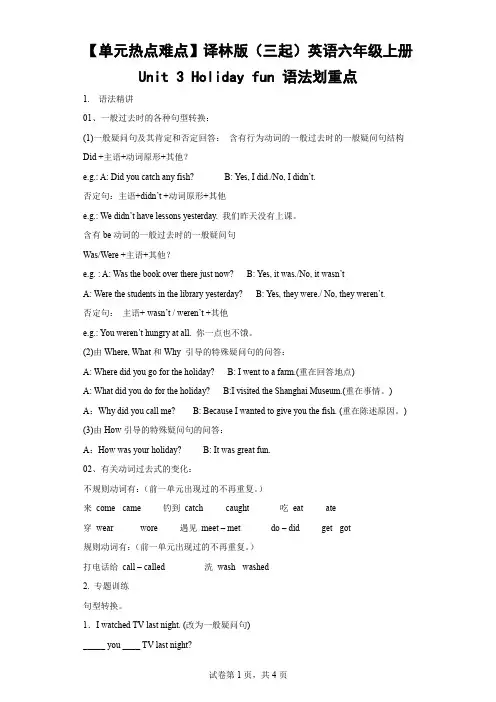
小学六年级英语语法 一般过去时态
(a) be 动词的过去式:
I/He/she/it was(not)…. You/we/they were….
一般疑问句was, were 放在句首。
(b) 动词过去式:
肯定句: I watched cartoons.
She visited the zoo.
一般疑问句: Did you read book last night? Yes, I did. No, I didn't.
Did she clean the desk just now? Yes, she did. No, she didn't.
否定句: They didn't go the the part yesterday.
He didn't make model ships last week.
(3)动词过去式的变化:
规则动词的变化:
Most verbs +ed eg. planted,watered,climbed。
Verbs ending in e +d eg liked。
Verbs ending in a consonant +y --y +ied eg : study-studied
Short verbs ending in a vowel + a consonant eg: stop --stopped
不规则动词的变化:
is/am-was,are-were,do-did,have/has-had,make-made,fly-flew/u:/
eat-ate,take-took,run-ran,sing-sang,drink-drank 等等
小学六年级英语语法 一般现在时
1 一般现在时。通常用 "usually, often, every day, sometimes"。
肯定句:
I go to school on foot every day.
She goes to school on foot every day.
一般疑问句:
Do you jump high? Yes, I do. / No, I don't.
Does he jump high? Yes, he does. / No, he doesn't.
否定句: We don't go to school on Sundays.
My mother doesn't like watching TV in the evening.
小学六年级英语语法 现在进行时
1 现在进行时.通常用"now".
形式: be + verb +ing
eg: I am(not) doing my homework.
You/We/They are(not) reading.
He/She/It is(not) eating.
动词 -ing 的形式
Most verbs +ing walk-walking
Verbs ending in e -e + ing come-coming
Short verbs ending in a vowel + a consonant run -running swim-swimming
小学六年级英语语法 There be 结构
there be 结构
肯定句: There is a …
There are …
一般疑问句:Is there …? Yes, there is./ No, there isn't.
Are there…? Yes, there are. /No, there aren't.
否定句: There isn't …. There aren't….
小学六年级英语语法 形容词及副词的比较级
1.形容词比较级用于两者比较,基本句式为:(A)主格+be|+形容词比较级+
than+B(宾格)。
2.副词比较级 基本句式为:(A)主格+动词|+副词比较级+than+B(宾格)。
3.比较级的用法:①一般+er
②双写最后一个字母+er,如
thin-thinner,big-bigger,fat-fatter,hot-hotter,
③ 不规则的比较级:
good/well-better,many/much-more,far-farther/further
4.一样的情况用as…as,句式为:as 原级 as
5. 注意:too,very+原级
小学六年级英语语法 名词复数规则
2、名词复数规则
(1).一般情况下,直接加-s,如:book-books, bag-bags, cat-cats, bed-beds
(2).以s. x. sh. ch结尾,加-es,如:bus-buses, box-boxes, brush-brushes, watch-watches
(3).以"辅音字母+y"结尾,变y为i, 再加-es,如:family-families,
strawberry-strawberries
(4).以"f或fe"结尾,变f或fe为v, 再加-es,如:knife-knives
(5)不规则名词复数: man ---men, woman---women, policeman---policemen,
policewoman---policewomen, mouse---mice child---children foot---feet,.tooth---teeth
fish---fish, people---people, Chinese---Chinese, Japanese---Japanese
1. 主格一般用在句中作为主语,一般用在动词前(除疑问句)
2. 宾格多用于动词介词后面。
3. 形容词性物主代词后面必须要跟名词。
4. 名次性物主代词=形容词性物主代词+名词
小学六年级英语语法 介词
①in+月、年the morning/afternoon/evening/a week表示时间
②on+具体某一天(几月几日)/某个假期(…Day)
③at+具体某点时间、某个假期(…Festival)/the weekend
①in…street
表示方位 ②on…road/left/right
③at the…crossing/stop/某个具体的地点
①in the tree(不是树上长出来的)
②on the tree(树上原来自己长出来的)
表示时间:① ago(……以前) later(……以后)
② before (在……以前) after(在 ……以后)
1. be动词(am/is/are)
主语 be动词(原形) be动词(过去式)
I am was He/she/it is was
We/you/they are were
2.助动词(do/does/did)
问句 答句
Do+非第三人称单数
+动词原形…?
…do/don't
Does+第三人称单数
…does/doesn't
Did+所有主格
…did/didn't
问句 答句
What do you/they/we…
+动词原形?
I/They/We+动词原形…。
What does he/she/it…
He/She/It +(动词+S)….
What did you/they/we/ he/she/it…
I/They/We/ He/She/It +动词过去式。