英语时态总结 完整
- 格式:docx
- 大小:30.64 KB
- 文档页数:10
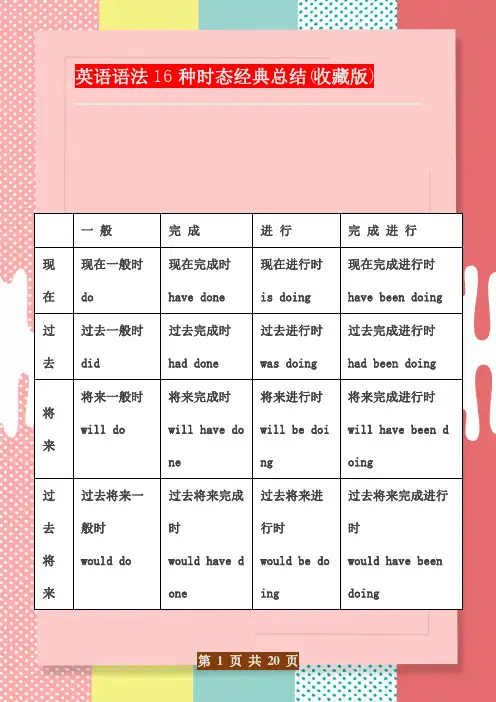
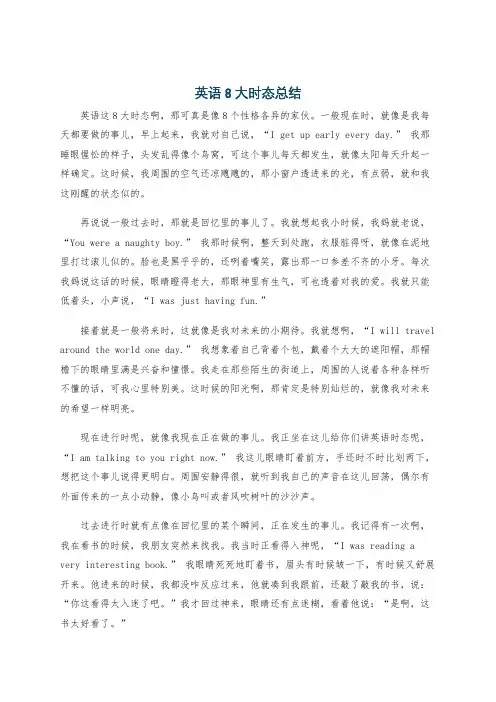
英语时态 英语共有十六个时态、四个体。(注:四个体为——一般、进行、完成、完成进行。) 时态(Tense)是表示行为、动作和状态在各种时间条件下的动词形式。即指的相应时态下的动词形式。分为十六种:一般现在、一般过去、一般将来、过去将来时,以及这四者的进行时、完成时和完成进行时。 (一….十六) 英语中的四个体相当于法语、西班牙语以及所有印欧语系中的式,如:直陈式,命令式等。
(1)一般现在时(一) 基本形式(以do为例): 第三人称单数:does(主语为非第三人称单数); 肯定句:主语+动词原形+其他; He works for us. 否定句:主语+don‘t/doesn't+动词原形+其他; He doesn't work for us. 一般疑问句:Do/Does+主语+动词原形+其他。 肯定回答:Yes,(+ 主语+do/does).
否定回答:No,(+主语+don't/doesn't.)
特殊疑问句:疑问词+一般疑问句语 Does he work for us? Yes, he does. No, he doesn't What does he do for us? He works for us. 用法: A) 表示现在发生的动作、情况、状态和特征 B) 习惯用语 C) 经常性、习惯性动作。例:He always helps others. 他总是帮助别人 D) 客观事实和普遍真理。尤其要注意,如果前后文不是一般现在时,则无法保持主句、从句时态一致 E) 表示一个按规定、计划或安排要发生的动作,(仅限于某些表示“来、去、动、停、开始、结束、继续”等的动词)可以与表示未来时间的状语搭配使用。常见的用法是:飞机、火车、轮船、汽车等定期定点运行的交通方式。例:The mext train leaves at 3 o’clock this afternoon.下一趟火车今天下午3点开车。How often does this shuttle bus run?这班车多久一趟? F) 在时间和条件状语丛句里经常用一般现在时(有时也用现在完成时)表示将来事情。例:When you have finished the report,I will have waited for about 3 hours.等你完成这份报告的时候,我就已经等了将近3个小时。 (2)一般过去时 (五) +的过去式 否定句式:在行为动词前加didn‘t,同时还原行为动词,或was/were+not; 一般疑问句:was或were放于句首;用do的过去式did提问,同时还原行为动词 例如: Did he work for us? He didn't work for us. He worked for us. 用法: A) 表示过去某个时间发生的动作或情况 B) 表示过去习惯性动作.特别是由would /used to do 表达的句型.本身表示的就是过去时 例:The old man would sit on a bench in the quiet park and look at others for hours without doing anything or talking to anybody.老人过去常常坐在宁静的公园里的一条长椅子,看着其他的人,一坐就是数个小时,什么也不干,也不和任何人交谈。 He used to visit his mother once a week.他以前总是每周看望一次他的母亲。 C) 有时可代替一般现在时,表达一种婉转、客气、礼貌、商量的语气。 例 I wanted to ask you if I could borrow your car?我想向你借车用一用,可以吗? Would you mind my sitting here?你介意我坐在这里吗? 注意事项: A)注意时间状语的搭配,一般过去时的时间状语应该是表示过去某个时间的词或词组,如:yesterday,last month,in 1999,two days ago等,绝对不可与recently,in the past 10 years,this month等连用,因为这样的时间状语都与现在有关系,应该用现在完成时或一般现在时。 B)Used to do 的否定形式和疑问形式很特别:你怎么写都正确,以否定的形式为例:usde not to do,didn’t used to do,didn’t use to do都对 Used to do经常与be used to doing sth/sth结构进行对比,前者表示“过去常常或过去曾经”要求加动词原形:后者表示“习惯于”,要求加名词或动名词
(3)一般将来时 (九) am/are/is+going to+do 或 will/shall+do am/is/are/about to + do am/is/are to + do; 一般将来时的表达方法 be going to +动词原形 be +不定式,be to+动词原形,be about to +动词原形 be able to +不定式 be about to+动词原形 will + 动词原形; 例如:He is going to work for us. He will work for us; He is coming.这是特殊的用一般现在时 表达 将来时态 的例子!! 用法: A) 基本结构是will/shall+do 例:We shall send her a glass hand-made craft as her birthday gift.我们将送给她一个玻璃的手工制品,作为给她的生日礼物 B) 有些动词,如:arrive,be close,come,do,done,go,have,leave,open,play, return,sleep,start,stay等,用于一般进行时,并且通常与一个表示将来时间的时间状语连用,可以表示将来时。例:My mother is coming to visit me next week and is staying here until may.我妈妈下周将来看我,并会呆到时五月。 C) 表示“打算去…..,要…….”时,可用be going to do 例:This is just what I am going to say.这正是我想说的。 D) 表示“即将,正要”时,可用be about to do .强调近期内或马上要做的事 例:Don’t worry,I am about to make a close examination on you.别担心,我马上就给你做一次仔细的检查。 E) ‘be to do ‘的5种用法: a) 表示“按计划、安排即将发生某事或打算做某事” 例:She is to be seen in the lab on Monday.星期一你准会在实验室见到她。 b) 该做或不该做的事情(语气上接近于should,must,ought to,have to)表示一种命令、规劝性语气。 例:You are to go to bed and keep quite, guests are arriving in less than 5 minutes.孩子们,你们必须上床睡觉,不准吵闹,我们的客人5分钟之内就要到了。 c) 能或不能发生的事情(接近can,may)例:How am I to pay such a debt?我怎么可能还得起这么大的一笔债呢? d) 不可避免将要发生的事情,后来将要发生的事情。 例I assure you that the matter …B..as quickly as a little patience. be attended be attended to attended attended to will be attended to 关键的一点是:attend表示“处理,解决”时是不及物动词,必须与to连用。另外,从上下文看,事情显然尚未解决,所以应该用将来时的被动语态。答案是B e) 用于条件丛句“如果..想,设想”(接近if…..want to,或if…should) 例:Greater efforts to increase agricultural production must be made if food shortage ....A….avoided. to be be be been 答案是A)is to be 全句的意思是:如果要避免食品短缺,就必须作出更大努力来增加农业产量。 F)同样可以表示“正要,将要”的意思的句型是be on the point of doing 例:The coach is on the point of giving up the game because our team has been scored 7 points.教练想要放弃这场比赛了,因为对方已经射进了7个球。 I was ……the point of telephoning him when his letter arrived. A)in B) to C) at D) on 答案是D on the point of doing是固定词组,意思是“正要,打算”全句的意思是:当他的信到的时候我正要打电话给他。