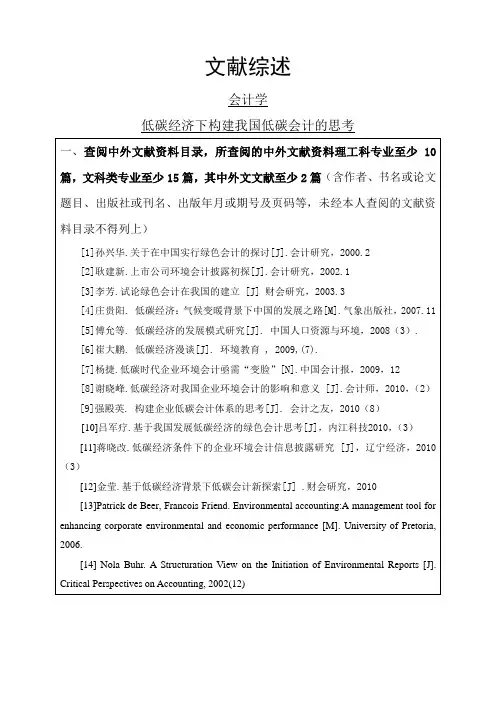
本份文档包含:关于该选题的外文文献、文献综述一、外文文献标题: A practitioner's guide to a low-carbon economy: lessons from the UK作者: Fankhauser, Samuel.期刊: Climate Policy卷: 13;期: 3;页: 345-362;年份: 2013A practitioner's guide to a low-carbon economy: lessons from the UK AbstractPractically all major GHG emitters now have climate change legislation on their statute books. Given what is at stake, and the complexity of the task at hand, it is important that policy makers learn from each other and establish a code of good low-carbon practice. The main lessons from the UK are distilled and presented. Carbon policy is considered for key sectors, such as electricity, buildings, and transport, and possible decarburization paths are also outlined. It is shown that the transition to a low-carbon economy is economically and technologically feasible. Achieving it is primarily a question of policy competence and political will. This in turn means that climate change action needs a strong legislative basis to give the reforms statutory legitimacy. Low-carbon policies will have to address a wide range of market, investment and behavioral failures. Putting a price on carbon is an essential starting point, but only one of many policy reforms.Keywords: climate change policy; decarburization; green growth; low-carbon transition;1. IntroductionMore and more countries are taking action against climate change. Nearly all major GHG emitters, including many emerging markets, now have climate change legislation on their statute books (Town- shend et ak, 2011). It is debatable whether these efforts - and any international agreement that might reinforce them - will be sufficient to limit climate change to an acceptable level. However, given what is at stake, and the complexity of the task at hand, it is important that policy makers learn from one another and establish a code of good low-carbon practice. This article attempts to distil the main lessons from the UK.The climate change debate in the UK is fairly advanced, with a strong legal basis for climate action, ambitious targets, and sophisticated institutional arrangements (Fankhauser, Kennedy, & Skea, 2009). The UK also has a constantly evolving regulatory landscape, with occasional policy failures and U- turns, while a waning commitment among politicians and latent climate scepticism in parts of the press are putting the institutional framework increasingly to the test. As such, the UK is a good case from which to learn lessons.1There is a rich analytical literature on many aspects of climate change policy. For example, much has been written about the relative merit of different policy options (Hepburn, 2006; Pizer, 2002), the design of emissions trading schemes (Fankhauser & Hepburn, 2010a, 2010b; Grüll & Taschini, 2011; Murray, Newell, & Pizer, 2009),policy performance (Ellerman & Buchner, 2008; Ellerman, Convery, de Perthuis, & Alberola, 2010; Martin, Preux, & Wagner, 2009), and low-carbon innovation (Acemoglu, Aghion, Bursztyn, & Heinous, 2009; Aghion, Boulanger, & Cohen, 2011; Aghion, Dechezleprêtre, Heinous, Martin, & van Reenen, 2011; Dechezleprêtre, Glachant, Hascic, Johnstone, & Ménière, 2011; Popp, 2002).This article differs from the existing literature in that it takes an explicitly practical approach. While drawing on the analytical literature, it looks at the specific case of a country that wants to reduce its GHG emissions, in this case the UK. The policy ambition is much deeper than a marginal change in emissions, which is the concern of much of the literature. It is a comprehensive redesign of the modern economy. At the same time, the scope is narrower than that of the green growth literature, which includes wider notions of sustainable development besides low-carbon growth (Bowen & Fan- khauser, 2011). All decarburization efforts will face at least four challenges. First, a strong legal and institutional basis for low-carbon policy must be put in place (Section 2). Second, low-carbon objectives must be translated into a credible roadmap of sector, technology, and reform targets that can guide policy and determine whether the objectives are achievable (Section 3). Third, the necessary policies to implement the roadmap must be put in place (Section 4). Fourth, the wider socio-economic conse- quences of decarburization must be managed (Section 5). It is concluded in Section 6 that the low- carbon transition is achievable if these challenges are met and there is sufficient policy competence and political will.2. Providing the legal and institutional basisThe starting point for economy-wide decarburization is a strong legislative basis. The fundamental reforms to energy, transport, industrial, agricultural, and fiscal policy that will follow will need statu- tory legitimacy. The adoption of a climate change law is also a way of forging the broad political con- sensus needed during implementation. It is striking how many of the climate change laws in major economies have been bipartisan efforts (Townshend et ak, 2011). The UK Climate Change Act of 2008, for example, was passed near-unanimously.Most climate change laws are unifying laws that bring together existing strands of regulation (e.g. on energy efficiency), express a long-term objective, and create a platform for subsequent action. The UK Climate Change Act calls for a cut in GHG emissions of at least 80%, relative to 1990, by 2050. This is based on an ambition to limit median global warming to 2°C and keep the risk of extreme climate change (of say 4°C) to a minimum. The Act also defines the mechanism through which the long- term target is to be met: a series of statutory, 5-year carbon budgets that set a binding ceiling for GHG emissions over that period. The UK has been subject to this economy-wide carbon constraint since 2008.One of the key purposes of the legislation is to make a statement of intent that can subsequently guide policy delivery and reduce uncertainty for decision makers. Although action is required immedi- ately, building a low-carbon economy will take decades, a much longer term than policy makers can credibly commit. This creates problems for businesses, which will mistrust the long-term validity of the plan and hedge their behaviour. An important role of climate change legislation is to overcomesuch time inconsistency problems and instil long-term credibility into the policy effort.The issue is akin to the credibility of inflation targets (Kydland & Prescott, 1977; Barro & Gordon, 1983; Rogoff, 1985), and the institutional remedies that have been proposed for both problems bear some resemblance to one another. An independent institution, the Committee on Climate Change (CCC), was created to recommend and monitor carbon budgets, in the belief that technocrats are more likely to take a long-term view than politicians. However, the carbon budgets are ultimately passed by Parlia- ment to give them statutory credibility. A judicial review is likely if the government systematically ignores the Committee's advice or if key policy decisions are inconsistent with carbon objectives.3. Defining a strategy for deliveryFor the high-level objectives of the climate law to be credible they need to be backed up by a sound implementation strategy. The UK, EU, and many other jurisdictions have developed concrete decarbo- nization roadmaps for this purpose (CCC, 2010; DECC, 2011; EC, 2011). These are not blueprints that need to be implemented to the letter. The markets and private initiative will determine most of the details. However, they represent important strategies that will detennine the speed and direction of travel.These roadmaps are underpinned by a fair amount of technical analysis, which ensures that the strat- egy is technologically and economically rational, as well as consistent with the ultimate emissions objective. Numerical simulation models are well suited to the calculation of the least-cost way of meeting a certain emissions target under given technology constraints. In the UK, both the CCC and the Department of Energy and Climate Change (DECC) have used such models to inform their low-carbon roadmaps. The model evidence used by the CCC, in particular, is quite detailed. Even so, model results are heavily complemented and qualified by professional judgement.Least-cost optimization models (e.g. MARKAL) are used to determine the correct choice of technol- ogies as a function of their cost profiles (CCC, 2010), which are themselves derived from detailed engin- eering studies (e.g. Mott McDonald, 2011). Least-cost models also inform the allocation of scarce resources among competing uses; e.g. in determining whether the limited supply of sustainable biomass should be used for electricity generation, heating, or transport (CCC, 2011a). Detailed models of the electricity market can simulate how the power sector will cope with a rising share of inter- mittent renewables and inflexible nuclear capacity (Pöyry, 2011). Least-cost models provide estimates of the likely economic costs, although these bottom-up estimates should be complemented with general equilibrium or macro-econometric model mns (Barker et ak, 2007).A key question that the roadmap should answer is about the speed of decarbonization: 'What is the most economically rational rate of bringing emissions down?' The anticipated fall in the cost of low- carbon technologies and the effect of discounting suggests that a slow start will be followed by steep emissions reductions later.2 However, progress in reducing technology costs is a function of cumulativeinvestment, not just the passage of time. Postponing low-carbon investment may therefore delay the point at which these technologies become cost-effective. Scientists can also point to the climate benefits of acting early: future climate change is determined by the sum total of emissions over time, and not their level in an arbitrary future year (Meinshausen et ak, 2009), so each year of delay imposes a social and environmental climate cost.Moreover, there are limits to the speed at which emissions may be reduced cost-effectively later. As an illustration, if carbon-intensive capital has a lifetime of 25 years, the maximum annual emissions cut that can be achieved through the regular investment cycle is 4%. To achieve this, all new invest- ment (in both replacement and expansionary capital) would have to be carbon-free. Going beyond 4% would require the premature scrapping of existing capital. This is expensive unless productivity improvements (e.g. through energy efficiency) are so high that an overall reduction in the capital stock is warranted. It is argued below that this is not the case.The UK debate about the speed of reducing emissions has been heavily influenced by the particular time profile of investment needed in UK power sector. A large proportion of UK power plants are due for renewal in the 2020s. This creates both an opportunity and a need to decarbonize power generation early, as the investments made in the 2020s will determine electricity emissions for many decades to come. For these reasons, the CCC has recommended a swift pace of emission reductions in the power sector and an overall abatement path that is only slightly back-loaded (see Figure 1). This decarbonization path has profound implications not just for electricity generation, but for all emitting sectors.3.1. EnergyThe decarbonization of the electricity sector is at the core of the low-carbon transition in UK and all industrialized countries, for several reasons. First, power generation is a major source of GHG emissions (see Figure 1). Second, low-carbon power generation is well-understood and feasible. A number of low- carbon options are available, including renewable energy (wind, solar, biomass, hydro, and in time perhaps even marine), nuclear energy, and the as yet unproven carbon capture and storage (CCS). Although each of these options has its challenges - related to cost (off-shore wind, perhaps nuclear), public acceptability (nuclear, onshore wind), and/or commercial availability (CCS, marine) - they provide an adequate technological basis and choice in low-carbon power generation. Third, decarbo- nized electricity has an important role to play in reducing emissions in other sectors, chief among them transport (through battery electric vehicles), residential heating (through ground source and air source heat pumps), and perhaps some parts of industry.Any combination of renewables, nuclear, and CCS will succeed in bringing down the carbon inten- sity of power production. The choice is determined by cost, environmental considerations, and issues of system operation, and different countries make this choice differently. Germany, for example, has resisted nuclear energy, but invested heavily in solar energy. The UK has emphasized wind power over solar photovoltaics, and so far has accepted nuclear power. It is putting particular emphasis on off- shore wind, which is more expensive than onshore wind but raises fewer localenvironmental concerns (Bassi, Bowen, & Bankhäuser, 2012). The carbon intensity of electricity is required to fall by as much as 90% within 20 years, from over 500 gC02/kWh to 50 gC02/kWh, according to the timetable of the CCC (CCC, 2010). This tight target reduces the scope of intermediate technologies like gas, which might otherwise be attractive. Modern combined cycle gas turbines emit around 350 gC02/kWh, which is a considerable improvement on the current system average but too much in a truly low-carbon power sector. Unless fitted with CCS, future gas-fired power plants will therefore only be used spar- ingly, primarily as back-up capacity. This is a limited but important role. The combination of inter- mittent wind and baseload nuclear power creates challenges for load management, as neither is particularly flexible in responding to short-term fluctuations in demand. Gas can provide that flexibility and balance supply and demand. However, electricity market arrangements in the UK do not currently reward a mode of operation in which a plant is predominantly idle. This will have to change.Current electricity market arrangements create another obstacle to low-carbon investment. Power prices are presently determined competitively to reflect short-term operating costs. Low-carbon tech- nologies, such as nuclear and wind, typically have high capital costs and low operating costs. If they come to dominate the sector and set short-term marginal costs, market prices may fall to a level that is too low to recoup the upfront costs. In this case, further investment would stall.Reform of the electricity market has therefore become an essential prerequisite for decarbonization. After decades of liberalization, the reforms will bring about an increased role for the state. State inter- vention will be aimed, in particular, at rectifying three market failures that would otherwise prevent low-carbon investment. First, the state can put a price on carbon to internalize the climate change externality. Ideally, this would happen through a carbon tax or a stringent emissions trading scheme. The reality in the UK is somewhat more complicated. The EU Emissions Trading Scheme (EU ETS) provides only a relatively weak price signal. The UK has thus legislated a unilateral carbon price floor to strengthen this signal. While this will motivate UK emitters to abate further, it will not reduce EU-wide emissions, which con- tinue to be set by the unchanged ETS cap (Fankhauser & Hepburn, 2010a, 2010b). The price instru- ments are complemented by a regulatory measure, an emissions performance standard set at (a high) 450 gC02/kWh.Second, the state can promote low-carbon (in particular renewable) energy and address market fail- ures related to technology development by using the classic instruments of either renewable energy obligations or feed-in tariffs (Section 4). The UK is moving from the former system to a variation of the latter, with the introduction of contracts for differences in low-carbon energy. Smaller-scale instal- lations benefit from a straight feed-in tariff. These demand-pull measures are complemented by a mod- erate supply-push from a new green investment bank, which will offer renewable energy investors improved access to finance. An investment subsidy is available for CCS pilots, although this process has been very slow.Third, the state can focus on the need to ensure investment into back-up capacity, as discussed above. In the UK, this will be achieved through the introduction of capacitypayments. The economic merit and practical challenges of this policy mix are further discussed in Section 4.3.2. TransportSurface transport is the second most important source of GHG emissions in the UK after electricity (see Figure 1). Cars dominate transport emissions, although emissions from lorries, vans, and buses are also substantial. Rail accounts for no more than 2% of the transport total.The strategy to reduce car emissions is two-pronged. In the short term, the emphasis is on reducing the carbon intensity of conventional cars through technological improvements and providing drivers with incentives to switch to more efficient cars. The UK has adopted an EU target to reduce the carbon intensity of new cars from current figure of around 145 g/km to 95 g/km in 2020. There is a similar target for vans.In the medium term, further efficiency improvements will have to come from new technologies (e.g. battery electric cars, plug-in electric vehicles, and perhaps fuel-cell-based vehicles). Biofuels will also play a role, with the limited amount of sustainable biofuel probably best targeted at heavy goods vehicles and aviation (where there are fewer alternatives). The CCC has calculated that 60% of new cars sold in 2030 will need to be electric (CCC, 2010), rising to 100% by 2035 for a fully electric car fleet in the late 2040s. These are very ambitious targets, which, if met, will have repercussions on elec- tricity demand and the country's refuelling infrastmcture.In comparison to technology, the role of demand-side measures will be relatively modest and insuf- ficient to reverse the growth in driving-kilometres, although it will nevertheless be important. Changes in travel behaviour, such as eco-driving, better journey planning, car sharing, and modal shift, can have a significant effect, but alterning entrenched behaviour patterns will require persistent effort (as suggested in a recent UK pilot study on 'smarter choices'; CCC, 2010).As in the power sector, a diverse set of policies are in place to encourage the transition. Arguably the most powerful - fuel duty - is primarily a fiscal measure; it accounts for almost 5% of total government income and is the most important source of indirect tax revenue after V AT (Adam & Browne, 2011). Fuel duty helps to correct a multitude of transport-related externalities. If the entire levy were treated as a carbon tax, the implicit tax rate would be over £200 per tC02 (Bowen & Rydge, 2011).In addition, other vehicle-related taxes, such as excise duty or company car tax, are differentiated by carbon efficiency. Electric cars are subsidized by up to £5000 per vehicle, while matched funding for recharging stations is provided under the Plug-In Places programme. These policies have been rela- tively effective. Since 2008, the carbon intensity of new cars in the UK has fallen by about 9%, although the uptake of electric cars is still very low.3.3. Residential buildings and industryThe buildings and industrial sectors, when combined, account for over two-thirds of UK GHG emis- sions. A large part of these are indirect emissions from electricity use, which are assigned to the power sector in carbon accounts. However, both direct and indirect emissions are important from a demand-management perspective.The initial focus for reducing residential and industry emissions is on energy efficiency. There is much debate about the potential of energy-efficiency measures that are available at low or zero econ- omic cost. In the UK, the CCC expects a 23% reduction in non-electric energy use in buildings and industry by 2020, relative to 2007, and a 13% reduction in electricity use (CCC, 2012).Over the medium term, the focus may shift from energy efficiency to renewable heat. The CCC expects the share of renewable heat to rise from the current 1% of heat demand to 12% in 2020, much of it back-loaded, as renewable heat is still relatively expensive. From the late 2020s onwards, further decarbonization will require currently expensive options such as solid wall insulation and heat pumps. Additional measures in industry are difficult and will require new emissions reduction techniques. Options include industrial CCS, process innovation, and product substitution, none of which is as yet proven.Energy-efficiency gains are notoriously elusive. There are a multitude of policy, market, and behav- ioural barriers, some of which are well understood, others less so. This is mirrored in the policy frame- work. No other aspect of UK low-carbon agenda has seen more policy experimentation, and nowhere else is the policy landscape more complex. Although regulatory measures dominate, there are price incentives in the form of a Climate Change Levy (a carbon-cum-energy tax) and the indirect effect of the EU ETS, the cost of both are passed through to end-users. Energy-intensive businesses can avoid the Climate Change Levy by entering into a voluntary Climate Change Agreement; around 50 sectors have already done so.Renewable heat is subsidized through a renewable heat incentive. The service sector has its own mechanism, the CRC Energy Efficiency scheme, which relies on a combination of reputation effects (through a performance league table) and price incentives (through a carbon tax, later to be converted into a trading scheme). Residential energy efficiency has been promoted primarily through a succes- sion of supplier obligations (which commit energy utilities to certain energy savings or carbon emis- sions targets in their client base) and the much-vaunted Green Deal, which promises easier access to energy-efficiency finance by tying loans to the energy meter rather than householders. Despite this flurry of activity, progress in increasing residential and industrial energy efficiency has been mixed (CCC, 2012).3.4. AgricultureAgriculture accounts for perhaps 10% of UK GHG emissions, most in the form of methane (CH4) and nitrous oxide (N20) (CCC, 2012). There are accounting issues, however: agricultural and land-use emis- sions are known with much less certainty than energy-related emissions. Similarly, low-GHG options for agriculture are less well understood than decarbonization in other sectors.The available evidence suggests that there is scope to reduce emissions further, e.g. through increased feed efficiency and dietary changes in livestock, the deployment of anaerobic digestion systems, and better nutrient management for crops. However, beyond these low-cost measures, deep decarbonization maybe difficult. On the supply side, further action may engender ethical and environ- mental issues (e.g. related to animal welfare and the role of genetically modified food). On the demand side,behavioural change with respect to diets is likely to be controversial (although it would have sub- stantial health benefits; see Ganten, Haines, & Souhami, 2010). It is therefore likely that agricultural emissions (together with sectors such as aviation) will account for an increasing fraction of the increas- ingly tighter carbon budgets over the longer term.Although agriculture is one of the most highly regulated sectors in the UK economy, the policy approach to agricultural decarbonization has chiefly relied on voluntary action. Opportunities to reduce emissions through adjustments in existing policies, such as the EU Nitrates Directive or the Common Agricultural Policy, have not been taken up. Consequently, emissions have primarily been reduced as a result of unrelated policies and developments. Fertilizer-related emissions, for example, have fallen significantly as a consequence of higher prices and regulation. (A similar story holds for waste management, where methane emissions have fallen sharply as a by-product of an aggressive landfill tax.)4. Designing policiesAs discussed in the previous section, policy measures to create a low-carbon economy are needed on three fronts (Stern, 2006). First, a price should be put on carbon to internalize the climate change externality. Second, low-carbon technology should be promoted by addressing externalities and market failures related to innovation. Third, carbon-efficient behaviour and investment should be encouraged, in particular to unlock the existing energy-efficiency potential.Although the emphasis is often on the carbon price, all three sets of policies are equally important. As shown in the previous section (see also Bowen & Rydge, 2011), the UK has an elaborate low-carbon policy landscape. There are measures to put a price on carbon (e.g. the EU ETS, Climate Change Levy, carbon price support), to support new technologies (e.g. renewable energy obligations, renewable heat incentives, feed-in tariffs), to provide investor confidence (e.g. electricity market reforms), to change energy-efficiency behaviour (e.g. CRC Energy Efficiency Scheme, supplier obligations), and to facilitate access to finance (e.g. Green Deal, Green Investment Bank). Despite this complexity, which itself poses challenges, independent observers have expressed doubt that the UK policy environment is sufficient to meet the targets the country has set itself (CCC, 2010).4.1. Putting a price on carbonThere are two generic ways of putting a price on carbon: taxation or an emissions trading scheme.3 There is a large body of literature, going back to Weitzman (1974), on the relative merits of the two options (see Hoel & Karp, 2001; Newell & Pizer, 2003). Most economists probably favour a carbon tax, although where there are mandatory carbon constraints (as in the UK) the traditional Weitzman argu- ment would advocate quantity-based policies.4In practice, policy makers have been swayed less by theoretical niceties than by political realities, and in most cases an emissions trading scheme is easier to implement than a carbon tax: it creates a valuable asset - emissions permits - which can be used to pacify industry. In the case of the EU ETS, the stock of permits is worth around euro20 billion a year, and handing them out for free has indeed beensufficient to secure industry buy-in. However, there has also been a backlash against the windfall profits enjoyed by carbon 'fat cats' (Sandbag, 2011). Indeed, the European Commission has found it hard to reverse the practice of free allocation. This suggests that the use of free permits should be cur- tailed as much as possible from the outset, although some will be necessary to create consensus. The EU ETS has yielded a wealth of other practical lessons, including the need to manage price fluctuations (e.g. through an auction reserve price) and the importance of competent regulation (see Ellerman et ak, 2010; Fankhauser & Hepburn, 2010a, 2010b, for a review).Even in the presence of an emissions trading scheme, most countries have complementary taxes that cover emissions outside the scheme, strengthen the price signal within it, address other externalities, or simply raise revenue. Levying taxes on top of a trading scheme will have a detrimental effect on the carbon permit price and reduce the gains from trade (Fankhauser & Hepburn, 2010a, 2010b), but there is merit in using the two instruments in parallel in different parts of the economy.The most effective way of sending a carbon price signal through taxation is a pure carbon (or carbon- equivalent) tax, probably levied upstream as this would be administratively easier. In practice, policy makers often opt for a combination of carbon and energy taxes, hoping to meet different objectives with one instrument, or responding to industry pressure. The result can be widely different carbon prices across sectors and therefore a potentially inefficient allocation of the abatement burden. Accord- ing to Mirrlees et ak (2011), the implicit carbon tax on UK transport and energy emissions ranges from zero to almost £250 per tC02.5 The potential for green taxes and green tax reform is discussed by the Green Fiscal Commission (2009).4.2. Promoting low-carbon innovationThe central role of new technologies in decarbonization makes innovation policy a critical part of the low-carbon strategy. There are well-known externalities in research and innovation, most of them generic and not related to climate change. Countries have research and development (R&D) policies to address them, such as research grants, innovation prizes, patents, and tax credits, all of which are available to low-carbon innovators.The question then is whether there are additional market failures involved in low-carbon inno- vation that require further intervention, or whether the combination of a carbon price (to correct the climate externality) and R&D support (to address innovation externalities) would be sufficient. Aghion, Boulanger et ak (2011) have suggested there is a need for further intervention and has found evidence of path dependence - e.g. in the automotive industry (Aghion, Dechezleprêtre, et ak, 2011) - which makes traditional high-carbon research more likely than low-carbon innovation. High-tech firms may also find it harder to access finance because they create few tangible assets at the outset.There are a number of market or system failures that prevent new technologies from moving along the innovation chain towards successful commercialization (Foxon et ah, 2005), including a well- documented 'valley of death' between demonstration and pre-commercial deployment (Gmbh, 2004). Policy intervention is therefore required,。