
大学英语写作讲座1
- 格式:ppt
- 大小:113.50 KB
- 文档页数:21


课程名称:大学英语读写教程授课对象:大一新生课时:2课时教学目标:1. 让学生掌握阅读技巧,提高阅读速度和理解能力。
2. 培养学生的写作能力,提高写作水平。
3. 增强学生的英语语感和表达能力。
教学重点:1. 阅读技巧的掌握和运用。
2. 写作能力的培养和提高。
教学难点:1. 阅读理解中的长难句分析。
2. 写作中语言表达的准确性和流畅性。
教学过程:第一课时:一、导入1. 复习上节课的内容,让学生回顾所学知识。
2. 引导学生思考:如何提高阅读速度和理解能力?二、阅读技巧讲解1. 讲解快速阅读的方法,如:略读、扫读、预测等。
2. 分析长难句的结构,讲解如何分析句子成分和逻辑关系。
3. 强调关键词汇的掌握,提高阅读理解能力。
三、阅读练习1. 分组讨论,让学生在小组内进行阅读练习。
2. 针对练习中的问题进行讲解和解答。
四、课堂小结1. 总结本节课所学内容,强调阅读技巧的重要性。
2. 布置课后阅读任务,让学生巩固所学知识。
第二课时:一、导入1. 回顾上节课的内容,让学生谈谈自己的阅读体会。
2. 引导学生思考:如何提高写作水平?二、写作技巧讲解1. 讲解写作的基本结构,如:引言、正文、结论等。
2. 分析写作中的常见错误,如:语法错误、逻辑错误等。
3. 强调语言表达的准确性和流畅性。
三、写作练习1. 分组讨论,让学生在小组内进行写作练习。
2. 针对练习中的问题进行讲解和解答。
四、课堂小结1. 总结本节课所学内容,强调写作技巧的重要性。
2. 布置课后写作任务,让学生巩固所学知识。
教学评价:1. 课堂参与度:观察学生在课堂上的表现,了解他们对阅读和写作的兴趣和积极性。
2. 课后作业完成情况:检查学生的课后阅读和写作任务完成情况,了解他们的学习效果。
3. 课堂提问回答情况:通过提问了解学生对所学知识的掌握程度。
教学反思:1. 根据学生的学习情况和课堂反馈,调整教学策略和方法。
2. 关注学生的个体差异,因材施教,提高教学效果。

大学讲座的英文作文英文:Recently, I attended a lecture at my university and it was quite an interesting experience. The speaker was a renowned expert in the field of psychology and he spoke about the importance of emotional intelligence in our daily lives.He started off by defining emotional intelligence as the ability to recognize, understand and manage our own emotions as well as the emotions of others. He then went on to explain how emotional intelligence can help us in our personal and professional lives. For instance, he gave an example of how a manager with high emotional intelligence can effectively communicate with his team and resolve conflicts in a constructive manner.Another interesting point he made was about the impact of technology on our emotional intelligence. He argued thatwith the rise of social media and other forms of digital communication, we are becoming increasingly disconnected from our emotions and those of others. He emphasized the need to consciously cultivate emotional intelligence in order to maintain healthy relationships and lead fulfilling lives.Overall, I found the lecture to be very insightful and thought-provoking. It made me reflect on my own emotional intelligence and how I can work on improving it.中文:最近,我参加了一场在大学举办的讲座,这是一次非常有趣的经历。

Find out the point and support in the following paragraph and essay.The Hazards of Movie-goingAlthough I love movies, I’ve found that there are drawbacks to movie-going. One problem is just the inconvenience of it all. To get to the theater, I have to drive for at least thirty minutes or more if traffic is bad. It can take forever to find a parking spot, and then I have to walk across a huge parking lot to the theater. There I encounter long lines, sold-out shows, and ever-increasing prices. And I hate sitting with my feet sticking to the floor because of other people’s spilled snacks. Another problem is my lack of self-control at the theater. I often stuff myself with unhealthy calorie-laden snacks. My choices might include a bucket of popcorn, a box of Milk Duds, a giant soda, or all three. The worst problem is some of the other moviegoers. Kids run up and down the aisle. Teenagers laugh and shout at the screen. People of all ages drop soda cups and popcorn tubs, cough and burp (打嗝), and talk to one another. All in all, I would rather stay home and wait to see the latest movie hits on cable TV in the comfort of my own living room.The Hazards of Movie-goingI am a movie fanatic. My friends count on me to know movie trivia and to remember every big Oscar awarded since I was in grade school. My friends, though, have stopped asking me if I want to go out to the movies. While I love movies as much as ever, the inconvenience of going out, the temptations of the theater, and the behavior of some patrons are reasons for me to wait and rent the video.To begin with, I just don’t enjoy the general hassle (trouble) of the evening. Since small local movie theaters are a thing of the past, I have to drive for thirty minutes to get to the nearest multiplex. The parking lot is shared with several restaurants and a supermarket, so it’s always jammed. I have to drive around at a snail’s pace (像蜗牛般爬行) until I spot another driver backing out. Then it’s time to stand in an endless line, with the constant threat that tickets for the show I want will sell out. If we do get tickets, the theater will be so crowded that I won’t be able to sit with my friends, or we’ll have to sit in a front row gaping up at a giant screen. I have to shell out (pay) a ridiculous amount of money ―up to $8 ―for a ticket. That entitles me to sit while my shoes seal themselves to a sticky floor coated with spilled soda, bubble gum, and crushed Raisinets.Second, the theater offers tempting snacks that I really don’t need. Like most of us, I have to battle an expanding waistline. At home I do pretty well by simply not buying stuff that is bad for me. I can make do with (设法/勉强应付) snacks like celery (芹菜) and carrot sticks because there is no ice cream in the freezer. Going to the theater, however, is like spending my evening in a Seven-Eleven that’s been equipped with a movie screen and comfortable seats. As I try to persuade myself to just have a diet Coke, the smell of fresh popcorn dripping with butter soon overcomes me. Chocolate bars, the size of small automobiles, seem to jump into my hands. I risk pulling out my fillings (补牙用填料) as I chew enormous mouthfuls of Milk Duds. By the time I leave the theater, I feel disgusted with myself.Many of the other patrons are even more of a problem than the concession stand (影院里的贩卖处). Little kids race up and down the aisles, usually in giggling packs. Teenagers try to impress their friends by talking back to (反驳/回嘴) the screen, whistling, and making what they consider to be hilarious (欢闹的) noises. Adults act as if they were at home in their own living room. They comment loudly on the ages of the stars and reveal plot twists that are supposed to be a secret until the film’s end. And people of all ages create distractions. They crinkle (弄皱) candy wrappers, stick gum on their seats, and drop popcorn tubs or cups of crushed ice and soda on the floor. They also cough and burp, squirm (蠕动) endlessly in their seats, file out (鱼贯而出) for repeated trips to the rest rooms or concession stands, and elbow me out of the armrest on either side of my seat.After arriving home from the movies one night, I decided that I was not going to be a moviegoer anymore. I was tired of the problems involved in getting to the theater, resisting unhealthy snacks, and dealing with the patrons. The next day, I arranged to have premium (额外花费) movie channels installed as part of my cable TV service, and I also got a membership at my local video store. I may now see movies a bit later than other people, but I’ll be more relaxed watching box office hits in the comfort of my own living room.。
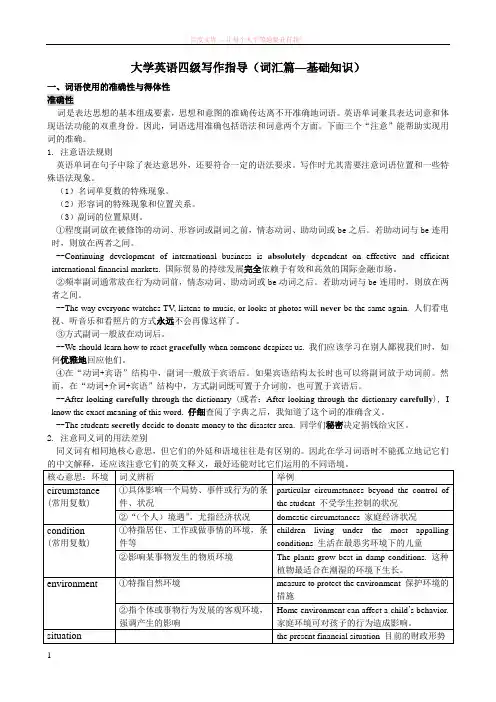
大学英语四级写作指导(词汇篇—基础知识)一、词语使用的准确性与得体性准确性词是表达思想的基本组成要素,思想和意图的准确传达离不开准确地词语。
英语单词兼具表达词意和体现语法功能的双重身份。
因此,词语选用准确包括语法和词意两个方面。
下面三个“注意”能帮助实现用词的准确。
1. 注意语法规则英语单词在句子中除了表达意思外,还要符合一定的语法要求。
写作时尤其需要注意词语位置和一些特殊语法现象。
(1)名词单复数的特殊现象。
(2)形容词的特殊现象和位置关系。
(3)副词的位置原则。
①程度副词放在被修饰的动词、形容词或副词之前,情态动词、助动词或be之后。
若助动词与be连用时,则放在两者之间。
--Continuing development of international business is absolutely dependent on effective and efficient international financial markets.国际贸易的持续发展完全依赖于有效和高效的国际金融市场。
②频率副词通常放在行为动词前,情态动词、助动词或be动词之后。
若助动词与be连用时,则放在两者之间。
--The way everyone watches TV, listens to music, or looks at photos will never be the same again. 人们看电视、听音乐和看照片的方式永远不会再像这样了。
③方式副词一般放在动词后。
--We should learn how to react gracefully when someone despises us.我们应该学习在别人鄙视我们时,如何优雅地回应他们。
④在“动词+宾语”结构中,副词一般放于宾语后。
如果宾语结构太长时也可以将副词放于动词前。
然而,在“动词+介词+宾语”结构中,方式副词既可置于介词前,也可置于宾语后。