
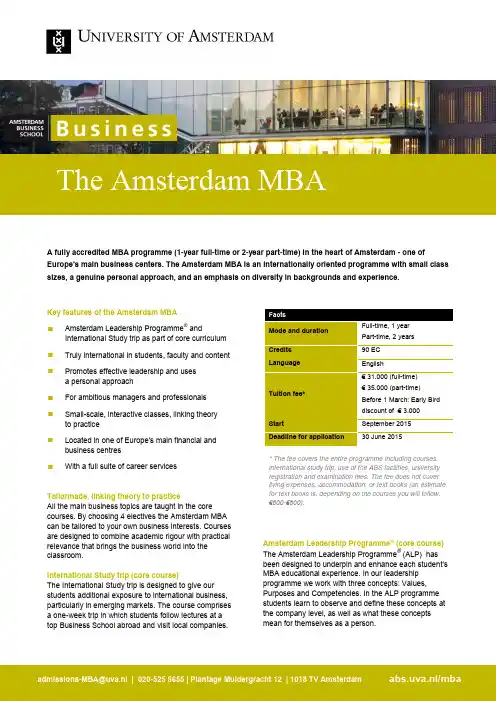
the-amsterdam-mba-factsheet2014
- 格式:pdf
- 大小:552.98 KB
- 文档页数:2

2014年Text 1※In order to “change lives for the better” and reduce “dependency” George Osborne, Chancellor of the Exchequer, introduced the “upfront work search” scheme.Only if the jobless arrive at the job centre with a CV, register for online job search, and start looking for work will they be eligible for benefit and then they should report weekly rather than fortnightly. What could be more reasonable?※More apparent reasonableness followed. There will now be a seven-day wait for the jobseeker’s allowance. “Those first few days should be spent looking for work, not looking to sign on.” he claimed.“We’re doing these things because we know they help people stay off bene fits and help those on benefits get into work faster.” Help? Really?On first hearing, this was the socially concerned chancellor, trying to change lives for the better, complete with “reforms” to an obviously indulgent system that demands too little effort from the newly unemployed to find work, and subsidizes laziness.What motivated him, we were to understand, was his zeal for “fundamental fairness”— protecting the taxpayer, controlling spending and ensuring that only the most deserving claimants received their benefits.※Losing a job is hurting: you don’t skip down to the jobcentre with a song in your heart, delighted at the prospect of doubling your income from the generous state.It is financially terrifying, psychologically embarrassing and you know that support is minimal and extraordinarily hard to get. You are now not wanted; you support is minimal and extraordinarily hard to get.You are now not wanted; you are now excluded from the work environment that offers purpose and structure in your life. Worse, the crucial income to feed yourself and your family and pay the bills has disappeared. Ask anyone newly unemployed what they want and the answer is always: a job.※But in Osborneland, your first instinct is to fall into dependency—permanent dependency if you can get it — supported by a state only too ready to indulge your falsehood.It is as though 20 years of ever-tougher reforms of the job search and benefit administration system never happened. The principle of British welfare is no longer that you can insure yourself against the risk of unemployment and receive unconditional payments if the disaster happens.Even the very phrase “jobseeker’s allowance” is about redefining the unemployed as a “jobseeker” who had no fundamental right to a benefit he or she has earned through making national insurance contributions.Instead, the claimant receives a time-limited “allowance,” conditional on actively seeking a job; no entitlement and no insurance, at £71.70 a week, one of the least generous in the EU.21.George Osborne’s scheme was intended to.[A] provide the unemployed with easier access to benefits*B+ encourage jobseekers’ active engagement in job seeking[C] motivate the unemployed to report voluntarily*D+ guarantee jobseekers’ legitimate right to benefits22.The phrase, “to sign on” (Line 3, Para.2) most probably means.[A] to check on the availability of jobs at the jobcentre[B] to accept the government’s restrictions on the allowance[C] to register for an allowance from the government[D] to attend a governmental job-training program23.What prompted the chancellor to develop his scheme?[A] A desire to secure a better life for all.[B] An eagerness to protect the unemployed.[C] An urge to be generous to the claimants.[D] A passion to ensure fairness for taxpayers.24.According to Paragraph 3, being unemployed makes one feel.[A] uneasy[B] enraged[C] insulted[D] guilty25.To which of the following would the author most probably agree?*A+ The British welfare system indulges jobseekers’ laziness.*B+ Osborne’s reforms will reduce the risk of unemployment.*C+ The jobseekers’ allowance has m et their actual needs.[D] Unemployment benefits should not be made conditional.Text 2※All around the world, lawyers generate more hostility than the members of any other profession—with the possible exception of journalism. But there are few places where clients have more grounds for complaint than America.※During the decade before the economic crisis, spending on legal services in America grew twice as fast as inflation. The best lawyers made skyscrapers-full of money, tempting ever more students to pile into law schools.But most law graduates never get a big-firm job. Many of them instead become the kind of nuisance-lawsuit filer that makes the tort system a costly nightmare.※There are many reasons for this. One is the excessive costs of a legal education. There is just one path for a lawyer in most American states: a four-year undergraduate degree in some unrelated subject, then a three-year law degree at one of 200 law schools authorized by the American Bar Association and an expensive preparation for the bar exam.This leaves today’s average law-school graduate with $100,000 of debt on top of undergraduate debts. Law-school debt means that many cannot afford to go into government or non-profit work, and that they have to work fearsomely hard.※Reforming the system would help both lawyers and their customers. Sensible ideas have been around for a long time, but the state-level bodies that govern the profession have been too conservative to implement them.One idea is to allow people to study law as an undergraduate degree. Another is to let students sit for the bar after only two years of law school. If the bar exam is truly a stern enough test for a would-be lawyer, those who can sit it earlier should be allowed to do so. Students who do not need the extra training could cut their debt mountain by a third.※The other reason why costs are so high is the restrictive guild-like ownership structure of the business. Except in the District of Columbia, non-lawyers may not own any share of a law firm.This keeps fees high and innovation slow. There is pressure for change from within the profession, but opponents of change among the regulators insist that keeping outsiders out of a law firm isolates lawyers from the pressure to make money rather than serve clients ethically.※In fact, allowing non-lawyers to own shares in law firms would reduce costs and improve services to customers, by encouraging law firms to use technology and to employ professional managers to focus on improving firms’ ef ficiency. After all, other countries, such as Australia and Britain, have started liberalizing their legal professions. America should follow.26.A lot of students take up law as their profession due to.[A] the growing demand from clients[B] the increasing pressure of inflation[C] the prospect of working in big firms[D] the attraction of financial rewards27.Which of the following adds to the costs of legal education in most American states?[A] Higher tuition fees for undergraduate studies.[B] Admissions approval from the bar association.*C+ Pursuing a bachelor’s degree in another major.[D] Receiving training by professional associations.28.Hindrance to the reform of the legal system originates from.*A+ lawyers’ and clients’ strong resistance[B] the rigid bodies governing the profession[C] the stem exam for would-be lawyers[D] non-professionals’ sharp criticism29.The guild-like ownership structure is considered “restrictive”partly because it.[A] bans outsiders’ involvement in the profession[B] keeps lawyers from holding law-firm shares[C] aggravates the ethical situation in the trade[D] prevents lawyers from gaining due profits30.In this text, the author mainly discusses.[A] flawed ownership of America’s law firms and its causes[B] the factors that help make a successful lawyer in America*C+ a problem in America’s legal profession and solutions to it*D+ the role of undergraduate studies in America’s legal educationText 3※The US $ 3-million Fundamental physics prize is indeed an interesting experiment, as Alexander Polyakov said when he accepted this year’s award in March. And it is far from the only one of its type.As a News Feature article in Nature discusses, a string of lucrative awards for researchers have joined the Nobel Prizes in recent years. Many, like the Fundamental Physics Prize, are funded from the telephone-number-sized bank accounts of Internet entrepreneurs.These benefactors have succeeded in their chosen fields, they say, and they want to use their wealth to draw attention to those who have succeeded in science.※What’s not to like? Quite a lot, according to a handful of scientists quoted in the News Feature. You cannot buy class, as the old saying goes, and these upstart entrepreneurs cannot buy their prizes the prestige of the Nobles, The new awards are an exercise in self-promotion for those behind them, say scientists.They could distort the achievement-based system of peer-review-led research. They could cement the status quo of peer-reviewed research. They do not fund peer-reviewed research. They perpetuate the myth of the lone genius.※The goals of the prize-givers seem as scattered as the criticism. Some want to shock, others to draw people into science, or to better reward those who have made their careers in research.※As Nature has pointed out before, there are some legitimate concerns about how science prizes—both new and old—are distributed. The Breakthrough Prize in Life Sciences, launched this year, takes an unrepresentative view of what the lifesciences include.But the Nobel Foundation’s limit of three recipients per prize, each of whom must still be living, has long been outgrown by the collaborative nature of modern research—as will be demonstrated by the inevitable row over who is ignored when it comes to acknowledging the discovery of the Higgs boson.The Nobles were, of course, themselves set up by a very rich individual who had decided what he wanted to do with his own money. Time, rather than intention, has given them legitimacy.※As much as some scientists may complain about the new awards, two things seem clear. First, most researchers would accept such a prize if they were offered one.Second, it is surely a good thing that the money and attention come to science rather than go elsewhere, It is fair to criticize and question the mechanism—that is the culture of research, after all—but it is the prize-givers’ money to do with as they please. It is wise to take such gifts with gratitude and grace.31.The Fundamental Physics Prize is seen as .*A+ a symbol of the entrepreneurs’ wealth[B] a possible replacement of the Nobel Prizes*C+ an example of bankers’ investments[D] a handsome reward for researchers32.The critics think that the new awards will most benefit.[A] the profit-oriented scientists[B] the founders of the new awards[C] the achievement-based system[D] peer-review-led research33.The discovery of the Higgs boson is atypical case which involves.*A+ controversies over the recipients’status[B] the joint effort of modern researchers[C] legitimate concerns over the new prizes[D] the demonstration of research findings34.According to Paragraph 4,which of the following is true of the Nobles?[A] Their endurance has done justice to them.[B] Their legitimacy has long been in dispute.[C] They are the most representative honor.[D] History has never cast doubt on them.35.The author believes that the now awards are.[A] acceptable despite the criticism[B] harmful to the culture of research[C] subject to undesirable changes[D] unworthy of public attentionText 4※“The Heart of the Matter,” the just-released report by the American Academy of Arts and Sciences (AAAS), deserves praise for affirming the importance of the humanities and social sciences to the prosperity and security of liberal democracy in America.Regrettably, however, the report’s failure to address the true nature of the crisis facing liberal education may cause more harm than good.※In 2010, leading congressional Democrats and Republicans sent letters to the AAAS asking that it identify actions that could be taken by “federal, st ate and local governments, universities, foundations, educators, individual benefactors and others” to “maintain national excellence inhumanities and social scientific scholarship and education.”In response, the American Academy formed the Commission on the Humanities and Social Sciences. Among the commission’s 51 members are top-tier-university presidents, scholars, lawyers, judges, and business executives, as well as prominent figures from diplomacy, filmmaking, music and journalism.※The goals identified in the report are generally admirable. Because representative government presupposes an informed citizenry, the report supports full literacy; stresses the study of history and government, particularly American history and American government; and encourages the use of new digital technologies.To encourage innovation and competition, the report calls for increased investment in research, the crafting of coherent curricula that improve students’ ability to solve problems and communicate effectively in the 21st century, increased funding for teachers and the encouragement of scholars to bring their learning to bear on the great challenges of the day.The report also advocates greater study of foreign languages, international affairs and the expansion of study abroad programs.※Unfortunately, despite 2½ years in the making, “The Heart of the Matter” never gets to the heart of the matter: the illiberal nature of liberal education at our leading colleges and universities.The commission ignores that for several decades America's colleges and universities have produced graduates who don’t know the content and character of liberal education and are thus deprived of its benefits.Sadly, the spirit of inquiry once at home on campus has been replaced by the use of the humanities and social sciences as vehicles for publicizing “progressive,” or left-liberal propaganda.※Today, professors routinely treat the progressive interpretation of history and progressive public policy as the proper subject of study while portraying conservative or classical liberal ideas—such as free markets and self-reliance—as falling outside the boundaries of routine, and sometimes legitimate, intellectual investigation.※The AAAS displays great enthusiasm for liberal education. Yet its report may well set back reform by obscuring the depth and breadth of the challenge that Congress asked it to illuminate.36. According to Paragraph 1, what is the author’s attitude toward the AAAS’s report?[A] Critical[B] Appreciative[C] Contemptuous[D] Tolerant37. Influential figures in the Congress required that the AAAS report on how to.*A+ retain people’s interest in liberal education*B+ define the government’s role in education[C] keep a leading position in liberal education*D+ safeguard individuals’ rights to education38. According to Paragraph 3, the report suggests.[A] an exclusive study of American history[B] a greater emphasis on theoretical subjects[C] the application of emerging technologies[D] funding for the study of foreign languages39. The author implies in Paragraph 5 that professors are.[A] supportive of free markets[B] cautious about intellectual investigation[C] conservative about public policy[D] biased against classical liberal ideas40. Which of the following would be the best title for the text?*A+ Ways to Grasp “The Heart of the Matter”*B+ Illiberal Education and “The Heart of the Matter”*C+ The AAAS’s Contribution to Liberal Education[D] Progressive Policy vs. Liberal Education。

2014欧洲最佳商学院排名英国《金融时报》European Business Schools" rankingRank 2014 3 year rankBusiness SchoolCountryFull time MBA 2014Executive MBA 2014 Masters in Management 2014 12London BusinessSchoolUK113 (3)***922 HEC ParisFrance 7 1** 232IE Business SchoolSpain 5 6 844Esade BusinessSchoolSpain 8 11** 555 InseadFrance 2 4 (2)*** -67University of StGallenSwitzerland 24 23 176Iese BusinessSchoolSpain 3 5 -89 SDA Bocconi Italy 11 30 11 98IMDSwitzerland47-1011University ofOxford: SaïdUK 9 10 -1110 Rotterdam Schoolof Management, Erasmus UniversityNetherlands 12 27 (17)*** 71211 ESCP EuropeFrance / UK /Germany / Spain / Italy- 8 61316Imperial CollegeBusiness SchoolUK 16 17 161414EMLyon BusinessSchoolFrance 27 38 171516Essec BusinessSchoolFrance - 21** 31615Vlerick BusinessSchoolBelgium 29 36 332014 yearrankSchool timeMBA2014MBA 2014 Management201417 20Edhec BusinessSchoolFrance 35* 46* 1418 26Mannheim BusinessSchoolGermany 19 21** 1519 18City University:CassUK 13 19 212014 yearrankSchool timeMBA2014MBA 2014 Management201419 21Warwick BusinessSchoolUK 10 9 2821 24ESMT - EuropeanSchool of Managementand TechnologyGermany 25 15 -22 19Cranfield School ofManagementUK 15 32 -23 23 Tias Business School Netherlands 21 43 4624 24Eada Business SchoolBarcelonaSpain 37* 48* 2625 27Católica LisbonSchool of Businessand EconomicsPortugal 17** 50*/ ** 4426 22Stockholm School ofEconomicsSweden - 42 3026 25Grenoble GraduateSchool of Business France - 30 1328 31Nova School ofBusiness andEconomicsPortugal 17** 50*/** 4329 -Kedge BusinessSchoolFrance - 14 3929 26 Aalto University Finland - 37 4229 42University ofCambridge: JudgeUK 6 16 -32 31University ofStrathclyde BusinessSchoolUK 20 29 4032 33HHL Leipzig GraduateSchool of ManagementGermany 36* 35 1034 - WHU Beisheim Germany - 11** 435 34University CollegeDublin: SmurfitIreland 26 41 4136 39 Henley Business UK - 24 -Manchester Business 41School2014 yearrankSchool timeMBA2014MBA 2014 Management2014School of Management38 43 NHH Norway - 49* 5438 48BI NorwegianBusiness SchoolNorway - 45* (25)*** 6041 38 Kozminski University Poland - 20 3242 41Antwerp ManagementSchoolBelgium - 26 3142 41WU (ViennaUniversity ofEconomics andBusiness)Austria - 28** 1944 43 HEC Lausanne Switzerland - 40 2345 39Copenhagen BusinessSchoolDenmark - 38 3446 40 Ashridge UK - - -47 -Neoma BusinessSchoolFrance 38* - 3747 - EBS Business School Germany - - 1247 40Nyenrode BusinessUniversiteitNetherlands - - 5947 47Solvay BrusselsSchool of Economicsand ManagementBelgium - - 3647 50Lancaster UniversityManagement SchoolUK 22 - 5647 57University of BathSchool of ManagementUK 23 - 5253 53Durham UniversityBusiness SchoolUK 28 - 5154 58Leeds UniversityBusiness SchoolUK 30* - 5555 -Iéseg School ofManagementFrance - - 182014 yearrankSchool timeMBA2014MBA 2014 Management201456 - ESC Rennes France - - 2056 55Skema BusinessSchoolFrance - - 2555 Aston Business SchoolUniversity of Edinburgh 59Business School2014 rank School timeMBA2014MBA 2014 Management2014School77 -Warsaw School ofEconomicsPoland - - 6177 77University ofEconomics, PragueCzechRepublic- - 6279 -CorvinusUniversity ofBudapestHungary - - 6380 -Hanken School ofEconomicsFinland - - 64*80 -University ofLiverpoolManagement SchoolUK 40* - -(注:可编辑下载,若有不当之处,请指正,谢谢!)。

2014National English Competitionfor College Students(Level C-Preliminary)参考答案及评分标准Part I Listening Comprehension(30marks)Section A(5marks)1—5CACBASection B(10marks)6—10CABDA11—15BABCASection C(5marks)16—20CBCBDSection D(10marks)21.get over22.preferred23.the same effect24.claim to be25.make sure 26.charges27.right away28.amount of time29.insurance company30.feel safe inPart II Vocabulary,Grammar&Cultures(15marks)31—35BBACB36—40DABCD41—45DBCABPart III Cloze(10marks)46.geese47.before48.survival49.shorter50.enormous51.flies52.against53.Navigation54.Amazingly55.whichPart IV Reading Comprehension(35marks)Section A(5marks)56.F57.T58.T59.T60.FSection B(10marks)61.F62.G63.B64.A65.DSection C(10marks)66.There are only three medical schools in Norway and it is difficult for her to find a chance.67.For six months.68.She wants to be a doctor.69.Almost all people in Munich drink beer.70.She did a part time job in a hospital near Oslo.Section D(10marks)71.creams72.harming/damaging73.reduce74.properties75.applied1--2--thoughtout people ’s rapidly a until √the grow itadjust Part V Translation (15marks)Section A (5marks)76.远程教育属于正规教育,它打破了传统的课堂教学模式。

Reading comprehension(1)Last week I visited one of my old neighborhoods in New York city. I had not been there for 20 years and as I walked along the street, my mind was flooded by memories of the past. I saw the old apartment building where I had lived and the playground where I had played. As I viewed once familiar surroundings, imagines of myself as a child there came to mind. However, What I saw and what I remembered was not the same. I sadly realized that the best memories are those left untouched.My old apartment building, as I remember, was bright and alive. It was more than just a place to live. It was a movie house, a space station, or whatever my young mind could imagine. I would steal away with my friends and play in the basement. This was always exciting because it was so cool and dark, and there were many things there to hide among. There was a small river in the back of the building. We would go there to lie in the shade of trees and enjoyed ourselves.However, what I saw was completely different. The apartment building was now in disrepair. What was once more than a place to live looked hardly worth living in. The windows were all broken. The once clean walls were covered with dirty marks. The river was hardly recognizable. The water was polluted and the trees and flowers were all dead, the once sweet smelling river now smelled terrible. It was really heartbreaking to see all this.I do not regret having seen my neighborhood. However, I do not think my innocent childhood memories can ever be the same. I suppose it is true when they say, “ You can never go home again.”1. In the first two paragraphs of the passage the writer tries to tell us that-------.A. he had lived in New York city for 20 years.B. he was very imaginative when he was a child.C. he had had fond memories of his old neighborhoodD. he had come from a very poor neighborhood.2. The writer, as a child, was very fond of playing in the basement because-------.A. it was right and aliveB. it contained a movie house and a space stationC. it was ideal for playing hide-and-seek.D. it was surrounded by trees and flowers3. How did the writer feel when he visited his old neighborhood in New York city?A. Greatly surprisedB. Very regretfulC. Quite excitedD. Very sad4. On his visit to his hometown, the writer found the old apartment building------.A. seemed unfit to live inB. had been repairedC. could hardly be recognizedD. looked dirty and smelt horrible5. “ You can never go home again” in the last sentence of this passage means that----.A. one should never visit his hometown after many years of absenceB. One will never find his hometown the same as it was in his childhood memoryC. a visit to one’s hometown will bring back one’s fond memories of homeD. a visit to one’s hometown will ring back any sad memories.(2)The present-day sculptor often makes references, half-humorous andhalf-serious , to his lot in life. Many people, he finds, buy paintings, but fewbuy sculpture. A painter, he says, can carry his supplies and his paintingsaround with ease, whereas a sculptor is weighted down by a mass of heavyand varied materials and equipment. Only a musician who has to transport alarge instrument can appreciate the problems of a sculptor, particularly onewho works in stone or solid metals, or on an unusually large scale.It is true that the sculptor of today is not in the enviable position of thesculptor of the past. Consider briefly the Renaissance sculptor. He received commissions from the Church and State and from wealthy patrons of thearts. Sculpture was then an established part of every architectural scheme,both as exterior and as interior decoration. The sculptor was not only wellpaid, but also highly honored for his accomplishments.Michelangelo,for example,executed countless pieces of sculpture, all designed as a definite part of an architectural setting. His great accomplishment as a sculptor was the way in which he used the humanfigure to convey emotions. Compare his Moses with Queen Hatshepsut , youwill see that Michelangelo has gone far beyond the calm serenity of theEgyptian sculptor. Even if you were unable to see the face of Moses or thedetailed modeling, the vigor of his pose convey a message of prophetic (先知的) power.Although sculpture was still greatly in demand, after Michelangelo its quality suffered a marked decline due to a prolonged interest in the mere imitation of the human figure. Sculpture, in fact, was not elevated until the twentieth century from its ignominious (屈辱的) position in the arts, with the possible exception of the efforts of Auguste Rodin.雕塑家的困惑当代雕塑家常常半幽默、半认真地提到他们一生中的命运。