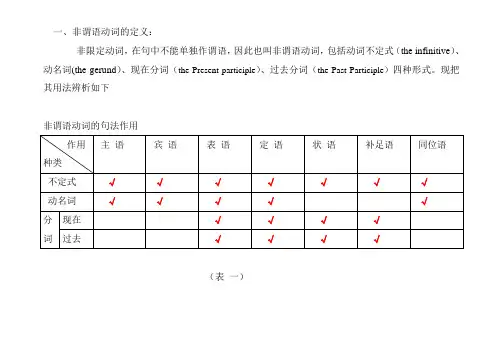
浅谈动词不定式的用法(The Infinitive)
- 格式:pdf
- 大小:125.22 KB
- 文档页数:3
第2O卷第2期 2006年6月 延安教育学院学报 Journal of Yanan College of Education Vo1.20 No.2 June.2006
浅谈动词不定式的用法(The Infinitive)
袁有社 ,李玲
(1.延安职业技术学院;2.延安中学,陕西延安716000)
[摘 要] 在通常的教学与学习中,动词不定式的用法是比较难以掌握的,笔者从多年的教学中积累了动词不定
式基本用法以及它的特殊用法,供大家在教学与学习中参考。
[关键词] 动词;不定式;用法
[中图分类号]H319 [文献标识码]A [文章编号]1009—3001(2006)o2—0o48一o3
动词不定式是由to+动词原形构成,它不能作谓语,但仍
留着动词的特征,可以接有所需要的宾语或状语而构成动词
不定式短语,没有人称和数的变化,但有时态和语态的变化。
语态 主动 被动
一般式to write to be written
完成式to have written to have been written
进行式to be writing ………………
完成进行式to have been writing—1..…………・
一、不定式的时态和语态
1.一般式:所表示的动作通常与其谓语动词同时或之后
发生。
I saw her enter the room.
They decided tO plant more trees this spring. 被动形式:
What is t0 be done next hasn’t been decided yet.(表语)
I had tO shout tO be heard(状语)
It’S great honor to be invited tO the party.(主语)
The performance tO be given tonight will be very interesting.(定语)
2.完成式:所表示的动作发生在其谓语动词前。
I'm sorry tO have kept you waiting.
He seems tO have read the book before.
被动形式:
The book is said tO have been translated into English.
No harm seems tO have been dofie. 3.进行式:所表示的动作与其谓语动词同时发生。
Tom pretended to be reading when the teacher came in. They are said to be having a meeting.
*在intended,expected,hoped,promised,wanted, wished,thought等后用不定式完成时,表示过去没有实现的
愿望,期待或计划等,也表示发生在谓语动词之前的动作或状
态。
I intended to have come to see you.
I hoped to have finished the work earlier.
二、不定式的用法
1.作主语: To play fair is as important as to play wel1.
To go tO bed early and tO rise early makes a man
healthy. *①不定式短语作定语时,常用形式主语it代替。
It is a great pleasure tO see you again.
It’S bad manners tO talk with your mouth ful1.
②下列表示事物性质的形容词同for后的名词或代词关
系不密切,没有意义上的主表关系,但与句中的不定式结构却
关系密切,有意义上的主谓关系,常与for搭配:easy,hard,
heavy,necessary,impossible,possible,important,difficult,
interesting
It is difficuh for her tO do it well in such a short time.
It is not easy for him tO get rid of his bad habits.
③下列表示人物特征的形容词同0f后的名词或代词关系
密切,有意义上的主表关系,常与0f搭配。brave,careful,
careless,clear,cruel,foolish,kind,nice,rude,stupid,silly,
wise,honest,thoughtful
It is brave of you tO do that.
[收稿日期] 2OO6一O3—2O [作者简介] 袁有社(1957一),男,陕西昊起人,延安职业技术学院师范教育分院副教授。 李玲
(1961一),女,陕西延安人,延安中学英语特级教师。 维普资讯 http://www.cqvip.com 第2O卷第2期 浅谈动词不定式的用法(The Infinitive) ・49・
It is nice of you to help me with my work. ④不定式表示具体特定的或将来的动作。
It’s necessary to read it many times
To finish the task within two weeks is very difficult. 2.作表语:
My job is to help the patient.
Our plan is to set up another school for the peasants’ children.
3.作宾语:
①作及物动词的宾语:
1 will manage to do it.
She has promised to help me with my work. ②作某些形容词的宾语(有些语法家认为作状语):
glad,sorry。afraid,ready,pleased,anxious。eager,sure,
willing,determined
His brother is eager to join the army.
The boy is afraid to face his mother.
③若不定式作宾语,其后还带宾语补足语,这时it作形式宾语:
Junex found it important to study the situation in
Russia.
He feels it his duty to help others.
④作介词but,except的宾语:
I have no choice but to accept the fact.
*若介词前有行为动词do的各种形式,介词后的不定式
则不带to.
She could do nothing but cry.
4.作宾语补足语:
Yesterday he asked me to go with him.
Tell the children not to play in the street.
这里需要注意的是:①在tell,hear,listen to,look at,
notice,observe,see,watch,have,let,make等动词后的宾
补中,不定式不带to.
I saw a little girl run across the street.
Let me do it myself.
②以上动词若变成被动结构时,则必须带to。
He was seen to go into the room.
He was made to clean the room alone as a punishment.
5.作定语:
The farmers thought of ways to protect their crops.
She didn’t have much money to spend. *①与所修饰的名词有主谓关系,动宾关系,同位关系。
There is no one to take care of her.
Have you got something to eat?
We got the order to leave the city.
②与修饰的名词为动宾关系,并且为及物动词,这时其后
不带宾语:
He has a lot of questions to ask.
Would you like something to drink? ③与修饰的名词为动宾关系,并且为不及物动词,应加适 当的介词:
There is nothing to worry about
He is looking for a room to live in. ④与修饰的名词为动宾关系,不定式既可以用主动语态,
也可用被动语态,但其含义有所不同。
Have you anything to send?你有什么东西要寄吗?
(动作的执行者是you)
Have you anything to be sent?你有什么要寄的东西吗?
(动作的执行者是被省略的me或someone else)
⑤介词+which+to do
It is not a good season in which to trave1.
There are all kinds of things from which to choose. 6.作状语:
1)作目的状语:
He stopped to have a rest.
We started early to get there before dark.
*in order to或so as to也可表示目的状语。
She reads China Daily in order to improve her English.
He works hard so as to catch up with others. *为了强调目的状语,可放句首(so as to不行)
To master a foreign language one must work hard at it.
2)作结果状语:
①In 1935 he left home never to return.
He hurried to the school only to find nobody there. ②adi./adv.+enough to do sth.
He is old enough to look after himself now.
The ladder was not long enough to reach the building. ③too+adj./adv.to do sth.
The tea is too hot to drink.
He is too tired to go any farther. ④so……to do sth. such……as to do sth.