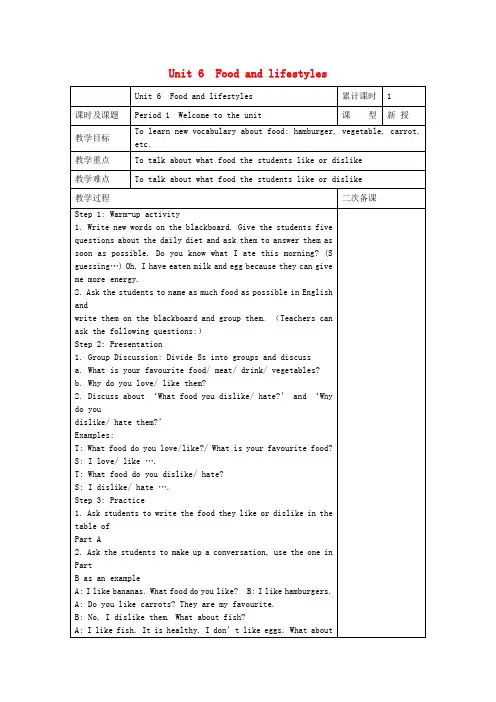
Unit 6 Food and lifestyles教学难点To practise the technique of skimming for overall comprehension and scanning for detail.教学过程二次备课Step 1 lead-in free talk1. Teacher talk to students about their diet and lifestyle freely andask some questions.①What do you often eat for breakfast/lunch/suppereveryday?②Do you know how to eat healthy?③Do you like sugar? Eating too much sugar is bad for ourteeth? Do you think so?④Do you often drink Cola? Cola is unhealthy, How to changethis bad habit?⑤If you are not strong or heal thy enough, What do you planto do?Through asking these questions, teach some new words. For example: breakfast lunch supper means meals. New word: meal Healthy means fit. New word :fitOther new words: sugar tooth(teeth) Cola change plan and so on.1. Ask students to complete partB1 about new words. Match newwords with their explains.2. Teacher summarize the result of the discussion and leadin the text.Step 2 Presentation1. Listen to Kitty’s article and answer simple questions:① What does she love doing? ② How long does she do that every day?2. Students read Kitty’s article silently and complete Kitty’s table on Part B2. then show Kitty’s recipes.3. Deal with Daniel’s article. Listen to Daniel’s article and answer:What does he like to do, to eat and to drink?1. Students read Daniel’s article and complete Daniel’s table onPart B2.2. Student read two articles loudly and judge somesentences. Askstudent to answer and check together.Step 3 Practice1. Show pictures of Kitty’s and Daniel’s recipes. Letstudentsdescribe their recipes. Each student only describe one or twopoints.2. Discuss in groups: How do we eat and live healthily?Afterdiscussion, each group say sth about the question in front ofBb.Step 4 Homework教后感总课题Unit 6 Food and lifestyle 累计课时 3 课时及课题Period 3 Reading 2 课型新授教学目标1. To revise and expand vocabulary about food and lifestyles.2. To learn about the relationship between diet and overall health.3. To practise the technique of skimming for overall comprehension andscanning for detail.教学重点1. To revise and expand vocabulary about food and lifestyles.2. To learn about the relationship between diet and overall health.教学难点To practise the technique of skimming for overall comprehension and scanning for detail.教学过程二次备课Step 1 RevisionRevision the text by asking some q uestions about it:1. What does kitty like?2. Why does kitty seldom eat cakes or sweets?3. Does Daniel often exercise?4. What does he like?5 .How often does he swim?Step 2 Reading1. Ask the students to read the text to finish off PartB3.Ask the students to tell whether the statement are true or false then correct the false ones.2. Ask the students to read the text again and then finish Part B4.Let the students read the dialogues by pairs to check the answers, then check the answers by asking and answering. Step 3 Practise教学过程二次备课Step 1 Presentation1. Show some pictures of different kinds of foods to thestudents.Teacher points at an apple, asking: What’s this? S: It’san apple.Write “an apple” on the blackboard. Present “a banana” inthe same way.2. Let the students watch and say the differences between“an apple” and “a banana”.Ask the students : How do we use “a” and “an”?3. Teacher also points at two cakes and asking “What arethey?”Ss: They are two cakes .”Write “two cakes’ on the blackboard and circle “s’.Let thestudents read and think “Why add “s”?4. Show more words on the blackboard and ask students tosay out their plural.5. Teacher says: Most countable nouns add “s”to changethem into plural. What about another countable nouns? Let thestudents look at the table on page 73 and have a discussionin groups of 4. Ask: How to change them into plural forms? Getthe students to find the rules6. Present: Write the rules of forming the plural formsof countable. Ask the students to read th e table on page120.Pay attention to “s”and “es”pronunciation. Let thestudents read after the teacher.Step 2 ExerciseGive some countable nouns for the students to change theminto the plural forms.Step 3 Presentation1. Show a bottle of water, and ask: What is it? It’s water.But can we say it a water?教学目标1. To get some information by reading and listening to the tape.2. To know about one’s lifestyle.3. To master the phrases of ordering meals.教学重点1. To get some information by reading and listening to the tape.2. To know about one’s lifestyle.教学难点1. To master the phrases of ordering meals.2. Four skills:教学过程二次备课Step 1 RevisionRevise countable and uncountable nouns.Step 2 Presentation1. Show a video about my lifestyle. Let the students watch the video .While the students are watching the video, show some new words on the Bb.T: Today we’re going to talk about how healthy you’re and how to keep fit.Do you think you’re healthy? Can you tell me how to be healthy? Ask several students to show their answers.2. Show a video about my lifestyle, after watching it. Ask the students: Do you think my lifestyle is healthy? Why?3. While asking and answer que stions, teach the new phrases, such as:I sleep less than 7 hours, right? How long do I sleep?T: I like walking, so I always walk more than an hour, about an hour and a half.Write “less than” and “more than” on the blackboard. Explain “less than” and “more than”.4. Ask the students: How often do I exercise? How long do I sleep every day? Explain “How long and How often”.5. Have a discussion with your partner and find out if they have a healthy lifestyle.Step 3 Listening1. Now let us see Benny’s lifestyle. Listen to an interview with him and tick the correct boxes.2. Listen to the tape again and check the ans wers together. Step 4 Speaking1. Get the students to read Part B individually and circle the phrases and sentences they don’t understand. Explain them.2. Listen to the tape and ask the students to read after the tape.3. Get the students to practice in pairs. Get some pairs to read.4. Have the students make a dialogue using the conversationas a model. Tell some pairs to act their dialogues. Correct them.Step 5 Homework1. Tell the students to write down their dialogues in theirexercise books.2. Revise countable and uncountable nouns.教后感总课题Unit 6 Food and lifestyles 累计课时 6 课时及课题Period 6 Study skills 课型新授教学目标1. To learn to read voiced consonants and voiceless consonants correctly.2. To develop the ability of spelling phonetic alphabets.教学重点1. To learn to read voiced consonants and voiceless consonants correctly.教学难点 1. To develop the ability of spelling phonetic alpha bets.教学过程二次备课Step 1 RevisionRevise the consonants the students have learnt: /p/, /b/,/t/, /d/, /k/, /g/, /h/, /m/, /n/, /ŋ/, /l/, /r/, /j/, /w/.Step 2 Presentation1. The teacher can tell the students what is voicelessconsonant and what is voiced consonant.2. The teacher can put the consonants into seven groups andeachgroup has a voiced consonant and a voiceless consonant. Thenthe teacher can teach them one by one. For example:The teacher writes ‘farmer’, ‘fat’, ‘fork’,‘five’on the blackboard and underline ‘f’in these words.Let the students read the sentence ‘The fat farmer has fiveforks.’as quickly as they can. Then the teacher can ask, ‘Howdo you pronounce it?’The students can answer /ʄ/. The teachergives a picture and also let the students read a sentence ‘Thebrave boy saved a girl’s life over there.’to teach theconsonant /v/.3. The teacher uses the same way to teach /ʃ/, /ʒ/, /θ/,/ð/, /z/, /s/, /tr/, /dr/, /ʧ/, /ʤ/, /ʦ/, /ʣ/.Step 3 Practice1. Listen to the tape and read the fourteen consonants2. Finish Part A on Page 77. Match the words if their lettersin bold have the same sound.Read the following phonetic alphabets and then fill inthe blanks to try to write down the words.3. Listen and finish Part B. Write S if the letters havethe same sound, write D if they don’t have. Then check theanswers4. Tell some students to read them aloud.Step 4 Presentation1. Let the students work in pairs to read Part C, especiallythe words in bold.2. List en to the tape and read after it.3. Let some of the students to read the four sentences.4. All the students read the sentences aloud.Step 5 ConclusionSum up the fourteen consonants and read again.Step 6 HomeworkRead the consonants and add three words to everyconsonant.教后感总课题Unit 6 Food and lifestyles 累计课时7 课时及课题Period 7 Task 课型新授教学目标1. To know about Simon’s diet and lifestyle through the article2. To write an article about one’s diet and lifestyle教学重点1. To know about Simon’s diet and lifestyle through the article2. To write an article about one’s diet and lifestyle教学难点To write an article about one’s diet and lifestyle教学过程二次备课Step 1 RevisionRevise the consonants the students have learnt: /p/, /b/,/t/, /d/, /k/, /g/, /h/, /m/, /n/, /ŋ/, /l/, /r/, /j/, /w/, /f/,/v/, /ʃ/, /ʒ/, /θ/, /ð/, /s/, /z/, /tr/, /dr/, /tʃ/, /dʒ/, /ts/,/dz/.Step 2 Presentation1. The teacher can tell the students: Here is an articleabout Simon’s lifestyle,. Please listen to the tape and answer the questions.(1) Why does Simon play football? (To keep fit.)(2) What helps Simon start the day well?(An egg, baozi or mantou and a glass of milk.)(3) Which meal gives Simon energy for the whole afternoon? (Lunch.)(4) What does Simon often have for dinner? (Soup, fish and vegetables.)Tell some students to answer t he questions and check the answers.2. The teacher goes on: Now please read the article. Ask and answer questions about Simon’s lifestyle with your partner. Encourage the students to raise one or two questions, their partners answer the questions. Then let the other students answer the questions.Step 3 Useful expressions1. Get the students to read the sentences and the phrases.2. Explain them.3. Get the students to make sentences using the phrases. Tell some students to write their sentences on the blackboard. Check them then the students read them aloud.Step 4 Writing1. Get the students to complete the information about themselves at Part B.2. Have the students write an article about themselves using Simon’s article as a model. Encourage them to use “Useful expressions” to help them to write their articles.3. Tell some students to read their articles. Comment the articles.Step 5 ExerciseThe students complete the exercises. Check the answers. Step 6 Homework1. Ask the students to write their articles in their exercise books2. C omplete the exercises in Workbook.教后感。