
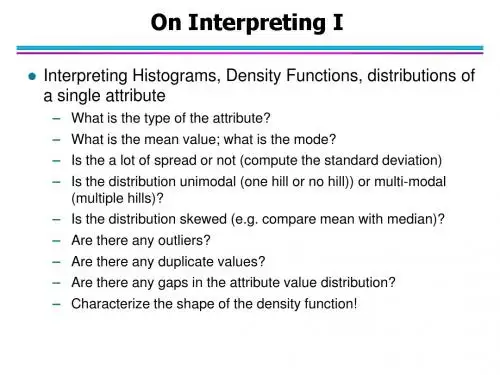
On Interpreting I
- 格式:ppt
- 大小:245.00 KB
- 文档页数:6

CHAPTER 3TEACHING NOTESFor undergraduates, I do not work through most of the derivations in this chapter, at least not in detail. Rather, I focus on interpreting the assumptions, which mostly concern the population. Other than random sampling, the only assumption that involves more than population considerations is the assumption about no perfect collinearity, where the possibility of perfect collinearity in the sample (even if it does not occur in the population) should be touched on. The more important issue is perfect collinearity in the population, but this is fairly easy to dispense with via examples. These come from my experiences with the kinds of model specification issues that beginners have trouble with.The comparison of simple and multiple regression estimates – based on the particular sample at hand, as opposed to their statistical properties – usually makes a strong impression. Sometimes I do not bother with the “partialling out” interpretation of multiple regression.As far as statistical properties, notice how I treat the problem of including an irrelevant variable: no separate derivation is needed, as the result follows form Theorem 3.1.I do like to derive the omitted variable bias in the simple case. This is not much more difficult than showing unbiasedness of OLS in the simple regression case under the first four Gauss-Markov assumptions. It is important to get the students thinking about this problem early on, and before too many additional (unnecessary) assumptions have been introduced.I have intentionally kept the discussion of multicollinearity to a minimum. This partly indicates my bias, but it also reflects reality. It is, of course, very important for students to understand the potential consequences of having highly correlated independent variables. But this is often beyond our control, except that we can ask less of our multiple regression analysis. If two or more explanatory variables are highly correlated in the sample, we should not expect to precisely estimate their ceteris paribus effects in the population.I find extensive t reatments of multicollinearity, where one “tests” or somehow “solves” the multicollinearity problem, to be misleading, at best. Even the organization of some texts gives the impression that imperfect collinearity is somehow a violation of the Gauss-Markov assumptions. In fact, they include multicollinearity in a chapter or part of the book devoted to “violation of the basic assumptions,” or something like that. I have noticed that master’s students who have had some undergraduate econometrics are often confused on the multicollinearity issue. It is very important that students not confuse multicollinearity among the included explanatory variables in a regression model with the bias caused by omitting an important variable.I do not prove the Gauss-Markov theorem. Instead, I emphasize its implications. Sometimes, and certainly for advanced beginners, I put a special case of Problem 3.12 on a midterm exam, where I make a particular choice for the function g(x). Rather than have the students directly comparethe variances, they should appeal to the Gauss-Markov theorem for the superiority of OLS over any other linear, unbiased estimator.SOLUTIONS TO PROBLEMS3.1 (i) hsperc is defined so that the smaller it is, the lower the student’s standing in high school . Everything else equal, the worse the student’s standing in high school, the lower is his/her expected college GPA.(ii) Just plug these values into the equation:colgpa = 1.392 - .0135(20) + .00148(1050) = 2.676.(iii) The difference between A and B is simply 140 times the coefficient on sat , because hsperc is the same for both students. So A is predicted to have a score .00148(140) ≈ .207 higher.(iv) With hsperc fixed, colgpa ∆ = .00148∆sat . Now, we want to find ∆sat such that colgpa ∆ = .5, so .5 = .00148(∆sat ) or ∆sat = .5/(.00148) ≈ 338. Perhaps not surprisingly, a large ceteris paribus difference in SAT score – almost two and one-half standard deviations – is needed to obtain a predicted difference in college GPA or a half a point.3.2 (i) Yes. Because of budget constraints, it makes sense that, the more siblings there are in a family, the less education any one child in the family has. To find the increase in the number of siblings that reduces predicted education by one year, we solve 1 = .094(∆sibs ), so ∆sibs = 1/.094 ≈ 10.6.(ii) Holding sibs and feduc fixed, one more year of mother’s education implies .131 years more of predicted education. So if a mother has four more years of education, her son is predicted to have about a half a year (.524) more years of education.(iii) Since the number of siblings is the same, but meduc and feduc are both different, the coefficients on meduc and feduc both need to be accounted for. The predicted difference in education between B and A is .131(4) + .210(4) = 1.364.3.3 (i) If adults trade off sleep for work, more work implies less sleep (other things equal), so 1β < 0.(ii) The signs of 2β and 3β are not obvious, at least to me. One could argue that more educated people like to get more out of life, and so, other things equal, they sleep less (2β < 0). The relationship between sleeping and age is more complicated than this model suggests, and economists are not in the best position to judge such things.(iii) Since totwrk is in minutes, we must convert five hours into minutes: ∆totwrk = 5(60) = 300. Then sleep is predicted to fall by .148(300) = 44.4 minutes. For a week, 45 minutes less sleep is not an overwhelming change.(iv) More education implies less predicted time sleeping, but the effect is quite small. If we assume the difference between college and high school is four years, the college graduate sleeps about 45 minutes less per week, other things equal.(v) Not surprisingly, the three explanatory variables explain only about 11.3% of the variation in sleep . One important factor in the error term is general health. Another is marital status, and whether the person has children. Health (however we measure that), marital status, and number and ages of children would generally be correlated with totwrk . (For example, less healthy people would tend to work less.)3.4 (i) A larger rank for a law school means that the school has less prestige; this lowers starting salaries. For example, a rank of 100 means there are 99 schools thought to be better.(ii) 1β > 0, 2β > 0. Both LSAT and GPA are measures of the quality of the entering class. No matter where better students attend law school, we expect them to earn more, on average. 3β, 4β > 0. The number of volumes in the law library and the tuition cost are both measures of the school quality. (Cost is less obvious than library volumes, but should reflect quality of the faculty, physical plant, and so on.)(iii) This is just the coefficient on GPA , multiplied by 100: 24.8%.(iv) This is an elasticity: a one percent increase in library volumes implies a .095% increase in predicted median starting salary, other things equal.(v) It is definitely better to attend a law school with a lower rank. If law school A has a ranking 20 less than law school B, the predicted difference in starting salary is 100(.0033)(20) =6.6% higher for law school A.3.5 (i) No. By definition, study + sleep + work + leisure = 168. Therefore, if we change study , we must change at least one of the other categories so that the sum is still 168.(ii) From part (i), we can write, say, study as a perfect linear function of the otherindependent variables: study = 168 - sleep - work - leisure . This holds for every observation, so MLR.3 violated.(iii) Simply drop one of the independent variables, say leisure :GPA = 0β + 1βstudy + 2βsleep + 3βwork + u .。
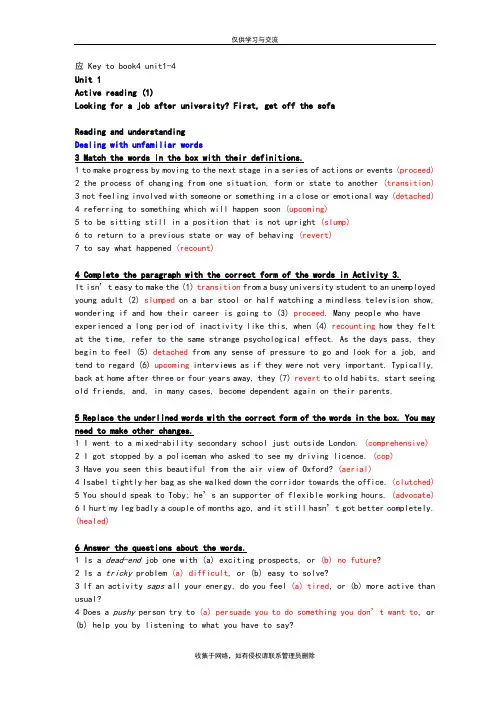
应 Key to book4 unit1-4Unit 1Active reading (1)Looking for a job after university? First, get off the sofaReading and understandingDealing with unfamiliar words3 Match the words in the box with their definitions.1 to make progress by moving to the next stage in a series of actions or events (proceed)2 the process of changing from one situation, form or state to another (transition)3 not feeling involved with someone or something in a close or emotional way (detached)4 referring to something which will happen soon (upcoming)5 to be sitting still in a position that is not upright (slump)6 to return to a previous state or way of behaving (revert)7 to say what happened (recount)4 Complete the paragraph with the correct form of the words in Activity 3.It isn’t easy to make the (1) transition from a busy university student to an unemployed young adult (2) slumped on a bar stool or half watching a mindless television show, wondering if and how their career is going to (3) proceed. Many people who have experienced a long period of inactivity like this, when (4) recounting how they felt at the time, refer to the same strange psychological effect. As the days pass, they begin to feel (5) detached from any sense of pressure to go and look for a job, and tend to regard (6) upcoming interviews as if they were not very important. Typically, back at home after three or four years away, they (7) revert to old habits, start seeing old friends, and, in many cases, become dependent again on their parents.5 Replace the underlined words with the correct form of the words in the box. You may need to make other changes.1 I went to a mixed-ability secondary school just outside London. (comprehensive)2 I got stopped by a policeman who asked to see my driving licence. (cop)3 Have you seen this beautiful from the air view of Oxford? (aerial)4 Isabel tightly her bag as she walked down the corridor towards the office. (clutched)5 You should speak to Toby; he’s an supporter of flexible working hours. (advocate)6 I hurt my leg badly a couple of months ago, and it still hasn’t got better completely. (healed)6 Answer the questions about the words.1 Is a dead-end job one with (a) exciting prospects, or (b) no future?2 Is a tricky problem (a) difficult, or (b) easy to solve?3 If an activity saps all your energy, do you feel (a) tired, or (b) more active than usual?4 Does a pushy person try to (a) persuade you to do something you don’t want to, or(b) help you by listening to what you have to say?5 If you feel apathy, do you want to (a) change the world, or (b) stay at home and do nothing?7 Answer the questions about the phrases.1 Is fork out (a) a formal, or (b) an informal way of saying to pay for something?2 If you are in the same boat as another person, are you (a) making the same journey together, or (b) in the same difficult or unpleasant situation?3 If you feel you have come full circle, do you (a) feel you are back where you started, or (b) feel a sense of satisfaction because you have completed something?4 If someone takes a soft line, do they deal with a person (a) in a kind and sympathetic way, or (b) in a lazy way without making a decision?5 If you strike the right note about something, are you expressing yourself (a) well, or (b) badly?6 If you do something by all means, do you (a) try your best to do it, or (b) not care about it?7 If you nudge someone back into the saddle, are you encouraging them to (a) take responsibility again, or (b) take it easy?8 If you talk through a problem with someone, do you (a) examine it carefully and sensitively, or (b) refer to it quickly and then change the subject?Active reading (2)If you ask meDealing with unfamiliar words4 Match the words in the box with their definitions.1 funny or entertaining (amusing)2 used for emphasizing that something good has happened, especially because of good luck (fortunately)3 an amount of money that a person, business or country borrows, usually from a bank (loan)4 to take an amount or number from a total (deduct)5 the most exciting, impressive, or interesting part of an event (highlight)6 to show that you understand someone’s problems (sympathize)7 needing a lot of time, ability, and energy (demanding)5 Complete the conversation with the correct form of the words in Activity 4.A After three years at university, I’m now quite heavily in debt.B I (1) sympathize with you, I know what it’s like to have financial problems. But(2) fortunately I didn’t need to take out a student (3) loan when I was at university, because I had a part-time job.A What did you do?B I worked in a restaurant at weekends.A That must have been very (4) demanding.B Yes, it was. I had to get the right balance between work and study. But the otherpeople who worked there were good fun to be with, so it was quite (5) amusing too. The(6) highlight of the weekend was always Saturday night when we worked overtime.A But I don’t expect you made a lot of money?B No, there wasn’t much after they’d (7) deducted tax and pension contributions. But it was enough to keep me going.6 Replace the underlined words with the correct form of the words in the box. You may need to make other changes.1 When I was at college I kept all my personal things in an old cupboard.2 A lot of people who leave university before getting a degree end up in good jobs.3 I think she’ll get a good degree, but I wouldn’t risk my money on the exact result.4 The money I spent at college was more than what I earned in my part-time job.5 The chances of my being offered a job after that interview must be quite remote.6 Our business has done very well since we changed our advertising.7 I think telling the truth and not cheating is always the best policy.Key:(1) belongings (2) dropouts (3) gamble (4) exceeded (5) odds(6) has thrived (7) honesty7 Answer the questions about the words and expressions.1 If something is not all it’s cracked up to be, is it (a) valid and interesting, or(b) just a little bit disappointing?2 If someone keeps banging on about something, are you likely to be (a) interested in, or (b) bored by what they say?3 If there is a lot of hassle in your life, are you likely to feel (a) stressed, or(b) relaxed?4 If something happens out of the blue, is it (a) unexpected, or (b) part of your plan?5 If you say you ended up in a particular job, do you suggest that (a) you have fulfilled your ambition, or (b) it happened almost by chance?6 Are the regulars in a pub (a) the customers who come very often, or (b) the food the pub offers most often?7 If something is dead easy, is it (a) very easy, or (b) not easy at all?8 If you treat someone to something, do you (a) buy something nice for them, or (b) behave badly to them?9 If you cheer a place up, do you (a) make the place look brighter, or (b) make the people in the place happier?Reading and interpreting8 Look at the sentences from the passage and identify the style features.1 Twelve years at school and three years at university, teachers banging on about opportunities in the big wide world beyond our sheltered life as students, and what do I find?This shows the informality of an incomplete sentence in the first part, the use of an informal expression (banging on) and a rhetorical question to the reader (What do Ifind?)2 Try as I might to stay cheerful, all I ever get is hassle, sometimes with people (especially boys, god, when will they grow up?) …This has the use of an informal word (hassle), an informal exclamation (god) and a question to thereader (When will they grow up?)3 Actually, I had my eye on the course at the London School of Economics (LSE). Here there is a discourse marker typical of speech (Actually) and an informal phrase (had my eye on).4 I kind of understand it, and not just because my degree is in economics.Here “kind of” is a sort of discour se marker of informal speech (showing something is general, vague or not definite).5 I wanted something in finance and investments, because you know, maybe with a job like that, I could use my degree.This has a discourse marker of informal speech (you know).6 ... it’s true, he really did seem to have three hands.Again here is a discourse marker of informal speech (it’s true).7 I talked to him about ... well, about pretty well everything …This has another discourse marker of informal speech (well) and an informal phrase (pretty well).Language in useword formation: compound nouns1 Write the compound nouns which mean:1 a degree which is awarded a first class (a first-class degree)2 work in a hospital (hospital work)3 a ticket for a plane journey (a plane ticket)4 a discount for students (a student discount)5 a pass which allows you to travel on buses (a bus pass)6 a room where an interview is held (an interview room)7 a period spent in training (a training period)word formation: noun phrases2 Write the noun phrases which mean:1 a career which is rewarding from the financial point of view (a financially rewarding career)2 legislation which has been introduced recently (recently introduced legislation)3 instructions which are more complex than usual (unusually complex instructions)4 an institution which is orientated towards academic (academically orientated work)5 work which makes physical demands on you (physically demanding work)6 information which has the potential to be important (potentially important information)7 candidates who have been selected after a careful procedure (carefully selected candidates)8 a coursebook in which everything has been planned beautifully (a beautifully planned textbook)try as … might3 Rewrite the se ntences using try as … might .1 I’m trying to fill this last page, but I just can’t think of anything.Try as I might to fill this last page, I just can’t think of anything.2 I try to be friendly with Marta, but she doesn’t seem to respond.Try as I migh t to be friendly with Marta, she doesn’t seem to respond.3 I try hard to get to sleep, but I can’t help thinking about my family.Try as I might to get to sleep, I can’t help thinking about my family.4 He just doesn’t seem to get the promotion he deserve s, even though he keeps trying. Try as he might, he just doesn’t seem to get the promotion he deserves. / Try as he might to get thepromotion he deserves, he just doesn’t seem to get it.5 I keep trying to remember her name, but my mind is a blank.Try as I might to remember her name, my mind is a blank.given that …4 Rewrite the sentences using given that …1 Since I know several languages, I thought I would look for work abroad.Given that I know several languages, I thought I would look for work abroad.2 Xiao Li has the best qualifications, so she should get the job.Given that Xiao Li has the best qualifications, she should get the job.3 Since we’re all here, I think it would be a good idea to get down to some work. Given that we’re all here, I thin k it would be a good idea to get down to some work.4 Since it’s rather late, I think we should leave this last task until tomorrow. Given that it’s rather late, I think we should leave this last task until tomorrow. clauses introduced by than5 Rewrite the sentences using clauses introduced by than .1 She’s experienced at giving advice. I’m more experienced.She’s less experienced at giving advice than I am. / I’m more experienced at giving advice than she is.2 You eat too much chocolate. It isn’t good for you.You eat too much chocolate than is good for you.3 She worked very hard. Most part-timers don’t work so hard.She worked harder than most part-timers do.4 You have arrived late too many times. That isn’t acceptable.You have arrived late more times than is acceptable.5 I don’t think you should have given so much personal information. It isn’t wise.I think you have given more personal information than is wise.collocations6 Read the explanations of the words. Answer the questions.1 highlight A highlight is the most exciting, impressive, or interesting part of an event.(a) What would you like to be the highlight of your career?I would like the highlight of my student career to be to receive a national award for the best student research project.(b) How can you highlight an important sentence in a text?You can underline it in pencil or pen or you can use coloured pens or highlighters.(c) What are the edited highlights of a football match?The highlights are when someone scores a goal or prevents one from being scored.2 loan A loan is an amount of money someone borrows from someone else.(a) Have you ever taken out a loan?No, I haven’t. But my parents have taken out several loans to buy kitchen equipment.(b) What is the best way to pay off a loan?It is best to pay a loan off quickly, although you will still have to pay some interest.(c) If you have a library book on loan, what do you have to do with it?You have to return it before the date it is due, otherwise you may have to pay a fine.3 thrive To thrive means to be very successful, happy or healthy.(a) What sort of business thrives best in your part of the country?In my part of the country, light industries and electronics companies thrive.(b) Which sort of plants thrive in a hot climate?In a hot climate you can see tropical fruit and vegetables thrive and also tropical plants and trees.(c) Why do you think some couples thrive on conflict?It is difficult to understand why some couples thrive on conflict. Maybe each one wants to compete with the other or maybe they enjoy “kissing and making up” after the conflict.7 Translate the paragraphs into Chinese.If you ask me, real life is not all it’s cracked up to be. Twelve years at school and three years at university, teachers banging on about opportunities in the big wide world beyond our sheltered life as students, and what do I find?Try as I might to stay cheerful, all I ever get is hassle, sometimes with people (especially boys, god, when will they grow up?), but mostly with money. It’s just so expensive out here! Everyone wants a slice off you. The Inland Revenue wants to deduct income tax, the bank manager wants repayments on my student loan, the landlord wants the rent, gas, water, electricity and my mobile bills keep coming in, and all that’s before I’ve had anything to eat. And then some bright spark calls me out of the blue, asking if I’m interested in buying a pension. At this rate, I won’t even last till the end of the year, let alone till I’m 60.(☞翻译时可以根据上下文增译,即增加原文暗含了但没有直接表达出来的意思。
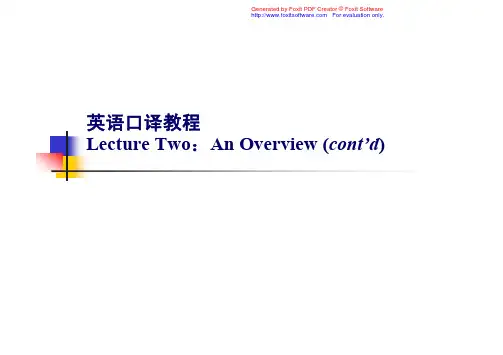
英语口译教程Lecture Two:An Overview (cont’d)Teaching ObjectiveBy getting students familiar with the theories and background knowledge and the basic skills ofinterpreting , this course aims to facilitate the students with interpreting procedure and basic skills and strategies ,such as :memory training、note-taking、oral presentation and public speaking skills etc., to arise students’awareness of current affairs and background knowledge, to cultivate their ability of discourse analysis , logical thinking ,cross-cultural communication andinterpretation both from English to Chinese and viseversa .Interpretation: An Overview⏹口译定义:definition⏹“口译是一种通过口头表达形式,将所听到(间或读到)的信息准确而又快速地由一种语言转换成另一种语言,进而达到传递与交流信息之目的的交际行为,是人类在跨文化、跨民族交往活动中所依赖的一种基本的语言交际工具。
”(教材P5)⏹口译是指“对口头表达的信息及文本进行的口头翻译”(Shuttleworth& Cowie, 1997:82)⏹It is defined as "oral translation of a written text" (Shuttleworth& Cowie: 1997:83).⏹Interpreting is a service activity with a communication function. (Gile) It is usually a face-to-face communicative act.⏹Differences between interpretation andtranslation⏹the difference in the medium⏹the difference in the time limit⏹The key skill of a very good translator is theability to write well,professional translatorsalmost always work in only one direction,translating only into their native language ,usinga good library of dictionaries and referencematerials,⏹An interpreter, on the other hand, has to be ableto translate in both directions, without the use ofany dictionaries on the spot.Types of interpreting⏹By forms:⏹交替口译( alternating interpretation )⏹接续口译( consecutive interpretation )⏹同声传译( simultaneous interpretation )⏹耳语口译( whispering interpretation )⏹视阅口译( sight interpretation )⏹By ways:⏹单向口译( one-way interpretation )⏹双向口译( two-way interpretation )⏹By contents:⏹导游口译( guide interpretation )⏹礼仪口译(ceremony interpretation )⏹宣传口译( information interpretation )⏹会议口译( conference interpretation )⏹谈判口译( negotiation interpretation )口译使用的语体⏹口语语体⏹Q: Dear Michael, who taught you how toplay golf and do you still use a coach?⏹A: A lot of people helped teach me—mostlymy buddies at the UNC while I was inschool.I occasionally use a PRO to adviseme on improving --but no one regular.I've come to realize that I'm just a"hack"--so now I am enjoying justplaying without a lot of coaching.⏹问:亲爱的迈克尔,谁教你打高尔夫球,你现在还有教练吗?⏹答:有许多人教过我—多数是我在北卡罗来纳大学时的老同学.偶尔会请个职业教练帮帮我,但不经常.我已经渐渐认识到我不过是随便玩玩而已.所以现在更不想要教练,就自己玩.⏹较正式语体⏹Q: Women in the United States generally livelonger than men. But in recent years that gaphas been narrowing a bit. How has thataffected the life insurance business?⏹A: It is not narrowing that much, thank goodnessWe are still outliving men, we are still. Wehave quite a gap on them, still about 7-8years. The only reason it’s narrowing is women aredoing things to themselves that they shouldn’t bedoing , like smoking ,and all those bad habits that menhave had for many years. But it is not narrowing forother reasons.⏹问:在美国,一般来说妇女比男人更长寿,但是近年来差距在缩小.这对人寿保险业有什么影响?⏹答:感谢上帝,差距并没有缩小多少.我们还是比男人寿命长.我们和他们的寿命有很大差距,大约仍有七、八年的差距。
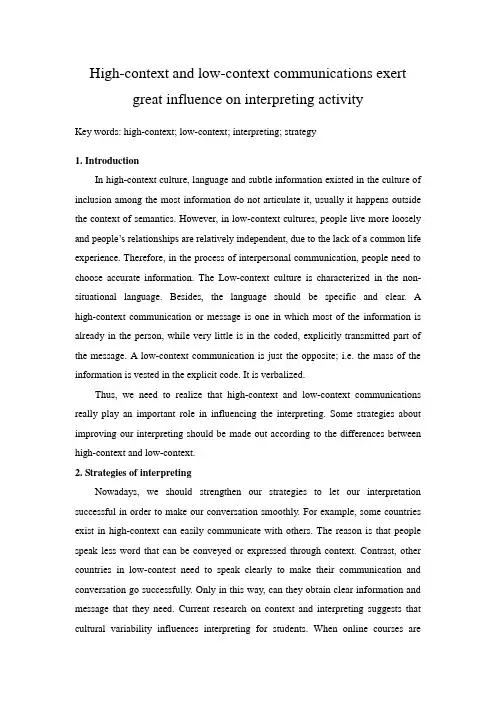
High-context and low-context communications exert great influence on interpreting activityKey words: high-context; low-context; interpreting; strategy1. IntroductionIn high-context culture, language and subtle information existed in the culture of inclusion among the most information do not articulate it, usually it happens outside the context of semantics. However, in low-context cultures, people live more loosely and people’s relationships are relatively independent, due to the lack of a common life experience. Therefore, in the process of interpersonal communication, people need to choose accurate information. The Low-context culture is characterized in the non- situational language. Besides, the language should be specific and clear. A high-context communication or message is one in which most of the information is already in the person, while very little is in the coded, explicitly transmitted part of the message. A low-context communication is just the opposite; i.e. the mass of the information is vested in the explicit code. It is verbalized.Thus, we need to realize that high-context and low-context communications really play an important role in influencing the interpreting. Some strategies about improving our interpreting should be made out according to the differences between high-context and low-context.2. Strategies of interpretingNowadays, we should strengthen our strategies to let our interpretation successful in order to make our conversation smoothly. For example, some countries exist in high-context can easily communicate with others. The reason is that people speak less word that can be conveyed or expressed through context. Contrast, other countries in low-contest need to speak clearly to make their communication and conversation go successfully. Only in this way, can they obtain clear information and message that they need. Current research on context and interpreting suggests that cultural variability influences interpreting for students. When online courses arewriting-based, they may provide easy information; However, the low-context medium may restrict the learning experience and class dynamic due to the lack of nonverbal communication. Students who come from a high-context culture may find low-context, online cultures to lack cues they would normally expect when they meet face-to-face. Judging that text-based communication is low-context, this study explores the impact of low-context communication and makes it in the learning environment of students from high-context cultures by investigating Hall's definitions of context dimensions of culture in view of online learning. The article concluded by offering suggestions for how to better serve high-context cultures in low-context online courses in Christian institutions of higher education.Interpreters who work in community settings with participants from disparate cultural backgrounds may confront difficulties in conveying the source message into the target message accurately due to cross-cultural differences. Such cross-cultural differences can range from linguistic differences at the discourse level of speech to pragmatic differences, which go beyond the utterances. When confronted with such instances, interpreters are almost always unsure of how to react and of what is expected of them. The few studies that have looked at cross-cultural differences in community interpreting clearly show that there is no consistency in the way that interpreters approach potential cross-cultural misunderstandings. This paper will present the results of a section of a questionnaire of a larger study, which asked practicing legal interpreters whether they alert judicial officers and tribunal members of potential cross-cultural differences, and which also asked judicial officers and tribunal members about their expectations of interpreters in such situations. The results point to a demand for greater guidance and clearer protocols for interpreters working in the legal system.In order to bridge this language gap, interpreting services is employed, which are rendered by family members of a patient, nurses, or at times even by porters or cleaners. As a result of the fact that these interpreters lack training in interpreting theory and practice, they tend to distort communication, which impacts negatively on the quality of the healthcare that the patient receives. This consequent lack of qualityin healthcare therefore can be directly related to the quality of the interpreted product that the interpreter renders. The goal of this article is to investigate interpreting practices within three tertiary hospitals, and to reflect on the quality of the service rendered by the interpreters at these places. Data were extracted from electronic medical and billing records. Principal Findings. Mean time in the ED, mean number of laboratory tests, radiology services, and rates of hospital admission for both language groups at both hospitals went down in the post-video-interpreting network period compared with the pre-video-interpreting network period. This article provides an introduction to the field of intercultural communication. Miscommunication among patients, families, and clinicians often results when participants are contextually "out-of-synch. High context communication embeds more information in the contexts within which people communicate and is less dependent on language. Very sick and dying patients often use high context communication strategies. Low context communication stresses explicit verbal communication and is commonly used by clinicians. When clinicians use low context forms of communication with patients using high context styles, misunderstandings frequently arise. Suggestions are given for avoiding miscommunication and enhancing mutual understanding.3. The significance in realizing the difference in high-context and low-contextIs wind direction an adequate marker of air mass history? This review looks at the evolution of methods for assessing the effect of the origin and pathway of air masses on composition change and trends. The composition of air masses and how they evolve and the changing contribution of sources and receptors are key elements in atmospheric science. Source–receptor relationships of atmospheric composition can be investigated with back trajectory techniques, tracing forward from a defined geographical origin to arrive at measurement sites where the composition may have altered during transport. The distinction between the use of wind sector analysis, trajectory models and dispersion models to interpret composition measurements is explained and the advantages and disadvantages of each are illustrated by examples. Historical uses of wind roses, back trajectories and dispersion models are explained as well as the methods for grouping and clustering air masses. The interface of thesemethods to the corresponding chemistry measured at the receptor sites is explored. The review does not detail the meteorological derivation of trajectories or the complexity of the models but focus on their application and the statistical analyses used to compare them with in composition measurements. A newly developed methodology for analyzing atmospheric observatory composition data according to air mass pathways calculated with the NAME dispersion model is given as a detailed case study. The steps in this methodology are explained with relevance to the Weybourne Atmospheric Observatory in the UK. Interpretation, which essentially means an extempore oral reproduction in one language of what is said in another language, has long been considered as a bridge across which people of different cultures may facilitate and further exchange in various realms, particularly nowadays when globalization has developed into a popular trend, more and more importance and attention will be attached to it to smooth cross-culture communication Interpretation, which essentially means an extempore oral reproduction in one language of what is said in another language, has long been considered as a bridge across which people of different cultures may facilitate and further exchange in various realms, particularly nowadays when globalization has developed into a popular trend, more and more importance and attention will be attached to it to smooth cross-culture communication. Experts see interpretation as a three-step linguistic reproduction, namely comprehending, translating and speaking, and each step is efforts-consuming. Understanding is of key importance. Without such accurate comprehension, an interpreter will fail to continue---it is definitely a tragedy. On this point, the difficulties involved may be lexical, contextual, and terminological ones, or those caused by the speaker' s exceptionally rapid or particular accent or intonation, or those arising from the interpreter' s lack of knowledge of subject concerned. People in different countries, especially in high-context and low-context, there is no doubt that useful strategies used to improve interpreting. Although individuals, even in the same culture, tend to have different value pattern, there are shared by the members of the gr oup. Understanding their culture’s value pattern is of great significance in terms of understanding their behaviors. Therefore, through the analysis of high-context andlow-context, importance about difference between them can express clearly in order to let us make a success in interpreting. Edward T. Hall defines context as In our daily life, and “the information that surrounds an event; it is inextricably bound up with the meaning of the event.” High-context people are apt to become impatient and irritated when low-context people insist on giving them information they do not need. We can learn to benefit a lot from it. It is not hard to make a conclusion that high-context and low-context communications exert great influence on interpreting activity.4. ConclusionSo everyone should realize that interpretation really needs us to make clear analysis about high-contest and low-context. Only in this way can we carry out good strategies to improve our interpreting well.References:[1] 李芳琴,2003,“试论语境在口译中的预测功能”。