小学英语语法详解介词--介词分类及表示地点的介词
- 格式:docx
- 大小:19.11 KB
- 文档页数:6
小学英语语法详解介词
——介词的分类及表示地点的介词
什么是介词?
介词又叫做前置词,是一种虚词。
一、介词的分类
1.按照介词的组合,可分为简单介词、复合介词和短语介词。
简单介词:是指单一介词,如:at,in,of, by,about, for, from,except, since,near,with等。
复合介词:是指由两个简单介词组成的介词,如:inside,outside,onto,into,throughout,wthout.upon等。
短语介词:由短语构成的介词,如:in front of, by means of, on behalt of, in spite of, by way
of, in favor of, in regard to 等。
2.按词义分类
介词类别 —
表示地点(包括动向) about,above,across, after, along, among,around,at,belfore,behind,below,beneath, beside,between, beyond, by, down,from, in, into, near, off, on,over,through, to,towards,under,up, upon, with, within,without...
表示时间 at,in, on,by, after,before, since, for,during, within, throughout,over,until/till,berween...
表示原因 because of,owing to, due to, for,with...
表示方式、方法或手段 by,in,with...
表示“除……外” except,besides,but, except for...
表示“数量” about,around,over...
表示“关于”的 on, about...
表示“所属”“部分与整体关系” of
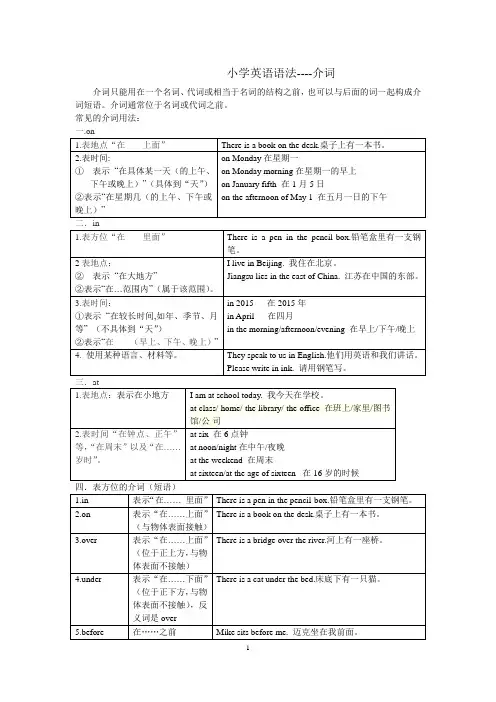
1) 表示地点(包括动向)的介词
① at, in, on, to
at
表示在小地方: I arrive at school at nine every morning.
我每天早上九点到校。
表示“在……附近,旁边”
The Smiths are at the beach.
史密斯一家在沙滩上。
in
表示在大地方:
When did you arrive in Beljing?
你什么时候到北京的?
表示“在……范围之内”:
The penclis in the pencl-box.铅笔在铅笔盒里。
on
表示毗邻,接壤,“在………上面”
Mongolia is on the north of China.
蒙古在中国的北面。
表示在某物体上面并与之接触:
He put his watch on the table.
他把手表放桌上。
to
表示“在……范围外”不强调是否接壤:或“到……”:
Japan is to the east of China.
日本在中国的东面。 ②above, over
above指“在……上方”,不强调是否垂直,与 below相对:
The bird is flying above my head.
鸟儿在我头顶上飞过。
over
指垂直的上方,与under相对,over有覆盖的含义在里面:
There is a bridge over the river.
江上有座桥。
③below, under
under表示“在……正下方”:
There is a cat under the table.
桌子下面有只猫。
below表示“在……下方”,不一定在正下方:
Please write your name below the line.
请在线的下方写上您的名字。
④in front of, in the front of
in front of“在……前面”,指甲物在乙物之前,两者互不包括:其反义词是behind(在……的后面):
There are some flowers in front of the house.
房子前面有些花卉。
In the front of“在……的前部,即甲物在乙物的内部,反义词是at the back of.(在……范围内的后部): There is a blackboard in the front of our classroom.
我们的教室前边有一块黑板。
⑤beside, behind,near
beside表示“在……旁边”:
Tom sits beside Ben.汤姆坐在本的旁边。
behind表示“在……后面”:
The fountain is behind the hill.喷泉在假山后面。
near表示“在……附近”(范围比较广):
Don't stand near the lake,children.
孩子们,不要站在河边。
Near my home,there is a supermarket.在我家附近有一家超市。
⑥between, among
Between(指时间、空间、顺序等)在……之间(两者之间):
They planted a lot of trees between the two buldings.
他们在两座建筑物之间栽了许多树。
These books were written between 1736 and 1770.
这些书写于1736年至1770年之间。
(指数量、距离、程度等)介于……之间(两者之间)
He is a man between sixty and seventy.
他的年龄约在 6O 到70之间。
连接着………;来往于……之间(两者之间):
There is a path between the house and the road. 有条小路将房子与出路连接起来。
among
(表示位置)处在……中,为……所环绕,为……所环抱:
He was sitig among a group of chidren, telling them a story.他正坐在一群孩子中间讲故事。
(表示范围)在……之内,在…一类之中,是……中之一,在……群中:
She is the tallest among her classmates.
她在她同学之中是最高的。
小提醒
between作为介词使用时往往会和and一起出现,如果没有出现,则后面的名词必须为复数形式,
例:
★ The table is between the tree and the bench.
桌子在树和长凳的中间。
★ The table is between the trees.
桌子在树的中间。
地点(动向)介词往往也会搭配一些动词,以动词词组的方式出现在句中。
⑦up/down(含义相反)
The car is running up the hill.
汽车正向山上开来。
The car is running down the hill. 汽车正向山下开去。
⑧on/of(含义相反)
We get on the train at nine and get off the train at five.
我们九点上火车,五点下火车。
⑨through/across(含义相近)
Go straignt through that door,please.请从那道门直穿过去。
We drove through the tunnel.我们开车穿过了隧道。
You must not run across the road. 你不要跑过马路。
A bridge was laid across the river.一座桥横架河上。
小提醒
across和through 都有“穿过,通过”的意思。
但 across 往往指的是在物体的表面通过,而 through指的是从物体的中间通过。
⑩along/by(含义相近)
She walked along the path.她沿着小路走去。
I looked along the length of the building.我的视线掠过整幢大楼。
He walked by me without speaking. 他从我身边走过,什么也没说。
My brother goes by the building every day.我哥哥每天经过这幢大楼。
小提醒
along和 by虽都有“在边上”的意思,但两者在空间上略有不同。along
更强调“沿着”,有一种延伸感;而 by 可以包括附近的地带。