Module2 No Drugs 教学案例
- 格式:doc
- 大小:42.50 KB
- 文档页数:7
外研版高中必修二Module2 No Drugs 教 学 案 例 设 计
教学年级:高中一年级
课题名称:Module2 No Drugs ---Listening and Vocabulary & Speaking
教材版本:外研版
授课时间:45分钟
一、 学生分析
班上的学生刚从初三升入高一的学习时,由于进行全英教学,有些学生还不是很适应,特别是从镇、农村考上来的学生,在听说方面有比较大的困难。由于初高中对学生的要求不同,学生普遍的问题是词汇量比较少,用中文思维,不知如何用英语表达等,但学生对英语学习的热情还是比较高涨,兴趣较浓。学生对本课时的话题No Drugs有所了解,在前一课的Reading and vocabulary中对吸毒及其危害的词汇接触了一些,但还是比较有限。因此在教此课前布置学生通过媒体网络上了解相关的背景信息。在课堂教学中,努力激发学生参与教学活动的热情,积极思考,相互讨论,共同协作。
二、 教材分析
本课时所教的是外研版高一上学期使用的必修⑵Module2中的Listening and
vocabulary和speaking部分的内容,是本模块的第三课时。要求通过听的活动了解和学习有关吸毒和犯罪的词汇,培养表达结果,作总结逻辑思维能力和获取信息的能力。Speaking讨论抽烟带来的危害,为了与听力部分的内容衔接,我对Speaking中的话题作个修改,把讨论吸烟的危害改编成毒品的危害。在这节听说课之前,学生学习了Reading and vocabulary,通过阅读文章,已经掌握了部分抽烟、吸毒及其危害的词汇,本课时由复习旧课入手,引入新课的新词汇,并以听说为主线,对吸毒这一主题进行延伸和拓展。
三、 教学目标
本模块是通过学习表达吸毒及其危害的词语和其它语言形式,养成良好生活习惯,教育学生关爱社会,关爱他人,远离毒品。
语言知识目标 :词汇有:burglary, connection, crime, criminal, illegal, ratio,
shoplifting, treatment
语言技能目标 :听懂有关吸毒及其危害的话语并获取信息,学会抓住关键意见,进行summarizing,并用英语讨论,表达吸毒的危害。
情感目标 :提高自我保护意识,养成良好生活习惯,珍爱生命,远离毒品。
学习策略方面 :通过组织学生预测问题、听辩问题,培养抓住和辨别信息要点的能力。通过拓展讨论问题,培养学生独立思考,自主学习的能力。以individual
work, pair work, group work等形式加强合作学习,从网上或其它媒体了解吸毒危害,学会分析、归纳。
文化意识方面 :通过听、说,还有一些补充材料加强学生为毒品危害的认识,提高自我保护意识。
四、 教学策略
本课时主要以听说教学为主线,以导学式模式培养学生的听力理解策略。以听力技能训练和口语表达训练为主线,贯穿说、读、写综合技能的培养。针对学生听力理解障碍,在教学中遵循“循序渐进”的原则,进行知识的输入、技能的培养,和文化意识的渗透,良好学习策略的培养。本课时采用多媒体教学,给予学生更直观的感受,也加快教学的节奏。课前从网上或其它一些媒体上下载些与毒品以及其危害的图片和资料。
五、 教学过程
I Organization for class
II Teaching of the new lesson Part one: Listening and Vocabulary Task1 :学习新单词,扫除部分听力障碍
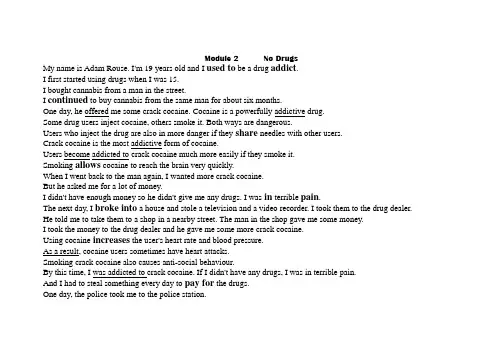
Step1 :做Activity1,复习Reading and Vocabulary中有关Adam Rouse的内容,从而学习新单词,通过师生的问答方式引入。
T:What did Adam Rouse do when he didn‟t have money to pay for his
addiction?
S: He broke into a house to steal.
T: We call it burglary. So was it legal or illegal?
S: Of course it was illegal. T: Sometimes some other addicts will not only break
into people‟s houses to steal , but also in small shops or shopping centers we call it
shoplifting.
T: Do you think that burglary or shoplifting are good behavior, good for society
and people?
S: Of course not.
T: They break the law when they do it. It is a crime and we call those people who
break the law criminals.
Step2 :通过稍微改编一下练习,巩固听学的新词汇。 领读单词让学生做下列填空练习:
l. ______ are the large places where you can buy things.
2. It is _____ to take drug as it is against the law.
3. ______ are people who break the law.
4. _______ is the crime of stealing from a shop.
5. _______ is the crime of stealing from a house.
6. ______ centers can help people to stop taking drugs.
Task2 :听力练习,层层递进,获信息抓关键。
Step3 :设疑、导读、预测: T: According to the given vocabulary, can you guess what
the listening material is about?(启发学生的想象思维) T: Go through the questions in
Activity 2 and predict the answers.(让学生讨论,培养学生的预测能力)
Step4 :导听、释题、听辩交流:
1. Listen and try to get the answers to the 5 questions in Activity
2. Require that students should write down some related information. Questions:
(1). Is the woman in the studio a police officer?
(2). Is she sure about the number of people who steal to pay for drugs?
(3). Do drug users only steal from shops?
(4). Do all drug users attend treatment centers?
(5). Are most drug users young men? (在教师的引导下,学生开始听录音) (针对听力练习的具体任务、目标) T: For the 2nd time, listen and try to fill in the form
below. name of the interviewee job of the woman number of the people who use
illegal drugs in Britain number of the people who break the law to pay for
drugs number of the addicts who go to treatment centers crimes they
commit After listening, check the answers. (在教师的指导下,学生边听录音斩
作摘记,养成边听边记边理解的良好习惯)
Step 5 :浏览原文,检查核对,扫除疑问。 再播放一次录音,把录音材料编成完形填空的形式,让学生复习,核对检查所听内容)(individual work ---- pair work)
I==Interviewer P===Professor I: Good evening, and welcome to the show. With
me in the studio is Professor Marion Smith, who is an expert on the ___________
between ________ and ________. Good evening, Professor Smith. P: Good evening.
I: First of all, how many people use _________ drugs in Britain? P: Possibly four
million people. I: Really? Four million? P: Yes. I: How many of them
________________ in order to pay for their drugs? P: It‟s possible that a hundred
thousand people ______ in order to pay for their ___________. I: A hundred
thousand?! That‟s incredible. And what kinds of __________ do they commit? P:
Mainly _________----- in other words, stealing from shops---- and __________.
Stealing from houses. I: I see. P: And there‟s another problem. Drug users get into
trouble with the police for other reasons as well. I: What kinds of reasons? P: Well.,
you often see drug users in public places, ---_______________ , railway stations, for