
铁将军胎压监测说明书【通用版】
- 格式:pdf
- 大小:4.53 MB
- 文档页数:5

Tire Pressure Monitoring System (TPMS)Monitors the tire pressure while you are driving.If your vehicle's tire pressure becomes significantly low, or if there is a problem with the TPMS with Tire Fill Assist or the compact spare tire is installed, the indicator blinks for about one minute, and then stays on.n What to DoStop your vehicle in safe place. Check the tire pressure and adjust the pressure to the specified level. The specified tire pressure is on a label on the driver's doorjamb.n Tire Fill AssistYour vehicle gives you visual and audible alerts to help you adjust the tire pressure to its appropriate level when the vehicle is on. For your reference,the proper tire pressure levels are located on a label on the driver'sdoorjamb.While inflating: The system beeps and the exterior lights flash once every 5 seconds.When the correct pressure is reached: The system beeps and the exterior lights flash continuously for 5 seconds. Stop filling the tire.If you overinflate: The system beeps and the exterior lights flash twiceevery 3 seconds.HANDLING THE UNEXPECTEDDriving on an extremely underinflated tire can cause it to overheat. An overheated tire can fail. Always inflate your tires to the specified pressure.n Tire Pressure Monitoring System (TPMS) - Required Federal Explanation U.S. modelsEach tire, including the spare (if provided), should be checked monthly when cold and inflated to the inflation pressure recommended by thevehicle manufacturer on the vehicle placard or tire inflation pressure label.(If your vehicle has tires of a different size than the size indicated on the vehicle placard or tire inflation pressure label, you should determine the proper tire inflation pressure for those tires.)As an added safety feature, your vehicle has been equipped with a tire pressure monitoring system (TPMS) that illuminates a low tire pressuretelltale when one or more of your tires is significantly under-inflated.Accordingly, when the low tire pressure telltale illuminates, you should stop and check your tires as soon as possible, and inflate them to the proper pressure.Driving on a significantly under-inflated tire causes the tire to overheat and can lead to tire failure. Under-inflation also reduces fuel efficiency and tire tread life, and may affect the vehicle's handling and stopping ability.Please note that the TPMS is not a substitute for proper tire maintenance,and it is the driver's responsibility to maintain correct tire pressure, even if under-inflation has not reached the level to trigger illumination of the TPMS low tire pressure telltale.Your vehicle has also been equipped with a TPMS malfunction indicator to indicate when the system is not operating properly. The TPMS malfunction indicator is combined with the low tire pressure telltale. When the system detects a malfunction, the telltale will flash for approximately one minute and then remain continuously illuminated. This sequence will continue upon subsequent vehicle start-ups as long as the malfunction exists.When the malfunction indicator is illuminated, the system may not be able to detect or signal low tire pressure as intended.TPMS malfunctions may occur for a variety of reasons, including theinstallation of replacement or alternate tires or wheels on the vehicle that prevent the TPMS from functioning properly.Always check the TPMS malfunction telltale after replacing one or more tires or wheels on your vehicle to ensure that the replacement or alternate tires and wheels allow the TPMS to continue to function properly.HANDLING THE UNEXPECTED。

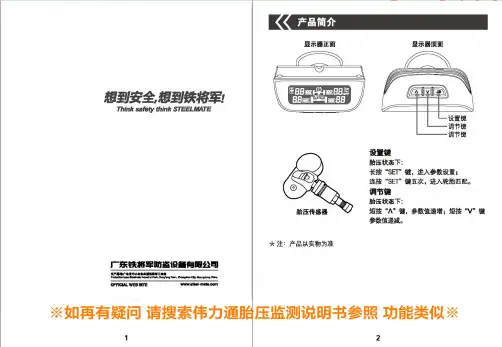
外置式胎压监测仪使用说明外置式胎压监测仪(Tire Pressure Monitoring System,简称TPMS)是一种用于监测车辆轮胎气压的设备。
它能够实时监测车辆轮胎的气压并提供警告,帮助驾驶员及时发现轮胎漏气及胎压异常情况,确保车辆行驶的安全性和稳定性。
以下是外置式胎压监测仪的使用说明。
一、安装与连接1.找到车辆轮胎上的胎压感应器(通常是安装在轮胎空气嘴上的小设备),它会发送轮胎的气压数据给胎压监测仪。
2.将感应器连接到监测仪上。
通常情况下,一个监测仪可以同时连接四个感应器,每个轮胎一个。
确保连接正确,轮胎与感应器匹配。
二、显示屏幕介绍1.开机后,显示屏幕将显示各个轮胎的气压数据。
通常是以图标的形式显示,每个轮胎对应一个图标。
2.屏幕上还会显示当前的胎压数据、胎压警告值、胎压趋势等。
三、胎压数据的读取与重置1.胎压监测仪会自动读取车辆轮胎的气压数据,并在显示屏幕上展示。
2.按下设备上的“读取”按钮,可以手动触发胎压数据的读取。
3.若要重置胎压数据,按住“重置”按钮,屏幕上的数据将被清零。
四、警报与警示1.当轮胎气压低于设定的警报值时,胎压监测仪会发出声音或者显示警告图标。
2.驾驶员应当及时停车检查轮胎气压并采取相应措施,如充气或更换轮胎。
3.警报声音持续响起时,应当尽快停车检查,以免出现危险。
五、胎压趋势的监测1.外置式胎压监测仪可以实时监测轮胎胎压的变化趋势,显示在屏幕上。
2.通过观察胎压趋势,可以及时发现轮胎漏气或者破裂等异常情况,避免事故发生。
六、常见问题与解决办法1.如果感应器与监测仪之间的连接出现问题,可以尝试重新配对或者更换感应器电池。
2.如果显示屏幕上的胎压数据与实际不符,可能是感应器损坏,需要更换。
3.必要时,可以根据监测仪的操作手册进行进一步的问题排查与解决。
外置式胎压监测仪是一项非常有用的车辆安全装备,它帮助驾驶员及时发现轮胎问题,提高驾驶的安全性和舒适性。
使用说明中的提示和建议应被严格遵循,以确保胎压监测仪的正常运行及准确性。
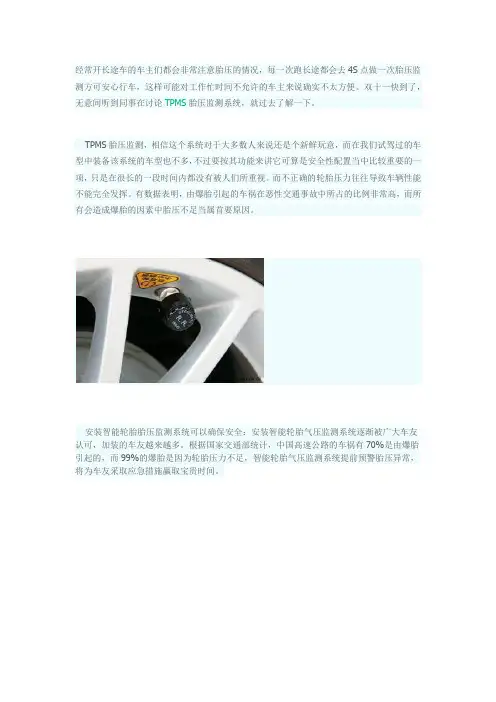
经常开长途车的车主们都会非常注意胎压的情况,每一次跑长途都会去4S点做一次胎压监测方可安心行车,这样可能对工作忙时间不允许的车主来说确实不太方便。
双十一快到了,无意间听到同事在讨论TPMS胎压监测系统,就过去了解一下。
TPMS胎压监测,相信这个系统对于大多数人来说还是个新鲜玩意,而在我们试驾过的车型中装备该系统的车型也不多,不过要按其功能来讲它可算是安全性配置当中比较重要的一项,只是在很长的一段时间内都没有被人们所重视。
而不正确的轮胎压力往往导致车辆性能不能完全发挥。
有数据表明,由爆胎引起的车祸在恶性交通事故中所占的比例非常高,而所有会造成爆胎的因素中胎压不足当属首要原因。
安装智能轮胎胎压监测系统可以确保安全:安装智能轮胎气压监测系统逐渐被广大车友认可,加装的车友越来越多。
根据国家交通部统计,中国高速公路的车祸有70%是由爆胎引起的,而99%的爆胎是因为轮胎压力不足,智能轮胎气压监测系统提前预警胎压异常,将为车友采取应急措施赢取宝贵时间。
同事跟我推荐了铁将军,他本人也是近期安装的,效果很好。
其实对于铁将军的牌子,个人觉得还是比较放心的,毕竟是国产汽车用品的老牌子,同事说之前使用他们的汽车防盗和倒车雷达都不错。
只要按照说明书给安装上了。
它是可以直接安装在轮胎的气嘴上,并和插在点烟口的接收器配对。
连安装工具都配了,所以安装也方便,自己就可以搞定。
还有各个轮胎的胎压情况通过蓝牙直观体现在手机上,胎压、胎温不正常时自动报警,当然希望行车一路平安它永远不要报警啦!
走进铁将军,了解TPMS胎压监测系统,安全一路同行。

HANDLING THE UNEXPECTEDTire Pressure Monitoring System (TPMS) Monitors the tire pressure while you are driving.If your vehicle's tire pressure becomes significantly low, the low tire pressure indicator comes on and a message appears on the multi-information display. The specific tire with low pressure is displayed.n What to DoStop your vehicle in safe place. Check the tire pressure and adjust the pressure to the specified level. The specified tire pressure is on a label on the driver's doorjamb.n Tire Fill AssistYour vehicle gives you visual and audible alerts to help you adjust the tire pressure to its appropriate level when the vehicle is on.While inflating: The system beeps and the exterior lights flash once every 5seconds.When the correct pressure is reached: The system beeps and the exterior lights flash continuously for 5 seconds. Stop filling the tire.If you overinflate: The system beeps and the exterior lights flash twice every3 seconds.Driving on an extremely underinflated tire can cause it to overheat. An overheated tire can fail. Always inflate your tires to the specified pressure.n Tire Pressure Monitoring System (TPMS) - Required Federal Explanation U.S. modelsEach tire, including the spare (if provided), should be checked monthly when cold and inflated to the inflation pressure recommended by the vehicle manufacturer on the vehicle placard or tire inflation pressure label.(If your vehicle has tires of a different size than the size indicated on the vehicle placard or tire inflation pressure label, you should determine the proper tire inflation pressure for those tires.)As an added safety feature, your vehicle has been equipped with a tire pressure monitoring system (TPMS) that illuminates a low tire pressure telltale when one or more of your tires is significantlyunder-inflated.HANDLING THE UNEXPECTEDHANDLING THE UNEXPECTEDAccordingly, when the low tire pressure telltale illuminates, you should stop and check your tires as soon as possible, and inflate them to the properpressure.Driving on a significantly under-inflated tire causes the tire to overheat and can lead to tire failure. Under-inflation also reduces fuel efficiency and tire tread life, and may affect the vehicle's handling and stopping ability.Please note that the TPMS is not a substitute for proper tire maintenance, and it is the driver's responsibility to maintain correct tire pressure, even if under-inflation has not reached the level to trigger illumination of the TPMS low tire pressure telltale.Your vehicle has also been equipped with a TPMS malfunction indicator to indicate when the system is not operating properly. The TPMS malfunction indicator is combined with the low tire pressure telltale. When the system detects a malfunction, the telltale will flash for approximately one minute and then remain continuously illuminated. This sequence will continue upon subsequent vehicle start-ups as long as the malfunction exists.When the malfunction indicator is illuminated, the system may not be able to detect or signal low tire pressure as intended.TPMS malfunctions may occur for a variety of reasons, including theinstallation of replacement or alternate tires or wheels on the vehicle that prevent the TPMS from functioning properly.Always check the TPMS malfunction telltale after replacing one or more tires or wheels on your vehicle to ensure that the replacement or alternate tires and wheels allow the TPMS to continue to function properly.。