
完整版中国戏曲opera英文介绍
- 格式:ppt
- 大小:12.16 MB
- 文档页数:19
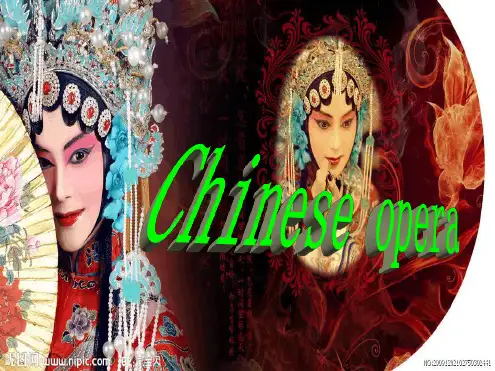

Title: The Essence of Chinese Opera: A Timeless Art Form
Chinese opera, an integral part of Chinese culture, stands as a testament to the
nation's profound history, wisdom, and artistic creativity. This vibrant and diverse art
form has evolved over centuries, blending elements of literature, music, dance, art,
martial arts, acrobatics, and performing arts into a harmonious whole. It is not merely
entertainment but a rich repository of cultural heritage, emotional expression, and
social commentary.
Origins and Evolution
Chinese opera traces its roots back to primitive dance-dramas, with early forms
emerging during the Han, Tang, Song, and Jin dynasties. Over the years, it has
undergone continuous enrichment, innovation, and refinement, finally blossoming
into a sophisticated art form. Today, there are over 360 varieties of traditional operas

中华文化戏曲英文介绍作文
英文:
Chinese culture has a rich history of traditional opera,
which is known as "Xiqu" in Chinese. This art form has been
an integral part of Chinese culture for centuries, with a
wide variety of regional styles and performance techniques.
Xiqu includes several different types of opera, such as
Peking opera, Cantonese opera, and Kunqu opera, each with
its own unique characteristics and performance traditions.
Peking opera, also known as Beijing opera, is one of
the most well-known forms of Chinese opera. It combines
music, vocal performance, mime, dance, and acrobatics to
create a visually stunning and emotionally captivating
theatrical experience. The performers often wear elaborate
costumes and makeup, and the performances are accompanied
by traditional Chinese instruments such as the erhu and the

介绍中国京剧的英文作文——让你了解中华传统戏曲艺术
英文回答:
Chinese Beijing Opera, also known as Peking Opera, is a
traditional form of Chinese theater that combines singing, dancing,
acting, and acrobatics. It originated in the late 18th century and
became popular during the Qing Dynasty. Beijing Opera is known for
its elaborate costumes, distinctive makeup, and stylized gestures.
The stories in Beijing Opera are usually based on historical
events, legends, or classical Chinese literature. The characters
are divided into four main types: sheng (male roles), dan (female
roles), jing (painted face roles), and chou (clown roles). Each type
has its own unique characteristics and performance techniques.
The singing in Beijing Opera is very distinctive and uses a
technique called "jingju", which combines singing and speaking. The
actors also use various movements and gestures to convey emotions

戏曲介绍英文作文初中
英文:
As a fan of Chinese traditional culture, I am very
interested in Chinese opera, also known as "xi qu" in
Chinese. It is a form of traditional Chinese theater that
has a history of over 2000 years. Chinese opera combines
music, singing, dancing, and acrobatics to tell stories of
Chinese history, legends, and folk tales.
There are many types of Chinese opera, including
Beijing opera, Cantonese opera, and Kunqu opera. Each type
has its unique style of music, costume, and makeup. For
example, Beijing opera is known for its powerful singing,
elaborate costumes, and colorful makeup, while Cantonese
opera is more melodious and focuses on the performers'
acting skills.
Chinese opera is not only an art form but also a
reflection of Chinese culture. It embodies traditional Chinese values such as loyalty, filial piety, and