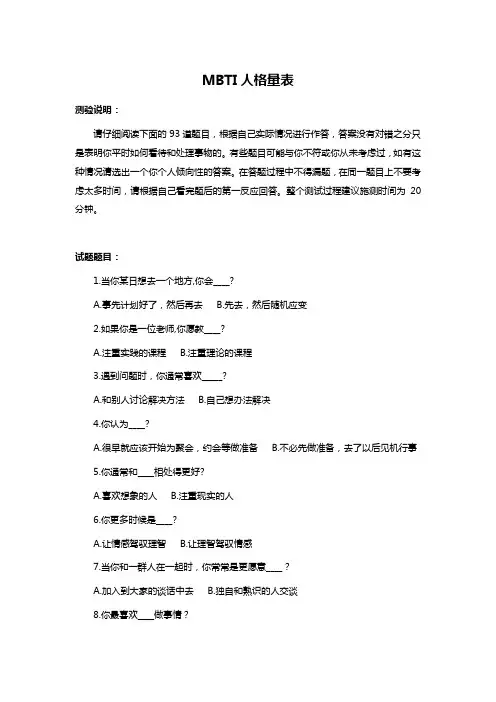
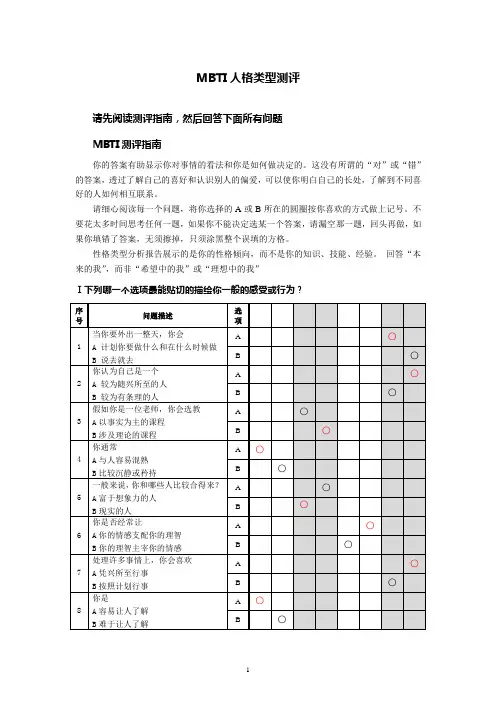
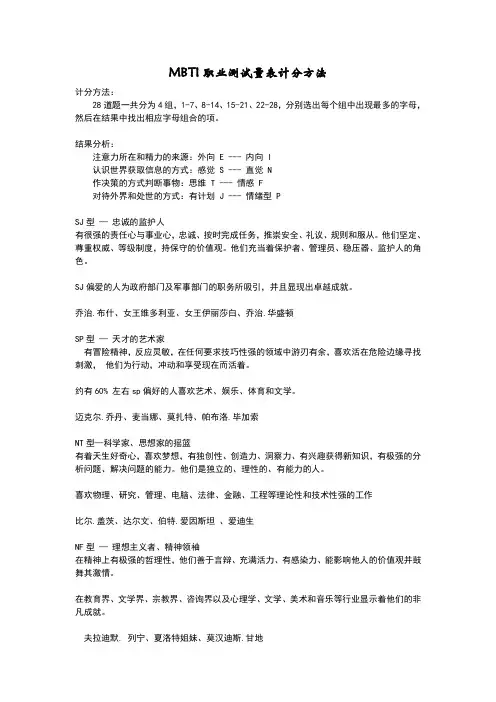
MBTI测试量表
- 格式:doc
- 大小:103.50 KB
- 文档页数:14
. . 了解自己的感情和情绪方式 性情方式测试 Myers-Briggs Type Indicator (MBTI) 从每组的两个选项里选出最适合自己的一个。From each pair of statements, please circle the statement that best describes you.
1. A.在人很多,声音也比较大的地方不会觉得受不了。 B.喜欢安静,对人太多的场合能免则免。 A. Tolerate noise and crowds. B. Avoid crowds and seek quiet.
2. A.通过概括性的概念学习新事物。B.通过观察和操作学习新事物。 A. Learn new things through general concepts. B. Learn new things by imitation and observation.
3. A.寻求客观事实。 B.寻求和睦相处。 A. Have truth as an objective. B. Have harmony as a goal.
4. A.通常会顺其自然的灵活处理生活中的各种事情和情况。 B.比较希望能按照自己的想法对生活中的各种情况作出计划和选择。 A. Seek to adapt my life and experience to what comes along. B. Prefer my life to be decisive, imposing my will on it.
5. A.说比听多。 B.听比说多。 A. Talk more than listen. B. Listen more than talk. . . 6. A.关注实践经验。 B.关注各种可能性。 A. Focus on actual experience. B. Focus on possibilities.
7. A.通过理性分析做决定。 B.通过内心感觉做决定。 A. Decide more with my head. B. Decide more with my heart.
8. A.喜欢尝试适应新情况。 B.对任何情况都希望先了解再进入。 A. Like adapting to new situations. B. Prefer knowing what I’m getting into.
9. A.通常不表现出内心的热情。 B.心中的热情会自然流露出来。 A. Keep enthusiasm to self. B. Communicate with enthusiasm.
10. A.通常比较具体和平铺直叙。 B.通常比较概括和形象描述。 A. Tend to be specific and literal. B. Tend to be general and figurative.
11. A.很容易留意到他人需要支持。 B.很容易留意到没有逻辑的说法。 A. Notice when people need support. B. Notice ineffective reasoning. .
. 12. A.做出决定后会感觉好一点儿。 B.比较喜欢保持事务的开放性。 A. Feel better after making decisions. B. Prefer to keep things open.
13. A.容易分心。 B.容易专心。 A. Distracted easily. B. Concentrate well.
14. A.常用比喻和打比方。 B.给予详细描述。 A. Use metaphors and analogies. B. Give detailed descriptions.
15. A.机智圆滑。 B.坦诚直率。 A. Choose tactfulness over truthfulness. B. Choose truthfulness over tactfulness.
16. A.喜欢开始新事情。 B.希望已经开始的事情能够做完。 A. Enjoy starting things. B. Enjoy finishing things.
17. A.喜欢与人相处和参与各种聚会活动。B.交友谨慎,有选择的参与聚会活动。A. Meet people readily and participate in many activities. B. Proceed cautiously in meeting people and participate in selected activities. .
. 18. A.行动时会自然运用想象力。 B.行动时较关注客观现实。 A. Behave imaginatively. B. Behave practically.
19. A.很有同情心。 B.需要时能够态度坚定不徇私情。 A. Deal with people compassionately. B. Deal with people firmly, as needed.
20. A.希望生活是按部就班的。 B.希望生活是有灵活性的,这样不会顾此失彼。A. Work for a settled life, with my plans in order. B. Keep my life as flexible as possible so that nothing is missed.
21. A.说话前会先仔细思量。 B.心直口快。 A. Think carefully before speaking. B. Blurt things out without thinking.
22. A.比较依靠直觉。 B.比较依靠经验。 A. Rely on hunches. B. Rely on past experiences.
23. A.希望凡事都有逻辑有原则。 B.希望各人的独特之处都能得到鼓励和赏识。 A. Expect world to run on logical principles. B. Expect the world to recognize individual differences. . . 24. A.不喜欢意料之外的情况,最好能预先心里有数。 B.喜欢事事都出人意料,享受随机应变。 A. Dislike surprises and want advance warning. B. Enjoy surprises and like adapting to last-minute changes.
25. A.聚会能给我充电。 B.独处能给我充电。 A. Parties recharge my batteries. B. Time alone recharges my batteries.
26. A.喜欢可预见的关系。 B.觉得关系应该是不断更新的。 A. Like predictable relationships. B. Value change in relationships.
27. A.关注每个决定的价值及其周围人的影响。B.擅于考虑到每个决定的利弊。A. Note how an option has value and how it affects people. B. Note pros and cons of each option.
28. A.时间是可循环使用的资源,事情的期限是可以有灵活性的。 B.做每件事情的时间是有限的,做事时有期限就要尽可能遵守。 A. See time as a renewable resource, and see deadlines as elastic. B. See time as a finite resource, and take deadlines seriously. .
. 29. A.需要安静下来思考的时间。 B.需要边做边思考。 A. Need to have time to reflect. B. Hate to do nothing. Like to be on the go.
30. A.喜欢用标准的方法解决问题。 B.用新颖独特的方法解决问题。 A. Appreciate standard ways to solve problems. B. Use new and different ways to solve problems and reach solutions.
31. A.能洞察问题,与人共事认真严谨。 B.取悦于人,擅于欣赏他人的长处。 A. See others’ flaws; critical. B. Like to please others; show appreciation.
32. A.喜欢在任务列表上核对打钩。 B.有任务表也不会太放在心上。 A. Like checking off “to do” list. B. Ignore “to do” list even if I made one.
33. A.喜欢团组工作和谈话。 B.喜欢小范围的合作或者独来独往。 A. Like working or talking in groups. B. Prefer to socialize in small groups or be “by myself”.
34. A.跳跃式思维行事。 B.有板有眼有条不紊。 A. Leap around in a roundabout way. B. Methodical.