
English Literature
- 格式:ppt
- 大小:587.00 KB
- 文档页数:63

英文文学著作English literature is a vast and rich field that encompasses a wide range of writing styles, themes, and periods. From the epic poems of Beowulf to the romantic poetry of the Victorian era, English literature offers a glimpse into the minds and hearts of those who have come before us. Reading works of English literature can transport us to different times and places, allowing us to experience the thoughts and emotions of people from centuries past.英国文学是一个广阔而丰富的领域,涵盖了各种写作风格、主题和时期。
从《贝奥武夫》的史诗诗歌到维多利亚时代的浪漫诗歌,英国文学为我们提供了一瞥那些过去的人们的思想和心灵。
阅读英国文学作品可以使我们穿越到不同的时代和地点,让我们体验几个世纪前人们的思想和情感。
One of the most significant periods in English literature is the Romantic era, which lasted from the late 18th century to the mid-19th century. Romantic literature is characterized by an emphasis on emotion, nature, and individuality, and prominent Romantic writers include William Wordsworth, Samuel Taylor Coleridge, and Lord Byron. The Romantics sought to capture the power and beauty ofnature in their writing, often using vivid imagery and intense emotions to convey their feelings about the world around them.英国文学中最重要的时期之一是浪漫主义时代,从18世纪末到19世纪中叶持续。

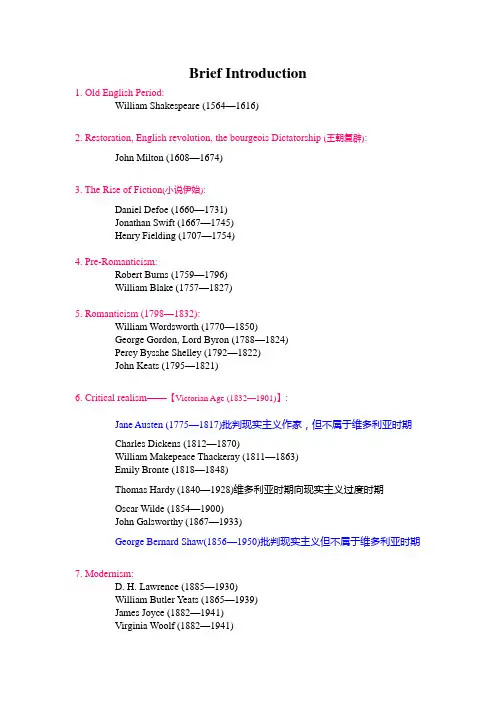
Brief Introduction1. Old English Period:William Shakespeare (1564—1616)2. Restoration, English revolution, the bourgeois Dictatorship (王朝复辟):John Milton (1608—1674)3. The Rise of Fiction(小说伊始):Daniel Defoe (1660—1731)Jonathan Swift (1667—1745)Henry Fielding (1707—1754)4. Pre-Romanticism:Robert Burns (1759—1796)William Blake (1757—1827)5. Romanticism (1798—1832):William Wordsworth (1770—1850)George Gordon, Lord Byron (1788—1824)Percy Bysshe Shelley (1792—1822)John Keats (1795—1821)6. Critical realism——【Victorian Age (1832—1901)】:Jane Austen (1775—1817)批判现实主义作家,但不属于维多利亚时期Charles Dickens (1812—1870)William Makepeace Thackeray (1811—1863)Emily Bronte (1818—1848)Thomas Hardy (1840—1928)维多利亚时期向现实主义过度时期Oscar Wilde (1854—1900)John Galsworthy (1867—1933)George Bernard Shaw(1856—1950)批判现实主义但不属于维多利亚时期7. Modernism:D. H. Lawrence (1885—1930)William Butler Yeats (1865—1939)James Joyce (1882—1941)Virginia Woolf (1882—1941)William Somerset Maugham (1874—1965)Thomas Stearns Eliot (1888—1965)John Boynton Priestley (1894—1984)Louis MacNeice (1907—1963)Old English Period:William Shakespeare William Shakespeare(1564—1616)★ Literary Achievements:·37plays,·2 narrative poems,·154 sonnets (Sonnets 1-126 addressed to a young man, Sonnets 127-152 addressed to “Dark Lady”, Sonnets 153-154 addressed to Cupid, the God of love in Greek mythology) ★ Literary Position:·“not of an age, but for all time”,·the greatest giant of English language and poetic form,·one of the founders of realism in world literature,·o ne of the greatest writers in the world’s literature.▲ Sonnet:1. What’s a sonnet?A poem in 14 lines; originated in Italy, a form very popular in Renaissance Europe, especiallyin Italy, France and England; introduced to England by Thomas Wyatt(怀亚特) and the Earl of Surrey (塞莱).2. By rhyme scheme, sonnets can be classified into 2 styles: The Italian or Petrarchan sonnet(意大利型或彼得拉克型) & The Shakespearian or English sonnet(英国或莎士比亚型)①The first eight lines—octave: the theme is put forward or a question is raised; the next sixlines—sestet, the answer to the theme【abba abba cdc dcd (cde cde)】②Three quatrains (四行诗) —the theme is put forward and developed; the couplet(两行诗)—a surprising conclusion or a shift of ideas 【abab cdcd efef gg】▲ Plays(4 periods)1. First period (1592-1594): His apprenticeship in plays.Historical plays: King Henry VI《亨利六世》, Richard Ⅲ《查理三世》Comedies: Love’s Labour’s Lost《爱的徒劳》2. Second period (1595-1600): Mature period, a marked increase in the knowledge of humanism(4大喜剧): A Midsummer Night’s DreamThe Merchant of VeniceAs You Like It, Twelfth NightRomeo and Juliet3. Third period (1601-1608): Flourishing period, a period of gloomy and depression(4大悲剧): HamletOthelloKing LearMacbeth4. Fourth period (1608-1612): The period of romantic drama in the form of tragicomediesReconciliation plays: The Winter’s Tale《冬天的童话》, The TempestThe Merchant of V enice—William Shakespeare1. The character of Shylock:Stone-hearted and pitiless;Inhuman;Stubborn;Malicious;Revengeful;Eloquent, quick-minded and flexible;Religious pious2. Theme of the play:·to praise the friendship between Antonio and Bassanio,·to idealize Portia as a heroine of great beauty, wit and loyalty,·to eulogize the triumph of friendship and love over greed and avarice, good over evil, humanity over inhumanity, commercial capitalism over the feudal practice of usury,·a satire on the Christian hypocrisy and their false standards of friendship and love, their cunning ways of pursuing worldliness and their unreasoning prejudice against the Jews.Restoration, English revolution, the bourgeoisDictatorship(王朝复辟)John Milton ★ Historical background1. The English revolution and the Restoration.·Causes: the conflict between the monarch and Parliament; the persecution of the Puritans2. The bourgeois Dictatorship and the Restoration·Glorious Revolution—a bloodless revolution·The constitutional monarchy.John Milton (1608—1674)★ Literary Achievements▲ Pamphlets·The Defense of the English People (1650)·The Second Defense of the English People (1650)▲ Poems·Paradise Lost《失乐园》(1667): his masterpiece——The greatest epic in English literature.·Paradise Regained (1671) 《复乐园》·Samson Agonistes (1671) 《力士参孙》★ Literary Position·A master of the Blank verse·The greatest English revolutionary poet of the 17th century·One of the greatest poets of the English languageParadise Lost—John Milton 1. Introduction·Long epic in 12 books·Written in blank verse·Based on Genesis《创世纪》in the Old Testament·Dramatizes the Biblical account of humanity’s banishment.2. Theme—Milton’s aimed purpose: “justify the ways of God to man”(昭示天道对人的公正)—Real purpose: challenge the restored monarch·God — tyrannical, represents the king·Satan — rebelling against monarch·Love between Adam and Eve — human pursuit for happiness, the spirit of Renaissance3. Writing features—Milton style: Sonority洪亮, Eloquence雄辩, Majesty尊严, Grandeur壮美·The blank verse·Long and involved sentences—Latinate style·Inversion·AllusionThe Rise of FictionDaniel Defoe (1660-1731)Jonathan Swift (1667-1745)Henry Fielding (1707-1754)※ FictionThe mainstream of 18th century literature, & The rise and growth of realistic novel —the most prominent achievement of 18th century English literatureDaniel Defoe (1660-1731): Father of modern journalism, & “jack-of-all-traders”★ Literary Achievements:—— Robinson Crusoe (1719)·Defoe’s masterpiece·The first English novel in a real sense·The first English realistic novelRobinson Crusoe—Daniel Defoe 1. Theme:—to sing the praises of human labor—to celebrate the strength of human rational will to conquer the natural environment—to beautify colonialism & Negro slavery2. Plot:run away from home → becom e a sailor → a planter in Brazil → to an uninhabited island because of shipwreck → made a living there all by himself → save a negro named Friday who became his servant → back to England → visit the remote island again and Friday was killed3. Robinson Cru soe’s characterization:typical of the rising English bourgeois class, practical, diligent, a restless curiosity to know more about the world and a desire to prove individual power in the face of social and natural challenges; shrewd, care about money and good at managing; courageous and intelligent to overcome all kinds of obstacles4. Style:journalistic truth with many vivid details, simple and plain sentence structure and language, first person point of view, natural order in narration, making the story intimate to the readers and become popular among lower classesJonathan Swift (1667-1745)★ Literary Achievements▲ Books·The Battle of Books《书籍之战》·A Tale of Tub《一个桶子的故事》·Guliver’s Travels《格列佛游记》——his masterpiece: a satire on the whole English society of the 18th century.▲ Pamphlets·The Draper’s Letters《一个布商的书信》·A Modest Proposal《一个温和的建议》——(A Modest Proposal for Preventing the Children of Poor People in Ireland from Beinga Burden to Their Parents)Guliver’s Travels—Jonathan Swift1. Plot:Part I: A Voyage to LilliputPart II: A Voyage to BrobdingnagPart III: A V oyage to Laputa, Balnibarbi, Glubbdubdrib, Luggnagg and JapanPart IV: A V oyage to the Country of the Houyhnhnms2.What are the implied ideas the author tried to convey by this chapter?The author believed Reason was very important for human being. If human’s desires aren’t controlled by reason, human will become disgusting like yahoos one day in the future.3. Style of Swift’s prose:His prose style is simple, clea r and vigorous. His famous saying “Proper words in proper places, makes the true definition of a style” influenced a lot later writers.Henry Fielding (1707-1754)★ Literary Achievements·Joseph Andrew s 《约瑟夫安德鲁斯》—Fielding’s first novel—Parody (sat irical imitation) of Richardson’s Pamela《帕米拉》/《贞洁得报》—A comic epic poem in prose·Jonathan Wild the Great《大伟人江奈生魏尔德传》·The History of Tom Jones, A Founding《弃儿汤姆琼斯》·Amelia《阿米利亚》★ Literary Position·The father of English novel—The founder of English realistic novel-setting up the theory of realism in literary position.—Establishing once for all the form of the modern novel.★ Writing Features·Third-person narration 第三人称叙述·Satire·Human portraits & dialogue·The educational function of the novel—The purpose of the novel is not only to amuse, but also to instruct.※ ParodyWriting, music, art something said, etc, which intentionally copies the style of someone famous or copies a particular situation, making the features or qualities of the original morenoticeable in a way that is humorous. 为嘲弄某作者或某作品而作成的模仿滑稽作品The History of Tom Jones, A Founding—Henry Fielding ·Fielding’s masterpiece, showing the whole life of 18th century England as she saw it.·18 books divided into 3 parts with 6 in each.·Country-versus-city motif—the countryside: the basic goodness of human race—the city: evil and sin·An allegorical (寓言的) novelThe 18th Century (1688-1798)★ Historical Background1. Comparatively peaceful development under the constitutional monarchy·A compromise between Tory and Whig·The leading navel power in Europe2. The Industrial Revolution 工业革命·Unprecedented technical innovations·Rapid growth of industry and commerce★ The Enlightenment1. An intellectual movement in Europe began in the late 17th and 18th centuries and ended with the French revolution of 1789—Originated in France, represented by Montesquieu, V oltaire, Diderot, Rousseau—An expression of struggle of bourgeoisie against Feudalism2. The influence of science and philosophy—Newton’s discovery of universal gravitation—John Locke·Knowledge is not innate, but comes only from experience and observation guided by reason. ·A great premium was placed on the discovery of truth through the observation of nature, rather than through the study of authoritative sources, such as Aristotle and the Bible★ Age of Reason1. Importance—a lasting heritage for the 19th and 20th century—it marked a key stage in the decline of the church and the growth of modern secularism(世俗主义)—it served as the model for political and economic liberalism.2. The development of Poetry: Classicism 古典主义—First half of the 18th century—Originated in France: Boileau (布瓦格): The Art of Poetry (诗艺)—A declaration of Classicism3. Characteristic of neo-Classicism1). Emphasizing reason rather than emotion, form rather than content.2). Didactic and satirical3). Heroic Couplet (英雄双韵体)4). Town poetry writing for the rising bourgeoisie5). Nothing related with “romantic”Alexander Pope(1688-1744) 亚历山大蒲柏★ Literary position—an outstanding enlightener—The greatest and the most important representative of the English classical poetry.★ Literary achievement▲ Pastorals 田园诗·The Windsor Forest—a patriotic poem▲Satirical poem 讽刺诗·The Rape of the Lock(1712) 《卷发遇劫记》—Finest and one of the most famous mock-heroic poem(滑稽英雄体诗)in the English language.·The Dunciad (1728) 《愚人记》▲Philosophical poems 哲理诗·An essay on Criticism (1711) 《批评论》To err is human, to forgive divine.错为人之事,恕为神之业For fools rush in where angels fears to tread. 智者裹足不前,愚者铤而走险·An essay on Man(1732-1734)《人论》Pre-Romanticism: Latter half of the 18th centuryRobert BurnsWilliam Blake 1. Romantic revival·A strong protest against the bondage of Classicism (=Formalism)·A recognition of the claims of passion and emotion.2. Representatives·Robert Burns (1759-1796) 罗伯特彭斯·William Blake (1757-1827) 威廉布莱克Robert Burns (1759-1796) 罗伯特彭斯★ Literary Achievements—Poems chiefly in the Scottish Dialect《苏格兰方言诗集》★ Theme·Love and friendship·The natural beauty of his native Scotland·The life and label of the common people·The patriotism of his compatriots and their struggle for liberty★ Features of his poetry·Beautiful lyricism·Sincerity of emotions·Profound sympathy for the poor·A new spirit of romanticism.A red, red Rose—Robert Burns1. Ballad meter 民歌体—Odd-number lines: iambic tetrameter—Even-number lines: iambic trimeter2. Rhetorical devices3. Theme: loveWilliam Blake 威廉布莱克★ Literary Achievements: Songs of Innocence, Songs of Experience—These two collections show, in Blake’s words “two country state of human soul”—The contrast between these two collections is of great significance for it makes a progress in the poet’s outlook on life.Songs of Innocence《天真之歌》·Written for children, express the poet’s delight in life.·To depict the happy condition of a child before it knows anything about the pains of exerience. ·Simple without being naïve, childlike without being childish, innocent without being insipid.Songs of Experience《经验之歌》·Much maturer work·The atmosphere is no longer sunny but sad and gloomy.·To draw pictures of neediness and distress and to show the suffering of the miserable.London—William Blake 『1』StanzaⅠ1.Where is the poet?2.What does he see?StanzaⅡ-sounds1.What does he hear?2.What is the sound which he can hear while others can not hear?StanzaⅢ - sounds1.What rhetorical device is mainly used?2.Why does the poet use the sharp contrast?StanzaⅣ - sounds & sights1.What does Blake want to show in the last stanza?(He attributes the social evil, esp. the evil war to ruling society.)『2』Q1: Do you think this poem is taken from Song of Innocence or Song of Experience?➢Song of ExperienceQ2: Did the author love the London described in the poem?➢No. (He once loved London very much and wrote such lines “golden London and her silver Thames” but London gradually degenerated in the poet’s heart)Q3: What is the rhyme scheme of the poem?➢ a b a b; iambic tetrameterQ4: What is the theme of the poem?➢Criticizing the dark sides of English society and showing the sufferings of common people (The poem has been called “mightiest brief poem” because it employs only several images to describe some deep-rooted social vices vividly.)『3』Linguistic Features·Anvil music—Simple, short, easy words are repeated used.—Regular stanza form -- four-line stanza with rhyme scheme a b a b·Past-participle is used as adjective which makes the poem more vivid and deeply, clearly expresses the poet’s theme·RepetitionThe Age of Romanticism (1798-1832)William Wordsworth ★ Political and social factors1. The American and French revolution: an upsurge of national liberation and democratic movementsAmerican revolution (1775-1783)—The formation of the independent United States.French revolution of 1789—“Liberty, equality and fraternity”2. The Industrial Revolution3. The Luddite movement★ Intellectual Background--Shift from emphasis on reason to instinct and emotion1. Rousseau 卢梭—the father of romanticism—To rely on feelings, to follow the instincts and emotions.—Return to nature.2. Edmund Burke 埃德蒙伯克—Reflection on the Revolution in France (1790)《法国革命感想》3. Thomas Paine 托马斯潘恩—Rights of Man (1791) 《人权》★ General characteristic features (style)1.Subjectivism2.Spontaneity3.Singularity4.Simplicity: everyday language spoken by the rustic people5. A dominating note of melancholy6. A freer verse form★ Romantic Poetry1. Lake poet (湖畔诗人)—the passive or escapist romanticists: Wordsworth, Coleridge, Southey—detesting the real world, escaping from the reality.2. Active or radical romanticists: Byron, Shelley, Keats—striving to strengthen man’s will to live and raise him up against the darkness in the world.William Wordsworth (1770-1850)★ Literary AchievementsMajor works·Lyrical Ballads (1798) 《抒情歌谣集》·The Prelude (1850) 《序曲》:—Wordsworth’s autobiographical poem.★ Major concern1. Nature (is)·The embodiment of the Divine Spirit·The greatest of all teachers2. The life of ordinary people★ Literary Position·Poet Laureate 桂冠诗人(1843)·One of the best and the most famous romantic poets★ Poetic features—Simplicity and purity of his language.Lyrical Ballads (1798)《抒情歌谣集》—William Wordsworth1.Written by Wordsworth and Samuel Taylor Coleridge2.Marked the break with the conventional poetic tradition of 18th century classicism, and thebeginning of romanticism in English poetry3.The preface serves as the manifesto of the English romantic movements in poetry.4.The principle of poetry: “All good poetry is the spontaneous overflow of powerful feeling.”——“所有好诗都是强烈感情的自然流露.”5. The function of poetry: “novelty and originality”6. The language in poetry: near to the real language of men.She Dwelt Among the Untrodden Ways—William Wordsworth —His “Lucy” poems are a series of short pathetic lyrics on the theme of harmony between humanity and nature.The Solitary Reaper—William WordsworthLondon—William WordsworthLake Poets: Coleridge 柯勒律治·The Rime of the Ancient Mariner(1798) 《古舟子吟》·Christable (1816) 《克里斯塔贝尔》·Kubla Khan (1816) 《忽必烈汗》Lake Poets: Southey 骚塞—Poet LaureateJane Austen (1775—1817)Jane Austen (1775—1817)★ Literary AchievementsSix Novels·Northanger Abbey《诺桑觉寺》·Sense and Sensibility《理智与情感》·Pride and Prejudice《傲慢与偏见》·Mansfield Park《曼斯菲苑林》·Emma《艾玛》·Persuasion《劝导》★ Writing Characteristics— Chief interestsThe relationship between men & women in love— Artistic features·Subtlety of observation 细致入微的观察·Depth of psychological penetration 深刻的心理分析·Delicacy of touch 细腻的笔触★ Literary Position—One of the greatest novelists of the 19th and 20th centuriesPride and Prejudice——Jane Austen’s best-known novel 1. Story—Love and marriage—Darcy’s pride against Elizabeth’s prejudice2. Feature—Irony·Verbal irony in dialogue and situation·Dramatic irony—Witty and delightful dialoguesActive Romantic PoetsGeorge Gordon ByronPercy Bysshe ShelleyJohn Keats George Gordon Byron (1788—1824)★ Life➢born in a noble family➢inherited the baronial title➢graduated from Cambridge University➢entered House of Lords➢strongly criticized by those conservatives and at last left England➢stayed in Italy and then Greece➢died in Greece at 36★ Major Works·Hebrew Melodies—lyrical poem collection·Child Harold’s Pilgrimage—One of his most readable books·Don Juan (1818-1823)—His masterpiece★ Byronic Heroes—The men with fiery and unbending will express the poet’s own ide al of freedom.— The men who rise against tyranny and injusticeDon Juan—George Gordon Byron1. Hero of the long poem:Don Juan, a Spanish young man born in a noble family; strange adventures he has experienced (Greece, Turkey, Russia and England);2. A panorama of the whole Europe and a strong satireShe Walks in Beauty—George Gordon Byron1. Background:— By ron’s most famous lyrical poem— wrote for his beautiful cousin Mrs. Wilmot Horton— taken from Hebrew Melodies2.Q1: Rhyme scheme of the poem?—— a b a b a b (iambic tetrameter)Q2:In the first stanza, the author used a simile to describe the woman’s beauty. Find out the simile and tell why the author made a comparison like this.——“night of cloudless climes and starry skies”; because th e woman wore a black mourning gown brightened with spangles.Percy Bysshe Shelley (1792—1822)★ Major Works·Queen Mab《麦布女王》(1813):his first important poem, in the form of fairy-tale dream ·The Revolt of Islam《伊斯兰的叛变》(1817)·Prometheus Unbound《解放了的普罗米修斯》(1819)—lyrical drama·The Cenci《沉西》(1819)·The Masque of Anarchy《专制魔王的化妆游行》(1819)·Song to the Men of England《给英格兰人的歌》(1819)·Ode to the West Wind《西风颂》(1819)★ Artistic Features— Lyrics intensity·Lyrics on politics·Lyrics on nature·Lyrics on love— Revolutionary ardency— Optimistic idealism—Image(意象)& symbol(象征)★ Literary Position—The great poet of revolutionary romanticism in England.—“The most wonderful lyric poet England has ever produced”Ode to the West Wind—It made Shelley the greatest English lyrical poet, and is the lyric of lyrics.1. Main ideaThe old world must go, a new word must come with the Spring, laden with fresh sweet promises for suffering humanity.2.1). Stanza ⅠWest wind is·Blowing over the land·Driving dead leaves away·Carrying the seeds to wintry bed so that they would grow up next year.·Both a destroyer and preserver—A destroyer of old, useless, decaying things, such as dead leaves.—A preserver of new, life-going things, such as seeds.2). Stanza ⅡWest wind is·Sweeping in the sky·Gathering the loose clouds·Preparing a storm with black rain, lightening and hail·Calling the dirge of the dying year3). Stanza ⅢWest wind is·Moving across the sea·From the Mediterranean to the Atlantic Ocean·Becoming stronger and stronger·Even frightening the sea vegetation4). Stanza ⅣThe poet compares “I” to and with the west wind·“if”s·Poetic inspiration·The poet’s personality5). Stanza ⅤThe poet’s wishes·To share the spirit of the west wind·To use his poem to quicken a new birth and awaken the earth The poet’s prophecy·If winter comes, can spring be far behind?3. West wind: A symbol·Strength, power·Change of season·Approaching revolution·The poet’s personality·The poetic inspiration·A revolutionary spirit·The destroyer of the old world·the preserver of the new world·Hope for the new lifeJohn Keats (1795—1821)★ Literary Achievement▲ Five long poems·Endymion《恩底弥翁》·Isabella《伊莎贝拉》·The Eve of ST. Agnes《圣尼亚节前夕》·Lamia《雷米亚》·Hyperion《赫波里昂》▲Short Poems —of the numerous short poems by Keats, the most important are his sonnets and odes.·On the Grasshopper and Cricket《蝈蝈和蟋蟀》·Ode to Nightingale《夜莺颂》·Ode to Autumn《秋颂》·Ode on a Grecian Urn《希腊古瓮颂》★ Features1. A clean split with 18th century classicism.Byron & Shelley: attempted to remold the contemporary society with both poetry andpolitical action.Keats: restricted his application of the principle of liberty to the sphere of Art.2. Beauty in truth, truth in beauty. (美即现实,现实即美)Keats found beauty in nature, in literature, esp. poetry, and in human struggle for liberty.On the Grasshopper and Cricket—John Keats 1. A sonnet embodying the idea of ever-beautiful nature2.Sensuous Image (感官意象): Sense appealing to five organs·sight·hearing·tasting·smell·touchingOde to Autumn—John Keats1.Stanza Ⅰ➢Early autumn and morning➢Colorfulness or sight of Autumn:—purple grapes, red apples, green moss, golden crops, multi-colored flowersStanza Ⅱ·Stylistic device: personification·Four activities: threshing, reaping, gleaning and cider-making. These four are typical act i vities of farmers in England·Mid-autumn and day-time·Farmers are resting·Specific aspect: harvesting people: thresher, reaper, gleaner, cider-makerStanza Ⅲ—It’s the music made of·“g nats” wailing·“lamb” bleating·“crickets” singing·“robins” whistling·“swallow” twittering—Stylistic device:·onomatopoeia 拟声— Late autumn and evening— Specific aspect: symphony or music of autumn2. Structure merit—The remarkable achievement in managing the structure is the creation of two underlying clues, the passage of a day as well as the transition of season.3. Tone:·Objective·Content·Relaxed·Peaceful4. Theme—To praise the warmth and fruitfulness of autumn.The Victorian Age (1832—1901)Charles DickensWilliam Makepeace ThackerayThe Brontë Sisters —Emily Brontë★ Historical background1. The Victorian Age—First Period (1832-1848): a time of social unrest—The mid-Victorian Period (1848-1870): The heyday of the Victorian Age—The last period: (1870-1901): The decay of Victorian values2. The end of poetry poem3. The rise of novels—Novel: dominant literary genre★ Critical Realism1. Appeared in 19th century and flourished in 1840s and early 50s2. RepresentativesCharles DickensThackerayThe Brontë Sisters3. Basic characteristics❖To expose and criticize the evil and injustice of capitalist society❖To satirize the ruling classes and show sympathy for the common people❖Essentially democratic and humanistic attitude❖Aiming at social reform rather than revolution.Charles Dickens (1812—1870)★Literary Achievements: Three periods—The 1st period (1836-1841): Naïve optimism, “Virtue will triumph in long run.”·Sketches By Boz 《博兹特写集》·The Pickwick Papers 《匹克威克外传》·Oliver Twist《雾都孤儿》·Nicholas Nickleby《尼古拉斯尼克尔贝》·The Old Curiosity Shop 《老古玩店》—The 2nd period (1842-1850): his naïve optimism about capitalism was profoundly shaken.·American Note《美国札记》·Martin Chuzzlewit《马丁朱述儿维特》·Dombey and the Son《董贝父子》·David Copperfield 《大卫科波菲尔》—The 3rd period (1851-1870): his loss of hope for English bourgeois·Bleak House 《荒凉山庄》·Hard Times《艰难时世》·Little Dorrit《小杜丽》·A Tale of Two Cities《双城记》·Great Expectation《远大前程》/《孤星血泪》·Our Mutual Friend《我们共同的朋友》★Features of Dickens's Novels·Character-portrayal·The description of pathetic scenes·The main plot is often interwoven with more than one sub-plot.·Humor and satire★Literary Position—The greatest and outstanding representative of English critical realism★Features of Charles Dickens’ novels1) A tendency to depict the grotesque characters (His characters always have peculiar habits,manners or behaviors) (such as Micawber)2)Believing in social reforms to change the world, thus sometimes created unnatural happyending for his novels3) Delicate structure and plot (well-designed and attractive)4) Good at depicting pathetic scenes to arouse sympathy5) Good at using rhetorical devices to make his language vivid and humorousDavid Copperfield 大卫科波菲尔“Of all my books, I like this best.”—— Charles Dickens 1. An autobiographical novel and Dickens’ masterpiece—Dickens has made good use of his own life experience to expose the social evils of the day.2. Chapter Ⅵ1. Why are both present and past tense used?—David: the young writer (present tense)—David: the boy of ten (past tense)2. What are the characteristics of the author’s style and language?—Humorous & ironical。