
the alphabet 英语字母表
- 格式:ppt
- 大小:1.51 MB
- 文档页数:28

26个英文字母排列表The 26 letters of the English alphabet have been a fundamental part of our written language for centuries. These letters, each with its unique shape and sound, come together to form the building blocks of words, allowing us to convey our thoughts, ideas, and emotions through the written word.The origins of the English alphabet can be traced back to the ancient Phoenician script, which was later adapted by the Greeks and then the Romans. Over time, the alphabet evolved, with different variations emerging in various regions and languages. However, the core 26 letters have remained the same, becoming a universal means of communication across the globe.The versatility of these letters is truly remarkable. They can be combined in countless ways to create an infinite number of words, each with its own meaning and nuance. From the simplest of words, such as "cat" or "dog," to the most complex and sophisticated terms, the 26 letters serve as the foundation for our written language.Beyond their utilitarian function, the letters of the alphabet have also become deeply embedded in our cultural and artistic expressions.Writers, poets, and artists have long been captivated by the power and beauty of the written word, using the 26 letters as their tools to create works of art that inspire, move, and enlighten us.In the realm of literature, authors have woven intricate narratives by deftly manipulating the letters, crafting words that evoke vivid imagery and convey profound emotions. From the rhythmic prose of Ernest Hemingway to the lyrical verse of Maya Angelou, the 26 letters have been the conduit through which some of the greatest literary masterpieces have been expressed.Similarly, in the visual arts, the alphabet has been transformed into a canvas for creative expression. Calligraphers and typographers have elevated the simple forms of the letters into works of stunning beauty, using them as the foundation for intricate designs and mesmerizing patterns. The interplay of light, shadow, and the organic curves of the letters have captivated audiences, revealing the inherent artistry inherent in these fundamental building blocks of our written language.But the significance of the 26 letters extends beyond the realms of literature and art. In the field of education, these letters are the building blocks upon which students learn to read and write, laying the foundation for lifelong literacy and communication skills. The mastery of the alphabet is a rite of passage for children, opening upa world of knowledge and expression.Moreover, the alphabet has played a crucial role in the dissemination of information and the preservation of human knowledge. The written word, facilitated by the 26 letters, has allowed for the recording and transmission of ideas, histories, and discoveries across generations and geographical boundaries. From ancient scrolls to modern e-books, the alphabet has been the medium through which humanity's collective wisdom has been shared and preserved.In the digital age, the significance of the 26 letters has only grown. As we navigate the ever-evolving landscape of technology, these letters have become the foundation for the way we communicate, interact, and access information online. From the keys on our keyboards to the text in our e-mails and social media posts, the 26 letters remain the essential building blocks of our digital discourse.In conclusion, the 26 letters of the English alphabet are more than just a set of symbols; they are a testament to the ingenuity and adaptability of the human mind. These letters have not only facilitated our ability to communicate but have also fostered the creation of some of the most profound and inspiring works of art and literature. As we continue to explore the endless possibilities of the written word, the 26 letters will undoubtedly remain a steadfast and integral part of our cultural, educational, and technologicallandscapes, shaping the way we express ourselves and understand the world around us.。

26个英文字母表精品说明A:The first letter in the English alphabet, A stands for Ability, Adventure, and Achievement. It symbolizes the possibilities that life can offer.B:The second letter of the English alphabet, B stands for Boldness, Bravery, and Brilliance. It's a reminder to always be brave and take chances.C:The third letter of the English alphabet, C stands for Calmness, Creativity, and Compassion. It encourages us to think outside of the box and show empathy towards others.D:The fourth letter of the English alphabet, D stands for Dedication, Determination, and Discipline. It reminds us to stay focused andstrive to reach our goals.E:The fifth letter of the English alphabet, E stands for Endurance, Effort, and Energy. It encourages us to push through difficult times and keep going.F:The sixth letter of the English alphabet, F stands for Faith, Flexibility, and Fun. It is areminder to have faith in ourselves and enjoy the journey.G:The seventh letter of the English alphabet, G stands for Generosity, Gratitude, and Growth. It encourages us to give back to those around us and continuously learn and grow.H:The eighth letter of the English alphabet, H stands for Honesty, Harmony, and Hope. It encourages us to always tell the truth and maintain peace and optimism.I:The ninth letter of the English alphabet, I stands for Imagination, Inspiration, and Intelligence. It encourages us to use our imagination and strive for greatness.J:The tenth letter of the English alphabet, J stands for Joy, Justice, and Jubilation. It reminds us to celebrate the good times and fight for whatis right.K:The eleventh letter of the English alphabet, K stands for Kindness, Knowledge, and Kindred. It encourages us to be kind to others and open our minds to new ideas.L:The twelfth letter of the English alphabet, L stands for Loyalty, Leadership, and Liberty. It encourages us to stay loyal to our ideals and stand up for freedom.M:The thirteenth letter of the English alphabet, M stands for Motivation, Mastery, and Meditation. It encourages us to stay motivated and master our craft.N:The fourteenth letter of the English alphabet, N stands for Nature, Nurture, and Nobility. It encourages us to appreciate the world around us and nurture our relationships.O:The fifteenth letter of the English alphabet, O stands for Optimism, Opportunity, and Open-mindedness. It encourages us to always look on the bright side and remain open to new experiences.P:The sixteenth letter of the English alphabet, P stands for Patience, Passion, and Perseverance. It encourages us to never give up and follow our dreams.Q:The seventeenth letter of the English alphabet, Q stands for Quality, Quest, andQuandary. It reminds us to focus on quality and take risks when necessary.R:The eighteenth letter of the English alphabet, R stands for Respect, Responsibility, and Resilience. It encourages us to respect others and take responsibility for our actions.S:The nineteenth letter of the English alphabet, S stands for Strength, Self-confidence, and Success. It reminds us to believe in ourselves and strive for success.T:The twentieth letter of the English alphabet, T stands for Trust, Teamwork, and Tenacity. It encourages us to trust in ourabilities and work together with others.U:The twenty-first letter of the English alphabet, U stands for Understanding, Unity, and Uniqueness. It reminds us to understand and appreciate one another’s differences.V:The twenty-second letter of the English alphabet, V stands for Vision, Vigor, and Vitality. It encourages us to have a clear vision and stay healthy and energized.W:The twenty-third letter of the English alphabet, W stands for Wisdom, Wonder, and Well-being. It encourages us to find wisdom within ourselves and appreciate the small moments.X:The twenty-fourth letter of the English alphabet, X stands for X-factor, eXpression, and eXcellence. It reminds us to always strive to be our best selves.Y:The twenty-fifth letter of the English alphabet, Y stands for Youthfulness, Yearning, and Yourself. It reminds us to stay young at heart and prioritize our own wellbeing.Z:The twenty-sixth letter of the English alphabet, Z stands for Zeal, Zealousness, and Zing. It encourages us to have a zest for life and never give up.。
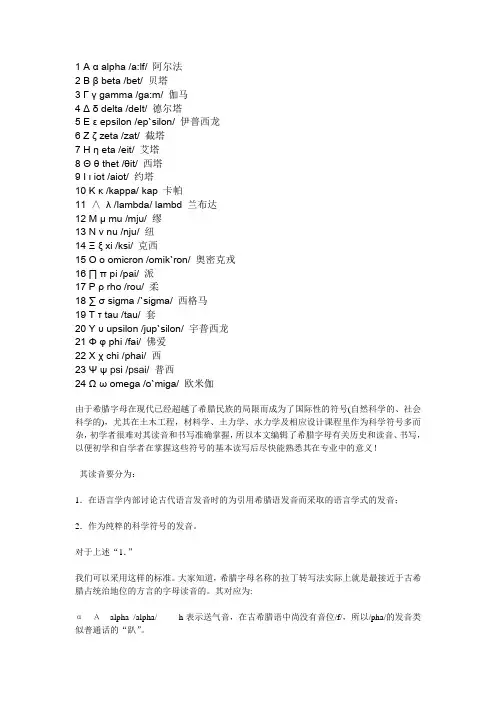
1 Α α alpha /a:lf/ 阿尔法2 Β β beta /bet/ 贝塔3 Γ γ gamma /ga:m/ 伽马4 Γ δ delta /delt/ 德尔塔5 Δ ε epsilon /ep`silon/ 伊普西龙6 Ε δ zeta /zat/ 截塔7 Ζ ε eta /eit/ 艾塔8 Θ ζ thet /ζit/ 西塔9 Η η iot /aiot/ 约塔10 Κ θ /kappa/ kap 卡帕11 ∧ι /lambda/ lambd 兰布达12 Μ κ mu /mju/ 缪13 Ν λ nu /nju/ 纽14 Ξ μ xi /ksi/ 克西15 Ο ν omicron /omik`ron/ 奥密克戎16 ∏ π pi /pai/ 派17 Ρ ξ rho /rou/ 柔18 ∑ ζ sigma /`sigma/ 西格马19 Σ η tau /tau/ 套20 Τ υ upsilon /jup`silon/ 宇普西龙21 Φ θ phi /fai/ 佛爱22 Υ χ chi /phai/ 西23 Φ ψ psi /psai/ 普西24 Χ ω omega /o`miga/ 欧米伽由于希腊字母在现代已经超越了希腊民族的局限而成为了国际性的符号(自然科学的、社会科学的),尤其在土木工程,材料学、土力学、水力学及相应设计课程里作为科学符号多而杂,初学者很难对其读音和书写准确掌握,所以本文编辑了希腊字母有关历史和读音、书写,以便初学和自学者在掌握这些符号的基本读写后尽快能熟悉其在专业中的意义!其读音要分为:1.在语言学内部讨论古代语言发音时的为引用希腊语发音而采取的语言学式的发音;2.作为纯粹的科学符号的发音。
对于上述“1.”我们可以采用这样的标准。
大家知道,希腊字母名称的拉丁转写法实际上就是最接近于古希腊占统治地位的方言的字母读音的。
其对应为:αΑalpha /alpha/ h表示送气音,在古希腊语中尚没有音位/f/,所以/pha/的发音类似普通话的“趴”。

英26个英语字母表AThe English alphabet consists of 26 letters, each with its own unique shape, sound, and significance. From A to Z, these letters form the foundation of the English language, enabling communication among millions of people worldwide. In this article, we will explore the 26 letters of the English alphabet, delving into their origins, pronunciation, and usage.BLet us begin with the letter A. Derived from the Phoenician letter aleph, it represents a glottal stop in Semitic languages. In English, it is pronounced as /eɪ/ in most cases. A is often used as the first letter of the alphabet as well as the indefinite article before consonant sounds. For example, "apple" starts with an A.CMoving on to the letter C, it comes from the Latin letter C, which was originally a drawing of a pointed stick. In English, it is pronounced as /siː/. C is versatile, taking on both the hard /k/ sound, as in "cat," and the soft /s/ sound, as in "city." Additionally, C is commonly used in conjunction with the letter H to create the "ch" sound.DNext up is the letter D, which has its roots in the Greek letter delta. Its English pronunciation is /diː/. D represents a voiced alveolar stop with thetip of the tongue touching the ridge behind the upper front teeth. It is a vital letter in many English words, such as "dog" and "day."EE, originating from the Phoenician letter he, is pronounced as /iː/ in English. With various uses, it appears in words like "elephant" and "easy." E is also significant in forming the past tense of regular verbs, as in "walked" or "talked."FThe letter F, derived from the Semitic letter waw, represents /ɛf/ in English. It is produced by pressing the upper teeth against the lower lip and forcing the air from the vocal cords through the small gap. F often starts words like "fox" and "friend" and can play a vital role in conveying meaning.GG, stemming from the Greek letter gamma, is pronounced as /dʒiː/ in English. It conveys the sound combination of /dʒ/. The letter G is commonly found in words like "goose" and "girl." It can also represent the /g/ sound, as in "game" and "gate."HThe letter H, originating from the Semitic letter heth, is pronounced as /eɪtʃ/. H is used predominantly as a consonant in English, and it often occurs at the beginning of words such as "house" and "happy." Additionally, it plays a crucial role in the formation of digraphs, such as "th" or "sh."II represents the Latin letter I and is pronounced as /aɪ/ in English. It functions as both a vowel and a consonant, depending on the word. As a vowel, it can be found in words like "idea" and "eye." As a consonant, it appears in words like "ill" and "ice."JJ, derived from the Semitic letter yodh, is pronounced as /dʒeɪ/ in English. It represents the sound combination of /dʒ/. J can be found at the beginning of words like "jump" and "justify." It is relatively rare in comparison to other letters and is absent from the ancient Roman alphabet.KThe letter K, originating from the Greek letter kappa, is pronounced as /keɪ/ in English. K represents a voiceless velar plosive sound. It frequently appears at the beginning of words like "kite" and "keep."LL, derived from the Greek letter lambda, is pronounced as /ɛl/ in English. It represents a voiced alveolar lateral consonant, formed by allowing the airstream to pass over the sides of the tongue. L is often found at the beginning of words such as "love" and "light."MThe letter M, originating from the Greek letter mu, is pronounced as /ɛm/ in English. It represents a voiced bilabial nasal sound. M frequently starts words like "moon" and "mother." Additionally, it is the first letter in the word "alphabet" itself.NN, derived from the Greek letter nu, is pronounced as /ɛn/ in English. It represents a voiced alveolar nasal sound. N often appears at the beginning of words such as "night" and "new."OO represents the Latin letter O and is pronounced as /oʊ/ in English. It functions as both a vowel and a consonant. As a vowel, it can be found in words like "open" and "orange." As a consonant, it appears in words like "once" and "onion."PP, originating from the Greek letter pi, is pronounced as /piː/ in English. It represents a voiceless bilabial plosive sound. P frequently starts words like "pen" and "picture." It is one of the most common letters in English.QQ, derived from the Semitic letter qoph, is pronounced as /kjuː/ in English. It represents the sound combination of /kw/. Q is often followed by the letter U, creating the digraph "qu." It can be found in words like "queen" and "quick."RR, stemming from the Latin letter R, is pronounced as /ɑr/ in English. It represents a voiced alveolar approximant sound. R frequently occurs at the beginning of words such as "red" and "run."SS, derived from the Greek letter sigma, is pronounced as /ɛs/ in English. It represents a voiceless alveolar fricative sound. S often starts words like "sun" and "song." It is one of the most frequently used letters in the English language.TThe letter T, originating from the Greek letter tau, is pronoun ced as /tiː/ in English. It represents a voiceless alveolar plosive sound. T is commonly found at the beginning of words like "table" and "time."UU represents the Latin letter U and is pronounced as /juː/ in English. It functions as both a vowel and a consonant. As a vowel, it can be found in words like "use" and "umbrella." As a consonant, it appears in words like "unit" and "unique."VV, derived from the Latin letter V, is pronounced as /viː/ in English. It represents a voiced labiodental fricative sound. V often starts words like "victory" and "very." It is crucial in distinguishing between words with similar spellings but different meanings.WW, originating from the Germanic rune wynn, is pronounced as/ˈdʌbljuː/ in English. It represents the sound c ombination of /w/. W can be found at the beginning of words like "water" and "wonder." It is the onlyletter in the English alphabet with more than one syllable in its pronunciation.XX, derived from the Latin letter XI, is pronounced as /ɛks/ or /ˈɛks/ in English. It represents the sound combination of /ks/. X often appears in words like "box" and "fix." It is one of the least frequently used letters in the English language.YY, originating from the Greek letter upsilon, is pronounced as /waɪ/ in English. It represents both a consonant and a vowel. As a consonant, it can be found at the beginning of words like "yes" and "yellow." As a vowel, it appears in words like "myth" and "symbol."ZZ represents the Latin letter Z, pronounced as /ziː/ in Engl ish. It represents a voiced alveolar fricative sound. Z frequently starts words like "zebra" and "zone." It is one of the least commonly used letters in the English language.ConclusionThe 26 letters of the English alphabet form the basis for written and spoken communication in English. Each letter has its own history, pronunciation, and significance. Understanding and utilizing the alphabet is essential for mastering the English language and engaging in effective communication.。