2015-2016牛津译林版英语五上·Unit3 Our animal friends教案Period4.doc
- 格式:doc
- 大小:39.58 KB
- 文档页数:3
Unit 3 Our animal friends
第4课时Culture time, Checkout time
教学目标:
1.了解中国和主要英语国家的特有动物。
2.能正确并熟练地运用本课词句简单介绍动物。
3.通过练习,检测学生对句型 He/She/It has...以及We/They have...的掌握情况,使学生能正
确运用。
教学重难点:
1.能正确并熟练地运用本课词句简单介绍动物。
2.能正确运用句型 He/She/It has...以及We/They have...。
教具准备:
教学设计(主备) 复备
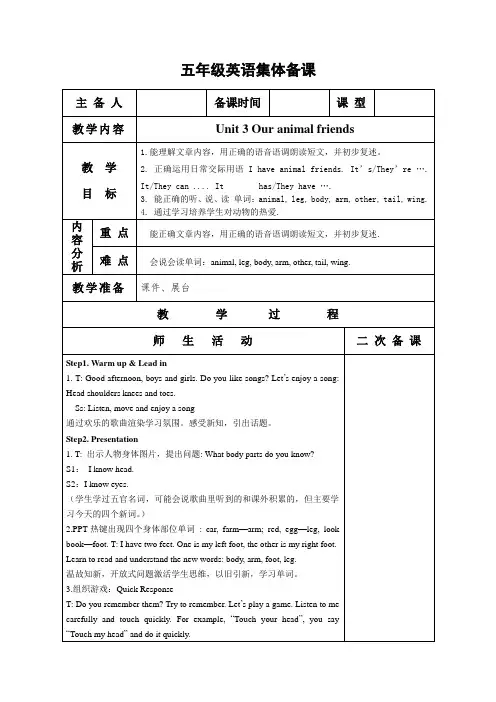
Step1. Free talk 1.Describe your animal friends. S1:I have an animal friend. It has..... 2.Ask some questions about “Animal friends” S2:Does it have...? S3:Do you...? 自由对话,既复习了前面课文中学到的重点句型,也是为下面的检测巩固做基础。 Step2. Checking time 1.Draw and write. Draw an animal and write about it work in groups。 This is my animal friend. It is . It has . It can . 让学生分小组写出各自喜欢的动物朋友,发挥小组合作,提优补差。 2.Say the animal friend in groups.
3.Look and say.
Look the picture and talk about it in groups.Try to say:
There’s /There are....on the farm.
It has/They have....
通过小组讨论交流,让学生正确使用单词的单复数形式,鼓励学生综合运用一起学
过的词汇,如颜色和形体特征类的词汇。让学生学会更加熟练的运用Unit1 的There
be 句型。教师在指导中注意学生对have和has的使用情况。
4.Action.
S1:There are five pigs on the farm. They’re pink. They’re short and fat. They have big
noses, big ears ,big mouths and big bodies. They .......
S2:.........
Step 3 Culture time
1.Look at the picture. What animals are they?
(They are panda ,bald eagles, polar bears and kangaroos.)
2.Teach the new words: bald eagle, polar bear, Canada, kangaroo, Australia.
3.Read “Culture time” in pairs.
教师设计练习来检测学生的理解情况
1).Where do pandas come from?
2).Where do bald eagles come from?
3).Where do polar bears come from?
4).Where do kangaroos come from?
4. Say something more
There are different animals in different countries. Now let’s talk about more animals in
China and in Western countries.
I can see________ in China, and I can see _______ in the US/Canada/Australia.
Step 4. Exercise (补充习题 )
1. Read and order.
2. Look ,read and write
Homework:
1. Draw one about your favorite animal and write about it.
2.Review Unit1
板书设计:
Unit3 Our animal friends
The … in ….
There is … on the farm. It’s ….
are … They’re ….
This is my animal friend.
It’s …. It has …. It can ….