
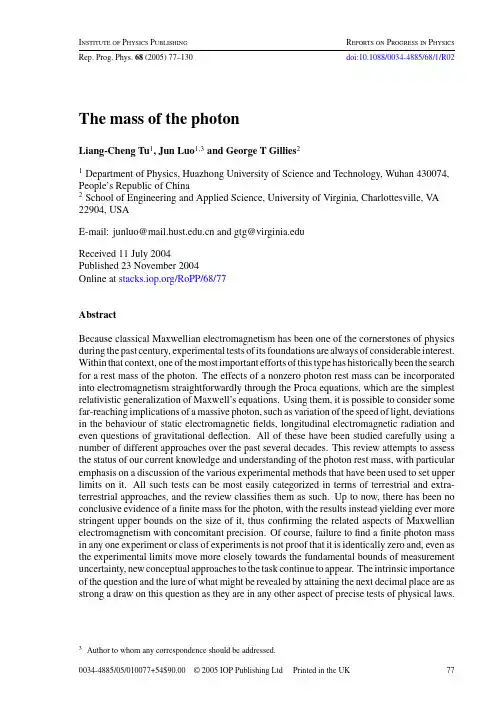
The mass of the photon
- 格式:pdf
- 大小:892.19 KB
- 文档页数:54
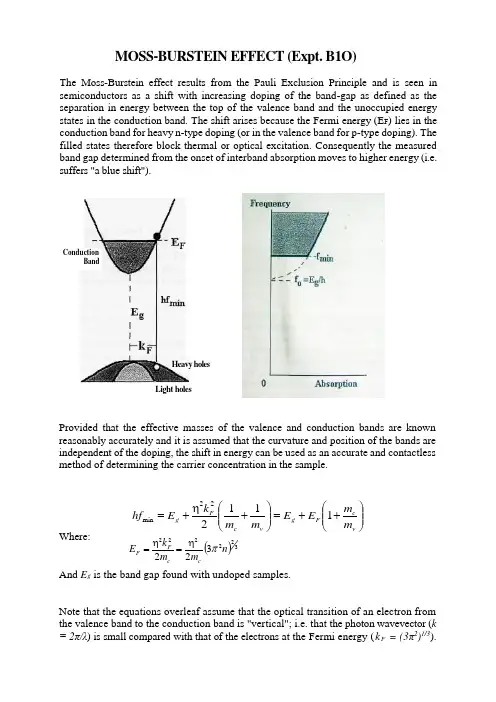
MOSS-BURSTEIN EFFECT (Expt. B1O) The Moss-Burstein effect results from the Pauli Exclusion Principle and is seen in
semiconductors as a shift with increasing doping of the band-gap as defined as the
separation in energy between the top of the valence band and the unoccupied energy
states in the conduction band. The shift arises because the Fermi energy (EF) lies in the
conduction band for heavy n-type doping (or in the valence band for p-type doping). The
filled states therefore block thermal or optical excitation. Consequently the measured
band gap determined from the onset of interband absorption moves to higher energy (i.e.
suffers "a blue shift").
Provided that the effective masses of the valence and conduction bands are known
reasonably accurately and it is assumed that the curvature and position of the bands are
第一章细胞cytoplasm细胞质property特性the mass of主体be bounded to限制organell细胞器dissolve溶解ion离子soluble可溶解的eukaryotic真核的prokaryote原核的hereditary遗传的nucleoid拟核nucleoli核仁division分裂pore-perforated孔的ribosome核糖体endoplasmic reticulum内质网vacuole液泡lysosome溶酶体mitochondria线粒体plastid质体amino acid氨基酸polysome多聚核糖体lacy花边vesicle小泡steroid类固醇oxidation氧化shunt转轨Prominent突出的phagocytosis吞噬pinocytosis胞饮exocytosis胞吐Subset亚单位degrade降级Cristae嵴Leucoplast白色体pigment色素starch淀粉chromoplast有色体chloroplast叶绿体chlorophyll叶绿素grana基粒stroma子座caroteoid类胡萝素Convoluted盘绕的latticework格子threadlike线状的contractile收缩性actin肌动蛋白Myosin肌球蛋白globular球状的tubulin微管蛋白scaffold脚手架impart给予machanoenzyme机械酶dynein动力蛋白kinesin驱动蛋白Gliding滑行substrate基质
adhere粘附geometry几何chemotaxis趋化性diffuse扩散Propell驱动whiplike鞭子cillia纤毛flagella鞭毛Spindle纺锤体centrioles中心粒basal body 基体
第二章光合作用algae海藻protist原生生物overall总体来说bond键respiration呼吸exergonic释能的 endergonic吸能的 Raw
Solution
Part 1a
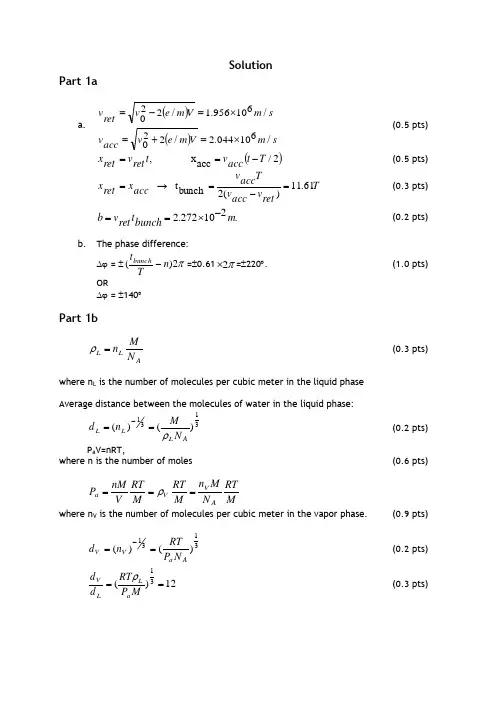
a. smVmevaccvsmVmevretv/610044.2/220/610956.1/220 (0.5 pts)
2/acc x ,Ttaccvtretvretx (0.5 pts)
TretvaccvTaccvaccxretx61.11)(2bunch t (0.3 pts)
.210272.2mbunchtretvb (0.2 pts)
b. The phase difference:
= 2)(nTtbunch=0.612=220. (1.0 pts)
OR
= 140
Part 1b
ALLNMn (0.3 pts)
where nL is the number of molecules per cubic meter in the liquid phase
Average distance between the molecules of water in the liquid phase:
3131)()(ALLLNMnd (0.2 pts)
PaV=nRT,
where n is the number of moles (0.6 pts)
MRTNMnMRTMRTVnMPAVVa
where nV is the number of molecules per cubic meter in the vapor phase. (0.9 pts)
3131)()(AaVVNPRTnd (0.2 pts)
12)(31MPRTddaLLV (0.3 pts)
Part 1c
a. (0.5 pts.)
b. Vi >> Vf (0.2 pts)
c. RC/Tife1VV (0.2 pts)

Bohr’s Model
Adith Prabhakar & Mike Barton
Learning Objectives:
Students will explain the structure and makeup of an atom.
Students will describe the concept of electron movement in Bohr’s model.
Students will describe an overview of the functions of models
Assessment Criteria: Homework will be examined for evidence of the following:
Students’ explanation of the structure and make up of the atom (group model)
should include protons and electrons and neutrons
Students descriptions of the Bohr model (individual model) will include the key
terms (electrons and protons) and explain why spectra from an atom would be
discontinuous
Students description of the function of a model should display an understanding
of the dynamic nature of science
Standards
Illinois State Science Standards:
o 12.C.4b: Analyze and explain the atomic and nuclear structure of matter