小升初英语句型转换专项练习
- 格式:doc
- 大小:107.50 KB
- 文档页数:11
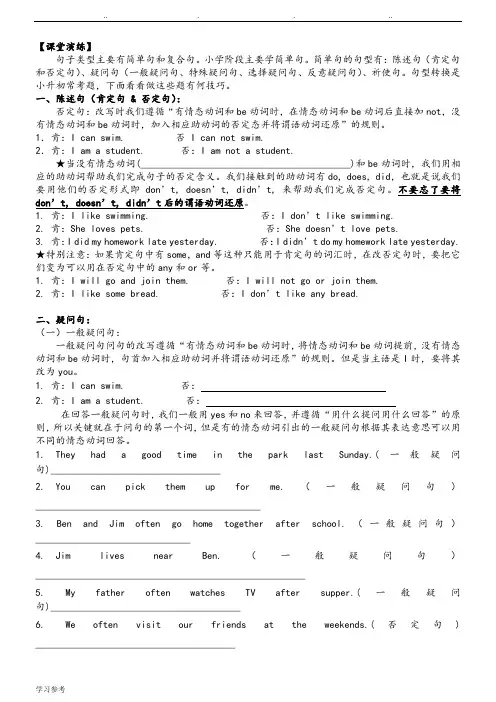
小学英语所有句型转换的方法 在几年的英语教学中,我总结了一些英语句子教学的小窍门,现简单归纳如下: 一、肯定句改否定句的方法 : 1、 在be动词后加not。如:is not , are not , am not, was not, were not; 2、 在can,should, will等后加not。如:cannot, should not, will not; 3、 上述都没有的,在动词前加助动词否定形式don’t/doesn’t/didn’t。 4、 some 改成any。 如: I am a girl. → I am not a girl. You are a student. →You are not a student. →You aren’t a student. This is Tom’s bag, → This is not Tom’s bag. → This isn’t Tom’s bag. 答题方法是;否定词not在be后边。 二、肯定句改一般疑问句的方法: 1、 把be动词放在句首,剩下的照抄,(some 改成any,I改成you,my改成your,)句点改成问号。 2、 把can,shall, will等放到句首,剩下的照抄,(some 改成any,I改成you,my改成your,)句点改成问号。 3、 上述都没有的,在句首请助动词Do/Does/Did帮忙,剩下的照抄,(some 改成any,I改成you,my改成your,)句点改成问号。 注意:句首的第一个字母要大写,句尾标点应为“?”。 如: I am in Class 6. →Are you in Class 6? You are from America. →Are you from America? It is an orange. →Is it an orange? 答题方法是:要想提问,be提前,句末“?”别忘了。 4、 就一般疑问句回答 一般疑问句有两种回答,即:肯定回答和否定回答。其中,肯定回答用yes,否定回答用no。 语句顺序为:Yes + 主语 + am /is/ are/was/were.|can.|do/does/did|; No + 主语+ am not/ isn’t/ aren’t/wasn't/weren't.|can't.|don't/doesn't/didn't|.。如: —Are you an English teacher?→Yes, I am. /No, I am not. —Is that a bird? →Yes, it is./ No, it isn’t. 三、对划线部分提问 “就划线部分提问”是小学阶段英语学习的难点,但是一旦掌握了规律,就变得容易多了。 小学英语对划线部分提问之答题口诀 : 一代:用正确的疑问词代替划线部分。 二移:把疑问词移至句首 三倒:颠倒主谓语,但对主语或其定语提问时除外(some 改成any,I改成you,my改成your), 四抄:照抄句子剩余部分。 ☆总结关键就是:“特殊疑问词+一般疑问句”(即: 先根据划线部分找到特殊疑问词; 再把没划线的部分变成一般疑问句的语序。) ★特殊疑问词的确定要根据划线内容而定,在小学阶段常出现的有以下几种: 1.划线部分是“事或物”,特殊疑问词用what 如: This is a book. ---What is this? I often play football on Saturdays . ---What do you often do on Saturdays ? 2.划线部分是“人”,特殊疑问词用who 如:He is my brother. ---Who is he ? 3、划线部分是“地点”,特殊疑问词用where 如:The box is on the desk.---Where is the box ? 4、划线部分是“时间”,特殊疑问词用what time或when 如:It's seven twenty . ---What time is it ? I usually get up at six . --- When do you usually get up? 5、划线部分是“年龄”,特殊疑问词用how old 如:I am twelve . ---How old are you? My father is thirty-three . ---How old is your father ? 6、划线部分是“职业”,特殊疑问词用what 如:Mike is a worker. ---What is Mike ? 7、划线部分是“颜色”,特殊疑问词用what colour 如: My hat is blue . ---What colour is your hat? 8. 划线部分是“数量”,特殊疑问词用how many或how much 如:I can see five kites .---How many kites can you see ? There is some milk in the glass. ---How much milk is there in the glass ? 9、划线部分是“多少钱”,特殊疑问词用how much 如:This pen is nine yuan . ---How much is this pen ? 10、划线部分是“形容词性物主代词或名词性物主代词”,特殊疑问词用whose 如:That is my book . ---Whose book is that ? The bag is yours. ---Whose is the bag ?
以下口诀要牢记: 1.问“谁”用who; 2.问“谁的”,用whose; 3.问“地点哪里”,用where; 4.问“原因”,用why; 5.问“身体状况”,用how; 6.问“方式”,用how; 7.问“年龄”,用how old; 8.问“多少”,用how many; 9.问"价钱”用how much; 10.问“哪一个”,用which ; 11.问“什么”,用what; 12.问“职业”,用what; 13.问“颜色”,用what colour; 14.问“星期”,用what day; 15.问什么学科,用what subject; 16.问“什么时候”,用when; 17.问几点用What’s the time?或 What time is it? 四、同义句型转换 同义句型转换,是把意思相同或相近的句子用不同的词汇、短语及句型表示出来。如: I’m Peter. → My name is Peter. Tom is tall. →Tom isn’t short. I‘m fine. →I'm all right. 我们现在学过的大多数句型,在一般情况下(就是不排除有特殊情况)都可以用简单的公式来记忆。 1.肯定句变否定句 1) 主语+be动词+…. *I am a teacher.→ I am not a teacher. He is a doctor. → He is not a doctor. They are students. →They’re not students.
2) 主语+do动词的不同形式+…. I play computer games everyday. →I don’t play computer games everyday. He plays computer games everyday. →He doesn’t play computer games everyday We played computer games yesterday.→ We didn’t play computer games everyday
2肯定句变一般疑问句 1)问:be动词+主语+…? 答:Yes, 主语+be动词。/No, 主语+be动词+not. I am a teacher. →Are you a teacher? Yes, I am. No, I am not. He is a doctor.→ Is he a doctor? Yes, he is. No, he is not. They are students. →Are they students? Yes, they are. No, they are not. 2) 问:助动词+主语+do动词的原形+…? 答:Yes, 主语+助动词。/No, 主语+助动词+not. I play computer games everyday. →Do you play computer games everyday? Yes, I do. No, I don’t. He plays computer games everyday. →Does he play computer games everyday? Yes, he does. No, he doesn’t. We played computer games yesterday. →Did you play computer games yesterday? Yes, we did. No, we didn’t. 句型转换专项练习 一、肯定句变否定句 1Tom and Mike didn’t drive to the new museum that day.(改为肯定句) Tom and Mike to the new museum that day. 2 Johnny does some shopping every weekend.(改为否定句) Johnny shopping every weekend. 3 He has a tennis racket. (改为否定句) He a tennis racket 4 Is the soccer ball under the bed? (做否定回答) ,it . 5.I can fly a kite( 改为否定句)
6. She’s got a postcard form China.(改为否定句) 7. Can the monkey jump? (作否定回答) 8. The girl is singing in the classroom. (改为否定句) 9. She is buying some food in the supermarket.(改为否定句) 10. The waiter and the waitress play table tennis every day. ( 改为否定句) 11. We need some masks. ________________________________ 12. They like making the puppet. ________________________________ 13. Su Hai and Su Yang live in a new house. _________________________________________________ 14. Put a book on my head. _________________________________________________ 15. They sing “In the classroom “together. _________________________________________________ 16.play basketball on Sundays. _________________________________________________ 17. Tom likes listening to music __________________________________________________ 18. I am listening to music. _______________________________________ 19. Mike is a student. _______________________________________ 20. Sarah can clean the classroom. ________________________________________ 21. They are in the zoo. ________________________________________ 22.There are some flowers in the vase. ________________________________________ 23.This is my sister. _________________________________________