赏析Percy Bysshe Shelley
- 格式:doc
- 大小:61.00 KB
- 文档页数:6
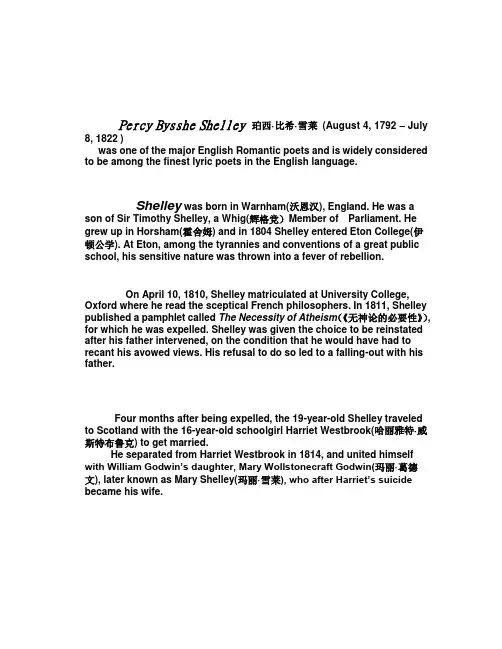
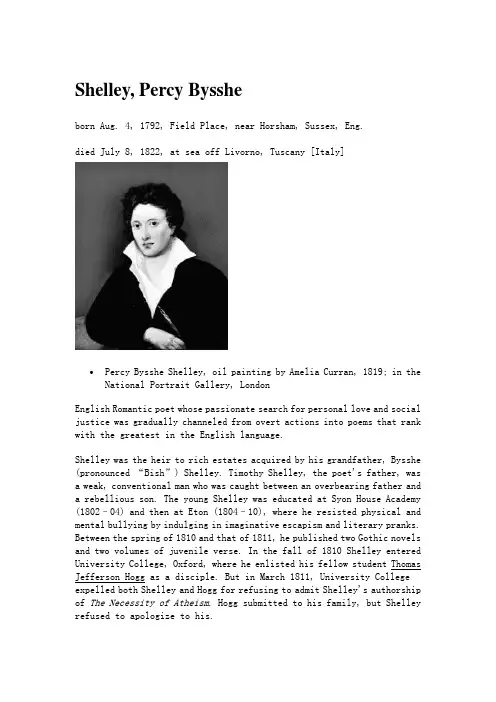
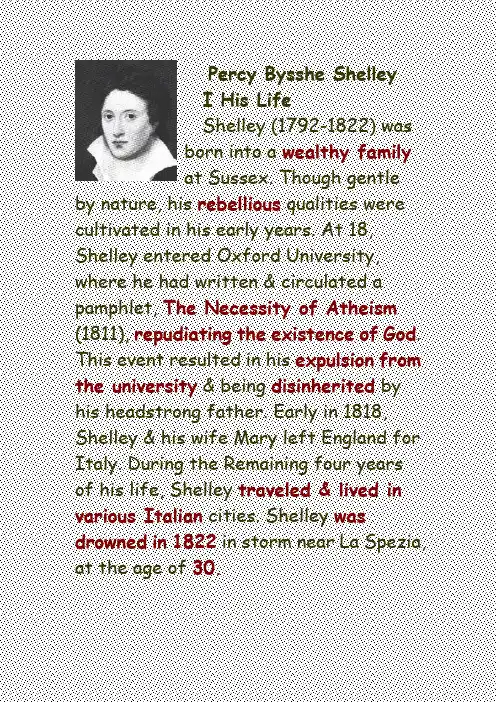
Percy Bysshe Shelley
Percy Bysshe Shelley (1792-1827), English Romantic poet who
rebelled against English politics and conservative values. Shelley drew no
essential distinction between poetry and politics, and his work reflected the
radical ideas and revolutionary optimism of the era.
Percy Bysshe Shelley was born on August 4, 1792, at Field Place, near
Horsham in Sussex, into an aristocratic family. His father, Timothy Shelley,
was a Sussex squire and a Member of Parliament. Shelley attended Syon
House Academy and Eton and in 1810 he entered the Oxford University
College.
In 1811 Shelley was expelled from the college for publishing The
Necessity of Atheism, which he wrote with Thomas Jefferson Hogg. Shelley's
father withdrew his inheritance in favor of a small annuity, after he eloped with
the 16-year old Harriet Westbrook, the daughter of a London tavern owner.
The pair spent the following two years traveling in England and Ireland,
distributing pamphlets and speaking against political injustice. In 1813 Shelley
published his first important poem, the atheistic Queen Mab.
The poet's marriage to Harriet was a failure. In 1814 Shelley traveled
abroad with Mary Wollstonecraft Godwin, the daughter of the philosopher and
anarchist William Godwin (1756-1836). Mary's young stepsister Claire
Claremont was also in the company. During this journey Shelley wrote an
unfinished novella, The Assassins (1814). Their combined journal, Six Weeks'
Tour, reworked by Mary Shelley, appeared in 1817. After their return to
London, Shelley came into an annual income under his grandfather's will.
Harriet drowned herself in the Serpentine in 1816. Shelley married Mary
Wollstonecraft and his favorite son William was born in 1816.
Shelley spent the summer of 1816 with Lord Byron at Lake Geneva,
where Byron had an affair with Claire. Shelley composed the "Hymn To
Intellectual Beauty" and "Mont Blanc". In 1817 Shelley published The Revolt
Of Islam and the much anthologized "Ozymandias" appeared in 1818. Among
Shelley's popular poems are the Odes "To the West Wind" and "To a Skylark"
and Adonis, an elegy for Keats.
In 1818 the Shelleys moved to Italy, where Byron was residing. In 1819
they went to Rome and in 1820 to Pisa. Shelley's works from this period
include Julian And Maddalo, an exploration of his relations with Byron and Prometheus Unbound, a lyrical drama. The Cenci was a five-act tragedy based
on the history of a 16th-century Roman family, and The Mask of Anarchy was
a political protest which was written after the Peterloo massacre. In 1822 the
Shelley household moved to the Bay of Lerici. There Shelley began to write
The Triumph of Life.
To welcome his friend Leigh Hunt, he sailed to Leghorn. During
the stormy return voyage to Lerici, his small schooner the Ariel sank
and Shelley drowned with Edward Williams on July 8, 1822. The
bodies were washed ashore at Viareggio, where, in the presence of
Lord Byron and Leigh Hunt, they were burned on the beach. Shelley
was later buried in Rome.
西风颂
O Wild West Wind, thou breathe of autumn’s being,
Thou, from whose unseen presence the leaves dead
Are driven, like ghosts from an enchanter fleeing,
Yellow, and black, and pale, and hectic red,
Pestilence-stricken multitudes: O thou,
Who chariotest to their dark wintry bed
The winged seeds, where they lie cold and low,
Each likes a corpse within its grave, until
Thine azure sister of the spring hall blow
Her clarion o’er the dreaming earth, and fill
(Driving sweet buds like flocks to feed in air)
With living hues and odours plain and hill:
Wild Spirit, which art moving everywhere;
Destroyer and preserver; hear, oh hear!
1
狂野的秋风啊,你这秋的精气!
没看见你出现,枯叶已被扫空,
像群群鬼魂没见法师就逃避——
它们或枯黄焦黑,或苍白潮红,
真是遭了瘟灾的一大片;你呀,
你把迅飞的种子载送去过冬,
让它们僵睡在黑黢黢的地下,
就像尸体在各自的墓里安躺, 直到你那蔚蓝的春天妹妹呀
对梦乡中的大地把号角吹响,
叫羊群般的花苞把大气吸饮,
又让山野充满了色彩和芳香。
狂野的精灵,你正在四处巡行,
既拉朽摧枯又保护。哦,你听!
II
Thou on whose stream, mid the steep sky’s commotion,
Loose clouds like earth’s decaying leaves are shed,
Shook from the tangled boughs of Heaven and Ocean,
Angels of rain and lightning: there are spread
On the blue surface of thane arty surge,
Like the bright hair uplifted from the head
Of some fierce Maenad, even from the dim verge
Of the horizon to the zenith’s height,
The locks of the approaching storm. Thou dirge
Of the dying year, to which this closing night
Will be the dome of a vast sepulchre,
Vaulted with all thy congregated might
Of vapours, from whose solid atmosphere