
Unit three My friends
- 格式:ppt
- 大小:1.04 MB
- 文档页数:9

Unit Three 第三单元My weekend plan 我的周末计划What are you going to do in the nature park 你打算在自然公园做什么I'm going to draw some pictures. 我要画画;What about you 你呢I'm going to look for some beautiful leaves. 我要找一些漂亮的叶子;Mike is going to see a film. 迈克要看电影;John is going to buy his favourite comic book.约翰要买他最喜爱的连环画;Hmm, what am I going to do this weekend 唔,这周末我做什么呢A Let's try 试一试It's Saturday morning. 星期六早上,Sarah is on the phone with Mike. 萨拉在和迈克打电话;Listen and circle. 听,然后圈出;Hi, Sarah. 嗨,萨拉;Good morning, Mike. 早上好,迈克;Today is so warm. 今天很暖和;Let's go swimming. 我们去游泳吧;Sorry, I can't. 对不起,我不能去;I have to do my homework now. 我现在必须做作业;B: OK. 好吧;What about this afternoon 那今天下午呢No, I can't. 也不行;I'm going fishing. 我要去钓鱼;1. Can Mike go swimming today 迈克今天能去游泳吗2. Why or why not 为什么Let's talk 谈话Mike: What are you going to do tomorrow 明天你打算做什么Sarah: I'm going to have an art lesson. 我要上美术课;Mike: What are you going to do in your lesson 你们课堂上要做什么Sarah: We're going to draw some pictures in Renmin Park. 我们要tomorrow. 我明天要看电影;Sarah: Have a good time 玩得高兴Mike: You too. 你也是;I have to do my homework now. 我现在必须做作业了;Bye. 再见;Sarah: OK. Bye. 好的;再见;What are Mike and Sarah going to do tomorrow 迈克和萨拉明天要做什么Let's learn 学习Sarah: What are you going to do today 你今天打算做什么Chen Jie: I'm going to see a film. 我要去看电影;visit my grandparents 看望爷爷奶奶see a film 看电影take a trip 旅行go to the supermarket 去超市B Let's try 试一试John is on his way home. 约翰在回家的路上;He sees Amy. 他看到了艾米;Listen and answer. 听,然后回答;Amy, where are you going 艾米,你要去哪儿啊I'm going to buy some fruit. 我要去买一些水果;Nice I'm going to buy some ice cream. 太好了我要去买冰激凌;Do you like ice cream 你爱吃冰激凌吗No, it's for my cousion Jack. 不,是给我表弟杰克的;1. What is Amy going to do 艾米要做什么2. Is the ice cream for John 冰激凌是给约翰的吗Let's talk 谈话My cousin Jack is going to visit me next week.我表弟杰克下周要来看我;That's nice. 太好了;Where are you going 你们要去哪儿We're going to the cinema. 我们要去电影院;We're going to see a film about space travel看一部有关太空旅行的电影;Cool 酷I have lots of comic books about space. 我有许多太空方面的连环画; When are you going 你们什么时候去Next Wednesday. 下周三;Why not go on Tuesday 为什么不周二去呢It's half price then 那时候半价Really Thank you 真的谢谢你Where are John and Jack going next week 约翰和杰克下周要去哪里Let's learn 学习Jack: Where are we going 我们要去哪儿John: To the bookstore. 去书店;I'm going to buy a new comic book. 我要买一本新的连环画; dictionary 字典comic book 连环画word book 单词本postcard 明信片Read and write 读和写Sunday 星期天Dear Diary, 亲爱的日记,Tomorrow is Mid-Autumn Festival. 明天是中秋节;My family are going to get together and have a bigdinner. 我们要全家团聚,吃一顿丰盛的团圆饭;My aunt is going to make mooncakes. 我姑妈要做月饼;My grandma will tell us a story about Chang'e. 我奶奶要给我们讲嫦娥的故事;Robin and I are going to read a poem. 我和罗宾准备朗诵诗歌; This is our poem: 这是我们的诗歌:F is for family. F 代表家庭;We will all be together tonight. 今晚我们团聚一起;A is for autumn. A 代表秋天;It is the autumn season. 现在是秋季;M is for moon. M 代表月亮;We eat mooncakes and tell stories about the moon. 我们吃月饼,讲有关月亮的故事;I is for "I". I 代表我;I am so happy today. 今天我很快乐;L is for love. L 代表爱;We love Mid-Autumn Festival. 我们爱中秋节;Y is for you. Y 代表你;You can be together with your family too 你也可以和家人团聚在一起Tips for pronunciation 发音小提示Listen, clap and repeat. 听,拍手,跟着读;lesson 课程dinner 晚饭;正餐tonight 今晚tomorrow 明天Let's check 检查Listen and tick. 听,然后打勾;1. Hi, John. 嗨,约翰;What are you going to do tomorrow 你明天打算做什么Not much. 没什么;I'm just going to do my home work and buy a postcard tomorrow morning. 我明天上午要写作业,然后买明信片;And you 你呢I'm going to see a film tomorrow afternoon. 我明天下午要去看电影; Great 太棒了Can I go, too 我能一起去吗Question: 问题:What is John going to do tomorrow morning 约翰明天上午要做什么2. Amy, did you see my new comic book 艾米,你看见我的新连环画了吗I'm going to read it this evening. 我今晚要看;Oh, it looks good. 哦,这书看着不错;Can I read it after you 你看完后能给我看吗Yes, I can give it to you tomorrow. 可以,我明天给你吧;OK. Thanks. 好的;谢谢;Question: 问题:What is the boy going to do this evening 男孩今晚要做什么3. I'm going to the bookstore to buy a new dictionary. 我要去书店买一本新字典;Oh, when are you going 哦,你什么时候去This afternoon. 今天下午;The bookstore isn't open this evening. 书店今晚不开;Question: 问题:Where is the boy going 男孩要去哪儿4. I'm going to buy some milk and a newspaper. 我要买牛奶和报纸; Where are you going to buy them 你去哪儿买I'm going to buy them at the small shop near the post office. 我去邮局附近的小商店买;Really 真的I'm going to buy a postcard there. 我要去那儿买明信片;Can I go with you 我能和你一起去吗Sure. 当然可以;Let's go together. 我们走吧;Question: 问题:What is the woman going to buy 女子要买什么Listen again and fill in the blanks. 再听一次,然后填空;1. Hi, John. 嗨,约翰;What are you going to do tomorrow 你明天打算做什么Not much. 没什么;I'm just going to do my home work and buy a postcard tomorrow morning. 我明天上午要写作业,然后买明信片;And you 你呢I'm going to see a film tomorrow afternoon. 我明天下午要去看电影; Great 太棒了Can I go, too 我能一起去吗Question: 问题:What is John going to do tomorrow morning 约翰明天上午要做什么2. Amy, did you see my new comic book 艾米,你看见我的新连环画了吗I'm going to read it this evening. 我今晚要看;Oh, it looks good. 哦,这书看着不错;Can I read it after you 你看完后能给我看吗Yes, I can give it to you tomorrow. 可以,我明天给你吧;OK. Thanks. 好的;谢谢;Question: 问题:What is the boy going to do this evening 男孩今晚要做什么3. I'm going to the bookstore to buy a new dictionary. 我要去书店买一本新字典;Oh, when are you going 哦,你什么时候去This afternoon. 今天下午;The bookstore isn't open this evening. 书店今晚不开;Question: 问题:Where is the boy going 男孩要去哪儿4. I'm going to buy some milk and a newspaper. 我要买牛奶和报纸; Where are you going to buy them 你去哪儿买I'm going to buy them at the small shop near the post office. 我去邮局附近的小商店买;Really 真的I'm going to buy a postcard there. 我要去那儿买明信片;Can I go with you 我能和你一起去吗Sure. 当然可以;Let's go together. 我们走吧;Question: 问题:What is the woman going to buy 女子要买什么C Story time 故事时间What are you going to do tomorrow 你明天打算做什么I'm going to learn how to swim. 我要学游泳;OK. I'll teach you. 好的;我来教你吧;Please don't disturb me. 请别打扰我;I'm learning to swim. 我在学游泳;How can you learn to swim without going to a pool 不去泳池你怎么能学会游泳呢Come on. 快来;Let's go to the swimming pool. 我们去游泳池吧;No I'm afraid of water. 不我怕水;Just jump in 只管跳进去Catch this. 抓着这个;Practise and you will learn. 练习,就能学会; Help Help 救命救命Just try. 试一试吧;This way ... This way ... 这样……这样……OK, now can you do it 好的,现在你会了吗Oh, it's easy. 哦,很容易的;We should always remember: 我们要牢记:"Learn by doing." “实践才能学会;”Songs in each unit 单元歌曲Unit 3 第三单元What are you going to do 你要做什么I'm going to walk on the moon 我要到月亮上行走Hooray Hoorray 万岁万岁I'm going to walk on the moon 我要到月亮上行走Hooray Hoorray 万岁万岁When I grow up, 当我长大了,I'll walk on the moon. 我要到月亮上行走; When I grow up, 当我长大了,I'll walk on the moon. 我要到月亮上行走; What are you going to do 你要做什么I'm going to be a solider 我要当一名士兵Hooray Hooray 万岁万岁I'm going to be a solider 我要当一名士兵Hooray Hooray 万岁万岁When I grow up, 当我长大后,I'll be a solider. 我要当一名士兵;When I grow up, 当我长大后,I'll be a solider. 我要当一名士兵;What are you going to do 你要做什么Now it's your turn. 现在该你唱了;I'm going to walk on the moon 我要到月亮上行走Hooray Hoorray 万岁万岁I'm going to walk on the moon 我要到月亮上行走Hooray Hoorray 万岁万岁When I grow up, 当我长大了,I'll walk on the moon. 我要到月亮上行走;When I grow up, 当我长大了,I'll walk on the moon. 我要到月亮上行走;What are you going to do 你要做什么I'm going to be a solider 我要当一名士兵Hooray Hooray 万岁万岁I'm going to be a solider 我要当一名士兵Hooray Hooray 万岁万岁When I grow up, 当我长大后,I'll be a solider. 我要当一名士兵;When I grow up, 当我长大后,I'll be a solider. 我要当一名士兵;What are you going to do 你要做什么Useful express-ions 常用表达法Unit 3 第三单元What are you going to do tomorrow 你明天打算做什么I'm going to have an art lesson. 我要上美术课;We're going to draw some pictures in Renmin Park. 我们要到人民公园去画画;Where are you going 你们打算去哪儿We're going to the cinema. 我们打算去电影院;When are you going 你们什么时候去Proverbs 谚语Unit 3 第三单元Think today and speak tomorrow. 三思而后行;-------------------Words in each unit 单元词汇表Unit 3 第三单元 visit 拜访film 电影see a film 看电影trip 旅行take a trip 去旅行supermarket 超市evening 晚上;傍晚tonight 在今晚tomorrow 明天next week 下周dictionary 词典comic 滑稽的comic book 儿童的连环画册word 单词word book 单词书postcard 明信片lesson 课space 太空travel 尤指长途旅行half 一半price 价格Mid-Autumn Festival 中秋节together 一起get together 聚会mooncake 月饼poem 诗moon 月亮。

Ⅰ. Read and choose the best answer.() 1. What I’d like to know about my penfriend is his school life and ________.A. interestedB. interestingC. interestD.interests() 2. The United States of America is thousands of kilometers ________ from China.A. farB. awayC. far toD. awayfar() 3. Many people from ________ countries come and visit Shanghai every year.A. otherB. othersC. the othersD. theother() 4. ________ many people riding bicycles and flying kites in the Century Park.A. There haveB. There areC. There isD. Therehas() 5. At the moment, I have no penfriends to write ________.A. withB. /C. toD. from () 6. We call people from ________ ________.A.English; EnglandB. Australia; AustralianC. Germany; GermansD. Germany; Germen() 7. Look! This is a photo of ________ in front of the Summer Palace.A. your and myB. yours and mineC. you and meD. I andyou() 8. —________ is it from your company to your home?—Thirty minutes’ ride.A. How longB. How soonC. How farD. Howoften() 9. I ________ to Australia twice. It’s an amazing country to pay a visit to.A. will goB. have goneC. have beenD. went () 10. —Would you like to watch movies with us tonight?—________.A. That’s all right.B. That’s right.C. All right.D. You are right.() 11. My parents have worked in this factory _______ 2 years ago.A. aboutB. forC.inD. since() 12. He ________ his home for two years.A. has leftB. left fromC. has been away fromD. was away from() 13. Her father ________ in 1990 and her husband ________ for more than five years.A.died; deadB. has died; deadC. died; has been deadD. has died; has died() 14. I know only ________ about the story.A./B. a lotC. a littleD. a few() 15. Two ________ of the students in my school are ________ students.A. hundred; boysB. hundreds; boyC. hundred; boyD. hundreds; boys().16. ________ does it take to get there by sea?A. How longB. How oftenC. How farD. Howmany() 17. _______ has Mr. White been a teacher since he _______ to Shanghai?A. How soon; comesB. How often; gotC. How long; cameD. How far; arrived() 18. My little brother ________ for a week.A. has caught a coldB. caught a coldC. has had a coldD. had a cold() 19. —________ you ________ anything for lunch today?—No, not yet. I’m going to have some spaghetti.A. Did; haveB. Do; haveC. Have; hadD. Will; have () 20.—Would you like to work at the South Pole in the future?—________.A. Yes, I do.B. Yes, we’d love to.C. Yes, I am.D. Yes, we will.II. Complete the sentences with the given words in their proper forms(用括号中所给单词的适当形式完成下列句子):(共8分)1.My__________ (nation) is Chinese.2.Help__________(you) to some fruits, everyone.3.The __________ (Britain) like going to different pubs at weekends.4.Tim is interested in__________ (cycle).5.John__________ (see) the film three times. He knows a lot about it.6.We call the people from Australia __________ (Australia).7.There are some __________ in the office. They are my colleagues. (German)8.The design is the most suitable for middle-__________ women. (age)III. Rewrite the following sentences as required (根据所给要求,改写下列句子,每空格限填一词):(共12分)1.Over six million people live in Hong Kong. (对划线部分提问)2.____________ _____________ people live in Hong Kong?3.How is your Chinese teacher like? (保持原句意思不变)4.____________ does your Chinese teacher look ____________?5.I have read about Thailand in newspaper.(对划线部分提问)6.___________ _________ have you read about it in newspaper?7.He is from Canada. (保持句意不变)8.He is ___________ ____________.9.I can speak English. I can also speak French. (两句合并成一句)10.I can speak English and French______________ _____________ .11.The Lis left Shanghai three day ago. (保持句意基本不变)12.The Lis have_______________ ______________ from Shanghai for three days.Ⅰ. Choose the words or expressions and complete the passage.A. Choose the best answer.(根据短文内容,选择最恰当的答案)Ben and Kitty are at Simon’s flat in Beijing. They are talking about the future city in their minds. Read what Ben, Kitty and Simon said.Ben My future city is called u Pollution-Free Town” .It is built on an island. I hope that there is no air pollution in my future city. People use only electric cars on the roads. The buildings are only seven floors high and there are no offices. People ride their boats to the cities to work. Students do not use books at school because they have their own computers.Kitty My future city is a modern city with buildings over 60 floors. Nobody drives on the roads. They use flying cars to travel from one building to another. There is a big building called “The Plaza”. In “The Plaza” ,there is a big restaurant. People can try all kinds of food:Cantonesefood, Beijing food or Western food, etc. There is also a big supermarket. People can buy everything there.Simon In the year 3000, people do not have to work in an office because computers and robots can do .all their work. Robots work in hospitals, supermarkets,etc. People can spend their time in the big entertainment centre in the future city. In the centre, there is a big shopping mall. People can buy very cheap things because computers and robots can make everything cheaply, For example, they can buy a big TV for only ¥ 500.They can also sing in the big karaoke club or go to the cinema there.().1. Where is the “Pollution-Free Town”?A. It’s on an island.B. It’s on a hill.C. It’s in a town.D. It’s in the city center.().2. How do people in the Pollution-Free Town’A. By car.B. By bus.C. By boatD. By bicycle().3. How do people in Kitty’s future city travel?A. They have planes.B. They use flying cars.C. They don't drive.D. They travel by boat.().4. What can people do in “The Plaza” ?A. They can see films there.B. They use flying cars.C. They can eat and buy things.D. They can buy very cheap TVs.().5. Why are the things so cheap in the shopping mall in Simon’s future city in the year 3000?A. People don’t have to work.B. There’s, a big karaoke club.C. Computers and robots help to make things cheaply.D. Computers help people work at home.().6. Which of the following statements is true?A. People in “Pollution-Free Town” will work in the offices in the town.B. Students will not use books at school in “The Plaza”.C. People must work in hospitals, supermarkets, etc. in the year 3000.D. The buildings in “Pollution-Free Town” will be low but the ones in Kitty’sfuture city will be high.B. Choose the words and expressions and complete the passage.(选择最恰当的单词或词语完成短文)Time is very important in our lives. But it never had any importance in my life until I received a watch from my father that made me responsible. It ___1___ me the importance of time in my life.I got this gift on a gray-sky day. I had to go to the airport at 9:00 am to pick up my uncle Ali and take him to my father’s house. However, I forgot it ___2___ I was playing with my friends. Later on that day, around 11:00 am, I remembered my uncle, but I was late for him. He had got out of the plane and ___3___ a taxi to my father’s house.I got to my father’s house at 2:00 pm ___4___. My father looked at me angrily. I said “hi” to him and my tired uncle. My father asked me to sit next to him and handed me this watch which was a gift from him It weighed 8 oz (盎司) and all of it was made of silver. Then he said, “Essa, did you have fun with your friends today? What you did was not very nice and you should be sorry for your ___5___. “I felt sorry and told my father that I wouldn’t do it again. Then he said, “This watch will be a reminder for you. I hope today you have learned something ___6___.”I learned a lesson from my father: to respect time and never be late. The watch is important to me, not because of its price, but because of the lesson that I learned from it.()1. A. learned B. found C. sent D. told()2. A. why B. because C. if D. though()3. A. got B. caught C. invited D. taken()4. A. one day before B. the next day C. the same day D. the other day()5. A. words B. actions C. play D. fun()6. A. important B. interesting C. expensive D. wonderfulC. Read the passage and fill in the blanks with proper words.(在短文的空格内填入适当的单词,使其内容通顺,每空格限填一词,首字母已给)Dear Disney,Last weekend, the four members of my family spent an enjoyable holiday at the Magic Kingdom—Disneyland. And one event made our v___1___ seem truly magical. We got to the front of the line at Space Mountain, only to find out that our little daughter Gloria couldn’t take her ice-cream on the ride.We were so excited that we all forgot ice-cream was not a___2___ on the ride. Gloria broke into tears and we all had no idea what to do. Then Murphy, one of the staff(员工) members, came over. She bent d___3___ and told Gloria that she would hold the ice-cream for her and give it to her when she finished the ride. Gloria said, “Promise?” Then she gave Murphy her ice-cream, and she completely enjoyed the ride.Sure enough, as we walked out of the exit, there was Gloria’s new friend with “her” ice-cream. Now you and I b___4___ know what happened, because we know that an ice-cream won’t l___5___ twenty minutes on a summer afternoon in Florida. Murphy knew what time we would get off the ride; she went to the nearest shop and bought a brand-new ice-cream thirty seconds b___6___ we walked out of the exit. Gloria said, “Thank you,” but I’m sure she thought it was the same ice-cream. We know that someone tried hard to make our trip special. Thanks so much for going above and beyond!Your fan,CarmenRivera1. ________2. ________3. ________4. ________5. ________6. ________D. Answer the questions. (根据短文内容回答下列问题)To my dear friendsI am so happy that we meet in this class. I don’t know who you are and you don’t know who I am. But it doesn’t matter because the destiny makes us together.We met in 2009. You were shy and I was nervous then. We were afraid of talking to each other. But just after several days, we became closer and we talked everything that was in our mind.After the military training, we all become more mature. We didn’t cry any more. We almost did everything by ourselves. We helped each other and never laughed anyone. We felt really happy then.Do you remember something on our last Children’s Day? We did a really meaningful thing to remember the special day—plant. That day we all felt very tired, but also pleased with what we did. And we will remember that day in the future.Do you remember our first sports meeting? We did so well in it. On the opening ceremony, we made everyone surprised. Although we didn’t win the first place a t last, we became more united. And we knew each other better.Do you remember the Christmas Party? We did everything about it by ourselves. We chose presents and decided what to act. We invited parents and teachers to our party. We enjoyed ourselves a lot and we were proud of ourselves.There are many events of our school life. I can’t count one by one. But I think we all remember everything. At least, I have never forgotten anything.Thanks for everyone in our class. Because of you, I know what friendship is. Because of you, I never stray too far from the sidewalk. Because of you, I am never afraid of anything. Because of you, I’ve learned how to love.Thank you, my dear friends. I’ll never forget Class 8 and the time we spent together. Promise! And one day, if I forget, please remind me to pick all up.(346 words)1. What was the writer in 2009?_________________________________________________________________________.2. What happened when they finished the military training?__________________________________________________________________________. 3.The writer and his friends didn’t get the first place in the first sports meeting, did they?__________________________________________________________________________. 4. In which party were the parents of the writer and his friends invited?___________________________________________________________________________.5.What does the word “stray” probably mean in Chinese?__________________________________________________________________________. 6. When did the writer probably write the passage?__________________________________________________________________________.Ⅰ. Writing.(写作)You want to make a penfriend, and you saw May’s name in magazine. Write a letter to her and tell her something about yourself. (写信给May, 介绍自己的情况,希望能收到May的回信,和她成为笔友。
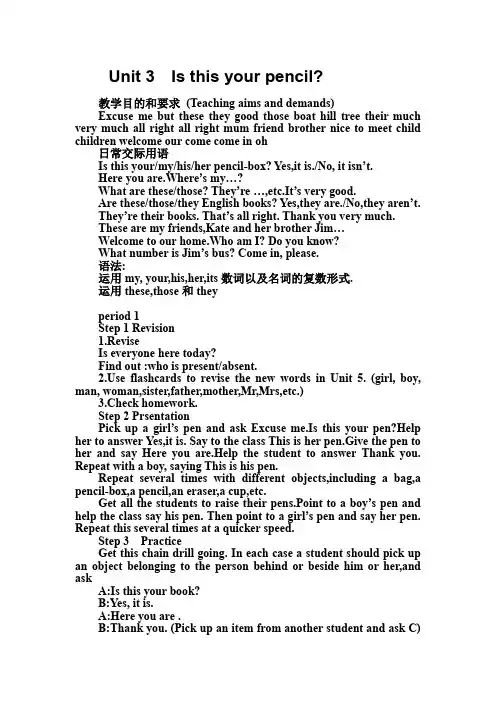
Unit 3 Is this your pencil?教学目的和要求(Teaching aims and demands)Excuse me but these they good those boat hill tree their much very much all right all right mum friend brother nice to meet child children welcome our come come in oh日常交际用语Is this your/my/his/her pencil-box? Yes,it is./No, it isn’t.Here you are.Where’s my…?What are these/those? They’re …,etc.It’s very good.Are these/those/they English books? Yes,they are./No,they aren’t.They’re their books. That’s all right. Thank you ve ry much.These are my friends,Kate and her brother Jim…Welcome to our home.Who am I? Do you know?What number is Jim’s bus? Come in, please.语法:运用my, your,his,her,its数词以及名词的复数形式.运用these,those和theyperiod 1Step 1 Revision1.ReviseIs everyone here today?Find out :who is present/absent.e flashcards to revise the new words in Unit 5. (girl, boy, man, woman,sister,father,mother,Mr,Mrs,etc.)3.Check homework.Step 2 PrsentationPick up a girl’s pen and ask Excuse me.Is this your pen?Help her to answer Yes,it is. Say to the class This is her pen.Give the pen to her and say Here you are.Help the student to answer Thank you. Repeat with a boy, saying This is his pen.Repeat several times with different objects,including a bag,a pencil-box,a pencil,an eraser,a cup,etc.Get all the students to raise their pens.Point to a boy’s pen and help the class say his pen. Then point to a girl’s pen and say her pen. Repeat this several times at a quicker speed.Step 3 PracticeGet this chain drill going. In each case a student should pick up an object belonging to the person behind or beside him or her,and askA:Is this your book?B:Yes, it is.A:Here you are .B:Thank you. (Pick up an item from another student and ask C)Is that your eraser?C:Yes,it is.B:Here you are!(Give the eraser to the owner.)C.Thank you.(To D) Is this her…? Etc.Explain that it is polite to say Excuse me!to get someone’s attention. Get them to repeat several times. Then repeat the chain drill adding Excuse me!Step 4 PresentationPick up a bag belonging to a girl, point to a boy and say Is that his bag?(No, it isn’t. I think it’s her bag.). Give extra emphasis to the word her.Pick up a pen that belongs to a boy,point to a girl, and ask Is this her pen?(No,it isn’t.I think it’s his pen).Put special emphasis on his. Repeat this several times with different students and different objects.Step 5 Look, listen and say.SB Page 26, Pictures 1, 2and 3, Speech Cassette Lesson 21. Say Open your books to page 26. Look and listen. Play the tape through once. Rewind and divide the class in two – A and B. Say Listen and repeat. Replay the tape, using the pause button. Students listen and repeat. Repeat changing roles. Notice the special emphasis on the word my in the last line. But where’s my cup?Step 6 Pair practiceDivide the class into groups of three. Get them to practise the dialogues with Pictures 2 and 3. After they have practised once or twice, get them to repeat the dialogue using other items and their own names.Step 7 ActingCall out four students, each with four different objects. Collect the objects from them, and have a similar dialogue. The teacher begins to say Excuse me. Is this your eraser? (Yes/No.)etc.Continue until the items are returned to the correct owners. Then call out five more students. Let one of them collect the objects and begin again.Step 8 Workbook.Sb Page 111, Wb Lesson 21. Exx. 2-3 should be done in class. Use the words in the box to substitute for the italicized words in the dialogue in Ex. 3.HomeworkFinish off the Workbook exercises. Write Exx. 1 and 2 in the exercise book.Note:When teaching new words, e.g. me,these,tree, meet,please,very, welcome,etc.remind the students of the spelling rules taught in the previous unit. From now on, the students have to learn more words. Help them deal with the English spelling.教后一得单词复数是本册的一个重点,也是一个难点.利用本单元的四个教案,通过实物.投影仪,电脑辅助进行教学,很好的解决了这个难点,取得了教好的效果.Period 2Step 1 Revision1.Ask a group to act out the dialogues from Page 26 with books. If desired, ask another group to act without books.2.Check hoework. Get some students to read and act Ex. 3 in Wb Lesson 21.Step 2 PresentationHold up a bag and ask What’s this? It’ s a bag.Hold up two bags and say What are these ? They’re bags.Repeat with a pen/ pens, a book/ books,a box/boxes,etc.Now get the class to ask and answer both questions ---What’s this ? What’re these?Make sure that they pronounce the plural forms correctly. Add /z/for banana, bag and pen,/s/for book and /iz/for box and bus. Also they should pronounce the ds in birds as one sound/dz/ not /d+z/.Step 3 PracticeChain drill . Call out several students to demonstrate.A:What are these ?(Holding up two pens. )B:They’re pens. What are these?(Holding up two books.)C:They’re books. What’re thes e? (Holding up two boxes. )etc.Organise a chain drill around the class in the same way.Step 4 PresentationDraw a banana on the Bb. Ask What’s this? It’s a banana.Draw two bananas and ask What are these? They’re bananas. Write one under the single banana and two under the two bananas.Repeat up to ten.Step 5. Read and say.SB Page 27, Part 1, Speech Cassette Lesson 22. Say Turn to Page 27, Part 1. Look at Picture 1. What’s this? Help them to answer It’s a banana.Ask How many can you see? One, two or three? (One.)Look at Picture 2. What are these? (They/They’re bananas.)Notice that the short form for They are is They’re.Ask How many can you see, two, three or four?(Two.)Repeat with the other pictures.Then ask What can you see in Picture 2?Ss:Two bananas.Do the same for the other pictures in random order.Step 6 PresentationSB Page 27, Part 2. Books closed. Use flashcards or draw a quick sketch of a car on the Bb. Step away from it and using a pointer askWhat’s that? (It’s a car.)Repeat with a bird, a cat, an egg and a cake. Teach a tree and a boat.Now draw a second car, and, pointing to it ask What are those? (They’re cars.)Repeat with birds, eggs, cakes, boats and trees.Be sure to stand back and point when you ask,so students aren’t confused by these and those. Teach hills, boats and pictures in the same way. Get the students to read the dialogue in Part 2 in pairs.Step 7 Ask and answerSB Page 27, Part 2. Call out a student and ask What can you see in the picture? What are those? Point to the birds in the picture. They’re birds. Get him or her to ask you a similar question.Ask the students to work in pairs to ask and answer similar questions using the picture.Step 8 WorkbookSB Page 112, WB Lesson 22. Do Exx. 1-3Ex.1 contains the numbers from one to thirteen.Help the students to spell fourteen and fifteen.Tell them the numbers from thirteen to nineteen all end in teen. They are all formed by the number plus teen,except for thirteen and fifteen which are slightly different.HomeworkFinish off the Workbook exercises. Choose Exx. 2 or 3 for written homework.教后一得单词复数是本册的一个重点,也是一个难点.利用本单元的四个教案,通过实物.投影仪,电脑辅助进行教学,很好的解决了这个难点,取得了教好的效果.Period 3Step 1 Revision1 Revise What’s this? /What are these?(They’re…) like this:Ho ld up a bag and ask What’s this? (It’s a bag.) Hold up two bags and ask What are these?(They’re bags.) Repeat. Help the class to answer.Repeat with pens, books,etc.Get the class to ask questions and give answers. Check for the use of plural forms.3.Revise What’s that?/What are those?in a similar way.This time use pictures from magazines, pictures on the wall or Bb drawing to emphasize that that and those refer to items that are not near.Chain drill. Call out several students to demonstrate.A:What are these? (Holding up three pens.)B:They’re pens. What are those?(Pointing to trees outside.)C:They’re trees. What are these?etc. Then get the class to continue this chain drill.Step 2 Pronunciation praticeWrite these lists on the Bb one at a time and get the students to practise reading and pronouncing them correctly. Write the phonetic symbols if you think they will help the students.1./s/2./z/3./iz/desks birds/dz/ busesbooks trees boxescats/ts/ girls orangesbikes boysAfter writing each list,underline the endings and explain These words have the …sound. Do Ex. 2 in Wb Lesson 23.Step 3 PresentationTake out a bag with some oranges or pears in it. Hold it up and let several students feel the bag, Ask Are these apples? Some students will say Yes, they are.Others may say No,they’re not.Still others may say I think they’re… Smile and say You don’t know! Open the bag and say Look!These are (pears).Teach Are those…? For example , put a small picture with two cars in the corner of the room,and ask Are those Chinese/Japanese cars? The students try to guess. They may answer Yes,they are./ No, They’re not. Then bring the picture closer so that they can confirm that they are/are not Chinese/ Japanese cars.Step 4 Read and saySB Page 28, Part 1, Speech Cassette Lesson 23. Play the tape. Students listen, and then listen and repeat. Get two or three pairs to read aloud the dialogue. Then get the students to read in ter, get some students to read and act.Step 5 Look, listen and saySB Page 2, part 2,Speech Cassette Lesson 23. Let the students listen to the tape and then get them to practise the same way as in Step 4. Put the students in groups of three (A,Band C). Later ,call out several groups to read the dialogue and act in front of the class.Step 6 WorkbookSB Page 113, Wb Lesson 23. Do Exx.1-3 in pairs orally. Then check the answers with the whole class. Wx. 4 is optional. Do this exercise if you think your students are ready. Point to the picture and draw the students’ attention to the difference between written English and Chinese, including the word order and the use of the verb to be.HomeworkFinish off the Workbook exercises. Revise the new language items in Lessons 21, 22 and 23. Do Ex.2 in the exercise book.教后一得单词复数是本册的一个重点,也是一个难点.利用本单元的四个教案,通过实物.投影仪,电脑辅助进行教学,很好的解决了这个难点,取得了教好的效果.Period 4Step 1 Revision1.Call the register. Get the students to talk about who is not at school today,etc.2.Revise the nubmers 1-28 and teach 29 and 30.ing flashcards, revise the plural words taught in this unit: hills,boats,birds,etc. Do Ex.2 in the Wb Lesson 23.e the same cards to practise What are these? Are these…? And further away,What are those? Are those…?Step 2 Read, listen and saySB Page 29, Part 1,Speech Cassette Lesson 24(Phonic Reading Work). Follow the same steps as in Lesson 20. Step 2. (Please see Pages 148-167 of the TB.) As in Lesson 20, use flashcards rather than going straight to the book.1.Books closed. Say Listen and play the tape.2.Play the tape again. Say Listen and repeat.Write the letter O on the Bb, and next to it write no,hello, those,home,zero and go.3.Students read aloud each word in turn as you point to it.4.Explain that in Chinese these words all have the letter O and the /eu/ sound.5.Repeat the above procedure with the words:6.Get the students to read and say the above words from the Bb in random order. Then ask them to read aloud the words in SB Lesson 24, Part 1.7. Do Ex. 1 in Wb Lesson 24.Step 3. PresentationDraw a picture on the Bb. There should be six children- three boys and three girls. Point to the first boy and say This is Jim Green.Write Jim Green under the picture. Point to the first girl and say This is Kate Green. Write Kate Green under the picture. Say Kat e is Jim’s sister. Write Jim’s sister under Kate. Point to Jim and say Jim is kate’s brother. Repeat. Have students repeat brother several times. Now point to the next picture of a boy and say Who is this? He’s Tom Read. Then, pointing to the girl Who is t his? She is Ann Read. Write the names below the pictures. Point to Ann again and ask Who is she? Help a student to answer She’s Tom’s sister. Point to Tom and say This is Tom Read. Who is he? Help a student to answer He is Ann’s brother.Write Ann’s brother under Tom’s picture.Repeat with Joy and David Smith.\When you are finished, say Jim is 12, Kate is 8, Ann is 12,Tom is 13, Joy is 7 and David is 12. They are all children. Write the word children on the Bb. Ask thestudents to guess what the word means. Explain if necessary and have the students repeat the word several times. Then draw a circle around all the pictures and say They are all children . They are all friends, too. Write the word friends on the Bb. Have the students guess the meaning and if necessary, explain.Step 4 PresentationCall out four students –two boys and two girls. Point to each one and give him or her a name. Say Kate, Jim, Ann and Tom. Ask them to leave the room and to come in two at a time, brother and sister together. When the first two come in say Hello, Jim .Hello,Kate. Welcome to our class! When the next two students come in say Look! There are your friends, Ann and Tom. Hello, Ann. Hello,Tom. Welcome to our class! Get the students to repeat Welcome to our class.Step 5 DrillStart a chain drill like this. Tell students to remember the name as you go around the rows pointing to each student in turn. Say 1-Jim, 2-Kate, 3-Ann,4-Tom,5-Joy,6-David, 7-Jim, etc.(Number the pictures on the Bb in the same way to help).Help S1 to say Hello, I’m Jim.S2:Hello Jim.I’m Kate.(Kate turns to Se and says. )Hello, I’,m Kate. This is my friend Jim.S3:Hello Kate. I’m Ann. (Ann turns to S4.) hello, I’m Ann. These are my friends Kate and Jim.S4:Hello, Ann. I’m Tom. (Tom turns to S5.)Hello, I’m T om.These are my friends Jim,Kate and Ann.Continue in the way until you reach S6. Student 7 starts again. Hello, I’m Jim. And so on.Step 6 Look, listen and saySB Page 29, Part 2, Speech Cassette Lesson 24,. Say Turn to Page 29. Play the dialogue for Picture 1. Students listen, and then listen and repeat. Explain that when people address a mother directly, they usually say Mum or Mom. Fathers are referred to as Dad. Get two or three pairs to read aloud the dialogue on Page 29. Then get the students to read in groups of three. Say Look at picture 2. Who is there? Do you know? Listen. Play the dialogue for Picture 2. Have students listen and repeat paying special attention to the pronunciation of the word room. Explain the meaning in Chinese. Get two or three pairs to read aloud the dialogue. Then get the students to read aloud the dialogue. Then get the students to read in groups of ter, get some groups to read the act.Step 7 Listen and answerSB Page 30, Part 3, Listening Cassette Lesson 24. Say Look at the picture on Page 30. What can you see? (Jim and Li Lei)Where are they? They are at the bus stop. Write at the bus stop on the Bb. Explain that Jim and Li Lei are at the bus stop. Jim wants to gohome. Say Listen. What number is Jim’s bus? Play the cassette twice, if necessary. The text of the tape is printed below. If you do not have the tape,read the following text aloud.Listening textJim:Is that my bus?Li Lei: What’s number?Jim:I think it’s 25.Li Lei:No, that isn’t your bus. Y our bus is numbe r 29.Jim:Look! Is that my bus?Li Lei: I think it is. Yes, It’s a 29 bus.Jim:Good. Oh, where are my bags?Jim: Thanks.Goodbye!Li Lei:Goodbye!Then repeat the question What number is Jim’s bus? (Answer:29)If time permits,play the tape again,and get the students to repeat. Half of them can be Jim, and the other half Li Lei.Step 8 Say and writeSB Page 30, Part 4. Books closed. Draw a boat on the Bb. Say This is a boat. Write the sentence on the Bb and then read it aloud. This is a boat.Have the students repeat.\Draw three boats. Say These are boats. Write the sentence on the Bb. Say These are boats.Hve the students repeat.Say Turn to Page 30. Point to Part 4. Explain the model to the students. Say Look at number 1. A box. This is… Help a student to say a box. Say These are … Help a student to say boxes.T: Picture No.2. A computer. Row 2Row 2: This is a computer.These are computers.T:Picture No.3.An apple. Row 4.Row 4: This is an apple. These are apples, etc.After you have gone over all of the words , get students to write the answers in their books. When they have finished, ask the students to exchange books and to “mark” each other’s work. Remind them to pay special attention to boxes and buses, where an “es”must be added in the plural form.Step 9 Check point 6Revise the plural from of the noun. Refer to the notes on Page 182 of the SB. Do Wb Lesson 24, Ex. 3. Give a short dictation as in Lesson 20. Use some of the words, expressions and sentence patterns in this unit. Give the Ss a few nouns. Get them to make the nouns plural.Step 10 Workbook\Sb Page 114, Wb Lesson 24. Most of the exercises help revise the plural form of nouns. E.g Exx. 3 and 7.Ex.6 shows a way of learning new words by classifying them according to their meanings. Exx.9 and 10 are optional. Ex.9 providesstudents with reading practice. Ex.10 is a chant that helps the students to practise rhythm.HomeworkFinish off the Workbook exercises.教后一得单词复数是本册的一个重点,也是一个难点.利用本单元的四个教案,通过实物.投影仪,电脑辅助进行教学,很好的解决了这个难点,取得了教好的效果.。

探索自然之美:我的周末之旅Last weekend, I had the pleasure of embarking on a journey of discovery, a trip that took me deep into the heart of nature. It was a perfect blend of adventure and learning, a chance to unwind from the hustle and bustle of daily life and immerse myself in the wonders of the natural world.The sun was shining brightly as I set out on my bike, eager to explore the trails that led through the nearby woods. The fresh air filled my lungs, and the sounds of birds singing in the trees provided a beautiful accompaniment to my ride. As I pedaled along, I couldn't help but marvel at the beauty of my surroundings. The greenery was lush and vibrant, and the sunlight filtering through the leaves created a dappled effect that was both calming and inspiring.After a while, I reached a small clearing in the woods where a stream flowed calmly. I stopped to take a break and admired the clear water bubbling over the rocks. The sound of the running water was soothing, and I found myself lost in the moment, completely at peace with the world.As I continued my journey, I came across a variety of wildlife. There were squirrels scurrying up trees and birds flitting from branch to branch. I even spotted a deer grazing peacefully in the distance. It was a reminder of the rich biodiversity that existed all around us, and it made me appreciate the natural world even more.As the afternoon drew to a close, I found myself back at the trailhead, feeling refreshed and invigorated. My weekend trip had been more than just a chance to enjoy nature; it had been an opportunity to learn and grow. I had discovered new places and seen things that I had never noticed before, and it had left me feeling more connected to the world and more appreciative of its beauty.This experience had taught me that there was so much to explore and discover in the world, and that taking the time to appreciate its beauty and wonders was essential. It had also reminded me of the importance of protecting our environment and preserving the natural world for future generations.In conclusion, my weekend trip had been a transformative experience. It had allowed me to escape thefamiliar surroundings of my daily life and immerse myself in the beauty and wonders of nature. It had been a chance to recharge my batteries, to refresh my spirit, and to rediscover the joy of exploration. As I looked back on my journey, I knew that this experience would stay with me forever, inspiring me to continue to explore and appreciate the beauty of the world.**探索自然之美:我的周末之旅**上个周末,我有幸踏上了一段探索之旅,这次旅行让我深入到了大自然的怀抱。