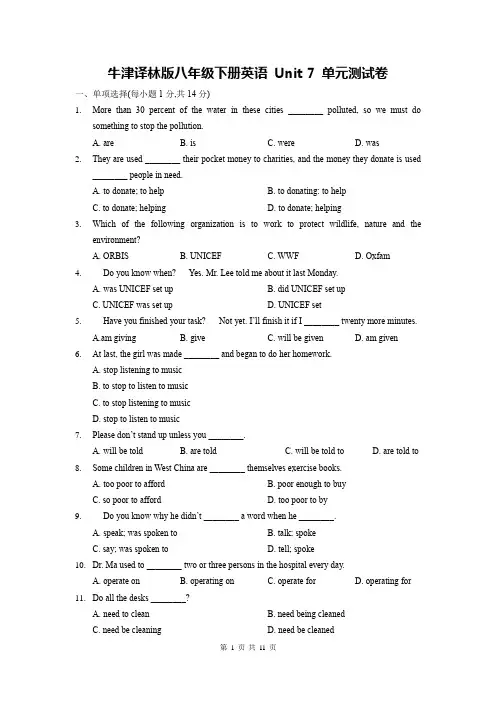
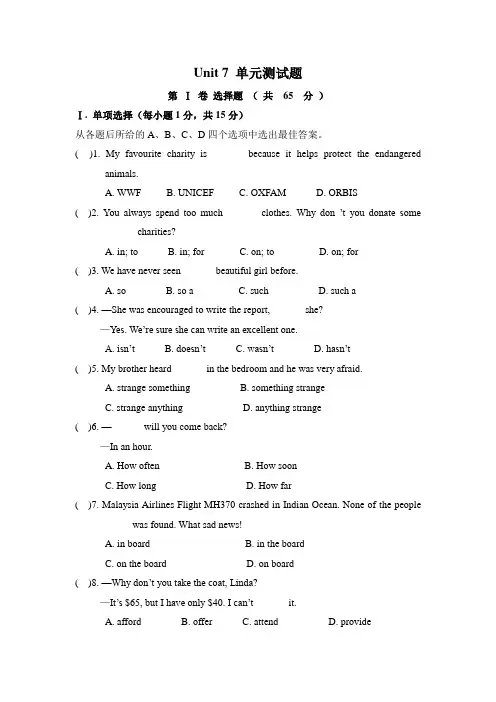
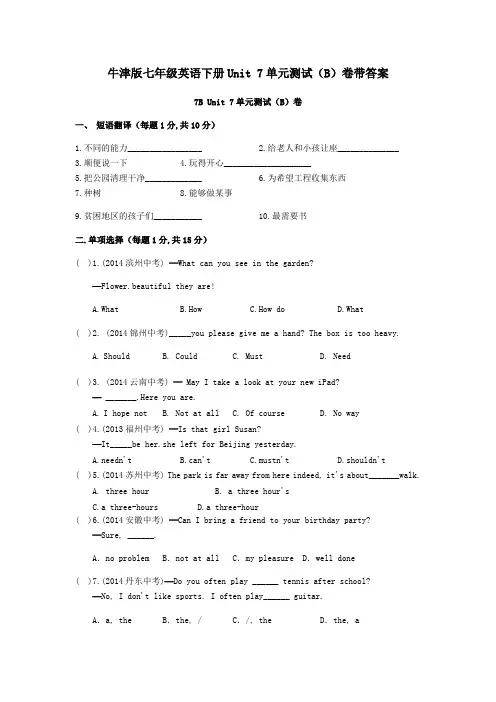
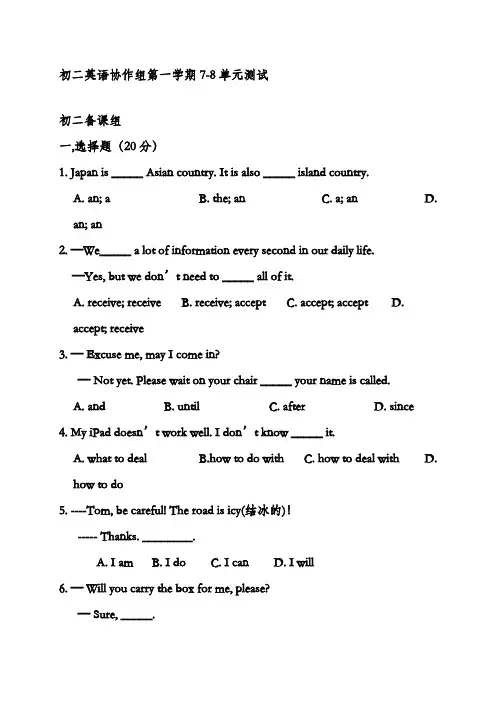
牛津译林版八年级下册英语Unit 7 单元测试卷一、单项选择(每小题1分,共14分)1.More than 30 percent of the water in these cities ________ polluted, so we must dosomething to stop the pollution.A. areB. isC. wereD. was2.They are used ________ their pocket money to charities, and the money they donate is used________ people in need.A. to donate; to helpB. to donating: to helpC. to donate; helpingD. to donate; helping3.Which of the following organization is to work to protect wildlife, nature and theenvironment?A. ORBISB. UNICEFC. WWFD. Oxfam4.--- Do you know when? --- Yes. Mr. Lee told me about it last Monday.A. was UNICEF set upB. did UNICEF set upC. UNICEF was set upD. UNICEF set5.--- Have you finished your task? --- Not yet. I’ll finish it if I ________ twenty more minutes.A.am givingB. giveC. will be givenD. am given6.At last, the girl was made ________ and began to do her homework.A. stop listening to musicB. to stop to listen to musicC. to stop listening to musicD. stop to listen to music7.Please don’t stand up unless you ________.A. will be toldB. are toldC. will be told toD. are told to8.Some children in West China are ________ themselves exercise books.A. too poor to affordB. poor enough to buyC. so poor to affordD. too poor to by9.--- Do you know why he didn’t ________ a word when he ________.A. speak; was spoken toB. talk; spokeC. say; was spoken toD. tell; spoke10.Dr. Ma used to ________ two or three persons in the hospital every day.A. operate onB. operating onC. operate forD. operating for11.Do all the desks ________?A. need to cleanB. need being cleanedC. need be cleaningD. need be cleaned12.The game was a great success in the United States and it soon ________ to Australia and thento other ________ countries.A. reached; English spokenB. floated; English speakingC. spread; English-speakingD. expanded; English spoken13.Many children ________ money to the charity ________ for disabled people.A. raise; donatingB. donate; raisingC. raise; raisesD. donate; donates14.--- Henry, you ________ on the phone. ---Oh, ________.Thank you.A. wanted; 1 comeB. are wanted; I’m comingC. want; I will comeD. are wanting; I’m coming三、完形填空(10分)Last autumn, my 80-year-old grandmother was having problems with her her. My family sent her to the hospital.After a careful examination, a famous doctor told my grandmother, “You have a ___1____ heart serious condition that you should have an operation.”“But the complications (并发症) can happen,” the doctor ___2____ “my grandmother and looked worries at her worried face.The doctor went on to say that she would have a 40.percent possibility of having a hearing trouble ___3____ the operation, a 35 percent possibility of being unable to stand up, and even a 20percent possibility of dying on the operating table because of her old age.My grandmother was terribly surprised and quickly said, “Doctor, since you’re talking about these possibilities, I have one for you: there is a 100 percent possibility that you won’t operate on me!” ___4____ these words, my grandmother got up and left the doctor’s office.The next day, my grandmother went to ___5____ doctor’s office. There she was also told she needed an operation, the doctor also said that her ___6____ might cause some problems, ___7____ he was quite sure about the success of the operation.My grandmother might be brave, but she is not silly. She then asked the-doctor, “If I am your mother, what will you ___8____?”The doctor walked up to her, smiled, put his arms ___9____her, and said, “Mom; let’s have the operation!”My grandmother had the operation and came out ___10___! Her positive-attitude added many wonderful and happy years for her to enjoy lie with my family.1. A. wonderful B. serious C. difficult D. proper2. A. advised B. warned C. promised D. encouraged3. A. during B. before C. till D. against4. A. At B. With C. For D. By5. A. other B. the other C. another D. one6. A. weight B. height C. length D. age7. A. when B. if C. but D. because8. A. imagine B. need C. mind D. recommend9. A. over B. above C. around D. below10. A. fine B. disabled C. dead D. sad三、阅读理解(每小题2分, 共28分)AHave you ever been barefoot water-skiing? It’s just like normal.water-sk1ing, being pulled. Go along behind a boat at 40 kmph (km per hour)—but without any skis! It sounds scary but it’s amazing! My cousin used to take me water-skiing, and that’s where I first learnt to stand up and balance. But I moved on to barefoot water-skiing when I did it for a laugh with some friends. And I loved it!Barefoot water-skiing is one of the most popular water sports there is—to watch, anyway! When someone jumps really high and then lands, it’s wonderful. And you didn’t need expensive things like boards, although a wetsuit (泳衣) is a good idea. But catching your toes on things in the lake can hurt. I guess you can’t help getting water up your nose when you start learning, too, as you have to lie almost flat in the water before pull yourself up─but it’s OK.Now I’m experienced, I’ve learnt not to attempt (尝试) new moves in rough water as it never goes well. Inside, I make sure I limit myself.to skiing directly behind the boat, where the water’s calmer. I ask the boat drivers to warn-me-about big waves coming, although they can’t always see them.Finding time to practice regularly is -hard as I’m still at school-but I’m not going to get any prizes. If l want to learn a new move, I need to repeat it over and over, and that’s not easy in winter when it’s cold. Lots of skiers say they’ll continue during cold water, but not many do.So I’m often the only one out on the lake!1.What is the writer trying to do in this text about barefoot water-skiing?A. To explain why he’s decided to become a champion.B. To describe what he does get better at his sport.C. To suggest the best ways to begin learning his sport.D. To tell people that his sport is both safe and easy.2.The writer started barefoot water-skiing when ________.A. he realized how easy it was to doB. he tried it out just for funC. he was taught how to do it by his cousinD. he was asked by friends to have a try3.What does he writer think are the disadvantages of barefoot water-skiing?A. If your felt hit something in the water, it’s painful.B. Although not much equipment is needed, it isn’t cheap.C. If you start in the wrong position, you breathe in water.D. Although you jump higher without skis, it’s harder to land.BA 17-year-old boy, caught sending text messages in class, was recently sent to the vice principal’s office at Millwood High School in Halifax, Nova Scotia. The vice principal, Steve Gallagher, told the boy he should not pay attention to his cellphone, but listen to his teacher carefully. The boy listened politely and nodded, and that’s when Mr. Gallagher noticed the student’s fingers moving on his lap. He was texting while being scolded for texting. “It was a subconscious act,” says Mr. Gallagher, who took the phone away. “Young people today are connected socially from the moment they open their eyes in the morning until they close their eyes at night. It’s compulsive (强迫的).”A study this year by psychology students at Covenant College in Lookout Mountain, Ga., found that the more time young people spend on Facebook, the more likely they are 10, have lower grades and weaker study habits. Heavy Facebook users show signs of being more sociable, but they are also more likely to be anxious, hostile (敌对的) or depressed. (Doctors, meanwhile are now blaming addictions to ‘night texting’ for disturbing the see patterns of tens.) Almost a quarter of today’s teens check Facebook more than 10 times a day, according to a 2009 survey by Common Sense Media, a nonprofit (非盈利的) group that monitors media’s influence on families. Will these young people get rid of this habit once they enter the work force, or will employers come to see texting and. social-network checking’ as accepted parts of the workday?Think back. When today’s older workers were in their 20s, they might have taken a break on the job to call friends and make after-work plans. In those earlier times, companies discouraged non-business-related calls, and someone who made personal calls all day risked being fired. It was impossible to imagine the constant (不断的) back-and-forth texting that defines interactions among young people today.Educators are also being asked by parents, students and educational strategists to reconsidertheir rules. “In past generations, students got in trouble for passing notes in class. Now students are skillful at texting with their phones still in their pockets.” says 40- year-old Mr. Gallagher, the vice principal, “and they’re able to communicate with someone one floor down and three rows over, Students are just fundamentally (根本地) different today. They will take suspensions (中途退学) rather than give up their phones,”4.The underlined word “a subconscious act” refers to an act ________.A. on purposeB. without realizationC. in secretD. with care5.Young people addicted to the use of Facebook ________.A. are good at dealing with the social relationships and concentrate on their studyB. have high spirits and positive attitudes towards their life and workC. have been influenced mentally in the aspects of behaviors and habitsD. are always in bad mood and have poor performance in every respect,6.Mr. Gallagher reminds us that the students in the past and those today ________.A. like to break rules and have the same means of sending messagesB. are always the big problem for the educators and their parentsC. like sending text messages but those today do it in a more secret and skillful wayD. cannot live without a cellphone7.What’s the best tile of the passage?A. Teenagers and CellphonesB. Teenagers’ Texting AddictionC. Employers and TeenagersD. Teenagers’ EducationCThe sun has begun to set and 1 bang up the smile I’ve worn all day, though I will make sure it is he first thing I put back on the next morning just in case it is “that day” I want her to see me at my very best.As usual, I eat dinner, clean the house, wrier the usual daily tings. And then I lay down hoping to fall asleep quickly, so my new day will hurry up and arrive; A new day with a completely new sin. But as I lay there and wait for the world to turn half way around, I think about her. And sometimes I smile, and sometimes that smile will turn into a snicker (窃笑), and then often that snicker will turn into a burst of laughter.And then there are times I get that lump, (肿块) in my throat and that tight feeling in my chest, and sometimes that 1 can’t stand that feeling and begins to turn into a tear, and often that tear increases greatly itself and 1 can no longer fight the feeling and I lose that battle Thensomehow through either the joy or the sadness I drift and find myself asleep. Then the dreams begin and keep me company until my new day arrives.When I am awake it’s with such excitement because I tell myself this could be the day that every other day has Jed up to and the first day of the rest of my life. Y quickly wear my smile because I really want her to see me at my very best, Then I look out the window because, even though I know it’s dawn I still have to confirm I’ve been given another chance to find her.And there it is ... the sun, even when it’s cloudy; somehow I still see it. And it smiles at me and I say, “Thank you,” and I smile back.Thank you for the sun, which began my new day. Thank you for feeling confident when I got up this morning that I would find her in this new day. But most of all, thank you for me not having to ever wait on another sunrise because whenever I want to see it, 1 will look at her and there it shall always be, in her eyes; she will forever hold it for me.8.The first thing the writer should do is to ________ the next morning.A. wear a smile once againB. forget what happened the day beforeC. eat dinner and clean up the houseD. thank his life for the new day,9.From the passage, the writer wishes her angel to see him ________.A. when he sleepsB. when he is dreamingC. when he is at his bestD. when he is greatly excited10.When the writer is awake the next morning, he is always, ________.A. sadB. disappointedC. happyD. excited11.Why does the writer say “thank you for the sun.” in the last paragraph?A. Because the sun brings him happiness.B. Because the sun begins his new day.C. Because he feels confident about everything.D. Because he can see his angel in a new day.五、词汇运用(10分)1.____________ (教育) is closely related to the future of a country.2.The boy didn’t feel any ____________ (自豪) even alter he won the first prize in theinternational Maths competition.3.ORBIS helps those with eye problems but too poor to ____________ (负担得起) thetreatment.4.Their mothers used to be ____________ (秘书) of the same international company.5.Mandeep would like to study ____________ (医学) when she goes to college.6.---How is your father now? --- He is still under ____________ (treat) in hospital.7.Now there are fewer and fewer ____________ (India) Tigers in the world.8.Dr. Brown felt tired after performing two ____________ (operate) in the day.9.China in one of the largest ____________ (develop) countries in the world.10.Every student should be____________ (equal) treated at school.六、动词填空(10分),1.The ORBIS plane ____________ (visit) over 20 countries in the past 15 years.2.The Zhangs ____________ (prepare) for the party when I got to Mr. Zhang’s home.3.You’d better ____________ (not take) too much exercise if you are in poo health.4.When and where to build another metro line in Wuxi ____________ (not decide) atyesterday’s meeting.5. A large crowd is gathering on the street to see what ____________ (happen) there with somuch noise.6.The students didn’t know what ____________ (expect) when they volunteered for the charityactivity.7.--- When ____________ the charity sale ____________ (old) at our school? --- Tomorrow.8.I can’t understand the story. It ____________ (writ) in French.9.Mary was heard ____________ (play) the piano when I passed by.10.The report says had some children ____________ (develop) more slowly than others.七.完成句子(9分)1.自无锡地铁投入使用以来人来越来越多的人习惯了乘地铁上班。