牛津译林版英语八年级上册
- 格式:pptx
- 大小:1.66 MB
- 文档页数:19

译林牛津八年级上学期英语期末复习试题一.单项选择1. — Do you know _________ famous building named Notre Dame de Paris(巴黎圣母院)caught _________ fire on April 15, 2019?— Of course. Sorry to hear that!A. a; theB. the; aC. the; /D. /; a2.— When will the next plane ?—It is said that it will__________the airport at 10 a. m.A. arrive at; get toB. reach; arrive atC. reach; reachD. arrive; reach3. — Oh, you didn’t carry an umbrella with you! Didn’t you listen to the weather report?— . But it when I left my home.A. Yes; didn’t rainB. No; didn’t rainC. Yes; wasn’t rainingD. No; was raining4.— Which do you like better, this film or that film?—I think this film is that one. I like both of them.A. more exciting thanB. less exciting thanC. as exciting asD. so exciting as5.— Dad, can you give me some advice about the coming English test?—O K. The you think about the questions, the mistakes you’ll make.A. more carefully; lessB. more carefully; fewerC. less carefully; lessD. less carefully; fewer6.Today the forests are becoming smaller and smaller. We must too many trees.A. prevent people to cut downB. prevent people from cutting downC. keep people cutting downD. stop people to cut down7.Someone ____a drum at 12p.m. last night. I didn’t sleep well, so I felt __in class today.A. beat; awakeB. is beating; unhappyC. beat; asleepD. was beating; sleepy8. The sentence structure of “The good news made all of us very excited.” is .A. S+V+OB. S+V+IO+DOC. S+V+PD. S+V+DO+OC9. —Don’t you think there are too many cars in our city?— I really think so. If there are _____ people driving, there will be ______ noise.A. less; lessB. fewer; fewerC. less; fewerD. fewer; less10. The giant panda weighs just _________ when it is _________.A.10-kilogram; 10-month-oldB. 10 kilograms; 10-month-oldC. 10-kilogram; 10 months oldD. 10 kilograms; 10 months old11. The earthquake hurt _________ people. _________ them got seriously hurt.A. thousands of; Two hundreds ofB. two thousand; Two hundredC. thousands of; Two hundred ofD. thousand of; Two hundred of12. —I’ll drink half of the milk. The rest _________ for you, Jane.—Only for us two? I’m afraid the rest _________ going to be unhappy.A. is; areB. are; isC. is; isD. are; are13. —Good news! It will be _________ and our head teacher is going to Qin LakeWetland Park with us tomorrow.—Great! Only if there isn’t _________.A. sunny; rainB. sunny; rainyC. sun; rainD. sun; rainy14. — How useful the trees are!—I agree with you. The group of trees _________ some shade _________ us.A. provide; forB. provide; withC. offer; forD. offer; with15.——I felt so sad when I saw tigers in the zoo, because they had to stay in cages.——. I think they should go back to the forests.A.I’m sorry to hear thatB. It doesn’t matterC.Not at allD. Don’t worry二、完形填空A rich man asked an old man to advise his son to keep away from his bad habits. The old man took the son for a slow walk through a 1 . Stopping suddenly he asked the boy to pull out a 2 plant growing in the garden.The boy held the plant between his two fingers and 3 pulled it out. The old man then 4 him to pull out a little bigger plant. The boy pulled hard and the plant came out 5 the roots(根). “Now pull out that one,” said the old man, 6 the biggest plant. The boy had to 7 all his strength (力量)to pull it out.Next, the old man, pointing to a big 8 , said, “Now, take this out .” The boy held it and 9 to pull it out. But the tree would not move. “It’s 10 ,” said the boy , out of breath (呼吸).“So it is like bad 11 ,” said the old man. “When they are young, it is easy to pull them out. 12 when they take hold, they cannot be controlled(控制). ” The old man’s words 13 the boy’s life.From the story above, the 14 we can learn is: Don’t wait for bad habits to grow in us. Drop them while we are in control of them, 15 they will control us.1. A. park B. forest C. garden D. mountain2. A. small B. strong C. green D. beautiful3. A. hard B. even C. happily D. easily4. A. helped B. asked C. pushed D. led5. A. of B. to C. with D. on6. A. pointing to B. waiting for C. looking after D. worrying about7. A. have B. help C. use D. catch8. A. flower B. tree C. stick D. bamboo9. A. had B. learned C. tried D. liked10. A. dangerous B. easy C. wrong D. hard11. A. habits B. ideas C. plans D. hopes12. A. And B. So C. Or D. But13. A. saved B. hurt C. changed D. improved14. A. lesson B. word C. subject D. programme15. A. but B. or C. and D. so三.阅读下列内容,从每小题所给的四个选项中选出一个最佳答案。

牛津译林八年级上册英语重点单词牛津译林八年级上册是一本中学教材,主要面向八年级学生。
在这本书中,学生将学习到许多重要的英语单词。
本文将详细介绍牛津译林八年级上册英语重点单词,并为每个单词提供相关的例句和用法。
1. achieve (v.) - to successfully complete or accomplish somethingExample sentence: He worked hard to achieve his goal of becoming a doctor.Usage: This word is often used when talking about goals, dreams, or success.2. challenge (n.) - a difficult task or problem that requires effort to overcomeExample sentence: Climbing Mount Everest was a great challenge for him.Usage: This word is commonly used to describe a difficult situation or task.3. community (n.) - a group of people who live in the same area and share common interestsExample sentence: She is actively involved in her local community.Usage: This word is often used to talk about a group of people who come together and support each other.4. cooperate (v.) - to work together with others towards a common goalExample sentence: The team members must cooperate to win the game.Usage: This word is commonly used when talking about teamwork or working together.5. develop (v.) - to grow or progress over timeExample sentence: He needs to develop better communication skills.Usage: This word is often used when talking about personal growth or the growth of something over time.6. environment (n.) - the natural world and the surroundings in which people, animals, and plants liveExample sentence: It is important to protect the environment for future generations.Usage: This word is commonly used when talking about nature and the world around us.7. global (adj.) - relating to the whole world; worldwideExample sentence: The company has a global presence with offices in many countries.Usage: This word is often used to describe something that affects or involves the entire world.8. improve (v.) - to make or become better or more satisfactoryExample sentence: She practices every day to improve her piano skills.Usage: This word is commonly used when talking about getting better at something or making something better.9. opportunity (n.) - a chance or possibility to do or achieve somethingExample sentence: Studying abroad is a great opportunity for personal growth.Usage: This word is often used when talking about chances or possibilities.10. pollution (n.) - the presence or introduction of harmful substances or products into the environmentExample sentence: The factory's waste is causing pollution in the river.Usage: This word is commonly used when talking about the harm caused by human activities on the environment.11. responsibility (n.) - the state or fact of having a duty or obligation to deal with somethingExample sentence: It is our responsibility to take care of the elderly in our community.Usage: This word is often used when talking about duties, obligations, or tasks that one must fulfill.12. strive (v.) - to try hard to achieve somethingExample sentence: Many people strive to become successful in their careers.Usage: This word is commonly used to describe the effort or determination put into achieving a goal.13. technology (n.) - the application of scientific knowledge for practical purposes, especially in industry and engineeringExample sentence: The advancement of technology has greatly improved our lives.Usage: This word is often used when talking about the tools, machines, or techniques used in various fields.14. tradition (n.) - a custom or belief that has been passed down within a society or familyExample sentence: Many cultures have unique traditions that have been passed down for generations.Usage: This word is commonly used to describe long-standing customs or beliefs.15. understand (v.) - to have knowledge or awareness of somethingExample sentence: It is important to understand the needs of others in order to provide proper support.Usage: This word is often used when talking about knowledge or awareness of a particular subject or situation.16. value (n.) - the importance or worth of somethingExample sentence: Many people place a high value on friendship.Usage: This word is commonly used to talk about the importance or worth of something.17. visual (adj.) - relating to the sense of sight or the ability to seeExample sentence: The artist has a keen visual sense, which allows her to create beautiful paintings.Usage: This word is often used when talking about the sense of sight or things that can be seen.18. welfare (n.) - the state of being healthy, happy, and prosperousExample sentence: The government provides welfare programs to assist those in need.Usage: This word is commonly used to describe the overall well-being of individuals or groups.19. wilderness (n.) - a large area of land that is undeveloped, untouched by humans, and usually uninhabitedExample sentence: Exploring the wilderness can be a thrilling experience.Usage: This word is often used when talking about natural areas that are untouched by human civilization.20. wilderness (n.) - a situation or place where there is no civilization, or where life is very hardExample sentence: The refugees lived in a state of wilderness until they found shelter.Usage: This word is commonly used to describe situations or places that lack civilization or are extremely challenging to survive in.21. accommodation (n.) - a place to live or stay in, especially while on atrip or for a short period of timeExample sentence: They found suitable accommodation near the university.Usage: This word is often used when talking about places to stay, such as hotels, apartments, or lodgings.22. acknowledge (v.) - to recognize that something exists or is true, often by saying that you understand or accept itExample sentence: She acknowledged the difficulties but was determined to overcome them.Usage: This word is commonly used to show that you recognize or accept a fact or situation.23. adequate (adj.) - enough or suitable for a particular purpose or needExample sentence: The hotel rooms were adequate for our stay.Usage: This word is often used to describe something that is sufficient or meets certain requirements.24. alternative (adj./n.) - another possibility or choice; something that can be chosen instead of something elseExample sentence: They are considering alternative能源 for their home.Usage: This word is commonly used to talk about other options or choices that can be chosen instead of the usual ones.25. analyze (v.) - to examine something carefully and in detail, often in order to find out why or how it worksExample sentence: The scientists analyzed the data to understand the effects of the new drug.Usage: This word is often used when talking about detailed examination or study of a subject.26. anticipate (v.) - to expect or think that something will happen in the near futureExample sentence: We anticipate a rise in sales next month.Usage: This word is commonly used to talk about expecting or predicting future events.27. appreciate (v.) - to recognize the value or quality of something and thank or reward someone for itExample sentence: She appreciated his help and thanked him accordingly.Usage: This word is often used when talking about recognizing and showing gratitude for something or someone.28. arbitrary (adj.) - based on random choice or personal whim, rather than any reason or systemExample sentence: The rules of the game seemed arbitrary and unfair.Usage: This word is commonly used to describe something that is based on random choice or personal preference, without any logical reasoning.29. aspect (n.) - a part of something, or a way of looking at somethingExample sentence: One aspect of the problem is the lack of available resources.Usage: This word is often used to refer to a particular part or aspect of a situation, object, or concept.30. asset (n.) - something that is owned by a person or company and has valueExample sentence: Good reputation can be a valuable asset for a business.Usage: This word is commonly used to describe items, properties, or qualities that have value and can be owned or controlled by individuals or entities.31. attribute (v./n.) - to say that a quality or skill is responsible for something, or to describe a quality or skill that someone hasExample sentence: He attributes his success to hard work and dedication.Usage: This word is often used when talking about qualities or skillsthat are responsible for certain outcomes or possessed by individuals.32. beneficial (adj.) - good for someone or something, often producing a good effectExample sentence: Eating a healthy diet can be beneficial for youroverall health.Usage: This word is commonly used to describe something that is good or advantageous for a person or thing.33. campaign (n.) - a series of actions designed to achieve a particular aim, often political or militaryExample sentence: The government launched a campaign to reduce poverty in the country.Usage: This word is often used when talking about organized actions or efforts aimed at achieving specific goals.34. category (n.) - a group of similar things that are considered as a unitfor a particular purposeExample sentence: The books are organized into different categories in the library.Usage: This word is commonly used to refer to groups or classes ofsimilar items, objects, or concepts that are treated as a unit for specific purposes.35. celebrity (n.) - a famous person, especially someone known for theirability in a particular fieldExample sentence: She is a celebrity in the world of fashion design.Usage: This word is often used to describe individuals who are widely known and recognized for their talents, achievements, or fame.这些是牛津译林八年级上册英语的一些重点单词,每个单词都有其独特的意义和用法。
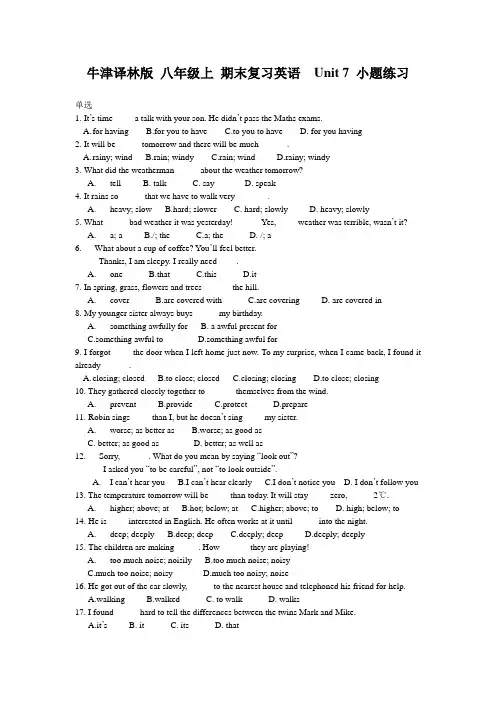
牛津译林版八年级上期末复习英语Unit 7 小题练习单选1.It’s time ____ a talk with your son. He didn’t pass the Maths exams.A.f or havingB.for you to haveC.to you to haveD. for you having2.It will be _____ tomorrow and there will be much ______.A.r ainy; windB.rain; windyC.rain; windD.rainy; windy3.What did the weatherman _____ about the weather tomorrow?A.tellB. talkC. sayD. speak4.It rains so _____ that we have to walk very _______.A.heavy; slowB.hard; slowerC. hard; slowlyD. heavy; slowly5.What _____ bad weather it was yesterday! --- Yes, ____ weather was terrible, wasn’t it?A.a; aB./; theC.a; theD. /; a6.--- What about a cup of coffee? You’ll feel better.--- Thanks, I am sleepy. I really need ____.A.oneB.thatC.thisD.it7.In spring, grass, flowers and trees ______ the hill.A.coverB.are covered withC.are coveringD. are covered in8.My younger sister always buys _____ my birthday.A.something awfully forB. a awful present forC.something awful toD.something awful for9. I forgot ____ the door when I left home just now. To my surprise, when I came back, I found it already ______.A.c losing; closedB.to close; closedC.closing; closingD.to close; closing10. They gathered closely together to ______ themselves from the wind.A.preventB.provideC.protectD.prepare11.Robin sings ____ than I, but he doesn’t sing ____ my sister.A.worse; as better asB.worse; as good asC. better; as good asD. better; as well as12. --- Sorry, ______. What do you mean by saying “look out”?--- I asked you “to be careful”, not “to look outside”.A.I can’t hear youB.I can’t hear clearlyC.I don’t notice youD. I don’t follow you13. The temperature tomorrow will be ____ than today. It will stay ____ zero, _____ 2℃.A.higher; above; atB.hot; below; atC.higher; above; toD. high; below; to14.He is ____ interested in English. He often works at it until _____ into the night.A.deep; deeplyB.deep; deepC.deeply; deepD.deeply; deeply15.The children are making _____. How ______ they are playing!A.too much noise; noisilyB.too much noise; noisyC.much too noise; noisyD.much too noisy; noise16. He got out of the car slowly, _____ to the nearest house and telephoned his friend for help.A.walkingB.walkedC. to walkD. walks17. I found _____ hard to tell the differences between the twins Mark and Mike.A.it’sB. itC. itsD. that18. The boy wasn’t ____. As a result, he didn’t pass the exam.A.enough carefulB.enough carefullyC.carefully enoughD. careful enough19. --- I failed my English exam again. I really want to give up.--- Come on. ____ is really over until the moment you stop trying.A.EverythingB.NothingC. AnythingD. None20.Look at the _____ look on their faces. The match must be wonderful.A.boredB. excitingC. excitedD. boring21.The radio says there will be ____ tomorrow. I think it will be _____.A. a bit snow; a bit snowierB. a bit of snowier; a bit of snowC.a bit snowier; a bit ofsnow D.a bit of snow; a bit snowier22.We saw her face ______ a white silk scarf ____ after she heard the teacher’s words.A.covered with; turned redB.was covered with; turn redC.covering; turned redD. covered with; turn red词汇1.Look, what a heavy snow! Maybe it will be even _____(snow) tomorrow.2.--- It _____ heavily last Thursday. There is much ______ this year in Wuxi.--- Yes, it’s much _____ than last year. (rain)3.We usually feel cool and comfortable after heavy ______(阵雨) in summer.4.--- What bad weather! --- Yes, the radio says it will be much ______(wind) tomorrow.5.The woman came in and began to have dinner without ______(introduction) herself.6.It was so quiet that you could hear a pin(针) _______(落下).7.It will be ______(雨) in three hours and there will be much _______(风).8.The weather report says it’s going to be ______(多云) in the afternoon.9.July, August and September are the _______(rain) months of the year in Thailand.10.Can you get someone else to help us finish the ______(剩余的) of the work?11.Do they find out what ______(引起) the big fire?12.I’m afraid you are the _______(noise) in your group. Please be quiet.13.My mother told me that the sun ______(rise) in the east and sets in the west.14.He ________(打赌) 200 yuan on the final score of the match, but failed.15.His _______(突然的) death surprised us all.动词1.--- Thank you for your wonderful treat last night. --- I’m glad you _____(enjoy) yourself.2.She always _______(hide) herself away in her office all day during her stay in Shanghai.3.We should stop all these farmers ______(make) more space for plants and rare birds in nature.4.--- Mary dances best in our school.--- I agree. I’ll never forget _______(see) her dance for the first time.5.The water of the river ______(rise) quickly last year because of the flood.6.--- What do you eat so much ice cream for? --- ______(feel) cool.7.The plane ______(not arrive) here on time because the radio says there will be a heavy snow soon.8.The pianist ______(feel) much better after she _____(take) some medicine just now.9.I think ______(do) the work correctly is more important than to finish it quickly.10.Jerry is a cheerful person. He has nothing ______(worry) about.11.Grace, how can you finish _______(write) the article in such a short time?12.The poor old man sat there alone, ______(watch) the children play football.13.When ________(enter) the classroom, I saw a wallet ______(lie) on the floor.14.A strong wind _______(blow) away all the clouds in the sky. It becomes clear now.15.We didn’t see snow for years because the temperature always ______(stay) above zero.16.I have to go now. Someone _____(wait) for me at the school gate.17.About 40 per cent of the students now in this school ______(come) from Shanghai.18.I stopped ______(listen), but heard nothing.19.Jessica may no more _______ (prevent) his son from meeting his friends.20.The news says that the number of Coronavirus people ________(not drop) at the end of this year in the USA.完成句子1.穿上这条棉质的短裙你会觉得凉爽。