
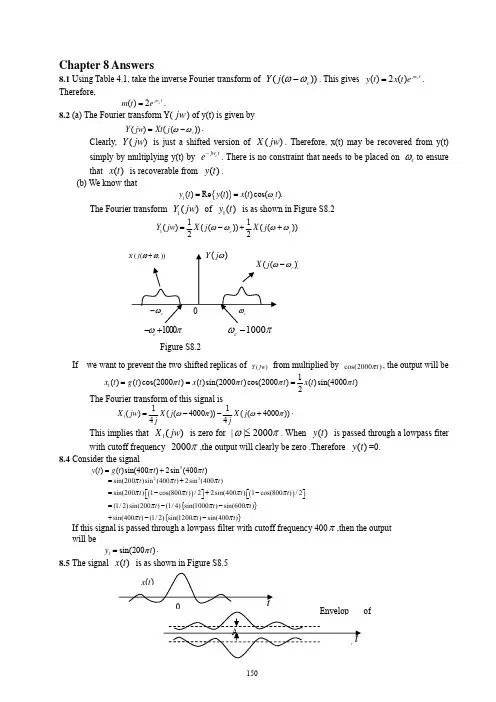
信号与系统奥本海姆英文版课后答案chapter8
- 格式:pdf
- 大小:207.58 KB
- 文档页数:8
Unit Eight: Computer Networks
Unit Eight/Section A
I. Fill in the blanks with the information given in the text:
1. MAN
2. open; closed
3. bus
4. token
5. Ethernet
6. client/server
7. equals; temporary
8. network
II. Translate the following terms or phrases from English into Chinese and vice versa:
1. file server 文件服务器
2. carrier sense 载波检测,载波监听
3. protocol suite 协议组,协议集
4. peer-to-peer model 对等模型
5. bus topology network 总线拓扑网络
6. inter-machine cooperation 机器间合作,计算机间合作
7. Ethernet protocol collection 以太网协议集
8. proprietary network 专有网络
9. utility package 实用软件包,公用程序包
10. star network 星形网络
11. 局域网 local area network (LAN)
12. 令牌环 token ring
13. 无线网络 wireless network
14. 封闭式网络 closed network
15. 环形拓扑结构 ring topology
16. 客户机/服务器模型 client/server model
17. 网络应用程序 network application
18. 进程间通信 interprocess communication
信号与线性系统分析课后答案_吴大正
第一章
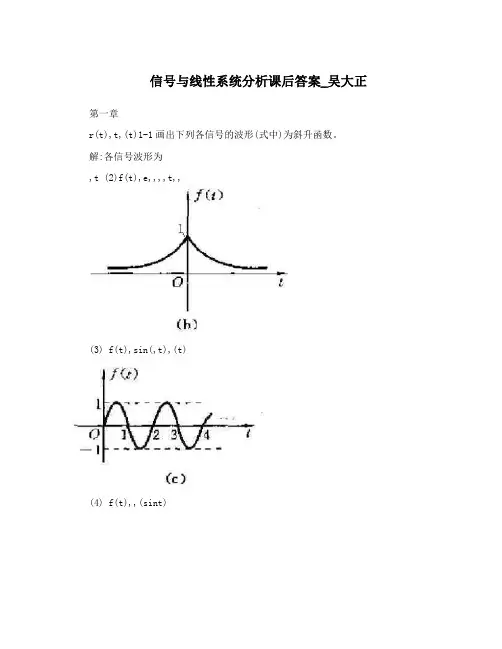
r(t),t,(t)1-1画出下列各信号的波形(式中)为斜升函数。
解:各信号波形为 ,t (2)f(t),e,,,,t,,
(3) f(t),sin(,t),(t)
(4) f(t),,(sint) (5) f(t),r(sint)
k(7) f(t),2,(k)
k(10) f(k),[1,(,1)],(k)
r(t),t,(t)1-2 画出下列各信号的波形[为斜升函数]。
f(t),r(t),2r(t,1),r(t,2)f(t),2,(t,1),3,(t,1),,(t,2) (1) (2)
f(k),k[,(k),,(k,5)]f(t),r(2t),(2,t) (5) (8)
,kkf(k),sin()[,(k),,(k,7)]f(k),2[,(3,k),,(,k)](11) (12) 6
解:各信号波形为
f(t),2,(t,1),3,(t,1),,(t,2) (1)
f(t),r(t),2r(t,1),r(t,2) (2) f(t),r(2t),(2,t) (5)
f(k),k[,(k),,(k,5)] (8)
,k f(k),sin()[,(k),,(k,7)](11) 6
kf(k),2[,(3,k),,(,k)](12)
1-3 写出图1-3所示各波形的表达式。
1-4 写出图1-4所示各序列的闭合形式表达式。
1-5 判别下列各序列是否为周期性的。如果是,确定其周期。
3,,,,f(t),3cost,2sin(,t)f(k),cos(k,),cos(k,) (2) (5) 524436
解:
f(t)1-6 已知信号的波形如图1-5所示,画出下列各函数的波形。
f(0.5t,2)f(1,2t)f(t,1),(t)f(t,1),(t,1) (1) (2) (5) (6)
tdf(t)
Chapter 06
1. The changes in a firm's future cash flows that are a direct consequence of accepting a project are
called _____ cash flows.
A. incremental
B. stand-alone
C. opportunity
D. net present value
E. erosion
2. The annual annuity stream of payments with the same present value as a project's costs is called
the project's _____ cost.
A. incremental
B. sunk
C. opportunity
D. erosion
E. equivalent annual
3. A cost that has already been paid, or the liability to pay has already been incurred, is a(n):
A. salvage value expense.
B. net working capital expense.
C. sunk cost.
D. opportunity cost.
E. erosion cost.
4. The most valuable investment given up if an alternative investment is chosen is a(n):
A. salvage value expense.
B. net working capital expense.
C. sunk cost.
D. opportunity cost.

Chapter 3 Solutions
3.1 (a) (i) x[0] = 3
(ii) x[3] = 5
(iii) x[–1] = 2
(b) (i)
(ii) The sketch for x[n+1] does not show the value of the sample x[5], since this
information is not provided in the question.
3.2 The impulse function is zero everywhere except n = 0.
a)[–4] = 0
b)[0] = 1 (c) [2] = 0
3.3 (a) This function is a mirror image of the impulse function across the vertical
axis, which means no change occurs. -3-2-10123450123456
-3-2-10123450123456x[n-2]
n
x[n+1]
n
(b) This function shifts the impulse two steps to the right and increases its amplitude
to 2.
(c) This function is the sum of two impulse functions.
3.4 The step function is zero for n < 0 and one everywhere else.
(a) u[–3] = 0
(b) u[0] = 1
(c) u[2] = 1
3.5 (a) x[n] = 4u[n–1]
00
00
00x[n]
n
x[n]
n
x[n]
n
(b) x[n] = –2u[n]
(c) x[n] = 2u[–n]