
研究生英语(人大版第三版)u12背景知识5
- 格式:ppt
- 大小:279.50 KB
- 文档页数:22


人大芸窗研究生英语读写教程
《人大芸窗研究生英语读写教程》是由人民大学出版社出版的
一本教材,主要面向研究生学习英语的教材。
该教材包括了阅读与写作两个部分。阅读部分包括了大量的英
语原文阅读材料,包括新闻报道、学术论文、专题报道等,旨
在帮助学生提高阅读理解能力,并能够从中获取相关的背景知
识和专业信息。
写作部分则提供了一系列写作练习,包括摘要、论文写作、翻
译和写作技巧等。通过这些练习,学生可以提高自己的写作水
平,培养良好的写作习惯和思维能力。
整本教材注重培养研究生学生的英语综合应用能力。除了提供
阅读和写作的训练,还提供了相关的词汇、语法和句型的讲解
和练习,帮助学生巩固基础知识。
《人大芸窗研究生英语读写教程》是一本综合性教材,适合研
究生学习英语的全面提高。

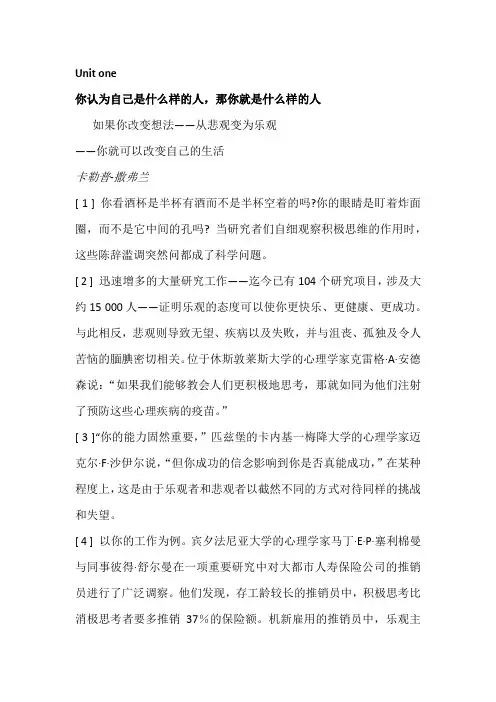
Unit one你认为自己是什么样的人,那你就是什么样的人如果你改变想法——从悲观变为乐观——你就可以改变自己的生活卡勒普-撒弗兰[ 1 ] 你看酒杯是半杯有酒而不是半杯空着的吗?你的眼睛是盯着炸面圈,而不是它中间的孔吗? 当研究者们自细观察积极思维的作用时,这些陈辞滥调突然问都成了科学问题。
[ 2 ] 迅速增多的大量研究工作——迄今已有104个研究项目,涉及大约15 000人——证明乐观的态度可以使你更快乐、更健康、更成功。
与此相反,悲观则导致无望、疾病以及失败,并与沮丧、孤独及令人苦恼的腼腆密切相关。
位于休斯敦莱斯大学的心理学家克雷格·A·安德森说:“如果我们能够教会人们更积极地思考,那就如同为他们注射了预防这些心理疾病的疫苗。
”[ 3 ]“你的能力固然重要,”匹兹堡的卡内基一梅降大学的心理学家迈克尔·F·沙伊尔说,“但你成功的信念影响到你是否真能成功,”在某种程度上,这是由于乐观者和悲观者以截然不同的方式对待同样的挑战和失望。
[ 4 ] 以你的工作为例。
宾夕法尼亚大学的心理学家马丁·E·P·塞利棉曼与同事彼得·舒尔曼在一项重要研究中对大都市人寿保险公司的推销员进行了广泛调察。
他们发现,存工龄较长的推销员中,积极思考比消极思考者要多推销37%的保险额。
机新雇用的推销员中,乐观主义者则多销了20%。
[ 5 ] 公司受到了触动,便雇用了100名虽未通过标准化企业测试但在态度乐观一项得分很高的人。
这些本来可能根本不会被雇用的人售出的保险额高出推销员的平均额10%。
[ 6 ] 他们是如何做的呢?据塞利格曼说,乐观主义者成功的秘诀就在于他的“解释方式”。
出了问题之后,悲观主义者倾向于自责。
他说:“我不善于做这种事,我总是失败。
”乐观主义者则寻找漏洞,他责怪天气、抱怨电话线路、或者甚至怪罪别人。
他认为,是那个客户当时情绪不好。

人教版九年级英语u12知识点Unit 12 is an important unit in the curriculum of the ninth-grade English textbook published by the People's Education Press. In this unit, students will learn about different subjects and academic performance through conversations, articles, and activities. The unit provides a comprehensive understanding of academic life and encourages students to reflect on their own learning experiences. In this article, we will delve deeper into the knowledge points covered in Unit 12.Firstly, this unit introduces various subjects taught in schools, such as Mathematics, English, Science, and Physical Education. Through dialogues and reading materials, students can practice using adjectives to describe their preference for different subjects. This not only helps them to develop their vocabulary skills but also encourages them to express their opinions in a coherent manner.Additionally, the unit focuses on academic achievements and progress. It teaches students how to discuss their school performance using comparative and superlative forms. This enables students to construct meaningful sentences to compare their achievements with others and to evaluate themselves effectively. Moreover, they learn expressions that provide positive feedback and encouragement to their classmates, fostering a supportive learning environment.Furthermore, the unit includes a section on sharing study tips and advice. Students are encouraged to share their personal experiences and strategies for studying effectively. Through peer discussions and group activities, students can gain insights into effective learning techniques and develop their problem-solving skills. This not only enhances their understanding of the language but also promotes critical thinking and collaboration.Moreover, the unit explores the concept of intelligence and multiple intelligences theory. Students learn about different types of intelligence, such as linguistic, logical-mathematical, musical, spatial, bodily-kinesthetic, interpersonal, and intrapersonal intelligences. By understanding this theory, students can appreciate the diversity of talents and skills among individuals. This knowledge empowers themto recognize and nurture their own strengths, leading to increased self-confidence and motivation in their academic pursuits.Additionally, the unit introduces the concept of goal setting and developing effective study habits. Students learn the importance of setting realistic goals and formulating action plans to achieve them. They are encouraged to identify their weaknesses and seek strategies to overcome challenges. By understanding the importance of perseveranceand self-discipline, students can develop good study habits that will benefit them not only academically but also in their future endeavors.In conclusion, Unit 12 of the ninth-grade English textbook published by the People's Education Press covers a wide range of knowledge points related to academic subjects, achievements, study tips, intelligence, and goal setting. Through engaging materials and activities, students can enhance their language skills while developing important life skills. By exploring these topics, students gain a deeper understanding of their own academic journey and are equipped with the tools and strategies to excel in their studies.。