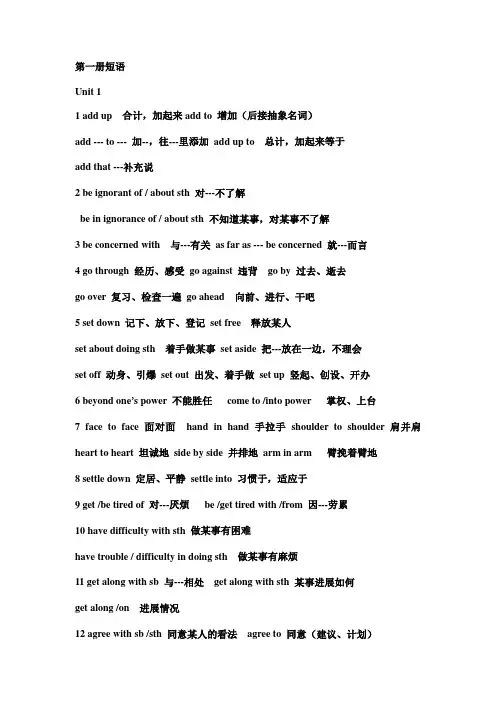
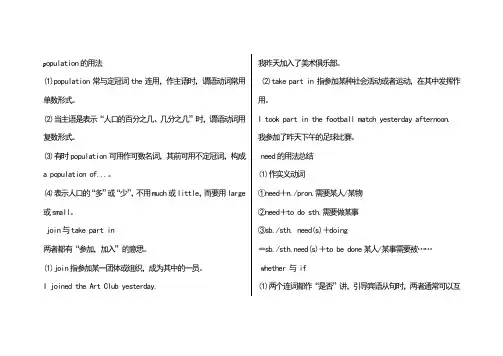
高中英语重点单词及短语汇总下面是高中英语重点单词及短语的详细介绍。
这些词汇和短语在学习英语过程中非常重要,掌握它们可以帮助你更好地理解和应用英语。
1. Vocabulary - 词汇Vocabulary refers to the words and phrases used in a particular language or by a particular group of people. It is essential to have a good vocabulary in order to understand and communicate effectively in English.2. Grammar - 语法Grammar is the set of rules that govern the structure and use of language. It includes various aspects such as tenses, parts of speech, sentence structure, and punctuation. Understanding and using grammar correctly is important for clear and accurate communication.3. Reading - 阅读Reading is an important skill that helps improve vocabulary, comprehension,and critical thinking. It involves understanding written text and extracting meaning from it. Reading various types of texts, such as novels, articles, and essays, can enhance your language skills.4. Writing - 写作Writing involves expressing thoughts and ideas using written words. It is a vital skill for academic and professional success. Effective writing requires good grammar, organization, and clarity of expression. Practice and feedback can help improve your writing skills.5. Listening - 听力Listening is the ability to understand spoken language. It is a crucial skill for effective communication. Developing good listening skills involves paying attention, understanding context, and recognizing different accents and speech patterns.6. Speaking - 口语Speaking is the ability to express thoughts and ideas orally. It involvesusing correct pronunciation, fluency, and appropriate vocabulary and grammar. Regular practice, conversations, and presentations can help improve your speaking skills.7. Conversation - 对话Conversation refers to an informal exchange of ideas and information between two or more people. It involves listening, responding, and engaging in meaningful dialogue. Conversations help improve fluency and communication skills.8. Pronunciation - 发音Pronunciation is the way in which words are spoken. It involves the correct articulation of sounds, stress, and intonation patterns. Practicing pronunciation can enhance clarity and understanding in spoken English.9. Comprehension - 理解能力Comprehension is the ability to understand written or spoken language. It involves extracting meaning, making inferences, and answering questions based on the given information. Improving comprehension skills requires practice and exposure to different texts.10. Idioms - 习语Idioms are phrases that have a different meaning from the literal interpretation of the words used. They are unique to a language and often reflect the cultural context. Learning idioms can help you understand native speakers and communicate more effectively.11. Phrasal Verbs - 短语动词Phrasal verbs are combinations of a verb and one or more particles (e.g., "look up," "take off"). They have a different meaning from the original verb and can be challenging for non-native speakers. Understanding and using phrasal verbs is important for natural and fluent communication.12. Collocations - 搭配词Collocations are words that frequently occur together. They form natural and common phrases in a language. Learning collocations can enhance vocabulary and improve accuracy in speaking and writing.13. Synonyms - 同义词Synonyms are words that have similar meanings. Knowing synonyms can help you avoid repetition and expand your vocabulary. Thesauruses and online resources are useful tools for finding synonyms.14. Antonyms - 反义词Antonyms are words that have opposite meanings. Knowing antonyms can help you express contrasting ideas and expand your vocabulary. Online resources anddictionaries can provide lists of antonyms.15. Homophones - 同音异义词Homophones are words that have the same pronunciation but different meanings and spellings (e.g., "their," "there," "they're"). Knowing homophones is important for accurate communication and avoiding confusion.16. Prefixes and Suffixes - 前缀和后缀Prefixes are added to the beginning of a word to change its meaning (e.g., "un-" in "unhappy"). Suffixes are added to the end of a word to modify its meaning or part of speech (e.g., "-able" in "enjoyable"). Understanding and using prefixes and suffixes can help expand your vocabulary.17. Context Clues - 上下文线索Context clues are hints or information surrounding an unknown word that can help infer its meaning. They include the words, phrases, or sentences that provide clues about the unknown word's definition. Recognizing context clues is essential for effective reading comprehension.18. Figurative Language - 比喻语言Figurative language refers to the use of words or expressions to convey meaning beyond their literal interpretation. It includes similes, metaphors, personification, and hyperbole. Understanding figurative language enhances language skills and enables more creative expression.19. Tenses - 时态Tenses are verb forms that express time relationships. They indicate when an action or state of being occurs. English has several tenses, including past, present, and future forms. Understanding tenses is crucial for accurate communication and writing.20. Modal Verbs - 情态动词Modal verbs are auxiliary verbs that express attitudes, abilities, or obligations. Examples include "can," "could," "should," and "must." Understanding and using modal verbs correctly can help convey meaning and express politeness in English.21. Active Voice - 主动语态Active voice is a grammatical voice in which the subject of the sentence performs the action. It is generally more direct and clear than passive voice. Using active voice can make your writing and speaking more dynamic and engaging.22. Passive Voice - 被动语态Passive voice is a grammatical voice in which the subject of the sentence receives the action. It is often used when the focus is on the action rather than the doer. Understanding when to use passive voice can enhance yourwriting and speaking skills.23. Conditionals - 条件句Conditionals are sentences that express hypothetical or conditional situations. They are used to talk about possibilities, permissions, and imaginary situations. There are four main types of conditionals, including zero, first, second, and third conditionals.24. Reported Speech - 间接引语Reported speech is used to tell someone what another person said, withoutusing the exact words. It involves changing direct speech into indirect speech, adjusting tenses and pronouns accordingly. Understanding reported speech is important for effective communication.25. Relative Clauses - 定语从句Relative clauses are used to provide additional information about a noun or pronoun in a sentence. They begin with a relative pronoun (e.g., "who," "which," "that") and are essential for building complex sentences and expressing relationships between ideas.26. Adjectives - 形容词Adjectives are words that describe or modify nouns and pronouns. They provide characteristics or attributes about the person, place, or thing being described. Using a wide range of adjectives can make your writing and speaking more descriptive and engaging.27. Adverbs - 副词Adverbs are words that describe or modify verbs, adjectives, or other adverbs. They provide information about how, when, where, or to what extent an actionis performed. Using adverbs correctly can enhance the clarity and precision of your communication.28. Prepositions - 介词Prepositions are words that show the relationship between a noun or pronounand other words in a sentence. They indicate time, place, direction, and other relationships. Understanding prepositions is essential for constructing clear and grammatically correct sentences.29. Conjunctions - 连词Conjunctions are words that connect clauses, phrases, or words within a sentence. They include coordinating conjunctions (e.g., "and," "but," "or")and subordinating conjunctions (e.g., "because," "although," "unless"). Using conjunctions effectively can improve the flow and coherence of your writingand speaking.30. Interjections - 感叹词Interjections are words or phrases that express strong emotions or reactions. They are often used to convey surprise, joy, enthusiasm, or disapproval. Including interjections in your communication can add emphasis and expressiveness.31. Punctuation - 标点符号Punctuation is the system of marks used in writing to separate sentences, clauses, and phrases. It includes periods, commas, question marks, exclamation points, and more. Using punctuation correctly is crucial for clear and effective communication.32. Spelling - 拼写Spelling refers to the correct arrangement of letters in a word. Good spelling skills are essential for clear and accurate writing. Practice, memorization, and the use of dictionaries and spell checkers can help improve your spelling.33. Abbreviations - 缩写Abbreviations are shortened forms of words or phrases, often used to save space or time. Common examples include "A.M." (ante meridiem) and "P.M." (post meridiem). Understanding and using abbreviations correctly can enhance your writing and comprehension skills.34. Acronyms - 首字母缩略词Acronyms are words formed from the initial letters of other words, such as "NASA" (National Aeronautics and Space Administration). They are often used in technical and professional contexts. Learning acronyms can help you communicate more efficiently and understand specialized terminology.35. Plagiarism - 抄袭Plagiarism is the act of using someone else's work or ideas without giving them proper credit. It is considered unethical and can have serious consequences in academic and professional settings. Understanding how to avoid plagiarism and properly cite sources is essential for maintaining integrity in your work.36. Paraphrasing - 改写Paraphrasing involves restating someone else's ideas or information in your own words. It is a valuable skill for avoiding plagiarism and demonstrating understanding. Practice and attention to detail can help improve your paraphrasing skills.37. Summarizing - 概括Summarizing involves condensing information or ideas into a shorter form. Itis a useful skill for writing reports, essays, and presentations. Developing effective summarizing skills requires extracting key points and presenting them in a clear and concise manner.。