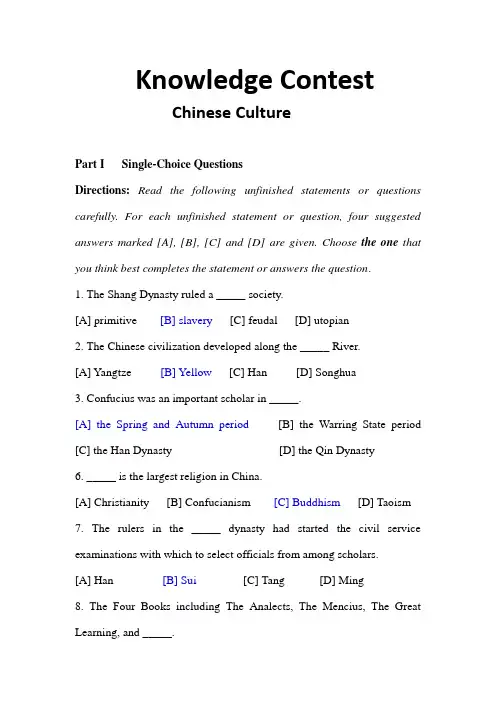
Knowledge ContestChinese CulturePart I Single-Choice QuestionsDirections: Read the following unfinished statements or questions carefully. For each unfinished statement or question, four suggested answers marked [A], [B], [C] and [D] are given. Choose the one that you think best completes the statement or answers the question.1. The Shang Dynasty ruled a _____ society.[A] primitive [B] slavery [C] feudal [D] utopian2. The Chinese civilization developed along the _____ River.[A] Yangtze [B] Yellow[C] Han [D] Songhua3. Confucius was an important scholar in _____.[A] the Spring and Autumn period[B] the Warring State period[C] the Han Dynasty [D] the Qin Dynasty6. _____ is the largest religion in China.[A] Christianity [B] Confucianism [C] Buddhism [D] Taoism7. The rulers in the _____ dynasty had started the civil service examinations with which to select officials from among scholars.[A] Han [B] Sui [C] Tang [D] Ming8. The Four Books including The Analects, The Mencius, The Great Learning, and _____.[A] The Book of Songs [B] Zen Buddhism[C] Sorrows at Departure [D] The Doctrine of Mean9. In 1940, Britain attacked China for a criminal purpose — to protect the _____ trade.[A] opium[B] tea [C] shipping [D] drug11. The earliest currency in China is ____.[A] stone [B] shell [C]feather [D]coin12. Chinese money can be divided into two categories: coin and paper. A great amount of coins were first found in _____.[A] the Shang dynasty [B] the Spring and Autumn period[C] the Qi dynasty [D] the Warring States period15. The largest inland river in China is ______[A]Jialing River [B] Nu River[C] Tarim River[D] Wu River16. ______ is called “the number one mountain in China”. It is also said that in ancient times, many emperors worshiped it when they ascended the throne or during peacetime.[A] Mount Tai [B] Mount Huang[C] Mount Hua [D] Mount Heng17. ______ is famous for Taoism. It is said that it is where Guolao Zhang, one of the Eight Immortals in Chinese mythology once lived.[A] Mount Song [B] Mount Hua[C] Mount Lu [D] Mount Heng18. Dragon Boat Festival falls on _____ of Chinese lunar calendar.[A] the fifteenth day of the fifth month[B] the fifth day of the fifth month[C] the fifth day of the sixth month[D] the fifteenth day of the sixth month19. During the Warring States period, Chinese people made use of the magnetic feature which is always pointing to the North to make a directional instrument, called ______.[A] Sinan [B] Guide car [C] Guide fish [D] compass20. Among the twenty-four solar terms, Spring Shower is followed by_______ .[A] Insects Waken[B] Spring Commencement [C] Vernal Equinox[D] Bright and Clear21. Located in the west of the West Lake, _______ is the largest and the oldest Temple in Hangzhou, with over 1600 years of history.[A] White House Temple [B] Shaolin Temple[C] Lingyin Temple [D] Foguang Temple22. The earliest Chinese medical book is ______.[A] The Yellow Emperor’s Canon of Interior Medicine[B] Jin Gui Yao Lue[C]Shen Nong’s Canon of Herbs[D] Shang Han LunKeys1. B2. B3. A 6. C 7. B 8. D 9. A 11.B 12.B 15.C 16.A 17.D 18.B 19.A 20.A 21.C 22.APart II Multiple-Choice QuestionsDirections: Read the following unfinished statements or questions carefully. For each unfinished statement or question, four suggested answers marked [A], [B], [C] and [D] are given. Choose the answers which you think best complete the statement or answer the question.1. Which of the following is one of the most important questions discussed in Tao De Jing?[A] the origin of the universe[B] the workings of all the things in the universe[C] the right way to live and behave[D] the right way to govern a state3.The Silk Road connected _____.[A] China [B] Europe [C] Western Asia[D] America4. Taoism refers to _____.[A] the philosophy founded by Lao Zi[B] the philosophy believed in by Mencius[C] the philosophy supported by Han Fei[D] the Taoist religion5. The Book of Songs is a collection of _____.[A] proses [B] poems[C] folk songs[D] fictions6. ______was a novel of the Ming dynasty.[A] Romance of the Three Kingdoms [B] Romance of the Five Dynasties[C]Water Margin [D] Journey to the West7. Buddhism was widely spread during the Southern and Northern Dynasties. Buddhist sculpture and painting flourished in many places. ______ is a representative.[A] Beijing [B] Shanxi [C] Henan [D] Gansu8. Which of the following proverb(s) is/are derived from the novel Romans of the Three Kingdoms?[A] “I’d rather let others down than to let others to let me down.”[B] “Losing your wife and army.”[C] “Three visits to the thatched cottage.”[D] “Oath of the Peach Garden.”9. There are many famous doctors in Chinese history, such as_______[A] Hua Tuo [B] Sun Simiao[C] Li Shizhen [D] Zhang ZhongjingKeys1. ABCD 3. ABC 4. AD 5. BC 6. ABCD 7. BCD8. ABCD 9. ABCPart III True or FalseDirections: Decide whether the following statements are true (T) or false (F).( ) 1. The Zhou Dynasty was a unified country.( ) 2. The phenomenon -- contention of a hundred schools appeared in the Eastern Zhou Dynasty.( ) 3. The author of The Analects is Confucius.( ) 4. About government and social order, Confucius is for nonaction. ( ) 5. Menci us’ mother moved house three times so that her son could live in a good neighbourhood.( ) 6. Confucianism is a religion.( ) 7. The Tang dynasty was the golden age of Chinese poetry.( ) 9. There were no ci writers in the Tang dynasty.( ) 11. Romance of the Three Kingdoms is a historical novel.( ) 13. “Riverside Scene on Qingming Festival” was done in the Southern Song period, presenting the scenes of a busy street with bridges, shops, houses and hundreds of people.( ) 14.Lu’s Spring and Autumn Annals is one of the best works of caring for life.( ) 15. Not until the 15th century did typography appear in Europe, which was 400 years later than Bi Sheng’s invention.( ) 16. China has the world’s longest man-made canal—the Beijing-Hangzhou Grand Canal. It links four great rivers such as HaiheRiver, Yellow River, Huaihe River and the Yangtze River.( ) 18. The Spring Festival is the most important Chinese traditional festival. As for the reunion dinner, people usually eat dumplings in Northern China and New Year Cake in South.( ) 19. In order to marry Princess Wencheng of the Tang dynasty, the king of Tibet Songtsan Gampo built the Potala Place in the 10th century A.D.( ) 20. In ancient China, chess mainly refers to Weiqi. The pieces are divided into black and white, symbolizing the Yin and Yang. There are 180 black and 180 white pieces, with a total number of 360.Keys1. F2. T3. F4. F5. T6. F7. T 9. F 11. T 13. F 14.T 15.T 16.F (five rivers, includes Qiantang River) 18.T 19.F (7th century) 20.F(181 white pieces)Part V Filling in the BlanksDirections: Complete the following blanked sentences with one or more words.2. Chinese Valentine’s Day falls on _____________________.3. Dragon boat racing is held in memory of ________.4. Chinese _____ is a unique animal species which live mainly on bamboos.5. In Qing Dynasty, different shades of red on the official caps showed _________.6. Lanterns originated from the ___________ Dynasty of more than 1,800 years ago.12. Hua Mulan is a heroine in a famous Chinese ancient poetry, __________________________.14. The palace Museum, once called Forbidden City, is the imperial palace of the _______ and _______ Dynasties.15. Beijing was once the capital of the ______, ______, ______, ______, and ______ Dynasties.16. People in north China eat _____ while those in the south eat _____ at midnight on the Chinese Lunar New Year Eve.17. Chinese buildings, especially temples, palaces and large houses were built of _____. Naturally this was very beautiful, but fire, insects and the warm climate have destroyed many of China’s historical buildings.18. At the entrances of the houses in ancient China, there are usually _______ (screen walls/metal doors) to ensure privacy.19. _______ set down a series of rules that Chinese people should follow.A son had to respect his father, a wife ought to respect her husband, ordinary people must respect officials, and officials had to respect the emperor.20. Shiji (史记)is an overview of Chinese history covering events from________ to ________ in the Han Dynasty.21. Zhang Qian was dispatched by Emperor Wudi to _______ to seek a military alliance with the Greater Y uezhi, with the intent to execute a cooperative attack against the Xiongnu tribes.22. ________ was a celebrated writer and calligrapher during the Eastern Jin Dynasty. His most famous calligraphic work is the Preface to the Poems Composed at the Orchid Pavilion (Lanting Xu).23. The four treasures of the study are the writing tools with Chinese characteristics. Also known as “the Scholars Four Jewels”, namely the ____, ______, ______, ______.25. Similar to people of other nationalities, ancient Chinese people grasp or tore food with bare hands at the beginning. ___, forks, knives and spoons were used much later, of which ____, with a history of thousands of years, are a wonder of Chinese dining utensils.26. Generally speaking, the ancient Chinese calendar divides a year into four seasons, ____ Jieqi, 72 hou, 360days.27. ____ are the traditional food for the Mid-Autumn Festival.28. The “Five Sacred Mountains” are the most famous ones among Chinese mountains. Located in central China, they are named according to the cardinal points on the compass, including ____ to the east in Shandong Province, _____ to the west in Shaanxi Province, ______in Hunan Province, ______ (same sound but different character in Chinese)to the north in Shanxi Province, and Mount Song in the center in Henan Province.30. The Ming and Qing Dynasties saw publication of the four famous Chinese classics of literature: ____, ____, _____, and ___.31. China’s four major inventions, _____, ____, ___ and ___ have become important symbols of China’s important role in the world’s civilization.32. The “five-animal exercise” is a set of health-building exercise imitating the movements of five animals--_____, ____, ____, ____ and____.33. Generally speaking, there are three essential factors by which Chinese cooking is judged, namely ____, aroma and taste, with ____ being the most important.34. Although there are hundreds of varieties of Chinese tea, they can be classified into five basic categories according to the different techniques involved in processing the tea. The five types are green tea, ___ tea, oolong tea, compressed tea and scented tea.35. In front of the gates of traditional palace halls, old government offices, mansions, temples and other houses of style, a pair of stone ____ are often seen standing guards. The male is on the left, his right paw resting on a ball, and the female on the right, her left paw fondling a cub.36. Cangjie (仓颉) is a very important figure in ancient China. Legendhas it that when he invented the ____, the deities and ghosts cried and the sky rained millet.38. In Xi’an, the world-famous _____ that guard the emperor----6,000 in the first hall, 1,000 in the second, and 68 in the third----are life-size. Each one is different from the rest and after 2,000 years, these figures are just as impressive as the day they were first placed there.40. Confucius was born in the state of ______ in 551 BC.41. Chi nese people call ______ the “Second Sage”.43.The Four Great Inventions are compass, paper, gunpowder and ______.44. Paper was first made in the ______ dynasty.45. The three literary forms in Chinese literature are Tang poetry, Song ci and ______.46. ______ embodies the fine tradition of ancient Chinese architecture and the great wisdom and creativity of working people. Now a museum open to the public, and it attracts ten of thousand people home and abroad every day.47. In Ming Dynasty, ______ made seven voyages and promoted the economic and cultural exchanges between China and such countries and areas as India, Southeastern Asia, the east coast of Africa, the Red Sea and Mecca.49. The content and meaning of Dream of the Red Mansions are so richand profound, and it has aroused so much interest among scholars that a special kind of learning called ______ started shortly after the novel was published.51. There are many cooking schools of Chinese cuisine. The most influential and representative ones also recognized by the community are: Shandong, Sichuan, Fujian, Jiangsu, Zhejiang, Hunan, ______ and _______ cuisine.52. ________ is one of the most famous Chinese cuisine in the world with the spices used diversely and distinctively.53. “Fuqi feipian” ,a k ind of famous dish, belongs to ______ cuisine.54. The four major traditional style of Chinese embroidery are Su, Xiang,______ and ______.55. The Yangtze River is the longest river in China, ______ kilometers in length. It covers ______ provinces and autonomous regions.56. _________ River is between the Yangtze River and Yellow River, whose branches densely cover four provinces—Henan, Anhui, Jiangsu and Shandong.57. ________River is the cradle of Chinese Culture and the mother river of the Chinese people.58. __________ River moistens the vast Sanjiang Plain.59. The highest one among the five sacred mountains is ______ , about 2200 meters above sea level.60. _______ ,which belongs to the Chinese native religions, was formed in the Han Dynasty two thousand years ago.61. Geographically, ancient Chinese gardens can be divided into two broad categories, namely, __________Gardens in the north, and the ________gardens in the south.62. The Chinese residences are diverse in design and construction. The most famous representatives are: Beijing’s Siheyuan, cave dwelling in Shanxi, Ganlan in Guangxi and Fujian Hakka__________.63. There are mainly two techniques in Chinese painting. One is “court-style” painting, the other one is _________ painting.Key:2. The seventh day of the seventh month in the lunar calendar.3. Qu Yuan, a famous patriotic poet in ancient China.4. panda.5. Different rankings.6. Western Han12. The Ballad of Mulan((《木兰辞》)14. Ming; Qing15. Liao, Jin, Yuan, Ming and Qing16. Jiaozi , niangao17. Wood18. screen walls19. Confucius20. Huang Di, Emperor Wudi21. the West Regions(Xiyu)22. Wang Xizhi23. writing brush, ink-stick, paper and ink-slab(stone).25. chopsticks, chopsticks26. 2427. Moon cakes28. Mount Tai, Mount Hua, Mount Heng, Mount Heng30. Romans of the Three Kingdoms, Water Margin, Journey to the West, Dream of the Red Mansions31. compass, papermaking, gunpowder, printing32. tiger, deer, bear, ape, bird33. color, color34. black35. lions36. characters38. terracotta warriors40. Lu41. Mencius43. the art of printing44. Eastern Han45. Y uan qu46. The forbidden city47. Zheng He49. Red Studies51. Guangdong, Anhui52. Sichuan cuisine53. Sichuan54. Shu, Y ue55. 6300, 1156. Huaihe57. Yellow58. Songhua59. Mount Hua60. Taoism61. Imperial, Private62. group houses63. freehandPart VI Short Answer QuestionsDirections: Give your answer to each of the following questions.4. What is the most important activity done by people on the Double-ninth Festival?5. What is the special food for the Lantern Festival?6. List three special activities on the Lantern Festival.7. Which festival is a period to honor and to pay respect to one’s deceased ancestors and family members?8. Which festival falls on the fifth day of the fifth lunar month?9. According to Chinese tradition, on which day the moon is the fullest and brightest?11. Over 2, 400 years ago, who made the first kite? Who brought stories of kites to Europe?12. What are the four skills that the Peking Opera performers practice?13. What are four main types of roles in Peking Opera?15. What is the earliest art of motion shadow pictures dubbed by people in the world?16. What does Chinese knot symbolize?17. What are the special tableware in China?18. What was the compass originally called? When did it appear?19. What is the largest Chinese School of thoughts and the mainstream consciousness of the ancient China?21. How many squares are there on the board of Chinese chess? How many pieces does each player of Chinese chess have?23. What laid a theoretical foundation for Traditional Chinese Medicine?24. What does WU XING (五行)refer to?25. What is the form of manually operated counting aid in ancient China?26. When did Chinese characters originate?27. Who is a famous ideologist, educator and the founder of Confucian School in ancient China?28. Who is a great ideologist and educator in the Warring States Period?29. Whose mother moved home three times only to find an environment that she felt was suitable for the child’s upbringing?30. When did Qin Shi Huang unify the ancient China and establish the first centralized feudal state in Chinese history?31. What are the merits of Qin Shi Huang?32. What is the most brutal means Qin Shi Huang once took?33. Who is the first Chinese writer who received the honor of winning the Nobel Prize?34. Who wrote the mythological novel, Journey to the West?35. Which book is the most important ancient Chinese classical military works?36. In the history of architect, what is the symbol of China?37. Where is the West Lake located?38. Who wrote the poetic masterpiece: The West Lake is like the beauty Xi Shi, who is always charming with either light or heavy make-up? (欲把西湖比西子,淡妆浓抹总相宜。