
2014年春人教版最新八年级英语下册《Unit2 I’ll help to clean up the city parks Section A》课件
- 格式:ppt
- 大小:6.02 MB
- 文档页数:41
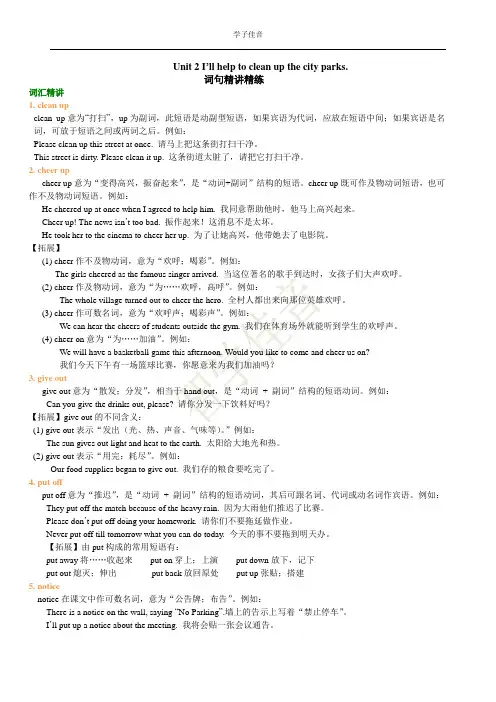
Unit 2 I’ll help to clean up the city parks.词句精讲精练词汇精讲1. clean upclean up意为“打扫”,up为副词,此短语是动副型短语,如果宾语为代词,应放在短语中间;如果宾语是名词,可放于短语之间或两词之后。
例如:Please clean up this street at once. 请马上把这条街打扫干净。
This street is dirty. Please clean it up. 这条街道太脏了,请把它打扫干净。
2. cheer upcheer up意为“变得高兴,振奋起来”,是“动词+副词”结构的短语。
cheer up既可作及物动词短语,也可作不及物动词短语。
例如:He cheered up at once when I agreed to help him. 我同意帮助他时,他马上高兴起来。
Cheer up! The news isn’t too bad. 振作起来!这消息不是太坏。
He took her to the cinema to cheer her up. 为了让她高兴,他带她去了电影院。
【拓展】(1) cheer作不及物动词,意为“欢呼;喝彩”。
例如:The girls cheered as the famous singer arrived. 当这位著名的歌手到达时,女孩子们大声欢呼。
(2) cheer作及物动词,意为“为……欢呼,高呼”。
例如:The whole village turned out to cheer the hero. 全村人都出来向那位英雄欢呼。
(3) cheer作可数名词,意为“欢呼声;喝彩声”。
例如:We can hear the cheers of students outside the gym. 我们在体育场外就能听到学生的欢呼声。
(4) cheer on意为“为……加油”。
例如:We will have a basketball game this afternoon. Would you like to come and cheer us on?我们今天下午有一场篮球比赛,你愿意来为我们加油吗?3. give outgive out意为“散发;分发”,相当于hand out,是“动词+ 副词”结构的短语动词。

Unit 2clean up 打扫(或清楚)干净【英国字母索源法】c(紧紧抓住)+lean倾斜(扫帚)→打扫,干净的lean[liːn]vi.倾斜;倚靠adj.瘦的;贫乏的vt.使倾斜n.瘦肉;倾斜[例]I’ll help to clean up the city parks.我将帮忙打扫市公园。
cheer /tʃɪə/ v. 欢呼; 喝彩【词汇倍增】看见beer他们cheercheer up (使)变得更高兴; 振奋起来[例]The girl could visit the sick kids in the hospital to cheer them up. 这个女孩会探访患病儿童给他们鼓劲儿。
give out 分发; 散发[例]The boy could give out food at the food bank.这个男孩会在食物银行发放食物。
volunteer /'vɒlən'tɪə/ v. 义务做; 自愿做n. 志愿者【英国字母索源法】vol,volunt= wish,will,表示“意志,意愿”volunteer n 志愿者(volunt+eer人→意愿的人→志愿者)voluntary a 志愿的,自愿的(volunt+ary)[例]The girl could volunteer in an after-school study program to teach kids. 这个女孩会在一个课外学习项目中担任自愿者来教孩子。
come up with 想出; 提出(主意、计划、回答等)[例]We need to come up with a plan for the City Park Clean-UP Day.我们需要就市公园清扫日的活动做出计划。
put off 推迟[例]We should put off the meeting.我们得推迟会议。
sign /saɪn/ n. 标志; 信号[例]We could see signs.我们能看见标志。

Unit2:I’ll help to clean up the city park.Section A:知识点一:clean up的用法:打扫干净如果宾语是名词:可放在之间或者末尾是代词:只能在之间。
例题:On Earth Day, many people in our city go to People’s Park to .A.Clean up itB.clean them upC.clean it upD.clean it up知识点二:cheer up使变得高兴;振奋起来如果宾语是名词:可放在之间或者末尾是代词:只能在之间。
例题:John isn’t happy today.Let’s go and .Good idea.A.cheer him upB.cheer up himC.to cheer up知识点三:give out散发,分发如果宾语是名词:可放在之间或者末尾是代词:只能在之间。
give的其他短语Give away 赠送give up 放弃give back 归还give off 发出放出Give sb sth给某人某物give in屈服例题:Could you please teach me how to red envelopes on WeChat? Sure. Let me show you.A.give outB.give backC.give way知识点四:put offput off意为“推迟”。
The concert was put off because of the heavy rain.演唱会因为大雨而被推迟了。
拓展:常见的put短语有:put off推迟;延迟穿上;put on展出;上演戴上put away收起来put out熄灭;扑灭put up with容忍put up搭建;建造张贴提升例4They the date of the meeting because of the bad weather.A.put offB.gave awayC.put onD.turn down知识点五used to的用法used to表示“过去常常;以前经常”,后跟动词原形,用来描述过去经常发生的动作或存在的状态。
