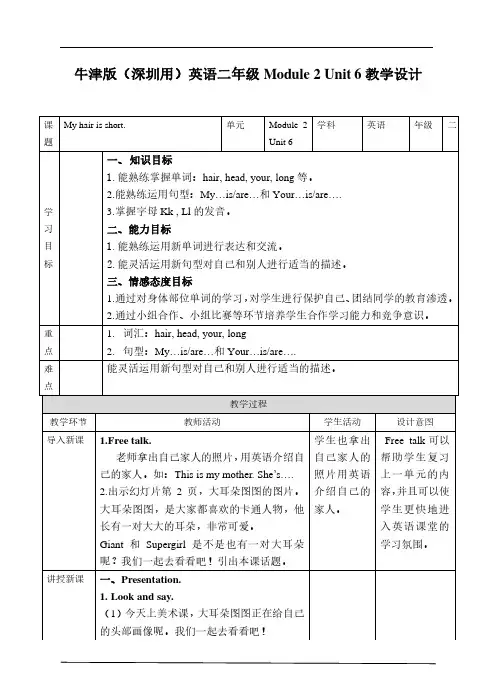
深圳版小学英语二年级下册全册教案
- 格式:docx
- 大小:164.01 KB
- 文档页数:136
深圳版小学二年级英语下册全册教案Primary English for ChinaBook 4教学计划及要求第1课时课题Unit 1 My school 教学目标New words: room, library, hall, music, art, playground Sentence patterns: This is …There is a an …教材分析重点New words: room, library, hall, music, art, playground难点Sentence patterns: This is …There is a an …教具Word cards, picture, tape-recorder教学过程I. Free talkⅡ. Presentation1.Bring in a picture of a school and photos or pictures of thedifferent rooms taught in the Unit.2.( Books closed ) Show the picture of you the school,saying This is my school.Give individual pupils the picture and ask them to repeat the sentence.3.Show the pictures of the different rooms in the school.Say their names and ask the pupils to repeat them after me Then practise by showing a room and asking the pupils to tell me the name.4.Choose a picture and point to something in the picture thepupils know, e. g. a tree, a well-known room and say There’s a/an …Show the picture to individual pupils and ask them to point to the object and repeat the sentence.Point to other known items in the picture and encourage them to make sentences about them.5.Play the Pupil’s Book Cassette and point to the speechbubble. Ask the pupils to repeat after the beeps.Ⅲ. Practice1.( Books open ) Show Transparency. Point to the places inthe school on the page, saying There’s a classroom, etc.Encourage the pupils to repeat the sentences after you. 2.Introduce the new character, Mike. Explain that Tim isshowing Mike a picture of his school. Teach the pupils the name of the school ( No. 1 Primary School ).教学过程3.Read Tim’s speech bubble. Get the pupils to point to thecorrect places. Make sentences about the other places using There’s a/an …4.Encourage the pupils to make sentences by using there isa /an…while I point to the places in the picture.5.Get the pupils to look at each of the rooms. Point at anobject in a room and say There’s a …布置作业1.Copybook 12.Workbook 13. Write the newwords on thenotebook.板书设计Unit 1 My schoolwords(picture cards)This is my school.There’s an art room.There’s a library.教学后记1.Teaching new words with motions impresses pupils.ing ‘a’ and ‘an’ should be emphasized.3. Pupils feel hard in pronouncing the words library, hall, and playground.第2课时课题Unit 1 My school教学目标New words: art room, music room, hall, library …Sentence patterns: Welcome to …Is there a …Yes, there is./ No, there isn’t.New words: art room, music room, hall, library…Sentences: Is there a … Yes, there is. / No, there isn’t.Word cards, picture, tape-recorderⅠ. Free talkⅡ. PresentationMake a plan of your school with the places marked on it.The plan does not need to have the English names written on it.( Books closed ) Show the pupils a plan of your school with the places marked on it, revising the English names for the places.Point to the plan and ask, for example, Is there a music room?Ask a pupil to come out and point to the place named and say Yes, there is. Ask about a place not in the school, e.g. Is there a swimming pool? Is there a zoo?Then teach No, there isn’t.4. ( Books open ) Show Transparency. Play the Pupil’s BookCassette and ask the pupils to repeat the characters’ words after the beeps.Ⅲ. Practice1.Show Transparency and play the Pupil’s Book Cassette.Explain that Tim and Pat are visiting Mike’s school. The Ss listen and follow in their books. Continue to play the cassette and ask the pupils to repeat.2.Show the words in Tim and Pat’s thought bubbles. Drillthe question form with the pupils by giving them the six word cues one by one and getting the pupils to ask Is there a/an …? For each place in the school.3.Show the words with ticks and crosses in Mike’s thoughtbubble. Explain that a tick means they should answer Yes, there is. A cross means that they should answer No, there isn’t.4.Divide the class into three groups to role-play Tim, Patand Mike. Get them to chorus the conversation following the order of the word cues in Tim and Pat’s thought bubbles.1.Copybook 22.Workbook 23.Review whatwe learnedtoday.Unit1 My school Welcome to my school!Is there a …Is there an …Yes, there is./No, there isn’t.1. Practice the sentence with the plans of different school, doing a survey, or drawing a plan of pupils’ ideal school may enable the lesson more interesting.2. Pupils need to be remind to add a ‘a’ in the sentence.第3课时Unit 1 My school教学目标New words: can’t coolSentence patterns: Come and have a look.Is there a/an …?Yes, there is./ No, there isn’t. Words and sentence patternsSentence patterns: Is there a/an… Yes, .../ No, … Picture cards, tape-recorderⅠ. Free talkWhat’s in your classroom?Is there a computer?Yes, there is. / No, there isn’tWhat’s on your desk?Is there a pencil case?…Ⅱ. Presentation1.Point to the characters in the pictures and read their speech bubblesaloud. Ask the pupils to point to the speech bubbles as you read them.2.Play the Pupil’s Book Cassette for the pupils and ask them to saythe sentences after the cassette.3.Explain that the man in the story is the school principal.4.Ask questions about what the boy can do, e. g. Can he sing ?Encourage the pupils to answer Yes, he can./ No, he can’t.5.Ask the pupils to role-play the story in groups of three and to readthe characters’ speech bubbles. Some groups may like to come out to the front and act the story.6.You may use Storycards to revise sequence and language of thestory.Ⅲ. Tick ( ) or cross ( )1.Ask the pupils to read the story again. I Read the words in thespeech bubbles with the pupils.2.Demonstrate how to tick or cross the first sentence with the pupilsas an example. If the pupils are not sure of the answer go backand read the story with them again until they find the answer.3.Check answers using Transparency.Ⅳ. SummaryI can sing. I can draw.I can’t sing. I can’t draw.1.Copybook P32.Workbook P33. Review what we learned todayUnit 1 My schoolIs there an art room? Yes, there is. /No, there isn’t.I can’t swim.I can play.1.Pupils have difficulty in understanding ‘come and have a look’, so they need tobe told the meaning and some situations and some practice are needed.2.Pupils have fun in reading the story imitating the record.With the guidance of the teacher, better pupils can retell the story---- feel delighted第4课时Unit 1 My school教学目标The pronunciation of “ou”in the following words: out, around, shout, playgroundsound “ou” in the words: around, shout, playground sound “ou” in the words: around, shout, playgroundPicture cards, tape-recorderⅠ.Free talkWhat’s in your pencil case?Is there a rubber?Is there a ruler?Yes, there is. /No, there isn’t.Are there any pencils?Yes, there are. /No, there aren’t.Ⅱ. Presentation ( E. say the sound and the words.)1.Play the Pupil’s Book cassette and ask the pupils to listento the sound and the words. Point out the spelling of this sound. It is important that the pupils realize the vowel sound is spelt with two letters. Demonstrate how to make the sound and get the pupils to look a t your face while doing so. Check that the pupils are opening their mouths sufficiently and making the sound correctly.2.Say the words slowly and clearly. Check that the pupilsare saying the sound correctly.3.Point to the pictures and check that the pupils can say thewords without your model.4.Play the Pupil’s Book Cassette again. Ask the pupils tolisten to the rhyme and to tick the correct picture. Get the pupils to say the rhyme.Ⅲ. More to do. ( Workbook P.4 )1.Ask Ss to look at the first part of the page and listen tothe Workbook Cassette.2.Draw a line to the correct words according to what theyhear on the tape.Tapescript and answers: ou ( mouth, playground )3. Ask Ss to look at the second part of the page. Tell them tolook at the pictures and fill in the blanks in the sentence.What’s in your school? Is there a library? Yes, there is.What’s in your school? Is there an art room? No, there isn’t.1.Copybook P42.Workbook P43. Review what we learned today Unit 1 My school out, around, shout, playground go out run around in the playgroundPupils feel hard to pronounce the word round and shout for they have never learned these words. So more practise is needed. Saying the rhyme with clapping hands for several times make pupils feel more interesting.第5课时Unit 1 My school教学目标Get Ss to be more familiar with the words and the sentence patterns “There be”“Is there a/an …”“Yes, there is/No, …”Words and sentence patterns Is there a/an … Yes, ../No,.. Words and sentence patterns Is there a/an … Yes, ../No,..Word cards, pictures and tape-recorderⅠ. Free talkWhat’s in your room?Is there a big TV?Is there a computer?Is there a fan?Yes, there is. /No, there is n’t.Ⅱ. Revision1.Review the wordclassroom, library, hall, music room, art room, playground…2. Choose some students to spell the words, and choose someable students, make sentences with these words.Ⅲ. Presentation ( F. Look and do. P.5)1.Tell the pupils to work in pairs. One should be Student Aand the other one Student B. ask all the pupils who are student A to put up their hands. Repeat with the pupils who are Student B.2.Read the instructions on the page with the pupil. Askthem to turn to pages 60 and 61. point out the different plans Students A and B should look at. Explain that the places on the plans are the same, but the objects are in different places.3.Tell the pupils to put ticks in the correct places in the gridon page 60 or page 61.4.Demonstrate one conversation by having one student Aask, e.g. Is there a fan?Get Student B to answer No, there isn’t. Then have Student A ask Is there a TV? Get Student B to answer Yes, there is. It’s in the classroom.Show the pupils that Student A should tick the box across from classroom and under the TV in the grid.IV. Tell them to take turns to ask and answer questions and to put ticks in their grid according to their partner’s answers. V. Summary1. Workbook P52. Review what we learned today Unit 1 My school Is there a fan? No, there isn’t.Is there a TV? Yes, there is.It’s in the classroom.第6课时Unit 1 My school教学目标Consolidate all the new words and sentence patterns of Unit 1Part G: Sing the songsThe words and sentence patterns in unit1Sentence patterns in unit1Word cards, picture cards, tape-recorder, projectorI. Free talkWhat’s the weather like today?Is there a computer in the classroom?Are there any fans in the classroom?How many fans in the classroom?Ⅱ. Revision1.Review the new wordsart room, library, hall, music room, playground, classroom, computer room, music room, around, shout 2. Review sentence patterns.This is my school. There’s an art room. There’s a library.Welcome to my school!Is there a library?Yes, there is./ No, there isn’t.Ⅲ. Sing and play1.Play the Pupil’s Book Cassette for the pupils to listen tothe song.2.Play the cassette again and tell the pupils to tick thecorrect pictures for the rooms in the first two verses ofthe song.3.Play the cassette again and encourage the pupils to joinin with the words. Then point to one of the rooms shownat the bottom of the page and ask the pupils to sing thenext three verses substituting the name of the room Ipoint to.Ⅳ. Workbook. (P5)1. Ask the pupils to read the speech bubbles in the pictureson the left.2. Then match them to the pictures on the right by writingthe correct letter in the circle.Ⅴ. Summary1.Read partA and partB together.2.Sing the songs again.1.Review the words and Part A,B,C,D,E,F.2.Prepare Unit 2Unit 1 My school There is an art roomIn my school,In my school,There’s an art room in …My school’s cool.第1课时Unit 2 At school (Ⅰ)New words: study, paint, line up, dining hall, eat,drink…Sentence patterns: Let’s …New words: study, paint, line up, dining hall, drink …Sentence patterns: Let’s …Word cards, picture, tape-recorderⅠ. Free talkWhat can you do?Can you run?Can you jump?Can you dance?Ⅱ. Presentation1.Revise with the pupils the verbs they learned in Pupil’sBook Unit 3 (run, dance, jump, sing, read, write). Doactions for run, dance, jump, sing, read and write andhave the pupils repeat the words after you. Thenencourage the pupils to do the actions with you bysaying, for example, Let’s run.2.Teach the new words with actions to demonstrate theirmeanings. For example, open more than one book, andmake notes for study, draw a paintbrush and pretend topaint, get a few pupils to line up, mime eat and drink andgently throw a ball to a pupil, saying Let’s play.3.Drill the new words by saying a word and getting thepupils to do the appropriate action or by doing an action and getting the pupils to say Let’s …4.Show Transparency and play the tape. Ask the pupils torepeat the words in the speech bubbles after the beeps.Do the same with the vocabulary items.Ⅲ. Practice1.Show Transparency. Point to the children on the pagewho are painting. Say Let’s paint. Get the pupils to do the action and join in with them. Let’s line up.2.Point to the other words. Ask the pupils to repeat themafter you and to do the action you have taught them.3.Ask the pupils to work in groups of four. Give a word cuelike study.Nominate one pupil in the group to make a sentence with Let’s …and to invite Ss to do the action with him or her.3.Copybook 54.Workbook 6 3. Write the new words on the notebook. Unit 2 At schoolwords (picture cards) Let’s study. Let’s paint. Let’s line up.The activity that teacher give orders (say the words) and pupils do actions is good for memorizing the new words and sentence pattern.第2课时Unit 2 At school (Ⅱ)New words: sing, play, study …Sentence patterns: What do you do in the …? We … and …New words: sing, play, study …Sentence patterns: What do you do in the …? We … andWord cards, picture, tape-recorderⅠ. GreetingHow are you today?Is there a library in the school?Can we shout in the library?Ⅱ. Presentation1.Bring in the plan of the school again.2.Point to an appropriate room on the plan. Make sentences about whatthe pupils do in the room. For example, say We study in the classroom.3.Drill the pupils by asking about the different rooms, e.g. What do youdo in the dining hall?Encourage the more able pupils to use morethan one verb by saying And? With rising intonation after they havetold you one thing they do, e.g. S: We eat. T: And? S: We drink.4.Show Transparency and play the tape. Point to the speech bubbles andget the pupils to repeat the sentences after the beeps.Ⅲ. Practice1.Show Transparency and play the tape. The pupils listen and follow intheir books. Continue to play the cassette and ask the pupils to repeat the words after the beeps.2.Show Ss the characters and explain Mike is in Pat’s school.3.Point to the pictures and ask, for example, what do you do in theplayground? Encourage the pupils to make a sentence about each small picture in the thought bubbles.4.Show the pupils, using the sentences in the speech bubbles, that whenwe talk about more than one thing we can use … and … to link the actions. We can also use …, too to link a sentence to a previous sentence.5.Point to Pat’s thought bubbles in picture 3. help Ss to link the actionsshown by saying … and … or …, too.6.Ask the pupils to work in pairs to complete the conversation. Thepupils take turns to role-play P and M.1.Copybook 62.Workbook 73. Review what welearned today.Unit 2 At school What do you do in the playground? We line up and sing.We play, too.Enlargement:1.We surf the internet/ play computer game in the computer room.2.We sing and dance/ have a show in the hall.3.We swim in the swimming pool.jump, run, read, write, etc.第3课时Unit 2 At school (Ⅲ)Words: here ,pool, coolSentence patterns “What do you do in the …?”“We … and …”“We play in the …”the sentence patterns of “ What do you do in the …?”the sentence patterns of “ What do you do in the …?”Picture cards, tape-recorderⅠ. GreetingWhat do you do at home?We eat and drink.We play, too.Ⅱ. Presentation1.Point to the characters in the pictures and read their speech bubblesaloud. Ask the pupils to point to the speech bubbles as you readthem.2.Play the Pupil’s Book Cassette for the pupils and ask them to saythe sentences after the cassette.3.Pupils say the speech bubbles together. And then say them groupby group, see which group is best.4.Ask the pupils to role-play the story in groups of three and to readthe characters’ speech bubbles. Some groups may like to come outto the front and act the story.e the storycards to revise sequence and language of the story.Ⅲ.Do the part D1.Ask the pupils to read the story again. Read the words in thespeech bubble with pupils and tell them to repeat the sentences.2.Demonstrate how to write a cross in the first one as an example.e Transparency to check the answers.Ⅳ. More to do1.Write the names of the different rooms on the board. Using stripsof paper with the action verbs written on them, ask the pupils to stick a strip of paper under an appropriate room name.2.Ask a pupil about a room, for example, what do you do in themusic room? The pupil makes a sentence using the word on the strip of paper under the room name. This game can also be played in teams for points.1.Copybook 72.Workbook 83. Review what welearned today.Unit 2 At schoolWe fly in here.We read in the swimming pool. Your school’s cool.Role-playing and acting out the story gain a good effect.Retelling the story with the help of teacher help pupils understand the story.第4课时Unit 2 At school (Ⅳ)The pronunciation of “ea” in the following words: ice cream, seat,read, eatpronunciation ea in the words: ice cream, seat, read, eatpronunciation ea in the words: ice cream, seat, read, eatPicture cards, word cards, tape-recorderⅠ. GreetingWhat’s your favourite food?Do you like apple?Do you like ice cream?Ⅱ. Presentation1.Play the Pupil’s Book Cassette and ask the pupils to listen to thesound and the words.2.Point out the spelling of this sound. It is important that the pupilsrealize the vowel sound is spelt with two letters.3.Say the words slowly and clearly. Check that the pupils are sayingthe sounds correctly.4.Point to the pictures and check that the pupils to listen to the rhymeand point to the children. Ask the pupils to read what is written onthe wrappers of each child’s ice cream. Tell them to circle thewinner. Get the pupils to say the rhyme.Ⅲ. Play the game1.Write the names of the different rooms on the board. Using stripsof paper with the action verbs written on them, ask the pupils to stick a strip of paper under an appropriate room name.2.Ask a pupil about a room, for example, What do you do in themusic room? The pupil makes a sentence using the word on the strip of paper under the room name. This game can also be played in teams for points.Ⅳ. Do workbook.(P9)1.Ask Ss to look at the first part of the page and listen to the tape.They need to circle the correct TVs according to the sound theyhear on the tape.2.Ask the pupils to look at the second part of the page. Tell them tolook at the pictures and fill in the blanks in the sentences.1.Copybook 82.Workbook 93. Review what welearned today.Unit 2 At school What do you do in the playground? We line up and sing.What do you do in the music room? We sing and dance.第5课时Unit 2 At school (Ⅴ)Get pupils to be more familiar with the words and thesentence patterns “ What do you do in the …?”“We …and …”…words and the sentence patterns “ What do you do …?”words and the sentence patterns “ What do you do …?”word cards, pictures andtape-recorderⅠ. Free talkWhat do you do in the playground?I play…What do you do in the classroom?I study………Ⅱ. Word revisionReview the words. Ask some pupils do actions for study, paint, line up, eat, drink…the others guess the wordsand spell the words.Choose some students to spell the words, and choose some able students, make sentences with words.Ⅲ. Presentation ( F. Look and do. P.11)1.Ask the pupils to draw their own face in the blank faceson page 62. Tell them to cut out the pictures and to stickthem in the four rooms at the top of page 11. Tell themnot to show their friend.2.Tell the pupils to work in pairs. Ask them to take turns toask What do you do in the …? The other pupil answers according to the picture he or she has put in that room.The pupil asking the questions ticks the correct boxes in the grid at the bottom according to their partner’s answer.3.At the end, the pupils check to see if their pictures andtheir partner’s grid match.Ⅳ. More to doThe pupils draw a picture of their favorite room in the school. They write a caption to tell what they do there.Ⅴ. SummaryWhat do you do in the library?I study.What do you do in the dining hall?We eat and drink.What do you do in the …?1.Workbook 102.Review the words3.Review what we learned today.Unit 2 At schoolWhat do you do in the library?I study.What do you do in the dining hall? We eat and drink.第6课时Unit 2 At school (Ⅵ)Consolidate all the new words and sentence patterns ofUnit 2Sing the songsNew words and sentence patternsSentence patternsWord cards, picture cards, tape-recorderⅠ. GreetingWhat do you do in the home?I do my homework.I eat and drink. I play, too.Ⅱ. Revision2.Review the new wordsstudy, paint, line up, dining hall, eat, drink, do, weat school, well2. Review sentence patterns.What do you do in the playground?We line up and sing. We play, too.What do you do in the classroom?We study.What do you do in the dining hall?We eat and drink.What do you do in the art room?We paint and draw.Ⅲ. Sing and play1.Play the Pupil’s Book Cassette for the pupils to listen tothe song. Ask the pupils What do you do in the …? For each of the rooms listed at the bottom of the page.2.Play the cassette again and tell the pupils to point to thecorrect pictures for each of the verses.3.Play the cassette again and encourage the pupils to join inwith the words.Ⅳ. The pupils play a miming game.Give a pupil a strip of paper with a verb from this unit written on it. The pupil reads the word on the strip of paper silently and then mimes the action. The others guess what action he or she is doing by making a sentence like We sing in the music room. Award points for correct guesses.Ⅴ. Summary1.Review theunit.2.Recite PartAand PartB3.Prepare Unit3第1课时Unit 3 My robot (Ⅰ)New words: arm, head, knee, leg, foot, feet, shoulder, hand, finger,toe…Sentence patterns: What’s in your…? There’s a/an …New words: arm, head, knee, leg, foot, shoulder, hand...Sentence patterns: What’s in your …? There’s a/an …Word cards, picture, tape-recorderⅠ.Free talkWhat’s the weather like today?Is there a computer in the classroom?Where’s the computer?Is it on the desk?Ⅱ. Presentation1.Introduce the parts of the body by pointing to your own body partsand saying the names.2.Draw a simple robot on the board. Label the robot and its bodyparts.3.Drill the names by getting the pupils to point to their own bodyparts when you say the names.4.Check that the pupils remember by pointing to your body parts andgetting the pupils to say the names.5.Show Transparency. Play the Pupil’s Book Cassette and ask thepupils to repeat the words in the speech bubbles after the beeps. Dothe same with the vocabulary items.Ⅲ. Practice1. Show Transparency. Show the robots on the shelf above the man’shead. Ask What’s this? Encourage the pupils to answer It’s a robot.2. Point to the box. Tell them that pieces of Tim’s robot are in the box.3. Read the speech bubbles. Get the pupils to point to the correct bodyparts in Tim’s box.4. Point to the body parts or say their names and get the pupils to ask Isthere a …?5. Divide the class into two halves. Point to or say the names of thebody parts. Tell half the class to ask the question Is there a …? Tell the other half to replay Yes, there is./No, there isn’t. Try to catch the class out by sometimes saying words like a car, a kite, a doll, etc.exchange the roles so half the other half of the class become the questions.1.Copybook 92.Workbook 113.Write the newwords on thenotebook.Unit3 My robotNew words(picture cards) What’s in your bag? There’s a /an…Is there a/an…1)Revision: eyes, nose, ears, mouth, fingers 2)Supplement: face, body, neck, toes.3)All the words presents in a picture of a man with labels. singing the song with motions, playing a game, and drawing enable pupils memorize all the words.第2课时Unit 3 My robot (Ⅱ)New words: big/small, long/short …Sentence patterns: It has …New words: big/small, long/short …Sentence patterns: It has …Word cards, picture cards, tape-recorderⅠ. GreetingⅡ. Presentation1.Draw two pictures of the same body part on the board. Make onebig and one small. Point to and talk about the pictures, saying, e.g.This is a big head. This is a small…2.Now draw two contrasting robots, i.e. one has a big head and theother has a small head etc. Talk about the robots, for example,Look at this robot. It has a big head. Look at this robot. It has asmall head.3.Point to the robots’ arms or legs. Count them. Tell the pupils thereare two. Remind them to say and write the ‘s’ at the end of pluralnouns. Write on the board, two arms, two legs. Say it has twoarms. It has two legs. Point out the plural of foot (feet).4.Revise the adjectives long and short by pointing to the arms andlegs of the two robots. Make sentences like It has long arms. Ithas short legs.5.Point to the different body parts and prompt the pupils to makesimilar sentences. Prompt them by giving the adjective and then the name of the body part if necessary.Ⅲ. Practice1.(Book open) Play the Pupil’s Book Cassette. The pupils listen andfollow in their books.2.Help the pupil’s to complete the sentences about the other robotsin picture3 and picture4.IV. Guessing game.1. Describe one of the robots on the page. Describe the robots inpictures 1 and 2 by using a different sentence order from the one in the book. Get the pupils to say the number of the picture for the robot you are describing.2. Then when I make a sentence describing a body part, Ss should pointto the body part and make a gesture to fit the description.1.Copybook 102.Workbook 123.Write the sentences we learned today.Unit 3 My robotLook at my robot.It has a big head.It has long arms.It has short legs.It has big knees and big feet.More pictures should be given to practise, not only the robot, but the bears or the doll, even pictures of a man.Revision: fat/thin, tall/short, big/small, long/ short。