词汇学--题
- 格式:docx
- 大小:22.05 KB
- 文档页数:13
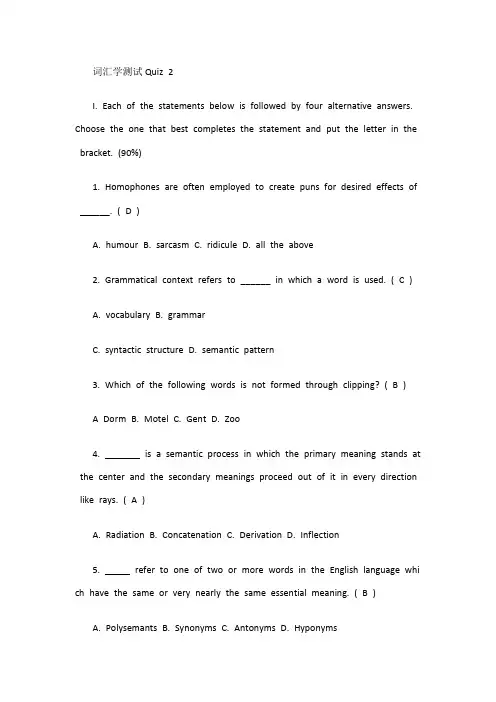
I. Decide whether the following statements are true or false. Circle T or F
as you see fit on your answer sheet. (10%)
1. The basic word stock of a language is changing rapidly all the time.
2. A free morpheme is a word in the traditional sense.
3. The total number of functional words is very limited in English.
4. Every English word has its motivation.
5. All the affixes in English are very productive.
6. The meaning of a word, especially that of a polysemous word, is often
determined by the context in which it appears.
7. Some synonyms are connected with euphemisms and vulgarisms.
8. The interaction between American English and British English is largely
from west to east nowadays.
9. If a native word has a borrowed synonym, the foreign word is always
more literary than the native one.
10. A synchronic dictionary is a dictionary of contemporary words.
II. The following are multiple-choice questions. Mark your answer by
circling A,B, C or D on your answer sheet. (20%)
11. The history of the English language began with the conquest and
settlement of what is now England by the _________.
(A) Romans
(B) Danish
(C) Angles, Saxons and Jutes
(D) Normans
12. The sentence “Feeling fatigued, Tom retired early” is stylistically
__________.
(A) colloquial
(B) slangy
(C) literary
(D) neutral
13. A morpheme is a two-facet language unit, which possesses both
________.
(A) function and meaning
(B) letters and meaning
(C) syllable and meaning (D) sound and meaning
14. A hybrid is a word made up of elements belonging to two or more
_________.
(A) foreign languages
(B) different languages
(C) Germanic languages
(D) Romance languages
15. In English the most productive type of conversion is conversion
__________.
(A) from verb to adjective
(B) from adjective to noun
(C) from noun to adjective
(D) from noun to verb
16. The majority of back-formed words are ___________.
(A) nouns
(B) adjectives (C) verbs
(D) adverbs
17. “Statesman” is an appreciative word whereas “politician” is a
_________.
(A) colloquial word
(B) derogatory word
(C) purr word
(D) neutral word
18. “Happy” and “unhappy” are ____________.
(A) non-gradable antonyms
(B) root antonyms
(C) derivational antonyms
(D) conversives
19. The language brought to North America by the British explorers in the
seventeenth century belongs to the early stage of _______.
(A) Old English (B) Middle English
(C) Modern English
(D) Contemporary English
20. “Corpse” originally meant the human body. Now it means a dead
body. This is a case of _______.(A) restriction of meaning
(B) extension of meaning
(C) degeneration of meaning
(D) elevation of meaning
III. Decide whether each of the following words is a A)simple word, B)
compound word, C) derived word or D) shortened form. Mark your answer
on the answer sheet.
21. taxi 22. lady
23. modernize 24. eager
25. friendship 26. warship
27. German 28. Frenchman
29. crocodile 30. photo
IV. Explain the following terms with appropriate examples. Do it on the
answer sheet. (10%)
31. allomorph 32. derivation
V. Give a short answer to the following questions. Do it on the answer
sheet. (30%)
33. The meaning of a ploysemous word is often determined by the
linguistic context in which it appears. Illustrate this point with examples.
34. What are the four commonest tendencies of the change of word
meaning?
VI. Give a longer answer (150-200 words) to the following question. Do it
on the answer sheet. (20%)
35. How are antonyms classified in English?
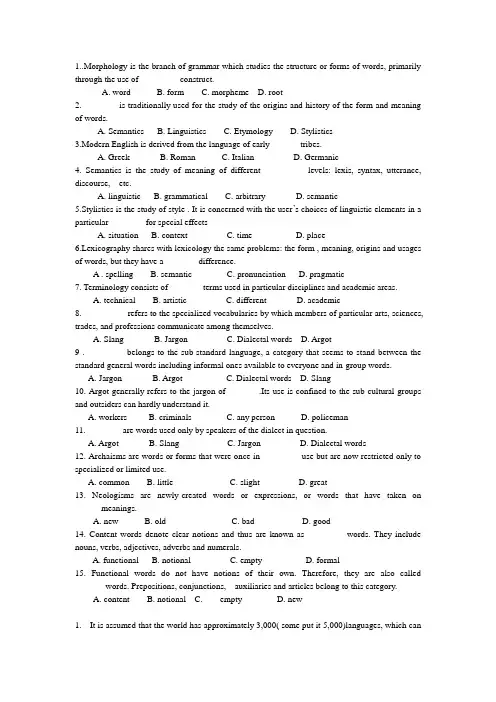
II. I. Decide whether the following statements are true or false. Circle T or F as
you see fit on your answer sheet. (10%)
1. All the words in a language together constitute what is known as its basic
word stock.
2. Greek borrowings in English are mostly words about things in daily life. 3. The English vocabulary is extremely homogeneous.
4. Content words as a class are used more frequently than function words.
5. Inflectional affixes have only grammatical meanings.
6. Root, stem and base refer to the same thing.
7. The prefix “de-“ is polysemic.
8. There is an intrinsic connection between the sound symbol and the sense
of all English words.
9. “Impossible” expresses a stronger negation than “not possible”.
10. When an idiom is reworded, its sense is usually destroyed.
II. Choose the correct answer. Mark your choice on the answer sheet. (20%)
11. Middle English began with the _________ conquest of England in 1066.
a. Greek b. Norman
c. Danish d. Roman