
Chapter Two Trade terms continued
- 格式:ppt
- 大小:146.50 KB
- 文档页数:16
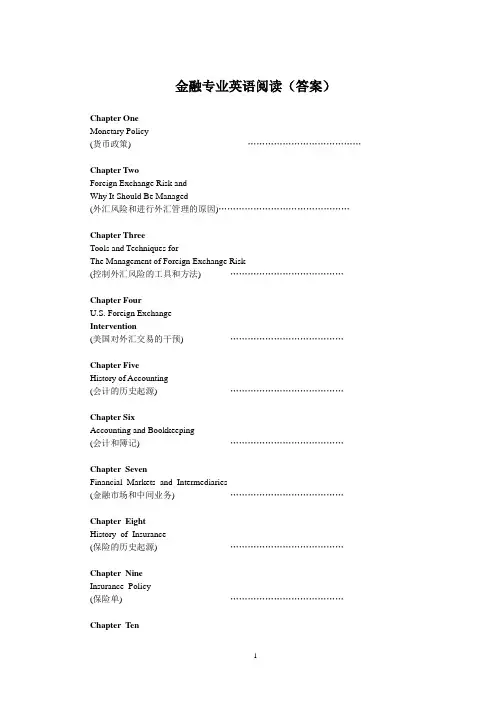
金融专业英语阅读(答案)Chapter OneMonetary Policy(货币政策) …………………………………Chapter TwoForeign Exchange Risk andWhy It Should Be Managed(外汇风险和进行外汇管理的原因)………………………………………Chapter ThreeTools and Techniques forThe Management of Foreign Exchange Risk(控制外汇风险的工具和方法) …………………………………Chapter FourU.S. Foreign ExchangeIntervention(美国对外汇交易的干预) …………………………………Chapter FiveHistory of Accounting(会计的历史起源) …………………………………Chapter SixAccounting and Bookkeeping(会计和簿记) …………………………………Chapter SevenFinancial Markets and Intermediaries(金融市场和中间业务) …………………………………Chapter EightHistory of Insurance(保险的历史起源) …………………………………Chapter NineInsurance Policy(保险单) …………………………………Chapter TenBank for International Settlements(国际清算银行) …………………………………Chapter ElevenCommercial Bank Lending(商业银行借贷) …………………………………Chapter TwelveCredit Analysis(信贷分析) …………………………………Chapter ThirteenWhat Kind of Mortgage Loan Should You Get?(何种抵押贷款更适合你?) …………………………………Chapter FourteenMutual Fund(共同基金) …………………………………Chapter FifteenBonds(债券) …………………………………Chapter SixteenOptions(期权) …………………………………Chapter OneMonetary Policy货币政策Answers:Multiple choices1.D2.B3.C4.C5.ATrue or False1.F2.T3.F4.T5.F6.TRead the following text and choose the best sentences for A to E below to fill in each of the gaps in text1. E2. B3. D4. A5. CCloseEmployment, demand, fiscal policy tools, monetary policy, central bank, interest rates, "stable" prices, inflation, "federal funds" rate, open market operationsTranslation:Translate the following passage into Chinese1.紧缩性货币政策和扩张性货币政策都涉及到改变一个国家的货币供应量水平。

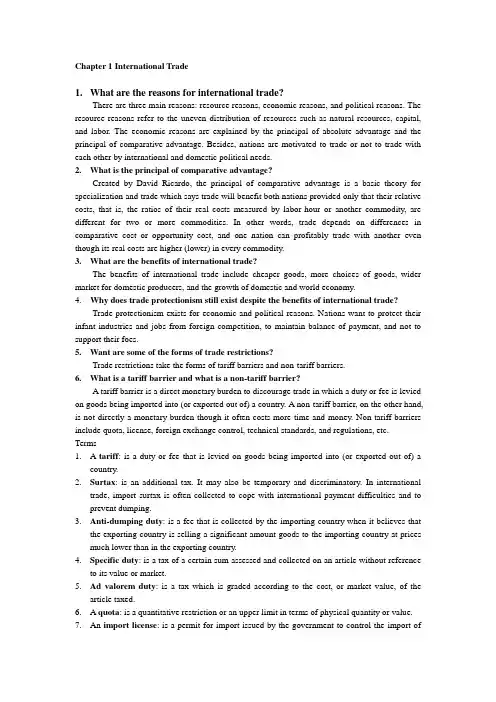
Chapter 1 International Trade1.What are the reasons for international trade?There are three main reasons: resource reasons, economic reasons, and political reasons. The resource reasons refer to the uneven distribution of resources such as natural resources, capital, and labor. The economic reasons are explained by the principal of absolute advantage and the principal of comparative advantage. Besides, nations are motivated to trade or not to trade with each other by international and domestic political needs.2.What is the principal of comparative advantage?Created by David Ricardo, the principal of comparative advantage is a basic theory for specialization and trade which says trade will benefit both nations provided only that their relative costs, that is, the ratios of their real costs measured by labor-hour or another commodity, are different for two or more commodities. In other words, trade depends on differences in comparative cost or opportunity cost, and one nation can profitably trade with another even though its real costs are higher (lower) in every commodity.3.What are the benefits of international trade?The benefits of international trade include cheaper goods, more choices of goods, wider market for domestic producers, and the growth of domestic and world economy.4. Why does trade protectionism still exist despite the benefits of international trade?Trade protectionism exists for economic and political reasons. Nations want to protect their infant industries and jobs from foreign competition, to maintain balance of payment, and not to support their foes.5.Want are some of the forms of trade restrictions?Trade restrictions take the forms of tariff barriers and non-tariff barriers.6.What is a tariff barrier and what is a non-tariff barrier?A tariff barrier is a direct monetary burden to discourage trade in which a duty or fee is levied on goods being imported into (or exported out of) a country. A non-tariff barrier, on the other hand, is not directly a monetary burden though it often costs more time and money. Non-tariff barriers include quota, license, foreign exchange control, technical standards, and regulations, etc.Terms1. A tariff: is a duty or fee that is levied on goods being imported into (or exported out of) acountry.2.Surtax: is an additional tax. It may also be temporary and discriminatory. In internationaltrade, import surtax is often collected to cope with international payment difficulties and to prevent dumping.3.Anti-dumping duty: is a fee that is collected by the importing country when it believes thatthe exporting country is selling a significant amount goods to the importing country at prices much lower than in the exporting country.4.Specific duty: is a tax of a certain sum assessed and collected on an article without referenceto its value or market.5.Ad valorem duty: is a tax which is graded according to the cost, or market value, of thearticle taxed.6. A quota: is a quantitative restriction or an upper limit in terms of physical quantity or value.7.An import license: is a permit for import issued by the government to control the import ofgoods.8.Foreign exchange control: means various forms of restriction imposed by a government onthe purchase/sale of foreign currencies by residents or on the purchase/sale of local currency by nonresidents.Chapter 2 Terms of Delivery1.What are the key issues that a contract must spell out clearly?Seller’s and buyer’s responsibilities and associated costsTime and place of deliveryDocuments and expensesTitle to the goods2.Why are Incoterms created?Incoterms are created to provide a set of international rules for the interpretation of the most commonly used trade terms in foreign trade. Thus, the uncertainties of different interpretations of such terms in different countries can be avoided or at least reduced to a considerable degree.3.How are the terms structured in Incoterms?The terms are grouped in four basically different categories: E-term, F-terms, C-terms, and D-terms. E-term requires the seller to make the goods available to the buyer usually at the seller’s own premises. F-terms require the seller to deliver the goods to a carrier appointed and paid by the buyer. C-terms require the seller to contract and pay for carriage without assuming the risk of loss of or damage to the goods or additional costs due to events occurring after shipment and dispatch. D-terms require the seller to bear all costs and risks needed to bring the goods to the place of destination.4.Do you have to use Incoterms in every transaction? Why or why not?No, sellers and buyers don’t need to use Incoterms in their transaction because Incoterms are created only to provide an option, not an obligation.5.What should be considered in the choice of terms of delivery?Transport capacityCustomer’s locationFreight rateLoading/unloading facilities and local port customRisks in transitChapter 3 Cargo Packaging, Stowage & Marking1.Generally speaking, what are the main reasons for cargo packaging?Generally speaking, there are four main reasons for cargo packaging:a.protective function that essentially involves protecting the contents from the environment andvice versa;b.loading and transport function that requires proper packaging design for easy handling andspace-saving transportationc.stowage function that facilitates stowage and distribution; andd.promotion function that helps generate product awareness and sales2.The protective function of packaging essentially involves protecting the contents fromthe environment. Is this statement true or false and why?This statement is only partially true because the protective function of packaging involves protecting people and the environment, not only the contents, particularly for hazardous materials.3.What is the most efficient method of handling general cargo?The most efficient method of handling general cargo is to make up cargo unit.4.What are the main factors influencing types of cargo packaging?The main factors influencing types of cargo packaging are:a.nature of cargo;b.transport;c.Customs and statutory requirements;d.Insurance acceptance conditions;e.Cost; andf.Ease of handling and stowage5.What should be considered in the stowage of cargo?The following should be considered in the stowage of cargo:a.observation of weight limitations and distributions;b.prevention of damage to transport vehicle;c.best use of available deadweight or cubic capacity to minimize the broken stowage;d.avoidance of mixing incompatible cargo;e.plan for ease of unloading6.What purposes does correct and complete marking serve?Correct and complete marking of packages helps prevent incorrect handling, accidents, incorrect delivery, losses of weight and volume and Customs fines7.What are the main types of marks?The main types of marks include shipping marks, information marks, indicative marks and warning marks.8.What are the marking requirements?The marking requirements are internationality, visibility, legibility and indelibilityChapter 4 Transport1.What are the key differences between liners and tramps?A liner operates over a regular route according to an advertised time-table but a tramp does not operate this way. Instead, a tramp is a vessel hired to pick up cargo from almost any port and go directly to the port of destination.2.What does the abbreviation FIO stand for? What does it mean?FIO stands for “free in and out”, which means that the charterer of a vessel, not the ship operator, is responsible for the costs of loading and unloading.3.What key purposes does a B/L serve?A B/L serves three key purposes. First, it is evidence that a valid contract of carriage exists between the carrier and the shipper, and it may incorporate the full terms of the contract between them. Second, it is a receipt signed by the carrier confirming whether goods matching the contract description have been received from the shipper in good condition. Third, it is also a document of title, creating ownership of the goods shipped.4.What should a clause of shipment include?A clause of shipment should include time of shipment, port of shipment and port of destination, advice of shipment, partial shipment and transshipment.5.What is Air Waybill and what is the key difference between the document and an OceanB/L?An air waybill is a transport document issued by airlines or air cargo companies or their agents. The key difference between this document and an ocean B/L is that air waybill is not a title document. As a straight waybill, an air waybill is not transferrable or negotiable and a shipper does not lose his ownership of the cargo by handing the air waybill to the airline. However, as the buyer is named the consignee on the waybill and he/she can claim the consignment from the carrier by simply showing proof of identity.6.What is international multimodal transport?International multimodal transport is the carriage of goods by at least two different modes of transport on the basis of a multimodal transport contract from a place in one country at which the goods are taken in charge by the multimodal transport operator to a place designated for delivery situated in a different country.7.What are the general considerations in cargo transport?Reliability, speed and frequency, and cost.Chapter 5 Foreign exchange rate & Contract formation- Offer & Acceptance1.How is the exchange rate between any two currencies expressed?There are two ways to express the exchange rate between any two currencies, i.e., the price of Currency A can be quoted in terms of Currency B or vice versa. Depending on whether home currency is used to express the price of foreign currencies or foreign countries are used to express the price of home currency, we have direct quotation and indirect quotation.2.How many rates does a bank normally quote?Two, a buying (bid) rate and a selling(ask)rate.3.Why is exchange rate an important issue for international traders?While the exchange rates between currencies float, payment is normally made sometime after the contract is concluded. The final earnings in the home currency (if the contract currency is a foreign currency) will only be known with the prevailing exchange rate at the time the payment is made. A favorable exchange rate will give the exporter more home currency. On the other hand, an adverse movement of the exchange rates will bring him a loss in terms of home currency.4.How can we manage the exchange rate risks (foreign exchange risks)?There are a number of choices: choosing the right currency for a transaction, booking a forward contract, and using other products that banks offer.5.If you intend to make your offer indefinite, what can you do to avoid misinterpretation?If an offerer wants to make an offer indefinite, he should make clear reservations to avoid misinterpretation.6.How can you terminate an offer?An offer can be terminated by:The party offering may revoke the offer if no consideration has been given.The offer may lapse (either after a specified time, or it may just become stale).Offer may come to an end after a stipulated event occurs or does not occur.Offer may lapse on death of the party offeringOffer is killed by a counter-offer.7.Who can accept an offer?Only the offeree can accept an offer.8.What does acceptance mean to a contract?Since an acceptance indicates assent to an offer, it validates the contract and means that boththe offerer and the offeree will be bound by the terms and conditions in the offer.9.What is a counter-offer?A counter-offer is either the office’s proposal of a new set of terms for the transaction or his conditional acceptance by making actual, material changes in the offer.1.Foreign exchange: is the currency of any foreign country which is the authorized instrumentof settlement and the basis for record keeping in that country.2.Like any other commodities, a foreign exchange has a price, which is expressed in anothercurrency. Exchange rate is the price relationship between the currencies of two countries or the price of one currency in terms of the other.3.Offer rate(of foreign exchange):is the price at which a bank is willing to sell foreignexchange to its customers4. A definite offer:is one that clearly expresses the offerer’s willingness in concluding atransaction by providing complete and clear information for the deal. Normally it includes all the necessary items for a transaction, specifies the time by which the offer is valid and the time the acceptance must be received, and uses the phrase “offer firm” meaning that the offer is made without reservations.5.An acceptance: is a statement made by the offeree indicating assent to an offer.。
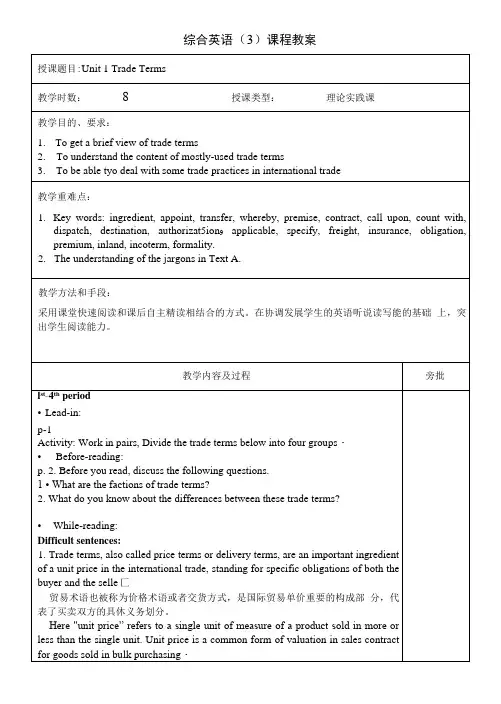
综合英语(3)课程教案8th period*Free talkingDiscussion topics: What are the differences between domestic trade and international trade? 作业布置:.1. Do Translation on p ・ 6 parts as HW.2.Try to retell the main idea of the text.3.Review the expressions about how to ask for an appointment. 课后小结:综合英语(3)课程教案综合英语(3)课程教案课后小结:综合英语(3)课程教案综合英语(3)课程教案综合英语(3)课程教案Difficult sentences:1.Foreign exchange traders generate profits, or losses, by speculating whether a currency will raise or fall in value in comparison to another currency.外汇贸易商们通过预测一种货币对另一种货币的升值或贬值进行投机,并由此盈利或亏损。
This sentence can be paraphrased as "Foreign exchange traders earn profit or loss money by doing their business with anticipation of one currency^ change in value compared with another's:Speculate, to buy goods, property, shares, etc, hoping that you will make a profit when you sell them.2.The value of a currency, in the simplest explanation, is a reflection of the condition of that contrry's economy with respect to other major economices.。