
初二下学期英语语法
- 格式:pdf
- 大小:2.16 MB
- 文档页数:6
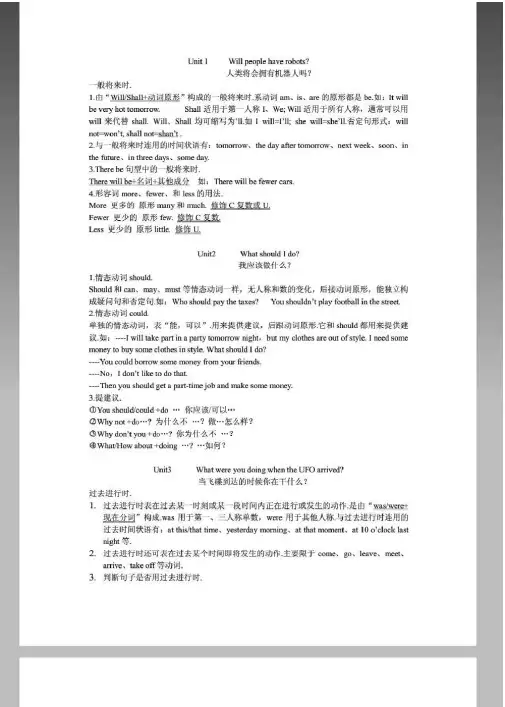

初二英语常用语法汇总及解析一、动词不定式1. 基本形式与用法:动词不定式的基本形式是“to + 动词原形”,它具有多种用法。
例如,作主语:To learn English well is important.(学好英语很重要),为了避免句子头重脚轻,常用it 作形式主语,而将真正的主语动词不定式后置,即It is important to learn English well. 作宾语:I want to go shopping.(我想去购物),常见的接动词不定式作宾语的动词有want (想要),decide(决定),hope(希望),plan(计划)等。
作宾语补足语:The teacher asks us to read English every day.(老师要求我们每天读英语)。
作定语:I have a lot of homework to do.(我有很多作业要做),这里的“to do”用来修饰“homework”,表示“要做的作业”。
作状语:To get good grades, he studies hard.(为了取得好成绩,他努力学习),表示目的。
解析:动词不定式在句子中可以充当多种成分,丰富了句子的表达。
作主语时,要注意形式主语it 的运用;作宾语时,需牢记常用的接不定式的动词;作宾语补足语时,要理解它与宾语之间的逻辑关系;作定语时,明确它与被修饰词的关系;作状语时,通常表示目的、结果或原因等,通过大量例句和练习可以更好地掌握其用法。
二、动名词1. 形式与功能:动名词由动词原形加ing 构成,它在句子中可以作主语、宾语、表语等。
作主语:Swimming is good for health.(游泳对健康有益)。
作宾语:I enjoy reading books.(我喜欢读书),常见的接动名词作宾语的动词有enjoy(享受),finish(完成),mind(介意),keep(继续)等。

初二英语语法重点归纳在初二的英语学习中,语法知识变得更加丰富和复杂。
掌握好这些重点语法,对于提高英语水平和应对各种考试都至关重要。
接下来,让我们一起对初二英语的重要语法点进行归纳。
一、一般过去时一般过去时表示过去某个时间发生的动作或存在的状态,常与表示过去的时间状语连用,如 yesterday(昨天)、last week(上周)、last month(上个月)、last year(去年)等。
其构成形式为:主语+动词的过去式+其他。
动词的过去式分为规则变化和不规则变化。
规则变化通常是在动词原形后加 ed,如 play played,work worked 。
不规则变化则需要特别记忆,如 go went,come came 等。
在使用一般过去时的时候,要注意句子中时间状语的使用,以及动词过去式的正确形式。
二、现在完成时现在完成时表示过去发生的动作对现在造成的影响或结果,或者从过去开始一直持续到现在的动作或状态。
构成形式为:主语+ have/has +过去分词。
现在完成时常与already(已经)、yet(还,尚未)、ever(曾经)、never(从不)、for +时间段、since +时间点等连用。
例如:I have already finished my homework(我已经完成了我的作业。
) He has lived here since 2010(他自 2010 年以来就住在这里。
)要注意区分一般过去时和现在完成时的用法,一般过去时强调过去的动作,与现在没有关系;而现在完成时强调过去的动作对现在的影响或与现在的联系。
三、过去进行时过去进行时表示过去某个时刻或时间段正在进行的动作。
其构成形式为:主语+ was/were +现在分词。
常与 at that time (在那时)、at this time yesterday(昨天这个时候)等时间状语连用。
例如:I was reading a book at eight o'clock last night(昨晚八点我正在读书。

人教版初二(下)英语:unit 4 语法篇(学生版)Unit 4 语法篇____________________________________________ __________________________________________________________________________________ ______________________________________学生通过本讲学习,能够掌握本单元的重点语法,并在综合能力上有一定的拓展。
1.Why don’t you do sth?=why not do sth 为什么不做…?2.在带有till或until引导的时间状语从句的主从复合句里,如果主句用肯定式,其含义是“一直到……时”谓语动词只能用延续性动词。
如果主句用否定式,其含义是“直到……才……”, “在……以前不……”, 谓语动词可用瞬间动词。
例如:The young man read till the light went out(熄灭).Let’s wait until the rain stops.We won’t start until Bob comes.Don’t get off(从下来)until the bus stops. 【Till是指直到某一特定事件发生的时候,而在那个时刻之后,该事情或状况仍将持续。
Until是指直到某一特定事件发生的时候,而讲话的人在自己心里认导。
例如:Though he is young, he knows a lot.Although I am tired, I must go on working.(2) although(though)不能用在同一个句子中。
例如:我们不能说:Though it was raining hard, but he still went out.应该说:Though it was raining hard, he still went out.或It was raining hard, but he still went out.1. I will wait I hear from you.A. untilB. sinceC. whileD.because 2. the work is difficult, all the workers are keeping on working.A. ButB.AlthoughC. AndD. So3. We turned on the light we could see what had made a big noise.A. howB. so thatC. inorder to D.although4. Would you mind him here?A. sitB. sittingC. to sitD. sits5. Music isn't Sally's maininterest, she doesn’t want to go to the concert today.A. butB. soC. orD. and基础演练一、单项选择1. --- This book is a bit difficult.read something easier?--- All right.A. Whynot to B. Whydon'tC. WhynotD. Whynot you2. --- Why don't you music club? --- I'm sorry. I can't sing or dance.A. to joinB. joinC. joiningD. to joinin3. he'stired, he keeps working.A.Although;but B.Although;/C. /;althoughD.But;/4. Mike feels happy every day he is poor.A. ifB. soC.because D.although5. Tom didn't have dinner his mother came back from work.A. whileB. unlessC. untilD. since6. You must work harder andharder you can go to a better college.A. inorder to B. so astoC. thatD. so that7. Lily knows some Chinese, she can read the words on the bottle.A. soB. orC. butD. for8. We need one person to take part in thegame, you hi m.A. both; andB. neither; norC. either; orD. not only; but also9. We didn't know each other at thattime, we're good friends now. A.becauseB. sinceC. butD. if10. I will stay with you the doctor comes to help you.A. afterB. ifC. unlessD. until二、翻译(根据中文提示完成句子)11. 我真的很累因为昨晚我学习到深夜。
