
大学英语语法1——主语谓语
- 格式:pptx
- 大小:166.50 KB
- 文档页数:28
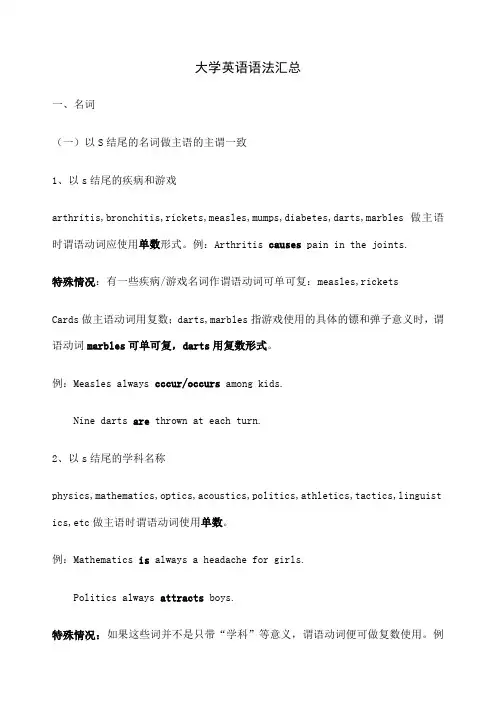
大学英语语法汇总一、名词(一)以S结尾的名词做主语的主谓一致1、以s结尾的疾病和游戏arthritis,bronchitis,rickets,measles,mumps,diabetes,darts,marbles做主语时谓语动词应使用单数形式。
例:Arthritis causes pain in the joints.特殊情况:有一些疾病/游戏名词作谓语动词可单可复:measles,ricketsCards做主语动词用复数;darts,marbles指游戏使用的具体的镖和弹子意义时,谓语动词marbles可单可复,darts用复数形式。
例:Measles always cccur/occurs among kids.Nine darts are thrown at each turn.2、以s结尾的学科名称physics,mathematics,optics,acoustics,politics,athletics,tactics,linguist ics,etc做主语时谓语动词使用单数。
例:Mathematics is always a headache for girls.Politics always attracts boys.特殊情况:如果这些词并不是只带“学科”等意义,谓语动词便可做复数使用。
例如,mathematics运算能力,athletic体育运动,acoustics音响效果,tactics策略,economics经济学意义。
例:The acoustics in Bon Jovi’s Tulsa concert were beyond criticism last spring.3、以s结尾的地理名称The States,the united states,the Netherlands,the Philippines,the United Arab Emirates,the United Nation做主语时,谓语动词使用单数。
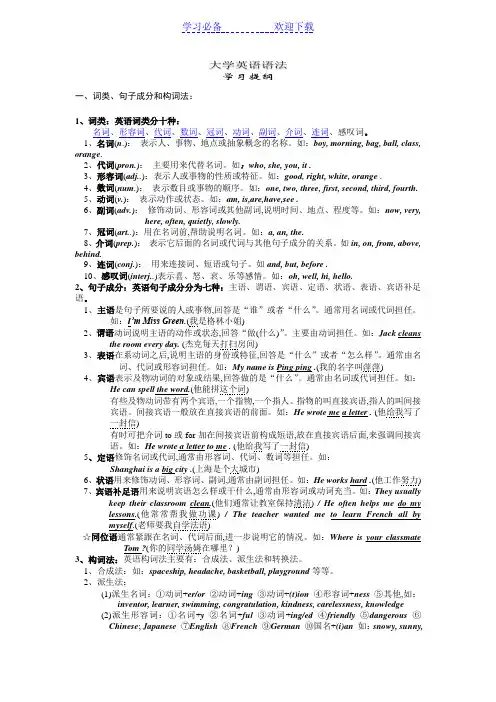
大学英语语法学习提纲一、词类、句子成分和构词法:1、词类:英语词类分十种:名词、形容词、代词、数词、冠词、动词、副词、介词、连词、感叹词。
1、名词(n.):表示人、事物、地点或抽象概念的名称。
如:boy, morning, bag, ball, class, orange.2、代词(pron.):主要用来代替名词。
如:who, she, you, it .3、形容词(adj..):表示人或事物的性质或特征。
如:good, right, white, orange .4、数词(num.):表示数目或事物的顺序。
如:one, two, three, first, second, third, fourth.5、动词(v.):表示动作或状态。
如:am, is,are,have,see .6、副词(adv.):修饰动词、形容词或其他副词,说明时间、地点、程度等。
如:now, very,here, often, quietly, slowly.7、冠词(art..):用在名词前,帮助说明名词。
如:a, an, the.8、介词(prep.):表示它后面的名词或代词与其他句子成分的关系。
如in, on, from, above, behind.9、连词(conj.):用来连接词、短语或句子。
如and, but, before .10、感叹词(interj..)表示喜、怒、哀、乐等感情。
如:oh, well, hi, hello.2、句子成分:英语句子成分分为七种:主语、谓语、宾语、定语、状语、表语、宾语补足语。
1、主语是句子所要说的人或事物,回答是“谁”或者“什么”。
通常用名词或代词担任。
如:I’m Miss Green.(我是格林小姐)2、谓语动词说明主语的动作或状态,回答“做(什么)”。
主要由动词担任。
如:Jack cleansthe room every day. (杰克每天打扫房间)3、表语在系动词之后,说明主语的身份或特征,回答是“什么”或者“怎么样”。
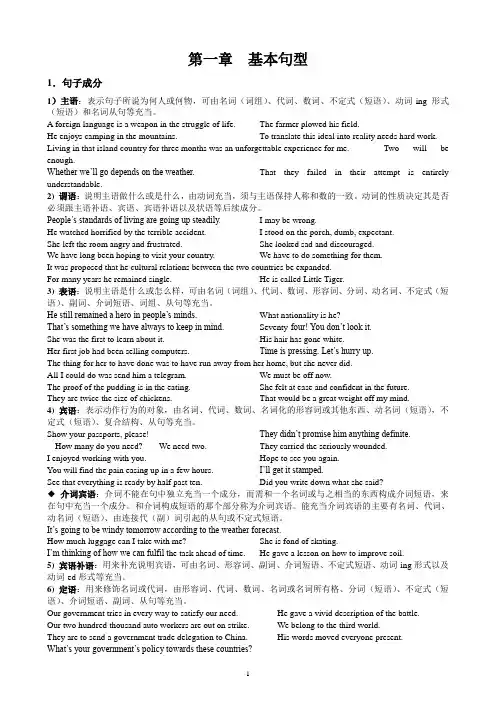
第一章基本句型1.句子成分1)主语:表示句子所说为何人或何物,可由名词(词组)、代词、数词、不定式(短语)、动词-ing 形式(短语)和名词从句等充当。
A foreign language is a weapon in the struggle of life. The farmer plowed his field.He enjoys camping in the mountains. To translate this ideal into reality needs hard work. Living in that island country for three months was an unforgettable experience for me. Two will be enough.Whether we’ll go depends on the weather.That they failed in their attempt is entirely understandable.2) 谓语:说明主语做什么或是什么,由动词充当,须与主语保持人称和数的一致。
动词的性质决定其是否必须跟主语补语、宾语、宾语补语以及状语等后续成分。
People’s standards of living are going up steadily.I may be wrong.He watched horrified by the terrible accident. I stood on the porch, dumb, expectant.She left the room angry and frustrated. She looked sad and discouraged.We have long been hoping to visit your country. We have to do something for them.It was proposed that he cultural relations between the two countries be expanded.For many years he remained single. He is called Little Tiger.3) 表语:说明主语是什么或怎么样,可由名词(词组)、代词、数词、形容词、分词、动名词、不定式(短语)、副词、介词短语、词组、从句等充当。

大学英语语法结构分析知识点汇总大学英语的学习中,语法结构的掌握至关重要。
它不仅是理解英语句子和文章的基础,也是正确表达自己思想的关键。
以下为大家汇总了一些重要的大学英语语法结构分析知识点。
一、句子成分句子成分包括主语、谓语、宾语、定语、状语和补语。
主语通常是句子所描述的主体,一般是名词、代词或相当于名词的短语或从句。
例如:“The book is interesting”(这本书很有趣。
)中,“The book”就是主语。
谓语则是表示主语动作或状态的部分,通常是动词。
像“ He studies hard”(他学习努力。
)里,“studies”就是谓语。
宾语是动作的对象,常为名词、代词等。
比如“ She loves music”(她喜欢音乐。
)中,“music”就是宾语。
定语用于修饰名词或代词,比如“ The beautiful girl is my sister”(那个漂亮的女孩是我妹妹。
),“beautiful”就是定语。
状语用来修饰动词、形容词、副词或整个句子,说明时间、地点、原因、方式等。
例如“ He runs fast in the park”(他在公园里跑得很快。
),“fast”和“in the park”都是状语。
补语则是对主语或宾语进行补充说明,比如“ The flower smells sweet”(这花闻起来很香。
),“sweet”就是补语。
二、名词性从句名词性从句包括主语从句、宾语从句、表语从句和同位语从句。
主语从句在句子中充当主语,例如:“What he said is true”(他说的是真的。
)宾语从句在句中作宾语,像“ I don't know where he lives”(我不知道他住哪儿。
)表语从句在系动词之后,充当表语,比如“ T he problem is whetherwe can finish it on time”(问题是我们能否按时完成。
)同位语从句用于解释说明前面的名词,例如“ The news that he won the game is exciting”(他赢得比赛的消息令人兴奋。