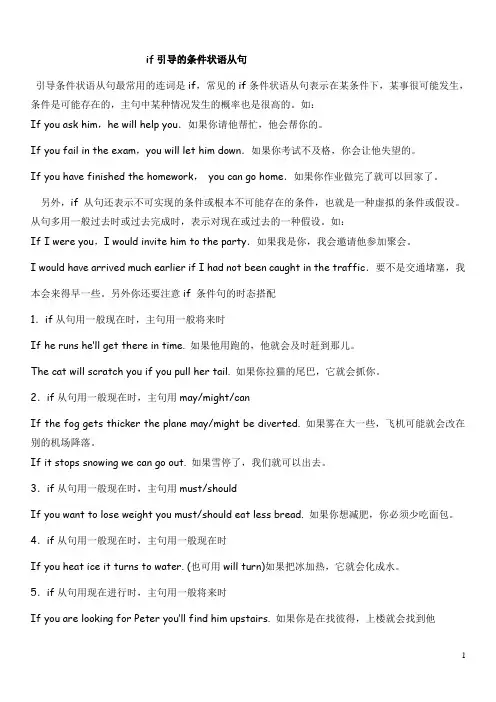
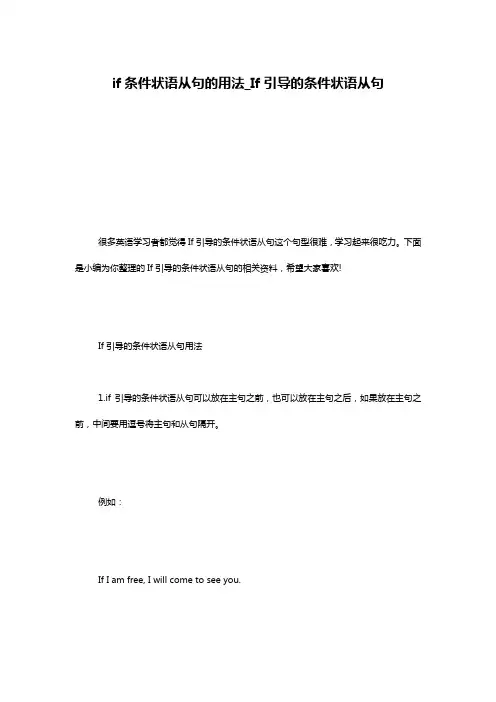
If引导的条件状语从句
- 格式:pdf
- 大小:42.30 KB
- 文档页数:4
学习必备欢迎下载
If引导的条件状语从句(用法)
状语从句:用一个句子(从句)来作另一个句子(主句)的状语,用作状语的句子就叫作状语从句。作什么样的状语就叫什么类型的状语从句。例如:条件状语从句就是用一个句子
来作条件状语。状语从句的分类:(1)时间状语从句凡是从句都必须有引导词,引导时间状语从句的词有when,before,after,until,as soon as,while 等。(2)条件状语从句主要看一下由if引导的条件状语从句。if 意为“如果”,引导条件状语从句时,
表示假如有从句的动作发生就(不)会有主句的动作发生。例如:If it doesn't rain tomorrow,we will go there by bike.如果明天不下雨,我们就骑自行车去那里。If I g
et there early,I can see the doctor quickly.如果我早早地到那里,我就可以快点看病。3)地点状语从句用法要点常用where(哪里)和wherever(无论哪里)eg. Where there is a will,there is a way. 有志者,事竟成。We will go wherever the mothe
rland need us most. 我们要到祖国最需要的地方去。(4)原因状语从句用法要点常用的引导连词有because,as和since,三者的区别是:在回答问题的时候,使用becaus
e;对于显而易见的原因,常用as或since;as和since的从句常放在主句之前,而because的从句常放在主句之后。eg. Why did you go?I went because Tom told me to go. 你为何去?那是因为汤姆叫我去。He was angry not because we were late
but because we made a noise. 他很生气不是因为我们来迟了,而是因为我们弄出了声音。As it was raining hard,we had to be indoors. 由于雨太大,我们只好呆在家
里。Since you feel ill,you'd better not go to work. 既然你感觉不舒服,你最好不要去上班了。(5)目的状语从句用法要点常用的引导连词有so that,that和in orderthat译为:以便,为了,目的是。eg. Please speak more slowly so that we can
make full notes. 请讲慢一点,以便我们能作详细笔记。I shall write down your ad学习必备欢迎下载
dress that I may not forget. 我要把你的地址记下来,以免忘记。I sent the letter
by air mail in order that it might reach him in time. 这封信我以航空信发出,以便他能及时收到。注:目的状语从句可以用动词不定式来替换做目的状语。eg. We work
harder than usual finish it in a week. 我们比平常加倍努力工作以在一周内完成工作。三、主句与从句时态一致的问题。在时间状语从句和条件状语从句中,主句和从句之间的时态一致问题一般分下列两种情况:1. 若主句是祈使句,或主句中有情态动词,或主
句中谓语动词是一般将来时,那么从句用一般现在时表示一般将来时。例如:Be careful when you cross the road. 过马路时要小心。Put up your hand if you have any
questions to ask. 如果你们有问题要问的话,请举手。The traffic must stop when the lights are red. 红灯亮时,车辆必须停下。2. 若主从句谓语动词都是陈述过去,那么主从句都可以用一般过去时。例如:She could sing when she was four years ol
d. 她四岁的时候就会唱歌。虚拟语气和if引导的条件状语从句有区别吗?
条件状语从句连接词主要有if, unless, as/so long as, on condition that 等。if 引导的条件句有真实条件句和非真实条件句两种。非真实条件句已在虚拟语气中阐述。unless = if not. 例如:Let's go out for a walk unless you are too tired.
如果不太累,我们去散散步。If you are not too tied, let's go out for a walk. You will be late ___ you leave immediately. A. unless B. until C. if D.or 答案A。句意:除非你立即走,否则你就回迟到的。可转化为If you dong leave
immediately, you will be late。B、D句意不对,or表转折,句子如为You leave immediately or you will be late. 虚拟语气1)虚拟语气用来表示说话人的主观愿望
或假想,所说的是一个条件,不一定是事实,或与事实相反。虚拟语气在条件句中应用学习必备欢迎下载
比较多。2)条件句可分为两类,一类为真实条件句,一类为非真实条件句。非真实条
件句表示的是假设的或实际可能性不大的情况,故采用虚拟语气。真实条件句用于陈述语气,假设的情况有可能发生。一般现在时shall/will + 动词原形祈使句情态动词
一般现在时例如:If he comes, he will bring his violin. 如果他来,会带小提琴来的。The volleyball match will be put off if it ___. A. will rain B. rains C. rained D. is rained 答案B。真实条件句主句为将来时,从句用一般现在时。注
意:1)在真实条件句中,主句不能用be going to表示将来,该用shall, will. (错)If you leave now, you are never going to regret it. (对)If you leave now,
you will never regret it. 2)表示真理时,主句谓语动词不用shall (will)+动词原形,而直接用一般现在时的动词形式。非真实条件句1)虚拟语气可以表示过去,现在和将来的情况,时态的基本特点是时态往后推移。a. 与现在事实相反的假设一般过
去时(be用were)should(would)等+动词原形例如:If they were here, theywould help you. 如果他们在这儿,会帮助你的。含义:They are not here, they
can’t help you. b. 与过去事实相反的假设过去完成时should(would)等+ have+ 过去分词例如:If he had come yesterday, I should / would have told him about it.如果他昨天来的话,我会把这件事告诉他的。含义:He did not come
yesterday, so I did not tell him about it. c. 表示对将来不大可能发生的事情的假想一般过去时should/would等+ 动词原形were+ 不定式should+ 动词原形例
如:If you succeeded, everything would be all right. 如果你将来成功了,一切都会好的。If you should succeed, everything would be all right. If you were to succeed, everything would be all right. 含义:You are not likely to succee
d, everything will be what it is now.学习必备欢迎下载